
Quick Answer: For most small businesses, outsourcing customer service works best as a mix. An outside team takes overflow calls, after-hours cover, order and booking questions, and routine email or chat. You keep complaints, refunds and key accounts in-house. It pays off when you miss calls, need longer hours or have too little work for a full-time hire. The pressure is real: 67% of UK small business decision-makers miss at least one call a day that they think could cost them business (BT Business, 2026).
Key Takeaways
- Most small firms still keep phone support in-house: 62% in the UK and 61% in the US. Another 27% and 25% use a mix (Capterra UK, Capterra US). A mix is the realistic place to start.
- One UK adviser on £27,500 costs about £31,500 a year in ongoing employer cost. In year one, with hiring, training and cover, it is £34,000 to £40,000.
- One US rep at the BLS median of $21.53 an hour costs about $55,000 to $70,000 a year once payroll taxes, benefits and cover are added.
- Answering services are the cheapest fix for missed calls. Part-time dedicated offshore agents suit steady repeat work. Full-time dedicated agents suit a full 40-hour week.
- Customers still want people: 84.9% prefer a human agent to AI for customer service (Metrigy, 2026).
- Start with a 60 to 90 day pilot on one queue or time slot, with a short exit clause. Avoid a 12 to 36 month contract at first.
Is Outsourcing Customer Service Worth It for a Small Business?
Outsourcing customer service is worth it when demand goes up and down, calls are being missed, customers want longer hours or there is too little work for a full-time hire. It makes less sense when every conversation needs deep product knowledge or the owner’s personal touch.
Small firms tend to move step by step. Capterra asked organisations how they handle phone support. In the UK, 62% keep it mainly in-house, 27% use a mix and 11% outsource it fully. The US picture is almost the same, at 61%, 25% and 14%. That points to handing over part of the work first, not all of it.
The reasons to outsource come down to three things. Lower or more flexible cost. Access to skills and managers you could not justify hiring. And the ability to scale cover up and down for evenings, weekends and busy seasons. The reasons not to are just as common. Owners fear losing control of the customer experience. They worry about quality and brand knowledge, data protection and minimum commitments that are too big for low volume. Our guide to choosing a customer service outsourcing company covers how to vet providers against those risks.
What One In-House Customer Service Hire Really Costs
One full-time adviser costs far more than their salary. Employer taxes, pension, holiday, hiring and cover all add up. In the UK that is about £34,000 to £40,000 in year one. In the US it is about $55,000 to $70,000 a year.
UK. Job market data puts a typical customer service adviser at around £27,500 in 2026. Employer National Insurance is 15% above the £5,000 threshold for 2025/26. That is about £3,375 at this salary. Auto-enrolment pension adds at least 3% of qualifying earnings, about £640. Full-time staff also get 5.6 weeks of paid holiday. So the ongoing employer cost is about £31,500. That is before hiring, training, kit, software, management time and holiday or sickness cover. For context, ONS put median full-time UK pay at £39,039 in April 2025.
US. The Bureau of Labor Statistics puts customer service reps at a median of $21.53 an hour, or $44,770 a year. About 2.6 million people do the job. Employers add 7.65% for Social Security and Medicare. Then come unemployment insurance, health cover, retirement, paid leave and workers’ compensation. BLS employer cost data shows benefits made up $13.79 of every $46.15 per hour of private-sector pay in December 2025. That is why salary alone understates the real cost. A realistic figure for one full-time rep is $55,000 to $70,000 a year.
One hire also covers only one shift, about 35 to 40 hours a week. You are exposed whenever that person is off. That gap in cover, not the salary, is often what pushes small firms to look outside.
How Much Does Small Business Customer Service Outsourcing Cost?
Small business customer service outsourcing costs anything from a few hundred pounds or dollars a month for an answering service to about $1,200 to $2,500 a month for a full-time dedicated agent in South Africa. The right choice depends on how much work you have and how steady it is.
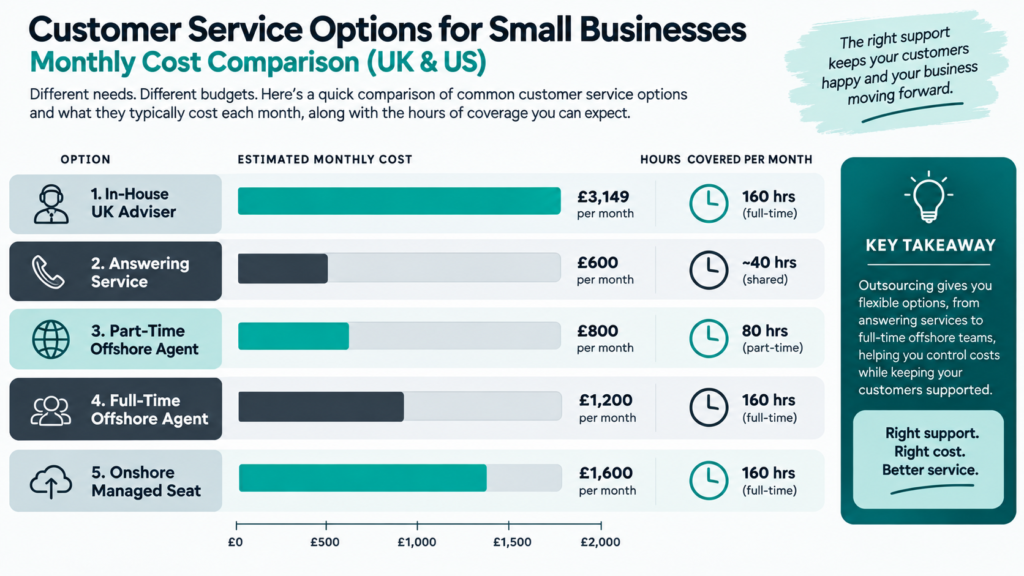
Table: Small business customer service options compared (illustrative monthly ranges)
| Option | Illustrative monthly cost | Hours covered | Quality control | Main risk |
| One in-house UK adviser | £2,600 to £3,300 recurring, more in year one | One shift, 35 to 40 hours a week | Direct supervision, strongest product knowledge | Absence, recruitment, limited hours |
| One in-house US representative | $4,600 to $5,800 recurring, more in year one | One shift, about 40 hours a week | Direct supervision | Benefits, payroll, turnover, cover |
| Answering service | About £25 to £200, or $125 to $400 for 100 to 200 minutes | Overflow, messages, extended hours | Scripted, reports vary | Limited issue resolution, per-call costs climb |
| Part-time dedicated offshore agent | About $600 to $1,500 | Roughly 10 to 25 hours a week | Direct relationship; QA may cost extra | One person is a single point of failure |
| Full-time dedicated agent, South Africa | About $1,200 to $2,500 | One 40-hour shift | Managed QA depending on contract | Still one shift of capacity |
| Onshore managed seat | About £1,500 to £3,000+ UK, $3,000 to $6,000+ US | One shift | Managed QA | Higher cost and minimum commitments |
Illustrative market ranges for planning, not quotes. In-house figures are built from CV-Library, HMRC and BLS data. Offshore ranges vary with hours, channel mix and management.
Read the terms as closely as the rate. Expect a setup fee and a minimum monthly spend or minimum hours. Expect extra charges for onboarding, scripts, CRM links, call recording, and weekend and holiday cover. Notice periods often run 30 to 90 days. Our breakdowns of the true cost of offshore customer service and outsourced customer support costs in 2026 go deeper on pricing.
The Cost of Missed Calls and Slow Replies
Missed calls are the most common reason small firms outsource, and the risk can be measured. Two thirds of UK small business decision-makers say they miss at least one valuable call every day. And most customers expect a reply within minutes, not hours.
BT Business research found 67% of UK SMB decision-makers miss at least one call a day that they believe could lose business. BT put the revenue at risk at £3.7 billion a year. Treat that total as a commercial estimate, not audited lost sales. Customer expectations are clearer. HubSpot reports that 90% of customers rate an immediate response as important or very important. And 60% define “immediate” as 10 minutes or less.
The best way to judge your own risk is a simple sum. Take your missed calls per month. Multiply by the share that are real leads, your conversion rate and your average profit per sale. For example: 80 missed calls a month, 40% real leads, 20% conversion and £250 profit per sale. That is £1,600 a month in lost profit. On those numbers, even a basic answering service at £200 to £500 a month pays for itself.
What Small Businesses Should Outsource First
Start with work that repeats and is time-sensitive: overflow calls, after-hours cover and order or booking questions. Move to harder work, such as complaints, only once the outside team has proved its quality.
A sensible order is:
- Overflow calls when your own staff are busy.
- After-hours, weekend and holiday cover.
- Booking, appointment, delivery and order-status questions.
- Routine email and live chat, backed by a knowledge base.
- First-line ticket sorting and routing.
- Busy seasons, launches and campaigns.
- Complex technical, complaint or retention work, only once quality is proven.
Keep in-house the work that needs judgement or relationships. That means refund exceptions and big complaints, sensitive personal or money issues, price talks, VIP and owner-led accounts, and the final say on escalations. The rule of thumb: outsource repeat tasks, not judgement, accountability or close customer relationships. If chat is your first channel, our guide to live chat and ecommerce support outsourcing shows how retailers usually set it up.
How to Protect Quality, Data and Flexibility
The safest start is a controlled pilot on one queue, channel or time slot. Set clear decision rights, record calls, hold weekly calibration sessions and keep a short exit clause. That protects your brand voice while you find out whether the provider can deliver.
Quality. Give the team a searchable knowledge base and a set of approved answers. Spell out what agents may decide without asking. Track first contact resolution, accuracy, escalation rate, CSAT and response time. Do not judge a provider on speed alone. A fast wrong answer creates repeat contacts, refunds and complaints. Our article on quality assurance in customer support outsourcing covers scorecards in detail.
Data protection. Under UK GDPR, an outside customer service provider is normally a processor. You need a written contract covering everything the ICO lists for Article 28. That includes security, sub-processors, audits and deletion at the end. Sending UK personal data to a provider in South Africa, the Philippines or India may count as a restricted transfer. The ICO says that needs a safeguard such as the UK International Data Transfer Agreement or the UK Addendum.
Card payments. If agents take payments, PCI DSS applies to the provider as well as to you. The safest set-up stops agents from seeing or hearing full card numbers. Use a payment link or keypad entry instead.
Flexibility. Before signing, check the minimum term, minimum spend, notice period, exit fees and yearly price rises. Check who owns scripts and recordings, and whether the provider can move the work to another country. Our guide to BPO contracts and SLAs explains which terms to push back on.
Where AI Fits for Small Business Customer Service
AI now handles a real share of simple work, such as FAQs, order status, routing and after-hours messages. But customers still strongly prefer people for anything sensitive. For most small firms, the cheapest set-up combines three parts. AI for routine questions, an outside team for first-line work and an internal owner for exceptions.
Salesforce reports that AI resolved 30% of service cases in 2025. Gartner predicts that agentic AI could resolve 80% of common issues by 2029. That second figure is a forecast, not a result. On the customer side, a 2026 Metrigy study found 84.9% of consumers prefer a human agent. Even when told the issue would be fixed either way, 80.1% still chose a human. A 2024 peer-reviewed study found lower satisfaction and repeat buying after chatbot chats than after human ones. Perceived empathy explained the gap.
The practical set-up looks like this. AI for FAQs, sorting and order status. A shared or offshore team for repeat phone, email and chat. An internal owner for complaints, key accounts and policy calls. And a clear route to a human on every automated channel. Our comparison of AI chatbots versus outsourced support agents sets out the costs side by side.
Frequently Asked Questions
Is outsourcing customer service worth it for a small business? It is worth it when you miss calls, need longer opening hours, have seasonal peaks or have too little volume for a full-time hire. It is less suitable when every conversation needs deep product knowledge or founder-level trust. Most small businesses start with a hybrid model rather than outsourcing everything.
How much does it cost to outsource customer service for a small business? An answering service can cost from about £25 to £200 a month in the UK or $125 to $400 for 100 to 200 minutes in the US. A part-time dedicated offshore agent costs roughly $600 to $1,500 a month, and a full-time dedicated agent in South Africa roughly $1,200 to $2,500 a month, depending on hours and management.
How much does an in-house customer service adviser cost? In the UK, an adviser on about £27,500 costs roughly £31,500 a year in recurring employer cost and £34,000 to £40,000 in the first year. In the US, a representative at the BLS median of $21.53 an hour costs roughly $55,000 to $70,000 a year once taxes, benefits and cover are included.
What customer service tasks should a small business outsource first? Start with overflow calls, after-hours and weekend cover, booking and order-status queries, and routine email or chat. Keep complaints, refund exceptions, sensitive issues, pricing negotiations and key accounts in-house until the outside team has proven its quality.
Can a small business outsource customer service offshore? Yes. Many small businesses use part-time or full-time dedicated agents in locations such as South Africa, the Philippines or India. UK businesses need an Article 28 data processing contract and, for restricted transfers, a safeguard such as the UK International Data Transfer Agreement.
Should a small business use AI instead of outsourcing customer service? Usually both. AI handles FAQs, routing and order status well, but 84.9% of consumers in a 2026 Metrigy study prefer a human agent. The most economical design uses AI for routine queries, an outside team for first-line work and an internal owner for exceptions and complaints.
How long should a small business outsourcing contract be? For a first engagement, a 60 to 90 day pilot with a short termination right is safer than a 12 to 36 month commitment. Check minimum terms, minimum spend, notice periods, price rises and who owns scripts and recordings before signing.
Afrishore BPO runs customer service teams from South Africa for UK and US businesses, including part-time and dedicated agents for smaller teams that need overflow, after-hours or seasonal cover. See our guides to customer support outsourcing in the UK and outsourcing customer support to South Africa, or explore our business process outsourcing services.
Talk to Afrishore about a small, flexible customer service team.