Most US businesses choosing an offshore BPO compare three things: agent cost per hour, time zone, and client references. These are reasonable starting points. They are not sufficient. The factor that most consistently determines whether an offshore customer service programme performs as modelled — or quietly fails to deliver its business case — is training quality.
Gartner has warned repeatedly that 80% of organisations that outsource customer service primarily to cut costs will fail to achieve their cost-saving goals, and that 60% will face customer defections and hidden costs that outweigh their savings. The common thread cited across Gartner, Forrester, and academic work on offshore CX failure is not headline rates or timezone misalignment. It is under-investment in recruitment, training, and knowledge management, compounded by high attrition.
This article covers what the data shows about agent training costs, the FCR-to-CSAT link that makes training measurable, the quality frameworks that differentiate serious providers from the rest, and the questions US buyers should ask before signing a contract.
Key Takeaways
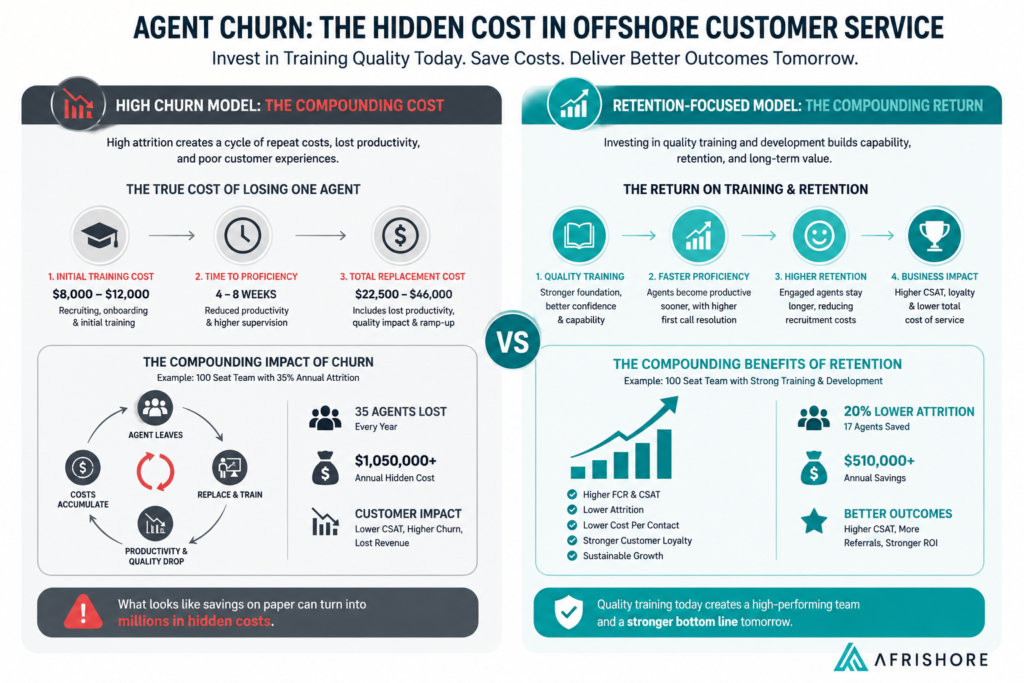
- Losing one offshore contact centre agent costs $22,500–$46,000 in total replacement and ramp-up impact (Insignia Resources 2026; ICMI 2025).
- A new agent takes 4–8 weeks to get on the phones, and up to 5–7 months to reach full proficiency (ProcedureFlow 2021; ICMI research).
- SQM Group finds a +0.70 correlation between First Call Resolution (FCR) and CSAT — they move almost point-for-point. Customer recommendation scores are 85 points higher when an issue is resolved on the first call.
- Gartner cites “very high offshore attrition” and inadequate training as primary drivers of offshore CX failure, not headline agent costs.
- Afrishore Academy is Afrishore’s internal agent training and upskilling programme, built on the same principles as COPC and ISO 18295 — frameworks that the industry’s top performers use to systematically close the gap between training completion and actual performance.
The False Economy of Choosing an Offshore BPO on Price
The logic of offshore customer service outsourcing begins with cost. A US contact centre agent at $40,000–$55,000 in base salary costs the employer $52,000–$78,000 fully loaded. An offshore agent at $8–$11/hr on a vendor invoice looks like a straightforward 40–60% saving.
But that comparison only holds if the offshore agent performs at an equivalent level, and performance depends almost entirely on how well the agent was trained — on your products, your policies, your brand values, and your customers’ expectations. When training is inadequate, the cost equation reverses.
Gartner has published multiple analyses over the years warning that cost-first outsourcing decisions consistently produce cost-last outcomes. Their finding that 60% of cost-driven outsourcing engagements produce customer defections and hidden costs that outweigh the savings is not an outlier finding. It reflects the persistent gap between what an offshore contract costs on the invoice and what it costs once attrition-driven retraining, quality remediation, and customer churn are included.
The math is straightforward. A 100-seat offshore team with 35% annual attrition — not far from industry average in high-turnover markets — turns over 35 agents per year. If each churned agent costs $30,000 in replacement and ramp-up impact, that is $1.05 million in annual cost that does not appear on the vendor invoice. The team that looked like a 50% saving is, in practice, running a $1 million side-cost that the operations team is absorbing.
What US Companies Actually Lose When an Offshore Agent Churns
The cost of agent attrition in contact centres is better-documented than most buyers realise, and the numbers are higher than most expect.
ICMI‘s 2025 analysis on contact centre attrition states that “losing just one agent can cost over $35,000 to replace,” explicitly including recruiting, onboarding, training, and the impact on CSAT and team morale. Insignia Resources‘ 2026 turnover analysis provides a component breakdown:
- Direct replacement costs (recruiting, interviewing, onboarding): $10,000–$20,000
- Lost productivity during ramp-up (6–8 months at reduced output): $5,000–$9,000
- Customer and quality impact (elevated error rates, CSAT degradation during ramp): included in total
- Total estimated impact per churned agent: $22,500–$46,000
NICE, citing McKinsey research, puts the range at $10,000–$20,000 per agent in direct replacement cost alone. Gitnux’s 2026 benchmark synthesising Gartner 2022 and Deloitte 2023 data puts total US turnover cost at $21,000 per contact centre agent on average.
These figures are for any contact centre. Offshore attrition complicates the calculation further because each churned agent also takes institutional knowledge about your products and processes with them — knowledge that took weeks or months to build and that the replacement must now rebuild from scratch under your contract, on your timeline.
How Long Does It Take an Offshore Agent to Actually Be Useful?
The gap between an agent completing initial training and an agent delivering the quality outcomes the business case assumed is wider than most buyers account for.
ProcedureFlow‘s 2021 contact centre training survey found that 55% of contact centres take 6–12 weeks for training and onboarding, and that more than one-third reported 5–7 months before agents reach full proficiency. ICMI research notes that onboarding to “work proficiently on their own” ranges from two weeks to six months, with a median in the 4–8 week range. ICMI’s State of the Contact Centre study found that nearly two-thirds of contact centres provide no more than 10 days of ongoing training per year after initial onboarding — meaning the ramp-up investment is front-loaded and ongoing skill development is limited.
The training cost per agent for initial onboarding typically runs $1,000–$5,000 for the classroom phase, plus $200–$500 per agent per month for ongoing training in well-run programmes (Aircall 2025). At a 35% attrition rate across 100 seats, a programme is spending $350,000–$1,750,000 per year just on initial training for replacement agents — before any ongoing development budget. For context on how attrition compares across different outsourcing destinations, see our guide to outsourcing destinations for US companies.
This is why attrition and training are inseparable in offshore cost analysis. A training programme that is inadequate accelerates attrition (agents who cannot perform are less engaged and leave sooner). Attrition that is high forces constant retraining investment. The two variables compound each other in a way that headcount cost-per-hour comparisons never capture.
The FCR Link: Why Training Quality Shows Up Directly in CSAT and NPS
The measurable case for training investment is clearest in the relationship between First Call Resolution (FCR) and customer satisfaction.
SQM Group‘s large-scale CX benchmarking finds a +0.70 correlation coefficient between FCR and CSAT — characterised as a strong relationship — with every 1-percentage-point improvement in FCR producing approximately a 1-percentage-point improvement in CSAT. Customer recommendation scores (NPS-proxies) are 85 points higher when a customer’s issue is resolved on the first call versus not resolved. CFI Group’s Contact Centre Satisfaction Index confirms that customers whose issues are resolved on the first call are 49% more likely to continue doing business with the company.
FCR is almost entirely a training outcome. Whether an agent resolves a customer’s issue on the first contact depends on: product knowledge (did they understand the question?), process knowledge (do they know the correct answer and how to apply it?), and system proficiency (can they navigate your CRM, lookup tools, and authorisation workflows without putting the customer on hold?). All three are training outputs.
SQM’s research on Customer Quality Assurance (CQA) programmes shows that replacing traditional checklist-style QA with outcome-focused coaching can produce up to 10% improvement in CSAT, FCR, and QA scores in the first year. The mechanism is targeted training informed by actual call outcomes, not generic competency checklists. This is also what separates providers who track compliance metrics from those who track customer outcomes — the latter is more predictive of CSAT and retention performance.
What Good BPO Training Looks Like — And Why Afrishore Academy Was Built Around It
Two frameworks are formally recognised as quality standards for contact centre training and operations: the COPC CX Standard and ISO 18295.
COPC CX Standard Release 8.0 (announced 2026) is the most widely-used operational framework for outsourced contact centre excellence globally. COPC certification covers agent training, journey-based quality design, and AI governance within a unified management framework. Providers certified to the COPC standard have their training design, delivery, and outcomes formally audited — not just reported internally.
ISO 18295-1 and 18295-2 are the first international standards dedicated specifically to customer contact centres. ISO 18295-1 sets requirements for the contact centre itself, including staff training, communication quality, and complaints handling. ISO 18295-2 sets requirements for organisations using contact centre services — giving buyers a formal specification to write into their RFPs. Certification is provided by SGS USA, TÜV NORD, and similar international bodies.
Afrishore Academy is Afrishore BPO’s internal agent training and upskilling programme. It is not an external certification and it is not sold commercially. It is the structured approach Afrishore uses to get agents performing to the standard US and UK clients expect, and to sustain that performance through tenure rather than losing it to attrition-driven knowledge gaps.
The Afrishore Academy framework operates on the same principles as COPC and ISO 18295: training designed around actual customer outcomes rather than process compliance, structured progression from initial onboarding through to product mastery, and ongoing coaching calibrated to FCR and CSAT performance data rather than generic knowledge tests. The specific gap Afrishore Academy addresses — agents who complete classroom training but take months to reach full production proficiency — is precisely the gap SQM and ICMI identify as the primary source of post-contract quality disappointment.
How to Evaluate BPO Training Quality Before You Sign a Contract
Most offshore BPO vendor evaluation processes assess training quality through a self-declared checklist: “Do you have a training programme? Yes. How many hours? 80.” This is an almost useless signal.
What to ask instead:
1. What is your time-to-proficiency benchmark, and how is proficiency defined? This forces the provider to specify what “proficient” means — FCR rate, QA score, handle time — and to produce evidence that new agents consistently reach that benchmark. Ask for data, not assertions.
2. What does your ongoing training curriculum look like beyond the onboarding programme? ICMI research shows two-thirds of contact centres provide under 10 days of ongoing training per year. A provider investing in continuous development shows it in structured monthly coaching, product update sessions, and performance-differentiated training tracks.
3. What is your first-year attrition rate by programme? First-year attrition is the clearest signal of training quality. Agents who cannot perform within the expected ramp period leave — or are managed out — in the first 90 days. Ask for first-year attrition disaggregated from overall attrition, and ask what percentage of early leavers are training-related exits.
4. How does your QA programme connect to training decisions? SQM’s research shows that 83% of agents say traditional QA doesn’t help them improve CSAT or FCR. A QA programme that produces coaching actions — specific training interventions triggered by specific performance gaps — is categorically different from one that produces compliance scores. Ask how QA and training are connected in the provider’s operating model.
5. What is your agent-to-coach ratio, and what does a coaching session look like? Peer coaching and team lead coaching are how training converts from classroom to production. A 1:10 or better coach-to-agent ratio with weekly structured coaching conversations is a baseline for a serious programme. Ratios of 1:20 or 1:30 with ad hoc coaching are a warning sign.
6. Can you show us CSAT and FCR trends for an existing programme in our vertical? Gartner and Forrester both note that buyers discover training gaps after go-live. The way to surface this pre-contract is to ask for 12-month performance data from a live programme — not projected KPIs, but actuals. Any reputable provider can redact client-identifying information while still showing the trend line.
FAQs
Why do offshore programmes so often underperform despite strong references? Gartner’s analysis identifies the most common cause: organisations select offshore BPOs primarily on cost, and vendors who compete on cost typically underinvest in training depth and ongoing development to maintain margin. The performance gap appears 90–180 days post-launch when initial enthusiasm has passed and training investment has stopped. Client references are typically provided by satisfied clients whose programmes were managed with above-average investment — they are not representative of the average outcome.
How does training quality affect CSAT scores specifically? SQM Group’s benchmarking shows that FCR and CSAT move approximately point-for-point, with a +0.70 correlation coefficient. Training quality is the primary driver of FCR — whether agents resolve issues on the first contact. Every 1-point improvement in FCR produces approximately 1 point of CSAT improvement. Conversely, high first-year attrition resets FCR as experienced agents are replaced by new ones still on the ramp.
Is it realistic to expect an offshore team to match onshore CSAT scores? Yes, with the right provider and sufficient transition investment. The performance gap between onshore and offshore contact centres is primarily driven by training depth, knowledge transfer quality, and attrition management — all factors within the control of the BPO and the client. Programmes that invest in structured onboarding, ongoing coaching, and client-integrated knowledge management close the gap within 6–9 months of launch.
What training certifications should I look for in a BPO partner? COPC CX Standard certification is the most rigorous. ISO 18295 certification confirms adherence to the international contact centre standard. Not all good providers are formally certified — particularly smaller providers — but you should ask whether their training design follows COPC or ISO 18295 principles and how they demonstrate outcomes rather than activities.
How does Afrishore Academy differ from standard onboarding? Afrishore Academy runs continuous rather than point-in-time. Initial onboarding is followed by a structured 90-day development track, product mastery assessments, QA-driven coaching interventions, and ongoing skill development aligned to each programme’s FCR and CSAT targets. It is calibrated to the specific failure modes SQM and Gartner identify — early attrition, knowledge loss at tenure transitions, and QA scores that do not correlate with customer outcomes.
Should training quality affect how I structure the BPO contract? Yes. Contracts that pay purely on headcount have no mechanism to incentivise training investment — the provider’s margin is protected whether agents perform at 60% FCR or 85% FCR. Performance-based payment structures tied to FCR, CSAT, and QA outcomes align the provider’s commercial interest with training quality. At minimum, include FCR and CSAT minimum thresholds as contractual service levels with clear remediation obligations.
What is the right ongoing training investment per agent per year? Well-run contact centre programmes invest $200–$500 per agent per month in ongoing training beyond initial onboarding (Aircall 2025). At the lower end, this covers team lead coaching and product update sessions. At the higher end, it includes structured skill development, simulation-based practice, and performance differentiation between top performers and those in development tracks. Providers who quote zero ongoing training investment after onboarding should be treated as a significant risk flag.
Training Is Not a Background Function — It Is Your Offshore Programme’s Foundation
The offshore BPO market gives US buyers a wide range of options at a wide range of price points. Most of what separates 60th-percentile programmes from 90th-percentile ones is not which destination was chosen or what the bill rate was. It is how seriously the provider — and the client — invested in getting agents to full performance and keeping them there.
Gartner’s warning about offshore outsourcing failure is two decades old. The reason it is still quoted is that it is still accurate. The antidote is not to avoid outsourcing — it is to select providers whose training infrastructure, attrition management, and QA practice are built around customer outcomes, not cost-centre compliance.
Afrishore BPO has delivered offshore customer service for US and UK clients for over 20 years. As one of the leading BPO companies in South Africa, Afrishore serves clients in iGaming, insurance FNOL and claims, fintech, and general call centre outsourcing programmes. Afrishore Academy is the training and development infrastructure that underlies that delivery — purpose-built to close the gap between completed onboarding and sustained production performance, and to do it in a way that keeps experienced agents in seat long enough to develop the institutional knowledge that complex programmes require.
Speak to Afrishore about how we approach agent training and development.