
Quick Answer: Customer care outsourcing means handing your customer service, support and retention conversations to a specialist provider whose trained team works in your brand’s name, across phone, email, chat and messaging. Companies do it to cover more hours, scale quickly and lower cost without losing a human touch. That human touch still matters: 87% of customers say companies using generative AI for service must offer a way to reach a person, according to Gartner’s 2026 survey.
Key Takeaways
- Customer care outsourcing covers the full customer relationship after the sale: questions, orders, account changes, complaints and retention, delivered by a dedicated or shared team.
- Customers still want people. 64% would prefer companies didn’t use AI for customer service, and 53% would consider switching if they found out a company planned to (Gartner, 2024).
- Self-service alone rarely finishes the job: only 14% of customer service issues are fully resolved in self-service (Gartner, 2024).
- Poor service costs UK businesses £7.3 billion a month in staff time (Institute of Customer Service).
- Onshore labour is getting more expensive: the median US customer service representative earned $21.53 an hour in May 2025 (BLS), and UK sales and customer service pay rose 5.8% in the year to April 2025 (ONS).
- South African contact centers resolve 86% of calls at first contact, ahead of the UK (81%) and US (76%) (ContactBabel).
- The biggest decision is not where to outsource but how: dedicated team or shared agents, and which work stays in-house.
What Customer Care Outsourcing Covers
Customer care outsourcing covers every conversation a customer has with you after they buy, handled by a trained external team that speaks as your brand. In practice that means service, support and retention, across voice and digital channels, managed against service levels you agree.
The terms overlap, and buyers use them loosely. “Customer service” usually describes answering questions and resolving requests. “Customer support” leans toward helping customers use a product, including technical help. “Customer care” is the widest of the three: it includes service and support, plus the relationship side, such as handling complaints well, spotting customers at risk of leaving and keeping them. The US Bureau of Labor Statistics describes the core role as answering questions about products and services, taking orders, processing payments, updating accounts and resolving complaints (BLS).
A typical outsourced customer care scope includes:
- Inbound service by phone, email, live chat, social media and messaging apps
- Order and account work, such as order status, changes, cancellations, refunds and billing questions
- Complaints and escalations, including vulnerable customers who need extra care
- Retention and save desks that speak to customers trying to cancel
- Proactive contact, such as follow-ups, renewals and service recovery
If your need is broader experience design and measurement rather than day-to-day conversations, our guide to customer experience outsourcing covers that layer.
Knowing the scope makes the next question easier: why hand any of it to someone else?
Why Companies Outsource Customer Care
Companies outsource customer care for four reasons: to cover more hours, to scale up and down with demand, to lower cost per contact, and to get experienced management and tooling they would struggle to build themselves. Cost is rarely the only driver any more.
Onshore staffing is getting harder and dearer. US customer service representatives earned a median $21.53 an hour in May 2025, and the BLS projects the occupation to shrink 5% between 2025 and 2035 even as roughly 289,500 openings arise each year to replace people who leave (BLS). In the UK, median full-time weekly earnings for sales and customer service occupations rose 5.8% in the year to April 2025, after a 7.7% rise the year before (ONS). Constant hiring and replacement is expensive and slow.
Service quality has a direct price too. The Institute of Customer Service estimates that poor service costs UK businesses £7.3 billion a month in staff time spent fixing problems (Institute of Customer Service). Its July 2026 UK Customer Satisfaction Index stood at 78.3 out of 100, up just one point on a year earlier (UKCSI).
Outsourcing is also changing shape. Deloitte’s 2024 Global Outsourcing Survey found that 83% of executives already use AI as part of their outsourced services, though tangible productivity and cost benefits have so far been limited (Deloitte). Buyers increasingly expect a provider to bring both trained people and the technology that supports them.
The reasons only pay off if you pick the right engagement model, so that comes next.
Customer Care Outsourcing Models Compared
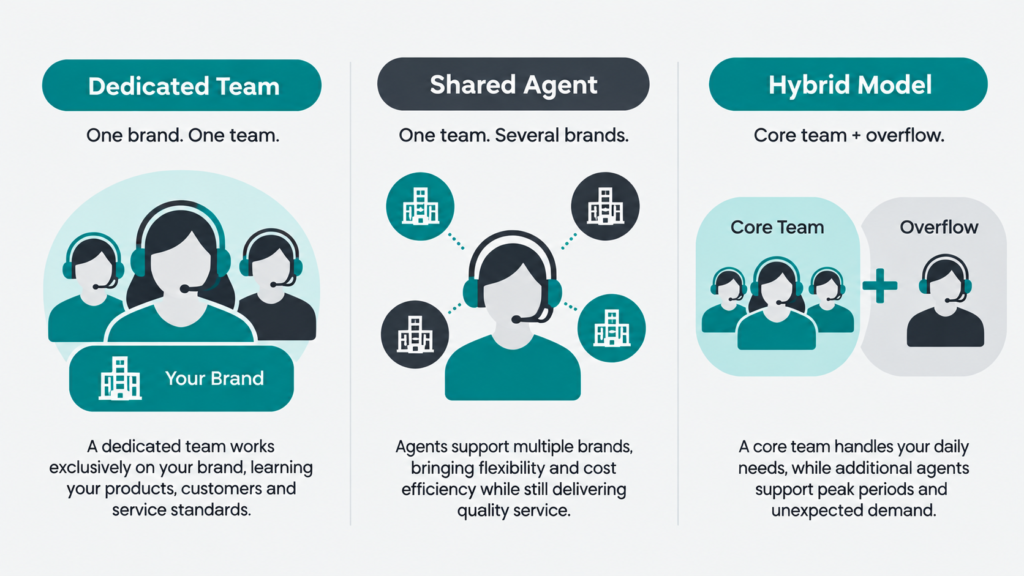
There are three common models: a dedicated team that works only on your account, shared agents who handle several clients, and a hybrid of the two. Most mid-market companies with steady volumes get the best results from a dedicated team, because agents learn the product and the brand voice.
Table: Customer care outsourcing models
| Model | How it works | Best for | Typical pricing | Main risk |
| Dedicated team | Agents, team leader and quality staff work only on your account | Steady volumes, complex products, strong brand voice | Per full-time agent per month | Paying for idle time if volumes drop |
| Shared agents | Agents split time across several clients | Low or irregular volumes, simple queries | Per contact or per minute | Weaker product knowledge and brand consistency |
| Hybrid | Dedicated core team plus shared or flexible overflow | Seasonal peaks, launches, after-hours | Per agent for the core, per contact for overflow | More complex governance and reporting |
| Outcome-based | Fees tied partly to results such as resolution or retention | Mature programs with clean data | Base fee plus performance element | Disputes over how outcomes are measured |
For a detailed look at pricing, our outsourced customer support cost guide lays out the numbers. Smaller teams have different needs, covered in our guide to small business customer service outsourcing.
What to Keep In-House and What to Outsource
Outsource the high-volume, repeatable conversations and the hours you cannot staff well yourself. Keep the decisions that define your product and policy close, and give the outsourced team clear authority to resolve the rest.
A practical split for most companies:
- Outsource: order and account queries, billing questions, first-line support, complaints within agreed policy, out-of-hours cover, overflow and seasonal peaks.
- Keep close or co-own: policy exceptions, product decisions, legal or regulatory complaints, and your most strategic accounts.
- Shared ownership: knowledge base content, quality standards and customer feedback, reviewed together on a set schedule.
The common failure is outsourcing the contacts but not the authority. If agents cannot issue a refund or fix an account without asking you, customers wait and satisfaction drops. Write resolution limits into the service design from day one.
Where AI Fits in Outsourced Customer Care
AI works best in customer care as support for human agents and as a filter for simple tasks, not as a replacement for people. Customers are clear that they want a person available, and self-service still resolves only a small share of issues end to end.
The evidence is consistent. Gartner found that 64% of customers would prefer companies didn’t use AI for customer service, with difficulty reaching an agent among their top concerns (Gartner, 2024). Only 14% of service issues are fully resolved in self-service (Gartner, 2024). In 2026, half of customers said generative AI made interactions easier, yet 87% said companies using it must provide access to a human agent (Gartner, 2026).
The practical model is human-led care with AI around it: automated routing and summaries, suggested answers for agents, quality monitoring across every interaction, and self-service for simple, low-risk tasks with an easy route to a person. Our article on AI-augmented offshore operations explores how that works in an offshore team.
With the model and the technology settled, the remaining work is running the partnership well.
KPIs, Governance and Risk
Strong outsourced customer care runs on a short list of agreed measures, regular joint reviews and clear rules for data and escalation. Without those, quality drifts and the relationship turns into arguments over invoices.
Track a balanced set of KPIs:
- Speed: average speed to answer and response time by channel
- Resolution: first-contact resolution and repeat-contact rate
- Quality: quality assurance scores against your standards
- Customer outcome: CSAT, complaint volumes and, where relevant, retention saves
- People: agent attrition and time to proficiency
Benchmarks help set realistic targets. ContactBabel’s 2025 US guide reports an average speed to answer of 99 seconds, abandonment of 8.9% and mean first-call resolution of 76% (ContactBabel US). Its South African study reports 27 seconds, 4.2% and 86% on the same measures (ContactBabel SA).
The main risks are predictable: inconsistent brand voice, data protection gaps, agent turnover and slow escalation. Reduce them with a shared knowledge base, monthly calibration sessions, a written escalation matrix, and contract terms covering data handling, exit and handover. Our guide to offshore call center attrition rates covers the people risk in depth.
Choosing a Location for Outsourced Customer Care
Location shapes cost, language fit and the hours your team naturally covers. For US and UK companies, the main options are onshore, nearshore in Latin America, and offshore in South Africa, the Philippines or India, and each suits different customers.
South Africa has become a strong choice for English-language customer care. It scored 602 on the 2025 EF English Proficiency Index, ranking 13th globally, and is one of only three countries rated “High” for spoken English (EF; EF EPI 2025). Its business services sector added 26,346 international jobs in 2025 (ITWeb), and its contact centers average $3.54 per inbound call (ContactBabel).
Data protection is aligned too. South Africa’s POPIA only allows personal information to leave the country under binding protection or with consent, which mirrors UK GDPR’s approach to international transfers (POPIA section 72). For destination comparisons, see our South Africa vs Philippines guide and our overview of outsourcing customer service to South Africa. UK buyers comparing providers can also use our guide to customer service outsourcing companies in the UK market.
Frequently Asked Questions
What is customer care outsourcing? Customer care outsourcing is handing your customer service, support and retention conversations to a specialist provider. Its trained team works in your brand’s name across phone, email, chat and messaging, against service levels and quality standards you agree together.
What is the difference between customer care and customer service? Customer service usually means answering questions and resolving requests. Customer care is broader: it includes service and support, plus the relationship side, such as handling complaints well, supporting vulnerable customers and keeping customers who are thinking of leaving.
How much does customer care outsourcing cost? Dedicated teams are usually priced per full-time agent per month, and shared models per contact or per minute. Costs depend on location, channels, hours and complexity. Offshore locations cost far less than onshore: South African contact centers average $3.54 per inbound call.
Should I choose a dedicated team or shared agents? Choose a dedicated team if you have steady volumes, a complex product or a distinctive brand voice, because agents learn your business in depth. Shared agents suit low or irregular volumes with simple queries. Many companies use a dedicated core team with flexible overflow.
Will AI replace outsourced customer care agents? Not for most companies. Gartner found only 14% of service issues are fully resolved in self-service, and 87% of customers say companies using generative AI must offer access to a human agent. The strongest model is human-led care supported by AI tools.
What KPIs should I track for outsourced customer care? Track speed to answer, first-contact resolution, quality scores, customer satisfaction and agent attrition. ContactBabel’s 2025 US benchmarks are 99 seconds to answer and 76% first-call resolution, which gives a useful reference point when you set targets.
Is South Africa a good location for customer care outsourcing? Yes, especially for English-language care for UK and US customers. South Africa ranks 13th on the 2025 EF English Proficiency Index, its contact centers resolve 86% of calls at first contact, and its POPIA data protection law mirrors UK GDPR on international transfers.
How long does it take to set up outsourced customer care? With Afrishore BPO, a dedicated customer care team is typically live in 4 to 6 weeks. That covers scoping, recruitment, training on your systems and tone of voice, and a closely supervised go-live.
Afrishore BPO delivers dedicated customer care teams from South Africa for companies across the United States, United Kingdom, Australia and Canada, including specialist programs in travel customer support and iGaming customer support. If voice is your main channel, read our call center outsourcing South Africa guide, or see our full range of business process outsourcing services.
Ready to talk about your customer care team? Contact Afrishore BPO.