Quick Answer: NOC outsourcing hands 24/7 network and infrastructure monitoring to a specialist provider. The provider triages alerts and handles first-line incidents under set SLAs. It usually wins on cost, because one seat staffed around the clock needs more than four full-time people before leave and management. Prices run from basic monitoring up to full management at around $112 per device per month (IBISWorld 2026 benchmark). So compare scope before you compare price.
Key Takeaways
- A year has 8,760 hours. So one 24/7 NOC seat needs 4.2 FTE in theory, and about 4.7 to 5.2 FTE once leave, sickness and training are covered. Three people cannot run a 24/7 NOC.
- US wages alone make in-house costly. A computer network support specialist earns a median $73,340. A network administrator earns $96,800 (BLS, May 2024).
- Outsourced prices vary tenfold. At the top end, a UK G-Cloud 24/7 NOC is listed at £80 to £230 per device per month.
- Downtime is the real cost. 54% of major outages cost over $100,000, and 16% cost over $1 million (Uptime Institute, 2024).
- For most mid-market firms and MSPs, a hybrid model works best. Your engineers own the day. An outsourced NOC covers nights and weekends.
- A good NOC contract splits acknowledgement, engagement, escalation and restoration. P1 acknowledgement in 10 to 15 minutes is a common target.
What a NOC Does, and How It Differs From a SOC and a Service Desk
A network operations centre keeps infrastructure up and running well. It watches networks, servers, cloud services and links. It turns alerts into ranked incidents, fixes what its runbooks allow and escalates the rest. That makes it different from both security operations and the user help desk.
A NOC’s core jobs are:
- Monitoring: uptime, latency, capacity and hardware health.
- Alert triage: checking alerts, removing duplicates and setting priority.
- Incident response: opening tickets, diagnosing faults and running approved fixes.
- Patching: which NIST treats as preventive maintenance that needs ranking, testing and checks.
- Change management: recording, approving and scheduling changes, with a rollback plan.
- Vendor coordination: chasing carriers, cloud providers and hardware support.
- Reporting: uptime, alert volumes, SLA results and repeat faults.
Work is split into tiers. L1 watches dashboards, checks alerts, gathers data and runs low-risk fixes, such as restarting an approved service. L2 troubleshoots servers, networks and cloud platforms and makes approved changes. L3 handles root cause, design changes and complex recovery. “L1 to L3 included” is too vague for a contract. The service description should say exactly what each tier may do on its own.
Table: NOC vs SOC vs IT service desk
| Function | NOC | SOC | IT service desk |
| Main objective | Infrastructure availability and performance | Detecting and containing security threats | Supporting users and fulfilling requests |
| Main signals | Device health, latency, utilisation, cloud metrics | SIEM, EDR, identity and threat intelligence events | Calls, emails and portal tickets |
| Typical incidents | Link outage, high CPU, failed backup, full disk | Malware, credential abuse, data exfiltration | Password resets, access requests, app problems |
| Core stakeholders | Infrastructure, network and cloud teams | CISO, incident response, legal and risk | Employees and business departments |
Security incidents belong to the SOC. Under the NIST Cybersecurity Framework 2.0, detecting, responding and recovering sit with security, even when the NOC raises the first alert. User support belongs to the service desk. We cover that in our guides to IT support outsourcing and help desk outsourcing.
Why a 24/7 NOC Costs More Than You Think
Round-the-clock cover is a staffing problem before it is a salary problem. One seat staffed every hour of the year needs at least five people on a rota. Add L2 cover and a manager, and even a small in-house NOC is a team of seven to ten.
The maths is simple. A year has 8,760 hours and a full-time worker covers about 2,080. So one seat needs 4.21 FTE before anyone takes leave, falls ill, trains or quits. With those allowances, it is 4.7 to 5.2 FTE. Add daytime L2 engineers and a working manager and a one-seat NOC becomes 7 to 10 people. Two seats at all times need 9.5 to 10.5 FTE before management.
US costs. The Bureau of Labor Statistics puts the median wage at $60,340 for computer user support specialists, a fair L1 match. Network support specialists earn $73,340, and network and computer systems administrators earn $96,800 (May 2024). Benefits make up about 30% of total pay in BLS employer cost data. That works out to 40% to 45% on top of salary. A one-seat team of four support staff, two admins and one manager has a base payroll of about $607,000. With benefits, it is about $862,000. Add tools, hiring and shift premiums and a realistic total is $925,000 to $1.25 million a year.
UK costs. The pattern is the same, at lower cost. The National Careers Service lists IT support technicians at about £24,000 to £36,000. It lists network engineers at about £25,000 to £52,000. Employer National Insurance rose to 15% in April 2025. A similar UK one-seat team costs about £435,000 to £540,000 a year. It rises toward £700,000 with two people on nights or scarce cloud skills. These are planning models built from official wage data, not published averages.
How Much Does NOC Outsourcing Cost?
Outsourced NOC prices run from under £15 per device per month for business-hours support of simple devices to $112 or more for full 24/7 management. The gap is wide because “NOC service” can mean anything from passing on alerts to owning L1 to L3. Compare scope first, then price.
Published prices show the spread. IBISWorld’s 2026 US procurement benchmark for NOC management is $112 per device per month. A UK G-Cloud listing prices 24/7/365 NOC cover at £80 to £230 per device per month. An older UK public rate card priced 24/7 switches and routers at £32.66 a month and firewalls at £100. Business-hours support for the same devices cost £14 and £28.
The common pricing models are:
- Per device: easy to predict and audit. Agree how virtual devices, clusters and cloud resources are counted.
- Per endpoint: suits estates heavy on servers and workstations.
- Per site: works for branch networks that repeat, with set device limits.
- Per FTE: suits dedicated white-label teams. You carry the risk of idle time.
- Retainer: a fixed monthly fee for an agreed estate and alert volume. Often best for smaller buyers.
- Tiered: monitoring only, monitor and escalate, managed L1 and L2, or full L1 to L3.
Check what is left out. Tool licences, new integrations, project work, onsite visits, emergency or firmware patching, writing missing runbooks and any SOC work are often extra. Our IT outsourcing services buyer guide covers wider managed IT pricing.
In-House vs Outsourced vs Hybrid NOC
A fully in-house NOC gives the most control at the highest cost. Full outsourcing gives the cheapest 24/7 cover but starts with the least context. A hybrid, where your team owns office hours and a provider covers nights and weekends, is the best starting point for most mid-market buyers.
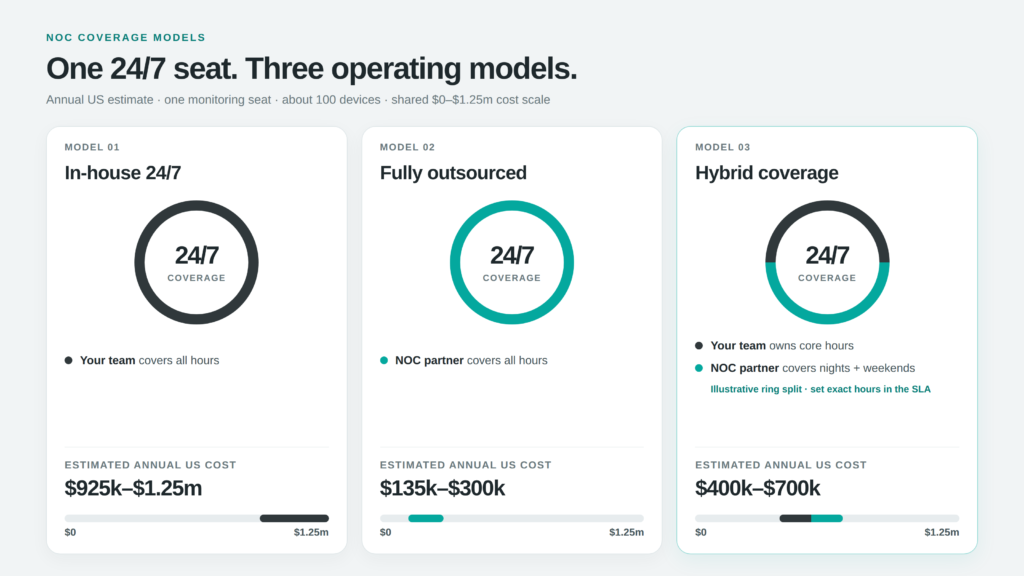
Table: In-house vs outsourced vs hybrid NOC (single monitoring seat, about 100 devices)
| Dimension | In-house 24/7 NOC | Fully outsourced NOC | Hybrid: in-house days, outsourced nights |
| US annual cost | $925,000 to $1.25m | About $135,000 to $300,000 | About $400,000 to $700,000 |
| UK annual cost | £435,000 to £700,000 | About £96,000 to £276,000 | About £250,000 to £450,000 |
| Internal staff needed | 7 to 10 | 0.5 to 2 for governance | 3 to 5 |
| P1 acknowledgement | 10 to 15 minutes if fully staffed | 10 to 15 minutes contracted | 10 to 15 minutes overnight |
| Operational context | Highest | Lowest at first, improves with onboarding | High during core hours |
| Main risk | Cost, vacancies, night-shift resilience | Weak runbooks, access risk, dependency | Handoff and split accountability |
| Best fit | Large, complex or regulated estates | MSPs and mid-market estates needing fast 24/7 cover | Teams that want to own architecture but not the night shift |
Planning model built from BLS and National Careers Service wage data and published G-Cloud and IBISWorld pricing. Only compare quotes once they include equivalent patching, L2 and L3 engineering, tooling and reporting.
Choose in-house when there is enough steady work to keep a team busy, and the NOC needs deep inside knowledge or makes frequent risky changes. Choose fully outsourced when you need low-cost 24/7 cover, repeatable runbooks and fast scaling, and you can keep a strong internal service owner. Choose hybrid when your engineers should own design and changes, but nights do not justify a full night shift. Our article on the hybrid outsourcing model explains the general pattern.
Why MSPs Outsource Their NOC
Managed service providers mostly outsource the NOC so daytime engineers stop carrying night on-call. The other reasons follow. Shared night staffing is cheaper. New clients can be added without hiring a shift. And a white-label NOC works inside the MSP’s own tools and brand.
The day-to-day gains are consistent. A white-label NOC works in the MSP’s ticketing system and follows its escalation rules. Shared L2 and L3 experts cover tools that do not justify a full-time hire. And internal engineers see fewer pointless alerts, so they can focus on projects and clients.
Pressure on technical teams is well documented, though not specific to MSP NOCs. ISACA’s State of Cybersecurity 2025 reports ongoing understaffing and rising stress in technical security teams. Catchpoint’s 2025 SRE Report found 40% of respondents had handled one to five incidents in the last 30 days, and 23% had handled six to ten. Read these as signs of wider workload pressure. They do not prove that outsourcing fixes burnout.
How Follow-the-Sun Coverage Works From South Africa
South Africa runs on UTC+2 all year. A normal day shift there covers most of the US night and much of the UK working day. That makes it a natural base for overnight cover of US estates and extended-hours cover of UK ones.
| South African shift | UK time | US Eastern time | US Pacific time |
| 08:00 to 17:00 SAST | 06:00 to 15:00 GMT | 01:00 to 10:00 EST | 22:00 to 07:00 PST |
| 14:00 to 23:00 SAST | 12:00 to 21:00 GMT | 07:00 to 16:00 EST | 04:00 to 13:00 PST |
Time zones alone do not guarantee faster response. Research on follow-the-sun delivery finds the benefit depends on clean handoffs, well-split work and some overlap between shifts. In practice, the model works when four things are true. The provider works directly in your ITSM tool. Every handoff records impact, timeline, actions and next step. Shifts have a set overlap. And one incident lead owns each P1 from start to finish. Our guides for US companies and UK businesses compare South Africa with other locations.
What a Good NOC SLA Looks Like
A good NOC SLA treats acknowledgement, engineer engagement, escalation, updates and restoration as separate promises. A four-hour fix for a fault that sits with a carrier or cloud provider is not realistic. So the contract should say when the clock pauses.
| Priority | Example | Acknowledge | Engineer engaged | Escalation | Updates |
| P1 critical | Full outage or severe customer impact | 10 to 15 minutes | 15 to 30 minutes | L2 immediately, L3 by 30 minutes | Every 30 minutes |
| P2 high | Major degradation, redundancy lost | 30 minutes | 60 minutes | L2 within 60 minutes | Hourly |
| P3 medium | Limited impact | 2 business hours | 4 business hours | Per runbook | Daily |
| P4 low | Minor defect or request | 1 business day | Agreed backlog target | Usually none | On material change |
Public-sector NOC agreements are a useful guide. NOAA’s N-Wave NOC targets a 15-minute service desk response and a 10-minute investigation for critical incidents. Beyond the table, the contract should set exact hours per tier and say how the SLA clock starts and stops. It should name escalation contacts and set a deadline for root-cause reports, often three to five business days for a P1. It should also include monthly SLA reports with raw ticket access, service credits and exit rights. Our guide to BPO contracts and SLAs covers the commercial terms.
Security Controls to Require From an Outsourced NOC
An outsourced NOC usually gets broad admin access to your systems. That makes it a high-impact supplier, even though it is not a SOC. Strong access controls and outside assurance are a must.
Require named accounts and ban shared admin logins. Insist on multi-factor sign-in for all remote and admin access, and least-privilege access by role and device. Ask for a privileged access tool with a credential vault, recordings of critical admin sessions and central logs that cannot be altered. The UK NCSC advises firms to risk-assess third-party admin access, limit it to the kit required and monitor it all the time.
For assurance, check that an ISO/IEC 27001 certificate covers the actual NOC service and site, not just the company. For a SOC 2 Type II report, check the audit period and what systems it covers. For UK delivery, ask for Cyber Essentials Plus. Our guide to outsourcing data security and compliance sets out the full checklist.
Common NOC Outsourcing Failures
Most failed NOC deals fail in the same few ways. Alert forwarding sold as a NOC, alert overload from untuned monitoring, weak runbooks and gaps between L1 and L2. Each one can be prevented in the contract.
- Alert forwarding dressed up as a NOC: require checks, correlation and a recorded action before anything is escalated.
- Alert overload: set tuning duties and review the top repeat alerts every month.
- Poor runbooks: keep versioned runbooks with owners, tests and review dates.
- Escalation gaps: use timed automatic escalation with named backups.
- Split ticket systems: keep one system of record so SLA times cannot be disputed.
- Lock-in: agree an exit plan up front, with configuration export and handover support.
Frequently Asked Questions
What is NOC outsourcing? NOC outsourcing means handing 24/7 monitoring, alert triage and first-line incident response for your networks, servers and cloud infrastructure to an external provider under defined SLAs. The provider watches your estate, fixes what its runbooks allow and escalates the rest to your engineers or its own L2 and L3 specialists.
How much does an outsourced NOC cost? Pricing ranges from under £15 per device per month for business-hours support of simple network devices to a 2026 IBISWorld benchmark of $112 per device per month for full NOC management. A UK G-Cloud listing prices 24/7 NOC coverage at £80 to £230 per device per month. Scope, device mix and the tiers included drive the difference.
How many people do you need to run a 24/7 NOC in-house? One seat staffed around the clock needs 4.2 FTE in theory and roughly 4.7 to 5.2 FTE after leave, sickness and training. With daytime L2 engineers and a manager, even a single-seat in-house NOC is typically a team of 7 to 10 people.
What is the difference between a NOC and a SOC? A NOC keeps infrastructure available and performing, handling outages, capacity problems and failed services. A SOC detects and responds to security threats such as malware and credential abuse. A NOC may raise the first alert on a security issue, but containment and recovery belong to the SOC.
What is a white-label NOC? A white-label NOC is an outsourced NOC that works under a managed service provider’s brand, inside the MSP’s own ticketing system and escalation policies. The MSP’s clients see their MSP, while the provider supplies the overnight and weekend monitoring and first response behind it.
What SLA should an outsourced NOC offer? A common benchmark for P1 critical incidents is acknowledgement within 10 to 15 minutes, an engineer engaged within 15 to 30 minutes and updates every 30 minutes. The SLA should measure acknowledgement, engagement, escalation and restoration separately and state when the clock pauses for third-party faults.
Is a hybrid NOC model better than full outsourcing? For many mid-market companies and MSPs, yes. In a hybrid model your engineers keep ownership of architecture, changes and business-hours operations, while an outsourced NOC covers nights and weekends. It costs far less than an in-house 24/7 team while keeping operational context in-house.
What security controls should an outsourced NOC have? Require named accounts, multi-factor authentication, least-privilege access, privileged access management with credential vaulting, session recording and central audit logging. Check that ISO 27001 certification covers the actual NOC service and site, review any SOC 2 Type II report, and ask UK providers for Cyber Essentials Plus.
Afrishore BPO’s IT Outsourcing division runs 24/7 infrastructure monitoring and IT operations from South Africa, built as a modular stack that can cover your nights and weekends while your engineers own the day. For the wider picture, see our guides to managed IT services outsourcing and IT help desk outsourcing from South Africa.
Talk to Afrishore’s IT Outsourcing team about overnight and weekend NOC coverage.