South Africa is now the top-ranked offshore customer support destination for US enterprise buyers, according to Ryan Strategic Advisory’s 2025 global survey. If you want to outsource customer support to South Africa, this guide covers exactly how it works, what it costs, and how to pick the right partner.
Key Takeaways
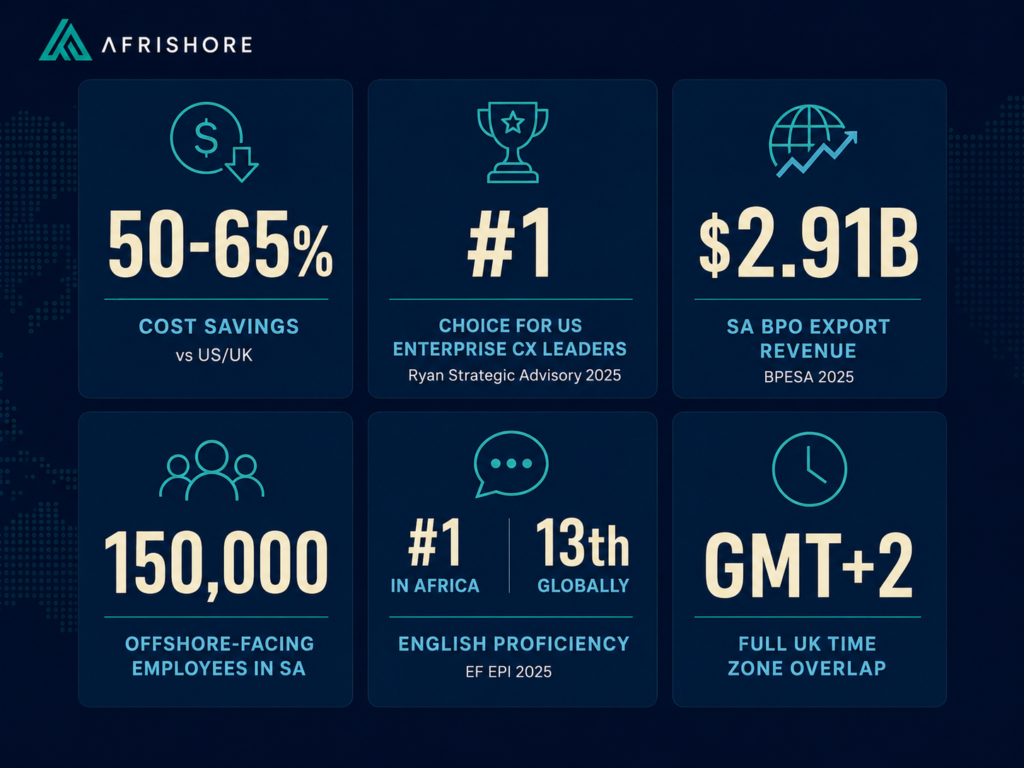
- South Africa is rated the #1 offshore CX destination for US enterprise buyers (Ryan Strategic Advisory, 2025)
- Outsourcing cuts agent costs 50-65% compared to equivalent US/UK in-house teams
- A 50-agent team costs $25,000-$35,000/month in South Africa vs $60,000-$80,000/month in-house in the US
- South Africa ranks 13th globally for English proficiency and #1 in Africa (EF EPI, 2025)
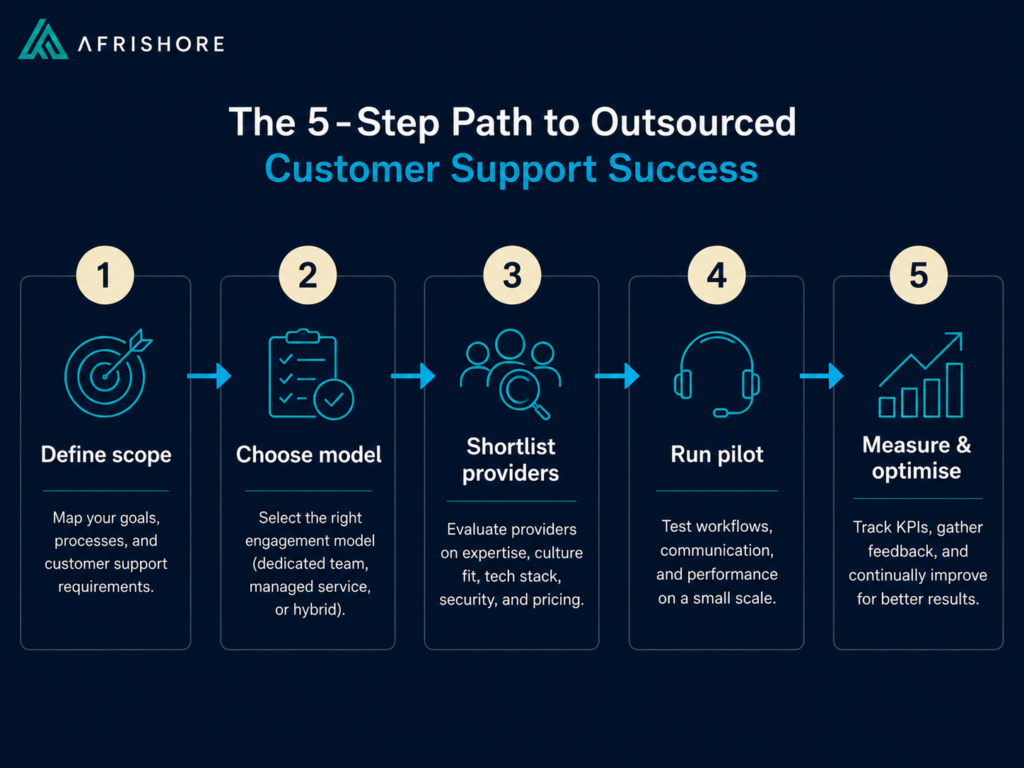
- The typical setup path runs five steps: scope, model, shortlist, pilot, measure
What Does It Mean to Outsource Customer Support to South Africa?
Outsourcing customer support to South Africa means contracting a South Africa-based BPO to staff, manage, and run your customer-facing support function. Your brand, escalation policies, and product decisions stay in-house. The day-to-day handling of calls, emails, chats, and live support moves offshore to a dedicated team. South Africa’s GBS sector employs 150,000 offshore-facing agents and generated $2.91 billion in export revenue in 2024 (BPESA, 2025) – which signals a mature, scalable supply of skilled labour, not a speculative market.
What transfers to the BPO:
- Inbound and outbound phone support
- Email and live chat handling
- Social messaging (WhatsApp, Messenger)
- First-contact resolution and ticket triage
- After-hours and overflow coverage
What stays in-house:
- Brand voice decisions and policy changes
- Tier 2/3 escalation authority
- Product knowledge updates and KB ownership
- Vendor relationship management
In practice, the smoothest transitions happen when clients treat the offshore team as an extension of their internal team – not a separate vendor. Shared Slack channels, weekly QA calls, and joint coaching on product updates close the distance fast.
For a broader overview of how business process outsourcing works as a model, see our full guide.
Why South Africa for Customer Support Outsourcing in 2026?
South Africa claimed the top spot among US enterprise contact center leaders in Ryan Strategic Advisory’s 2025 global benchmarking study – “far-and-away first choice,” in their exact language. That result follows a 2024 ranking where South Africa tied for 2nd place globally. The country’s ascent is not a fluke. It reflects measurable advantages across language, culture, cost, and workforce stability.
English proficiency and cultural fit
South Africa ranked 13th globally and 1st in Africa in the EF English Proficiency Index 2025, with a national literacy rate of 95.02%. Neutral accents, strong comprehension, and cultural familiarity with US and UK consumers make South African agents effective on first contact rather than after weeks of accent neutralisation training.
Cultural alignment is frequently underweighted in outsourcing decisions. Buyers focus on cost and English score, then discover six months in that agents don’t share reference points with customers. South Africa’s long exposure to US and UK media, sport, and consumer culture shrinks that gap considerably. We’ve written a dedicated analysis on cultural alignment in customer support outsourcing that goes deeper on why this matters for CSAT.
Timezone coverage
South Africa operates at GMT+2. That gives you full working-day overlap with the UK and 4-5 hours of overlap with US Eastern during standard business hours. Shift extensions cover US Central and Mountain. Compared to India (GMT+5:30) or the Philippines (GMT+8), South Africa requires fewer unsociable night shifts to cover Western business hours.
Cost savings
Agent rates run $10-12/hour in South Africa versus $23-28/hour in the US for comparable roles. A 50-agent team costs $25,000-$35,000/month in South Africa, compared to $60,000-$80,000/month for an equivalent in-house US team. That is a 50-65% saving before you account for US employer taxes, benefits, and office overhead.
For the full cost breakdown including hidden fees, see The True Cost of Offshore Customer Service.
Workforce stability
South Africa’s contact centre attrition rate runs 15-20% annually. The Philippines, by contrast, averages 40% or above. High attrition is not just an HR headache – it destroys institutional knowledge, inflates training costs, and directly damages CSAT scores. Our deep-dive on offshore call center attrition rates shows how the arithmetic compounds against you in high-churn markets.
Sector scale
The SA GBS sector created 20,500 new jobs in 2024 alone (BPESA, 2025), confirming the pipeline of trained talent is growing – not thinning. For a fuller picture of the country’s BPO credentials, see our guide to BPO in South Africa and our South Africa vs Philippines comparison.
Ryan Strategic Advisory’s 2025 global contact center survey named South Africa the “far-and-away first choice” for US enterprise offshore CX leaders, following a 2024 ranking of tied-2nd globally. Combined with a $2.91 billion export sector (BPESA, 2025) and 95.02% literacy, South Africa offers a rare combination of language quality, cultural alignment, and cost advantage in a single offshore destination.
How Do I Outsource My Customer Service to South Africa? 5 Steps
The fastest path to a working offshore support team in South Africa runs five stages. Most clients move from initial scoping to live operations in 6-10 weeks, though a well-prepared client with a documented knowledge base can compress this closer to 4.
Step 1: Define Your Scope
Before you approach a single provider, document exactly what you need covered. Ambiguity at this stage costs time and money in every step that follows.
Pin down: monthly contact volume by channel (calls, emails, chats), average handle time, peak hours, languages required, and any regulatory constraints (GDPR, PCI-DSS, HIPAA). A realistic volume estimate is the single most important number in any BPO commercial conversation.
Step 2: Choose Your Operating Model
The two main structures are a dedicated team (agents work exclusively for your account) and a shared pool (agents rotate across multiple clients). Dedicated teams cost more per hour but give you brand consistency, knowledge depth, and priority availability during peaks.
For most established B2C or B2B customer support programmes, a dedicated model is the right choice. Shared pools work for low-volume overflow or seasonal burst coverage. Our call center outsourcing South Africa guide covers both models with indicative pricing.
Step 3: Shortlist Providers and Run Due Diligence
Compile a shortlist of three to five providers. Request an RFP that specifies team structure, QA methodology, attrition rate, technology stack, and compliance certifications (ISO 27001, ISO 9001, PCI-DSS, HIPAA where relevant).
Reference checks are non-negotiable. Speak to at least two current clients of comparable size and vertical. Our guide on how to verify offshor e BPO provider references has a question set you can use verbatim. For a broader view of the South African BPO market, see BPO companies in South Africa.
Are You Ready to Outsource? Quick Checklist Before approaching providers, confirm:
You know your monthly contact volume (calls/emails/chats)
You have a documented escalation policy
Your knowledge base is current and searchable
You can commit to a 2-4 week onboarding period
You have defined KPIs (FCR target, CSAT target, AHT target)
Step 4: Run a Pilot
A 2-4 week paid pilot with your top-ranked provider is the most efficient risk mitigation available. Use it to validate agent quality, system integration, and QA cadence under real traffic before committing to full headcount.
Give the pilot team your full knowledge base, your escalation policy, and a sample of real contact recordings so they can calibrate tone and complexity. Measure FCR and CSAT daily, not weekly, during the pilot phase.
Step 5: Measure and Optimise
Go live with a defined KPI dashboard from day one. Standard metrics: First Contact Resolution (FCR), Customer Satisfaction Score (CSAT), Average Handle Time (AHT), and Quality Assurance (QA) pass rate. Hold a weekly review call for the first three months. Problems that surface in week two are fixable. Problems that go unreviewed for 90 days compound into contract disputes.
What to Look For in a South Africa Customer Support Partner
The right South Africa BPO partner has transparent processes, proven attrition data, and a QA framework you can inspect before you sign. South Africa has strong mid-market and enterprise providers, but the market also has operators that win on price and underdeliver on quality. Knowing the difference before shortlisting saves months of pain.
Green Flags
Dedicated team structure. The provider assigns named agents to your account, not a rotating shared pool. You should know who is handling your customers.
Attrition transparency. A credible provider will share their actual annual agent attrition rate, broken down by tenure band. South Africa’s sector average is 15-20%. Any provider unable or unwilling to share this number is a risk.
QA framework with client access. You should be able to listen to call recordings, review chat transcripts, and see QA scoring breakdowns on demand. If QA lives inside the provider’s system with no client visibility, push back.
Platform compatibility. Confirm the BPO can connect to your CRM (Salesforce, Zendesk, Freshdesk, HubSpot), telephony, and ticketing systems before shortlisting. Re-platforming at pilot stage is expensive and avoidable.
Onboarding process documentation. A mature provider has a written onboarding playbook. If they can’t show you one, that tells you something.
Red Flags
Watch for the classic offshore BPO bait-and-switch: a senior, polished team pitches the deal and a junior, undertrained team delivers the work. Ask specifically who will manage your account day-to-day and whether the people in the room are the people on your floor.
Other red flags: vague SLA language (“best efforts”), no penalty mechanism for missed KPIs, reluctance to provide client references, and pricing that is significantly below market rate without a structural explanation.
For a broader comparison of South Africa’s leading BPO providers, our customer service BPO companies guide covers the major players and what they specialise in.
South Africa’s contact centre attrition rate averages 15-20% annually, compared to 40%+ in the Philippines. For a 50-agent team, that difference translates to roughly 10-12 fewer agent replacements per year – each one representing lost institutional knowledge and a training cost of two to four weeks of salary (Offshore Call Center Attrition Rates, 2025).
How Much Does It Cost to Outsource Customer Support to South Africa?
South Africa agent rates run $10-12 per hour, versus $23-28 per hour for comparable in-house roles in the US. At team scale, a 50-agent dedicated operation costs $25,000-$35,000 per month in South Africa, compared to $60,000-$80,000 per month for an equivalent US in-house team Ryan Strategic Advisory, 2025. That is a 50-65% saving on direct labour costs alone.
What’s Included in the Monthly Rate
Most BPO contracts bundle the following into the per-agent or per-hour rate:
- Agent salary, benefits, and HR
- Floor management and team lead
- Facilities, equipment, and connectivity
- Basic QA and reporting
What’s Not Included (Watch These)
Hidden costs catch first-time buyers. The main ones:
Tooling and integrations. CRM licences, telephony, and workforce management software may be billed separately or may require a client-funded integration project. Confirm this in the RFP stage.
Team lead and quality analyst overhead. Some providers bill team leads as a percentage of headcount (typically one TL per 10-15 agents). Clarify whether this is within the quoted rate.
Onboarding and training time. A 2-4 week ramp period is normal. Confirm whether this is billed at full rate, reduced rate, or absorbed by the provider.
Outbound telephony. Inbound calls are typically included. Outbound per-minute rates vary significantly. If your programme has outbound volume, model this separately.
For a complete breakdown of what offshore customer service really costs when all variables are included, see The True Cost of Offshore Customer Service and our dedicated call center outsourcing cost guide.
Common Mistakes When Outsourcing Customer Support
Most outsourcing programmes that underperform do so because of avoidable setup errors, not because South Africa is the wrong destination. These four mistakes account for the majority of early-stage failures we see.
Choosing on Price Alone
The cheapest quote in your shortlist is almost never the best value. Providers that undercut the market rate are typically cutting corners on agent quality, training time, or management coverage. The offshore BPO bait-and-switch is a well-documented pattern where the sales experience bears no resemblance to the delivery reality.
Run a cost-per-resolved-contact analysis, not a cost-per-hour comparison. A cheaper agent with a 45% FCR rate is more expensive than a better-paid agent with a 75% FCR rate.
Not Defining Escalation Paths Before Go-Live
Offshore agents handle Tier 1 contacts well. They handle ambiguous escalations poorly when the path is unclear. Document your escalation matrix before onboarding begins – who owns Tier 2, what triggers it, and what the response SLA is. This single document prevents more CSAT damage than any amount of QA scoring.
Skipping the Pilot
Pressure to launch fast often leads buyers to skip or compress the pilot to one week. This is a false economy. A 2-4 week pilot surfaces integration problems, knowledge gaps, and tone mismatches before they reach real customers at scale. Compress the pilot and you are paying to discover these problems under live fire.
Poor Knowledge Base Handover
The offshore team can only be as good as the information you give them. A knowledge base that is out of date, unstructured, or locked in your internal wiki is a direct CSAT liability. Dedicate one internal person to KB preparation before onboarding starts. Send articles, not raw policy documents.
Frequently Asked Questions
How do I outsource my customer service to South Africa?
Start by documenting your contact volume by channel, your escalation policy, and your KPI targets. Then shortlist three to five South Africa BPO providers, run a structured RFP, check references, and agree a 2-4 week paid pilot before committing full headcount. Most clients are fully operational within 6-10 weeks of signing a contract. South Africa’s large pool of English-proficient agents (EF EPI 2025: 13th globally, 1st in Africa) makes onboarding faster than most offshore markets.
How much does it cost to outsource customer support to South Africa?
Agent rates in South Africa run $10-12 per hour versus $23-28 per hour in the US. A 50-agent team typically costs $25,000-$35,000 per month all-in, compared to $60,000-$80,000 per month for equivalent US in-house headcount – a saving of 50-65%. Confirm what is and isn’t bundled in the monthly rate, particularly tooling, team lead overhead, and outbound telephony.
Why is South Africa better than the Philippines for customer support?
South Africa ranked higher than the Philippines in Ryan Strategic Advisory’s 2025 and 2024 global offshore CX benchmarks. The key advantages are cultural alignment with US and UK buyers, a GMT+2 timezone that overlaps naturally with UK and US East Coast business hours without night shifts, and a significantly lower attrition rate (15-20% vs 40%+). See our full South Africa vs Philippines comparison for a structured side-by-side.
How long does it take to set up an outsourced customer support team in South Africa?
Most programmes move from contract signature to live operations in 6-10 weeks. A well-prepared client with a current knowledge base and documented processes can move faster, closer to 4-6 weeks. The main variable is integration complexity – telephony and CRM connections are typically the longest lead-time item.
What channels can be outsourced to a South Africa BPO?
All major CX channels can be handled from South Africa: inbound and outbound phone, email, live chat, WhatsApp, social messaging, and back-office ticket resolution. Most established BPOs operate omnichannel platforms and can support multi-channel programmes from a single managed team.
Is outsourced customer support in South Africa GDPR and HIPAA compliant?
Yes, with the right provider. South Africa’s Protection of Personal Information Act (POPIA) is structurally comparable to GDPR, and South Africa is generally recognised as an adequate destination for EU/UK data transfers. For HIPAA, confirm the BPO holds a current Business Associate Agreement (BAA) framework and has ISO 27001 and PCI-DSS certifications. Not all providers hold all certifications – verify this in the RFP, not after signing.
What is the minimum team size for outsourcing customer support?
Most South Africa BPOs set a minimum of 5-10 dedicated agents for a standalone contract. Below that threshold, a shared pool arrangement may be more cost-effective. For programmes under 5 agents, consider whether a managed shared service or a hybrid model makes more sense than a full dedicated team.
Conclusion
South Africa’s combination of language quality, cultural alignment, cost savings, and workforce stability makes it the strongest offshore customer support destination available to US and UK businesses in 2026. The ranking from Ryan Strategic Advisory is not marketing language – it reflects measurable advantages across every criterion enterprise buyers use to evaluate offshore CX partners.
The process of outsourcing customer support to South Africa is straightforward when you prepare correctly. Define your scope, choose your model, shortlist and check references carefully, run a pilot, and measure from day one. The businesses that struggle with offshore CX are almost always those that cut corners on one of those five steps.
If you’re ready to explore what a South Africa-based customer support team could look like for your business, contact Afrishore BPO for a no-obligation scope assessment. Afrishore operates from Johannesburg with 750 seats, 20 years of BPO experience, and ISO 27001/ISO 9001/HIPAA/PCI-DSS certification.
Related reading: Call Centre Outsourcing South Africa · South Africa vs Philippines · BPO Companies in South Africa