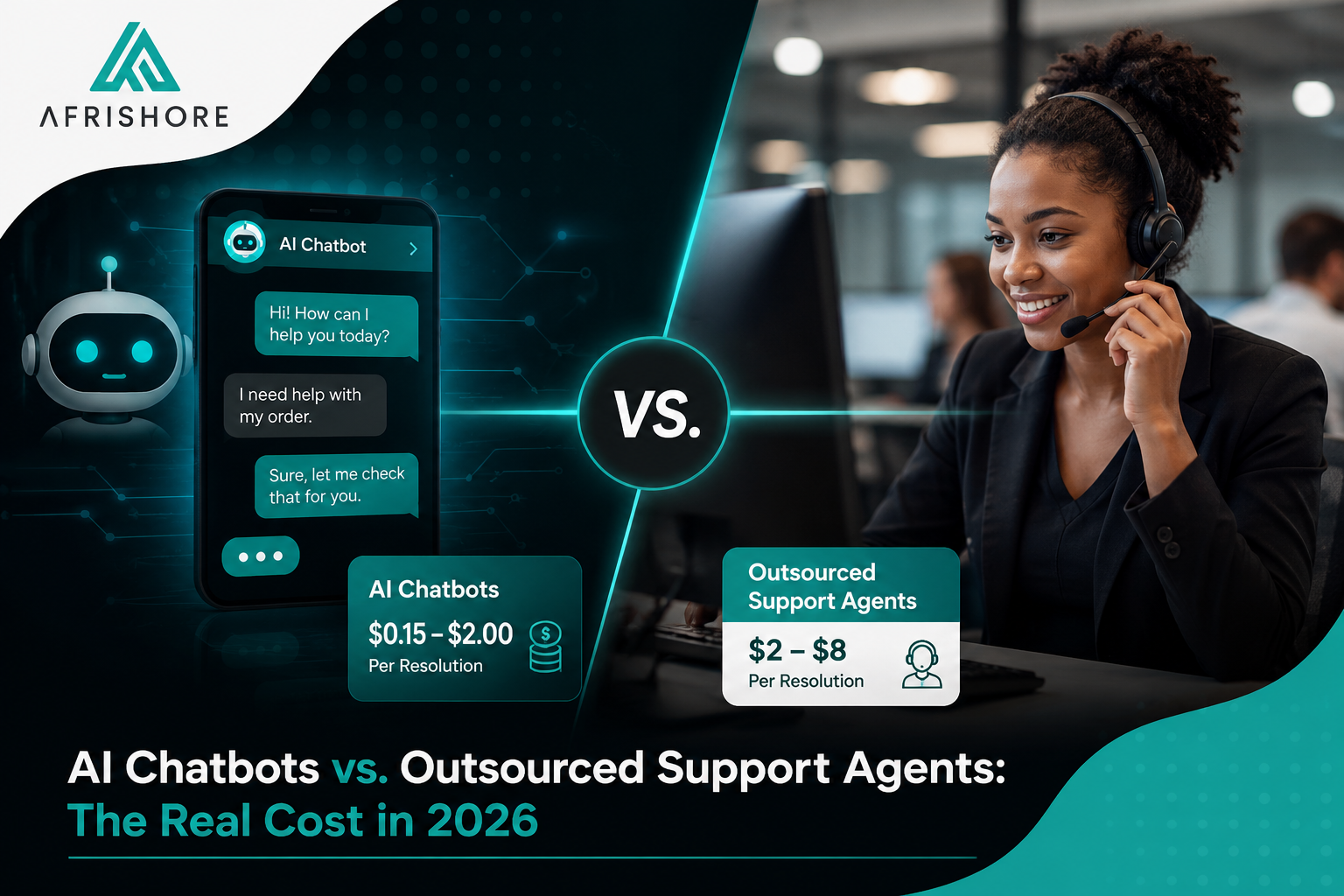
Every CX leader budgeting for 2026 has run the same mental math: an AI chatbot can resolve a ticket for pennies, so why pay $2–$5 for a human to do it? The unit economics look decisive — until you factor in what a well-designed 2026 program actually needs: containment that holds up under real complexity, CSAT that doesn’t quietly erode, and a rollback story you don’t want to become the next Klarna headline.
Key Takeaways
- Per-resolution AI pricing runs $0.15–$2.00 depending on platform and complexity, but enterprise AI platforms (Ada, Sierra) carry $30k–$300k+ annual contracts plus $15k–$200k implementation costs and 3–11 month deployments
- Fully-loaded outsourced human agents (South Africa, Philippines, India) run $7–$16/hour, translating to roughly $2–$8 per resolved interaction depending on channel and complexity
- A 2025 US consumer survey found 93.4% prefer a human over AI, 49.6% would cancel a service over AI-driven support, and 41.5% would pay extra for human access
- Klarna’s 2023 AI-only rollout (claimed to replace 700 agents) was reversed by 2025 after quality complaints — the company rehired human agents and now positions AI for routine queries only
- Hybrid AI-assisted human support delivers 30–50% cost savings versus human-only, with the CSAT gap between AI and human narrowing from 0.20 points to about 0.05 points when AI augments rather than replaces
- Gartner predicts over 40% of agentic AI projects will be canceled by 2027 due to cost overruns and unclear business value
What AI Chatbots Actually Cost
AI platforms bill $0.15–$2.00 per resolution, but enterprise deployments (Ada, Sierra) carry $30k–$300k+ annual contracts plus $15k–$200k implementation costs — the headline per-resolution number is real, but it’s not the total cost.
AI customer service pricing has largely shifted to outcome- or resolution-based models rather than flat licensing, which makes the sticker price look deceptively small until volume scales.
Intercom Fin charges $0.99 per “outcome” — counted when a customer confirms resolution or a workflow completes — with no separate seat or setup fee, though a minimum monthly commitment applies. Independent pricing analysis shows real-world spend for teams handling 1,000+ conversations often lands around $800–$2,500/month, and running 60–80% higher than initial budget expectations once usage scales.
Zendesk’s AI Resolution Platform bills automated resolutions at roughly $1.50 per resolution on committed plans, $2.00 pay-as-you-go, with a handful of free resolutions per agent per month depending on tier. Zendesk’s own marketing cites 50–80% autonomous resolution potential, but independent buyer data suggests real-world AI resolution rates closer to 10–20% — a meaningful gap between vendor messaging and typical deployment results.
Salesforce Agentforce runs $2 per customer-facing conversation, or a Flex Credit model at $500 for 100,000 credits (roughly $0.10 per discrete action). Analyst commentary notes that fewer than 10% of Agentforce customers have scaled beyond pilot deployments, citing 5–11 month setup timelines and data-integration complexity.
Ada and Sierra — both enterprise-grade AI agent platforms — don’t publish list pricing. Procurement data puts Ada’s typical contracts at $30k–$300k+ annually with $15k–$100k+ implementation costs over 8–16 weeks. Sierra’s contracts reportedly start around $150k/year plus $50k–$200k in implementation fees, with 3–7 month deployment timelines.
The pattern across every platform: the headline per-resolution number is real, but it’s not the total cost. Setup, integration, ongoing knowledge-base maintenance, and — per Forrester’s 2026 predictions — an entirely new internal “AI ops” function that roughly 30% of companies will build to onboard, coach, and troubleshoot their AI agents, all sit on top of the per-resolution fee.
Containment isn’t the same as resolution
Chatbot containment rates (the share of conversations handled without human involvement) typically start at 20–40% and reach 70–90% in mature deployments. More granular 2026 data on “true resolution containment” shows wide variance by task: 94% on order tracking, 88% on refunds and returns, 81% on subscription changes — but only 52% on technical troubleshooting, where human specialists are still doing the real work.
Crucially, containment counts abandonments and “rage-quits” the same as genuine resolutions. Several vendors now warn buyers to track resolution rate, CSAT, and repeat-contact rate together — not containment alone — because a bot that traps a frustrated customer in a dead-end flow looks efficient on paper while quietly damaging the relationship.
What Outsourced Human Agents Actually Cost
Fully-loaded outsourced agents run $7–$16/hour across South Africa, the Philippines, and India, translating to roughly $2–$8 per resolved interaction — more than AI’s per-resolution cost, but with a materially different reliability profile for anything beyond simple, scriptable requests.
Fully-loaded outsourced agent costs in 2026 cluster in a fairly tight band across the three major offshore CX destinations — see the full outsourced customer support cost breakdown for the complete regional and channel-by-channel model:
| Destination | Fully-loaded cost (USD/hour) | Approx. annual cost/FTE |
| South Africa | $8–$14 | ~$12,000–$22,000 |
| Philippines | $8–$15 | ~$12,000–$20,000 |
| India | $7–$14 | ~$12,000–$24,000 |
| US onshore (for comparison) | $28–$65 | ~$53,000–$80,000 |
Converting hourly cost into per-resolution cost using typical handle times, a human agent resolving a voice call or chat interaction runs roughly $2–$8 per resolved interaction, depending on channel and complexity — substantially more than AI’s $0.15–$2.00 range, but with a materially different reliability profile for anything beyond simple, scriptable requests.
South Africa’s positioning within that band is specific: agent costs are competitive with the Philippines and India, but South Africa’s lower attrition (15–20% annually versus 25–40% in the Philippines and India) reduces the retraining and knowledge-loss costs that erode savings over a program’s lifetime — the same dynamic that shows up in destination comparisons across the industry.
Where AI Genuinely Wins — and Where It Doesn’t
AI performs well on simple, transactional requests, but consumer data is unambiguous on everything else: 93.4% of consumers prefer a human, and Klarna’s own reversal of its AI-only rollout shows what happens when automation is pushed past what it reliably handles.
The quality data tells a consistent story: AI is strong on simple, transactional, low-stakes requests, and weaker wherever a customer is stressed, upset, or dealing with money.
A 2026 synthesis of AI support data found AI-handled tickets average a CSAT of 4.10/5 versus 4.30/5 for human agents — a real but modest 0.20-point gap. That gap narrows to roughly 0.05 points in hybrid setups, where AI assists a human rather than replacing them outright.
But consumer sentiment is where the real signal is. A 2025 US survey reported via BusinessWire found:
- 93.4% of consumers prefer interacting with a human over AI
- 88.8% believe companies should always offer a human option
- 49.6% would cancel a service over AI-driven customer service
- 41.5% would pay extra specifically for access to a human representative
Separate research from CSG and Five9 found 77% of consumers are comfortable with AI resolving an issue — but 73% of that group only accept it when they know they can escalate to a human if needed. The pattern holds across studies: AI is broadly accepted for routine, low-stakes tasks, and demand for a human spikes sharply the moment urgency, money, or emotion enters the interaction.
The Klarna case: what happens when AI-only doesn’t hold up
Klarna’s rollout is the most cited cautionary tale in this space. In 2023, the fintech deployed an OpenAI-powered chatbot it said could do the work of 700 full-time agents, initially reporting 2.3 million conversations handled and resolution time cut from 11 minutes to under 2. By 2024–2025, Klarna’s own leadership acknowledged declining service quality and rising unresolved inquiries, with customers frustrated by robotic, unhelpful responses. Klarna reversed course, rehired human agents, and now publicly states customers should “always have the option to speak to a real person” — using AI for routine queries while reserving humans for what the company calls “moments that matter.”
Klarna isn’t an isolated case. Broader 2026 industry reviews suggest roughly half of companies that experimented with AI-only support have since begun hiring humans back, typically after recognizing that pure automation was damaging CSAT and brand trust faster than it was saving money.
The Hidden Costs Nobody Budgets For
Double-handling on failed AI escalations, hallucination and liability risk, and the new internal “AI ops” function Forrester expects 30% of companies to build all sit on top of the per-resolution fee — and rarely appear in the initial AI business case.
Double-handling on escalation. When AI attempts a resolution and fails before handing off, the customer endures a longer, more frustrating journey — and the business pays the AI usage fee and the full human resolution cost. Poorly designed containment can look efficient in a dashboard while actively generating repeat contacts and lower CSAT.
Liability and hallucination risk. Gartner warns that over 40% of agentic AI projects will be canceled by 2027, citing escalating costs and inadequate risk controls. Concrete failure modes in customer service specifically include incorrect billing or refund decisions, misleading answers about regulatory rights (chargebacks, insurance coverage, cancellation terms), and tone-deaf responses to complaints — exactly the scenarios where a CX leader is held accountable regardless of whether a human or an AI produced the answer.
Change management. Forrester expects roughly 30% of companies to build a parallel internal function just to manage AI — onboarding and coaching the AI system, optimizing its performance, and troubleshooting failures. That’s a genuinely new, ongoing cost layer that rarely appears in the initial AI business case.
The Hybrid Model: Where 2026 Is Actually Landing
Analysts frame AI as a collaborator, not a replacement — real-world “80/20” hybrid programs where AI handles routine volume and humans own complexity deliver 30–50% cost savings versus human-only support with minimal CSAT impact.
Gartner frames AI agents as collaborators for human agents, not replacements — AI handling personalization, summarization, and routine actions while humans own complex work. Forrester’s 2025 predictions expect genAI to displace a meaningful share of frontline agent volume at the largest outsourcers, but explicitly frame that as automating low-complexity issues, with humans remaining essential for complex and emotional interactions.
Real-world hybrid deployments back this up. Industry guidance on 2026 hybrid programs describes an “80/20” model — AI handling roughly 80% of routine volume, humans focused on the 20% requiring empathy and complex problem-solving — achieving strong first-contact resolution alongside significant operating-cost savings, without the brand risk that comes with AI-only.
Used as a copilot rather than a replacement, AI shows up differently in the numbers: Zendesk’s 2025 CX Trends research found 73% of agents believe an AI copilot helps them do their job better, and 90% of CX “Trendsetters” report positive returns on AI tools for agents — without the CSAT erosion seen in AI-only deployments. The net effect across the data: AI-assisted outsourcing typically delivers 30–50% cost savings versus human-only outsourcing, with minimal CSAT impact — a materially better risk-adjusted outcome than betting the whole program on AI-only.
What This Means for South African BPO Delivery
South Africa’s neutral English accents, cultural alignment, and attrition running roughly half the Philippines/India rate are exactly what makes human agents worth keeping at the center of a program — with AI layered in to handle volume, not replace the people who handle complexity.
South Africa’s positioning fits this hybrid model well. The sector’s advantages — neutral English accents, cultural alignment with UK/US customers, and attrition running roughly half the Philippines/India rate — are exactly the qualities that make human agents worth keeping at the center of a program, with AI layered in to handle routine volume and accelerate the agents who remain.
That’s the model Afrishore builds toward: human agents as the core of the delivery team — handling complexity, judgment calls, and the emotional interactions where CSAT data consistently shows AI still falls short — with AI used for routing, summarization, and knowledge-surfacing rather than as a replacement strategy. Combined with South Africa’s $8–$14/hour fully-loaded cost band, that structure delivers US/UK-grade CX at a materially lower cost than onshore staffing via call center outsourcing in South Africa, without the brand and quality risk that AI-only deployments have repeatedly run into.
Frequently Asked Questions
Is AI cheaper than outsourced human agents for customer support?
On a pure per-resolution basis, yes — AI platforms typically cost $0.15–$2.00 per resolution versus $2–$8 for a human agent. But enterprise AI platforms also carry $30k–$300k+ annual contracts, $15k–$200k implementation costs, and ongoing “AI ops” overhead that rarely appears in the initial cost comparison, which narrows the real-world gap significantly.
What percentage of customer service tickets can AI actually resolve?
Vendor marketing often claims 50–80% autonomous resolution, but independent buyer data suggests real-world resolution rates closer to 10–20% for many deployments, with wide variance by task — as high as 94% for simple tasks like order tracking, but as low as 52% for technical troubleshooting.
Did any major company reverse an AI-only customer service rollout?
Yes — Klarna is the most cited example. The fintech deployed an AI-only chatbot in 2023 claiming it replaced 700 agents, but by 2024–2025 acknowledged declining service quality and rehired human agents, now positioning AI for routine queries only while keeping humans for complex “moments that matter.”
Do customers actually want to talk to AI instead of humans?
No, broadly. A 2025 US survey found 93.4% of consumers prefer a human over AI, and 49.6% would cancel a service specifically over AI-driven customer service. Consumers show more tolerance for AI on simple, low-stakes tasks, but demand for a human option rises sharply with urgency, money, or emotional stakes.
What is the hybrid AI-human customer support model?
It’s an approach where AI handles routine, transactional volume (order status, simple refunds, FAQs) while human agents handle complex, escalated, or emotionally charged interactions. Industry data shows this model delivers 30–50% cost savings versus human-only support with minimal CSAT impact — a better outcome than AI-only deployments, which have shown a pattern of quality erosion and rollback.
How much does an outsourced customer support agent cost in South Africa?
Fully-loaded outsourced agent costs in South Africa run roughly $8–$14/hour, or $12,000–$22,000 per year, competitive with the Philippines and India. South Africa’s lower attrition rate (15–20% annually versus 25–40% elsewhere) reduces the retraining and knowledge-loss costs that erode savings over the life of a program.
Conclusion
The honest 2026 answer isn’t “AI or humans” — it’s how you combine them. AI’s per-resolution economics are genuinely compelling for simple, transactional volume, but the CSAT data, the consumer preference data, and Klarna’s own reversal all point the same direction: pushing AI beyond what it reliably handles well creates quality and trust problems that end up costing more than the automation saved. A hybrid model — AI handling routine volume, human agents owning complexity and judgment — is where the data consistently lands, and it’s the model South Africa’s cost structure and CX quality are particularly well suited to support.
For the full breakdown of outsourced customer support pricing across regions, channels, and pricing models, see Outsourced Customer Support Cost in 2026. To scope a human-plus-AI support model for your business, contact Afrishore BPO for a no-obligation assessment.
Related reading: Outsourced Customer Support Cost in 2026 · Business Process Outsourcing · Why Outsource to South Africa