
Quick Answer: Customer service outsourcing companies run all or part of your customer support, across voice, email, live chat, and social, under formal SLAs, usually on a dedicated-team or shared-agent model. Choosing one comes down to matching a provider’s sector experience, English quality, security certifications, and pricing model to your own volumes and risk profile. Outsourcing is now mainstream: around 60% of enterprises across the UK, Western Europe, North America, Australia, and Japan already maintain a CX outsourcing partnership, and the UK allocates a higher share of contact-centre work to outsourcers than any other major market.
Key Takeaways
- The global outsourced customer care market sat at roughly $77 billion in 2024 and is forecast to reach $113 billion by 2030, with wider call and contact-centre outsourcing estimates running to $102.59 billion in 2024.
- The UK is Europe’s largest contact-centre outsourcing market at around $7.7 billion and 630 outsourced centres, employing roughly 155,000 agents across 70-plus outsourcing partners.
- Inbound voice still dominates UK contact volume at about 55% of interactions, but email, live chat, and social are the fastest-growing channels a modern partner must cover.
- A fully loaded in-house UK agent costs roughly £3,500 to £4,500 per month, a UK onshore outsourced agent £2,000 to £3,500, and an offshore agent £800 to £1,600, implying 40% to 60% savings from a high-quality offshore partner.
- The single most important commercial distinction is managed service (the provider owns outcomes under SLAs) versus staff augmentation or seat leasing (you still manage the people). Compare proposals on this before comparing rates.
- Non-negotiable provider checks: relevant sector experience, fluent and accent-neutral English, ISO 27001 and SOC 2, PCI-DSS if handling payments, GDPR and UK-GDPR data-processing terms, and clear SLAs with service credits.
- South Africa has become a preferred English-language destination: 13th globally for English proficiency on the 2025 EF index, a 1 to 2 hour UK time overlap, and labour costs 55% to 65% below UK and US roles.
What Customer Service Outsourcing Companies Actually Do
A customer service outsourcing company takes over defined parts of your support operation, from front-line contact handling to the technology behind it, and runs them against agreed service levels. Understanding the scope is the first step, because the resourcing model and the price both follow from how much of the operation you hand over.
Typical scope spans inbound customer support across phone, email, live chat, messaging, and social; outbound contact such as follow-ups, satisfaction surveys, renewals, and retention save desks; front-line technical support and triage; and non-voice back-office tasks like order processing and refunds. Most mature relationships run a tiered model: self-service and chatbots at tier 0, front-line agents at tier 1, specialists handling escalations at tier 2, and your own internal experts at tier 3. The outsourcer usually owns tiers 1 and 2, so clarity on handover points matters more than almost anything else in the contract. Note that pure IT and infrastructure support sits in a different category; if that is your need, our guide to IT outsourcing services covers help desk and managed IT specifically, distinct from the customer-facing CX work described here.
Managed Service vs Staff Augmentation
Getting this distinction right is the difference between buying an outcome and buying people you still have to manage. It is worth settling before you look at any rate card, because the same headline price means very different things under each model.
With a managed service or fully outsourced contact centre, the provider takes end-to-end responsibility for recruitment, training, scheduling, quality assurance, and continuous improvement, and is measured on service-level and quality KPIs rather than hours. With staff augmentation or seat leasing, the provider supplies agents as a flexible resource, but you keep direct control of processes, tools, and day-to-day management, which is closer to hiring contractors than to outsourcing a function. Managed services fit ongoing, stable operations where you want predictable cost and accountability; staff augmentation fits overflow, seasonal ramps, and pilots. A clear responsibility map, showing exactly where the provider’s remit begins and ends, is essential when comparing proposals side by side. The same logic applies when choosing a call or contact-centre partner for voice-led operations.
How to Evaluate and Shortlist Providers
Judge providers on eight dimensions: sector experience, language quality, security, operational scalability, quality assurance, cultural fit, technology, and commercial transparency. Headline rates are the least reliable signal, so build a weighted scorecard and hold every shortlisted provider to the same checklist.
Start with domain experience, because a provider that already supports your sector ramps faster and handles regulation better. The UK outsourcing sector concentrates heavily in finance, telecoms and media, and health, so sector-matched references are a strong predictor of success. Next, language and culture: for UK and US brands, fluent, accent-neutral English and familiarity with local customer expectations are core requirements, not nice-to-haves. Third, security and compliance: ISO 27001 is the baseline, SOC 2 matters for US-facing work, PCI-DSS is essential where card data is handled, and GDPR and UK-GDPR data-processing agreements are mandatory for UK and EU data. This layer is important enough that we cover it separately in our guide to evaluating a partner’s data security and compliance.
The remaining checks are operational. Confirm scalability and resilience (how fast they ramp from pilot to full scale, and whether multiple sites or home-working underpin business continuity), a genuine quality assurance programme (call monitoring, client calibration, coaching, and continuous improvement), and cultural alignment with your brand’s tone. On technology, check integration with your CRM and helpdesk stack and any AI augmentation such as knowledge suggestions or QA automation. Finally, insist on commercial transparency: which pricing model, what is included, what the setup fees are, and what the minimum commitments look like. Our companion piece on customer service BPO companies goes deeper on building the shortlist itself, and agent training quality explains why the training model is often the hidden variable behind consistent CX.
How Much Does Customer Service Outsourcing Cost?
Expect a fully loaded in-house UK agent to cost roughly £3,500 to £4,500 per month, a UK onshore outsourced agent £2,000 to £3,500, and an offshore agent £800 to £1,600, which is where 40% to 60% savings appear. The spread is wide because location and pricing model matter more than any single rate, so it helps to see the in-house baseline first and then the outsourced comparison.
The in-house number is higher than most buyers assume. UK outsourcing provider Odondo estimates an average fully loaded in-house cost of around £3,557 per agent per month, once salary, employer National Insurance, pensions, office space, hardware, management, and holiday cover are added, while Resolvable puts the 2026 median customer service advisor salary at about £25,087 before those on-costs. The ONS confirms sales and customer service pay rose 7.7% year on year to April 2024, so the in-house cost base is still climbing.
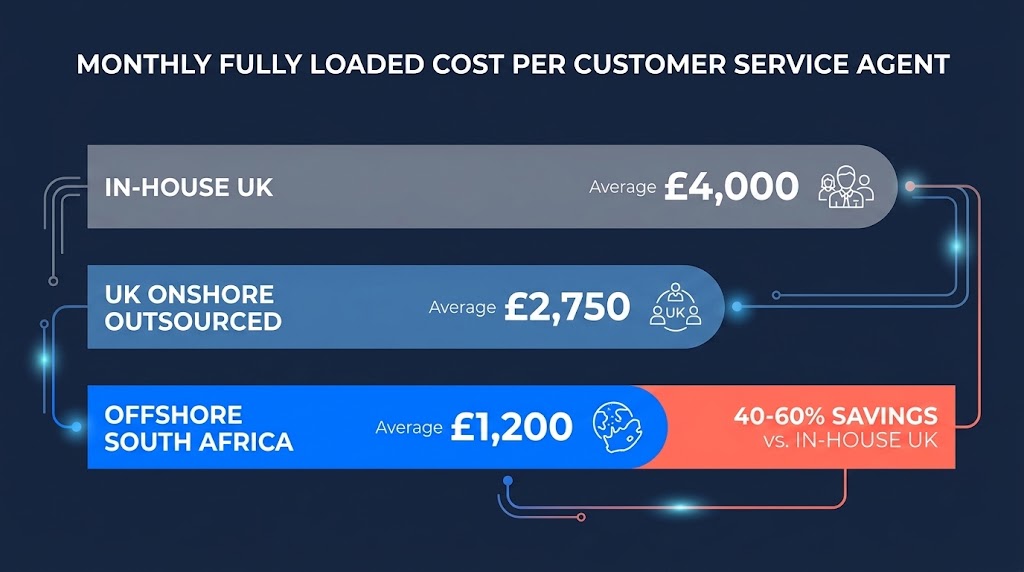
Table: Monthly cost per customer service agent by model (UK buyer)
| Model | Cost per agent per month | Typical saving vs in-house | Best fit |
| In-house UK (fully loaded) | £3,500 to £4,500 | Baseline | Core, high-control functions |
| UK onshore outsourced | £2,000 to £3,500 | ~30% to 50% | UK-accent-critical, regulated voice |
| Offshore (South Africa) | £800 to £1,600 | ~40% to 60% | Scalable English-language CX |
Sources: Odondo, Callin.io UK pricing, Kimon Services. Onshore UK agents commonly bill £20 to £30 per hour; offshore fully managed runs roughly £800 to £1,600 per month.
Pricing itself comes in four common shapes: per minute (around £0.75 to £1.50 for UK onshore), per call (£3 to £7 inbound), per agent or seat (£2,000 to £3,500 for UK dedicated agents), and outcome-based, tied to conversions or CSAT. Match the model to your volume profile: per-interaction for variable demand, per-agent for stable teams. For a fuller treatment of interaction-level economics, see our outsourced customer support cost breakdown and the total-cost logic in the true cost of offshore customer service.
Why UK and US Companies Choose South Africa
South Africa pairs top-tier English, near-UK time-zone alignment, and genuine cultural affinity with a mature, scalable sector and labour costs well below UK and US levels. Those advantages are exactly what turns the cost table above from a spreadsheet exercise into a workable operating model.
On language, South Africa ranks 13th globally on the 2025 EF English Proficiency Index with a score around 602, first in Africa and firmly in the very-high band. On time zone, it runs on UTC+2 year-round with no daylight saving, giving a 1 to 2 hour offset from the UK for near-full workday overlap, far tighter than India at UTC+5:30 or the Philippines at UTC+8. Culturally, South African agents consume UK and global media and share communication norms that make voice interactions feel natural to UK customers.
The sector is also large and mature. BPESA reports the South African BPO sector employs over 270,000 people across six cities, with around 65,000 serving international clients, and Investec notes roughly 112,441 GBS jobs created between 2015 and 2023. The UK is the single largest demand market, taking about 62% of South Africa’s international outsourcing work. On cost, BPESA’s national value proposition puts BPO wages 55% to 65% below equivalent US and UK roles on a fully loaded basis, which typically converts to 40% to 60% total savings for buyers. Our overview of BPO companies in South Africa, the wider BPO statistics, the South Africa versus Philippines comparison, and our dedicated guide for UK businesses outsourcing to South Africa set out the detail.
Common Failure Modes and How to Avoid Them
Most outsourcing disappointments trace back to a handful of predictable mistakes: hidden costs, quality drift, high attrition, and misaligned KPIs. Knowing the evaluation checklist is only half the job; the other half is designing the engagement so these failures cannot take hold.
The most common trap is hidden costs, where buyers fixate on the headline rate and overlook setup, training, technology, and out-of-scope charges. Insist on a full cost breakdown and clear inclusions in the statement of work. Quality drift is next: strong early performance decays as agents turn over and training falls behind, so define quality KPIs, run joint calibration, and keep knowledge bases current. High attrition erodes team experience, so ask for attrition metrics by site and campaign and favour providers with real career progression. Misaligned KPIs, such as rewarding average handle time at the expense of satisfaction, quietly damage CX, so co-design SLAs that balance efficiency with CSAT, NPS, and first-contact resolution. Finally, treat outsourcing as a governed partnership, not set-and-forget: weekly operational reviews, monthly performance reviews, and quarterly business reviews keep the relationship honest. Handled this way, a provider in a mature destination like South Africa delivers high-quality, cost-effective service rather than a race to the bottom.
Frequently Asked Questions
What do customer service outsourcing companies do? Customer service outsourcing companies run all or part of your customer support under agreed service levels. Typical scope includes inbound support across phone, email, live chat, and social, outbound contact such as surveys and retention, front-line technical support, and non-voice back-office tasks. Most run a tiered model and provide the technology, quality assurance, and reporting alongside the agents.
How much does customer service outsourcing cost in the UK? A fully loaded in-house UK agent costs roughly £3,500 to £4,500 per month. A UK onshore outsourced agent typically runs £2,000 to £3,500, and an offshore agent in a destination such as South Africa runs about £800 to £1,600. Pricing models include per minute (around £0.75 to £1.50), per call (£3 to £7), per agent, and outcome-based.
How much can you save by outsourcing customer service? Outsourcing to a UK onshore provider typically saves around 30% to 50% versus in-house, and a high-quality offshore partner can deliver 40% to 60% total savings once labour arbitrage, bundled technology, and removed overhead are counted. Savings should be measured on total cost of ownership at comparable service levels, not on the headline hourly rate alone.
What is the difference between a managed service and staff augmentation? A managed service means the provider owns and operates the function end to end under SLAs and is accountable for outcomes. Staff augmentation or seat leasing means the provider supplies agents while you retain control of processes and day-to-day management. Managed services suit stable, ongoing operations; staff augmentation suits overflow, seasonal peaks, and pilots.
What certifications should a customer service outsourcing provider have? Look for ISO 27001 for information security as a baseline, SOC 2 reports for US-facing work, and PCI-DSS if the provider handles card payments. For UK and EU data, require GDPR and UK-GDPR compliance, including a data-processing agreement, defined data residency, and clear handling of data-subject rights.
Is South Africa a good location for customer service outsourcing? Yes, for English-language CX. South Africa ranks 13th globally for English proficiency on the 2025 EF index, sits 1 to 2 hours ahead of the UK for strong workday overlap, and offers labour costs 55% to 65% below UK and US roles. Its BPO sector employs over 270,000 people, with the UK its largest client market.
Which customer service channels can be outsourced? Providers cover inbound and outbound voice, email and case management, live chat and messaging, and social media customer care, with more mature partners adding in-app chat, video support, and co-browsing. Inbound voice still accounts for about 55% of UK contact volume, but non-voice channels are the fastest-growing part of a modern outsourcing brief.
How do you avoid a customer service outsourcing engagement failing? Prevent the four common failures: demand a full cost breakdown to avoid hidden charges, define quality KPIs with joint calibration to stop quality drift, review attrition metrics to protect team stability, and co-design SLAs that balance efficiency with CSAT and first-contact resolution. Run a proper governance cadence rather than treating the contract as set-and-forget.
Afrishore BPO delivers dedicated, English-language customer service teams from South Africa, supporting UK and US brands across voice, email, live chat, and social under formal SLAs. For the buyer’s shortlist see our guide to customer service BPO companies, for voice-led operations see call centre outsourcing in South Africa, and our business process outsourcing hub shows how customer service sits alongside the wider offering.
Speak to Afrishore about a dedicated customer service outsourcing team for your business.