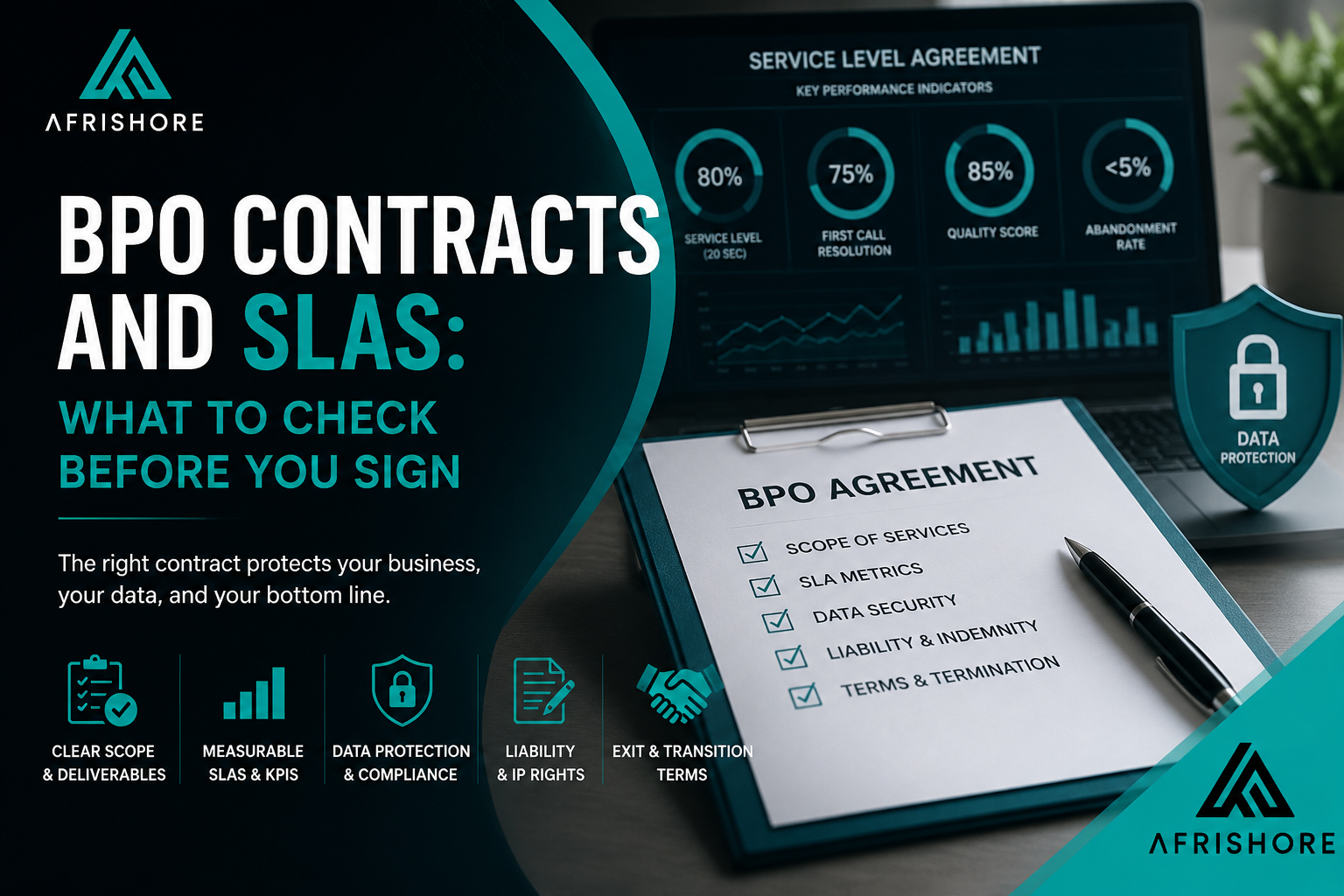
Quick Answer: A well-structured BPO contract combines a master services agreement, a detailed statement of work, and an SLA schedule covering scope, pricing, data protection, liability, and exit terms. The stakes of getting this wrong are real: a vendor due-diligence study of 89 real outsourcing disputes found scope creep and poorly structured SOWs behind 29% of cases, with median losses of $980,000, while missing data-protection clauses drove disputes averaging over $2 million in losses.
Key Takeaways
- Scope creep and poorly structured statements of work cause 29% of BPO contract disputes, with median losses around $980,000, per a 2026 vendor due-diligence study of 89 real cases.
- Missing IP ownership clauses appear in roughly a quarter to a third of disputes, sometimes forcing buyers to pay millions to secure rights to their own data and tooling after the fact.
- Standard SLA targets in 2024-2026 guidance: 80% of calls answered within 20 seconds, first-call resolution above 75%, quality scores above 85%, and abandonment rates below 3-5%.
- Service credit penalties typically run 5-25% of monthly fees, with total at-risk amounts capped around 8-12% of monthly fees on larger contracts.
- Auto-renewal clauses with short notice windows contributed to 18% of disputes in one dataset, often locking buyers into unwanted multi-year extensions.
- Exit clauses without defined transition assistance are functionally worthless. Buyer-side guidance recommends negotiating a 90+ day transition period and data export terms before signing, not at termination.
- For South African BPO providers serving US/UK clients, contracts need a three-layer data protection approach: POPIA-compliant processing in South Africa, GDPR/UK GDPR-compliant DPAs with Standard Contractual Clauses for EU/UK personal data, and consistent internal controls across both regimes.
What Should Be in a BPO Contract Before You Sign?
A comprehensive BPO agreement is built around a master services agreement plus annexes for the statement of work and the SLA schedule, not a single loosely-worded document.
Recent contracting guides describe a consistent structure: scope of services and statement of work (processes, channels, hours, locations, and volumes), term and renewal mechanics, pricing and payment terms, an SLA schedule with KPIs and remedies, data protection and confidentiality provisions, intellectual property and work product ownership, liability caps and required insurance, change management procedures, and transition/exit terms. Unity Connect’s 2025 BPO contracting guide treats scope, KPIs, data security, indemnification, governing law, insurance, and audit rights as now-standard clauses in any comprehensive BPO agreement.
The commercial model shapes which terms matter most. A dedicated FTE or per-seat arrangement needs detailed staffing and schedule clauses with minimum seat commitments; a managed-service model needs strict acceptance criteria and change-order control to prevent scope creep; an outcome-based or gainshare arrangement needs precise measurement methodology and causation clauses, since disputes often center on whether the vendor actually caused the result being paid for.
What SLA Metrics Should You Actually Negotiate?
Voice work and back-office work need different SLA metrics entirely, and the 2024-2026 benchmark ranges give you a real number to negotiate against, not a vague promise of “good service.”
For voice and contact-centre work, the standard metric set covers service level (the share of calls answered within a threshold), average handle time, first-call resolution, abandonment rate, quality/QA scores, and CSAT or NPS. For back-office and transactional work, the equivalent set is turnaround time, accuracy or defect rate, throughput, and ticket response/resolution times by priority tier.
Table: Typical BPO SLA benchmarks, 2024-2026
| Metric | Typical target | Context |
| Service level (voice) | 80% of calls answered within 20 seconds (“80/20”) | Standard for inbound call centers; some European markets use 90% within 30 seconds |
| Average handle time | 4-6 minutes (transactional); 6-8 minutes industry average | Must be balanced against FCR to avoid rushed calls |
| First call resolution | 70-80%, often set at 75%+ | Below 70% is treated as a symptom of deeper process issues |
| Abandonment rate | Below 3-5% | Financial services trends toward 2-4%; retail toward 4-6% |
| Quality/QA score | 85%+ monthly average | Measured against internal or client QA rubric |
| CSAT | Above 85% | Often on a 5-point scale, targeting 4.0+ |
| Back-office turnaround time | Varies by priority tier | Set per task type: claims, tickets, data entry |
| Uptime (hosted platforms) | 99.5%+, often 99.9% for critical systems | Applies to IT-enabled BPO more than pure labor engagements |
Source: GigaBPO’s 2026 BPO KPI guide and related 2024-2026 industry benchmark reports.
What Happens When a BPO Provider Misses Its SLA?
The standard remedy is a service credit, a percentage of monthly fees returned to the buyer, but the size and structure of that credit varies enormously and is entirely negotiable.
The CIO.com guide to SLA best practices notes that providers and buyers typically put a percentage of monthly fees, often roughly equal to the vendor’s profit margin, “at risk” for credits. Tiered structures are common: misses under 5% might trigger a 2% credit, misses of 10-20% a 10% credit, and misses above 20% a 15% credit, with monthly caps often set at 20-25% of fees. Procurement glossaries describe typical service credit ranges of 5-25% of monthly fees, and larger contracts often cap total at-risk amounts at 8-12% of monthly fees. Some templates now include earn-back mechanisms, letting a vendor recover a portion of credits by exceeding targets in a following month.
The gap buyers most often miss is proportionality. One 2026 BPO disputes analysis describes a case where a 5% monthly service credit, $10,000 on $200,000 in fees, was the only contractual remedy for a failure that caused $5 million in actual business harm. Service credits work as an incentive mechanism, not as compensation for real losses, which is why liability caps and carve-outs matter as much as the credit schedule itself.
What Causes Most BPO Contract Disputes?
Four issues account for the overwhelming majority of BPO contract disputes: scope creep, vague acceptance criteria, IP ownership ambiguity, and data-protection failures.
A 2026 vendor due-diligence study reviewing 89 real outsourcing disputes found scope creep tied to missing fixed-price clauses and poorly structured SOWs behind 29% of cases, with median losses around $980,000, an order of magnitude higher than the cost of preventing it upfront. Vague acceptance criteria and “reasonable efforts” language, without a clear definition of what “done” means, contributed to 21% of disputes. Missing IP ownership clauses showed up in roughly a quarter to a third of disputes, sometimes leaving vendors holding rights to code, data, or tooling that clients assumed they owned. Data-protection failures, most often a missing SOC 2 validation, accounted for around 18% of disputes, with median losses exceeding $2 million where a breach occurred.
The same study documents two illustrative failures: an $18 million mainframe-to-cloud migration where the vendor filed for bankruptcy at 62% completion, causing $4.8 million in sunk costs, traced back to the buyer skipping a financial-health check on the vendor; and a $22 million CRM project with an undefined “joint ownership” IP clause that led to litigation and an eventual $4.2 million payment just to secure full IP rights, pushing total project cost to $29 million. Neither failure was caused by the outsourcing model itself. Both were caused by contract language that was vague exactly where it needed to be precise.
How Do Vendors Lock You In, and How Do You Avoid It?
Vendor lock-in is rarely accidental. It is usually built into the contract through vague data-export language, narrow renewal-notice windows, and exit clauses with no real teeth.
Recent vendor lock-in analyses identify a consistent set of mechanisms: contracts that promise data export in “commercially reasonable” ways without specifying format or completeness, multi-year terms with auto-renewal unless the buyer gives 30-60 days’ notice (often buried in boilerplate), and exit-assistance clauses that use vague “reasonable efforts” language with no deliverables, timeline, or fee cap attached. In one disputes dataset, auto-renewal without adequate notice periods contributed to 18% of cases, typically resulting in unwanted multi-year extensions the buyer had no realistic way to avoid.
The fix is negotiated before signing, not discovered afterward. Guidance on avoiding vendor lock-in recommends portability terms as standard contract language: format-agnostic data exports (CSV, JSON, XML, or API access), defined transition assistance periods of 90 or more days, and caps on exit fees agreed at signing. A separate exit-strategy analysis puts it bluntly: a termination right without a duty to assist transition is a “paper right” that can still leave a buyer commercially trapped, which is why transition assistance clauses, not just termination clauses, are the real safeguard.
What Data Security Terms Should Be Non-Negotiable?
SOC 2 or ISO 27001 evidence, defined breach-notification timelines, and audit rights are now standard expectations, not premium add-ons, in any offshore BPO contract.
Standard data-protection clauses now include: specific technical controls (encryption in transit and at rest, MFA, logging, regular penetration testing), a requirement for up-to-date SOC 2 Type II or ISO 27001 evidence within a defined window of signing and annually thereafter, defined breach-notification timelines (often 24-72 hours), and audit rights allowing the buyer to inspect or request compliance evidence with reasonable notice.
For a South African BPO provider serving US/UK clients specifically, cross-border data transfer requires attention to both regimes at once. South Africa’s POPIA restricts transfers of personal information outside the country unless the recipient is bound by protections substantially similar to POPIA’s own principles, the data subject has given informed consent, or the transfer is necessary to perform the contract. GDPR and UK GDPR separately require Standard Contractual Clauses, Binding Corporate Rules, or another recognized safeguard for transfers involving EU/UK personal data. In practice, this means a well-drafted contract needs three layers: POPIA-compliant processing terms for work performed in South Africa, GDPR/UK GDPR-compliant data processing agreements with SCCs or the UK’s International Data Transfer Agreement for any EU/UK data, and internal controls consistent enough to satisfy both regimes without contradiction.
What Should Your Exit Clause Actually Guarantee?
An exit clause that only grants the right to terminate, without a defined transition period, is close to worthless in practice.
Cross-industry guidance converges on the same core elements for a real exit clause: distinct termination rights for convenience, for cause, and for provider insolvency; a defined transition assistance period, typically 3-6 months for complex engagements; named deliverables including data handover, documentation, architecture and process runbooks, and scheduled knowledge-transfer sessions with key personnel; data export in common, non-proprietary formats within a fixed timeline (often 5-30 business days) at no extra charge; and written certification of data deletion after transition, typically within 30-60 days.
Fee structure matters as much as the obligations themselves. Guidance on IT outsourcing exit strategy recommends pre-agreed rates for transition assistance, capped termination fees tied to how far into the contract term you are, and “no hostage” language that prevents a vendor from conditioning data return or transition support on payment of a disputed invoice. On term length, one 2026 procurement analysis found 51% of contracts in its dataset running 36-month terms, with average managed-services contract duration growing from 2.5 years in 2023 to 2.9 years in 2024. Longer terms can improve pricing, but only if they are paired with a genuine, priced exit path negotiated at signing, when the buyer still has leverage, rather than at renewal, when the vendor does.
Frequently Asked Questions
What is the most common cause of BPO contract disputes? Scope creep tied to poorly structured statements of work is the single largest cause, accounting for 29% of disputes in a 2026 study of 89 real cases, with median losses around $980,000. Vague acceptance criteria and undefined IP ownership are the next most common causes.
What SLA metrics should a BPO contract include? Voice and contact-centre work should be measured on service level, average handle time, first-call resolution, abandonment rate, quality/QA score, and CSAT. Back-office and transactional work should be measured on turnaround time, accuracy/defect rate, throughput, and priority-tiered response times.
How much should a service credit be if a BPO provider misses its SLA? Typical service credits run 5-25% of monthly fees for a given failure, with total at-risk amounts often capped at 8-12% of monthly fees on larger contracts. Tiered structures that scale the credit to the severity of the miss are standard practice.
Can a service credit actually compensate for real business losses from an SLA failure? Not usually. Service credits function as a performance incentive, not a compensation mechanism. Contracts should include liability terms proportionate to potential harm, with carve-outs for data breaches and IP infringement, rather than relying on service credits alone.
What is vendor lock-in and how does it happen in BPO contracts? Vendor lock-in happens through vague data-export language, multi-year auto-renewal clauses with short notice windows, and exit-assistance provisions with no defined deliverables or timeline. It is prevented by negotiating format-agnostic data portability, a 90+ day transition assistance period, and capped exit fees before signing.
What data protection terms should a BPO contract require? Current expectations include SOC 2 Type II or ISO 27001 evidence provided within a defined window and annually thereafter, breach notification within 24-72 hours, and buyer audit rights. For South African providers serving US/UK clients, contracts also need POPIA-compliant processing terms alongside GDPR/UK GDPR data processing agreements.
How long should a BPO contract’s exit transition period be? Guidance converges on 3-6 months for complex engagements, with named deliverables, data export in non-proprietary formats within a fixed number of business days, and written certification of data deletion after transition.
What is a typical BPO contract term length? Most BPO contracts run one to three years. One 2026 procurement analysis found 51% of contracts using 36-month terms, with average contract duration growing from 2.5 years in 2023 to 2.9 years in 2024, though longer terms should always be paired with a clearly priced exit path.
Understanding what belongs in a BPO contract is the first step. The next is verifying that a prospective provider will actually honor those terms. Read our guides on Offshore BPO Bait-and-Switch: How to Avoid the A-Team to C-Team Problem before signing, and spotting offshore BPO bait-and-switch tactics during the sales process. Once a contract is in place, measuring BPO ROI tells you whether the terms you negotiated are actually delivering value. For context on what fair SLA-backed pricing looks like, see our breakdowns of call center outsourcing cost and outsourced customer support cost in 2026. Afrishore BPO operates from ISO 27001 and ISO 9001-certified facilities in South Africa, serving US and UK clients under contracts built around exactly these safeguards.
Speak to Afrishore about structuring a BPO contract that protects your business.