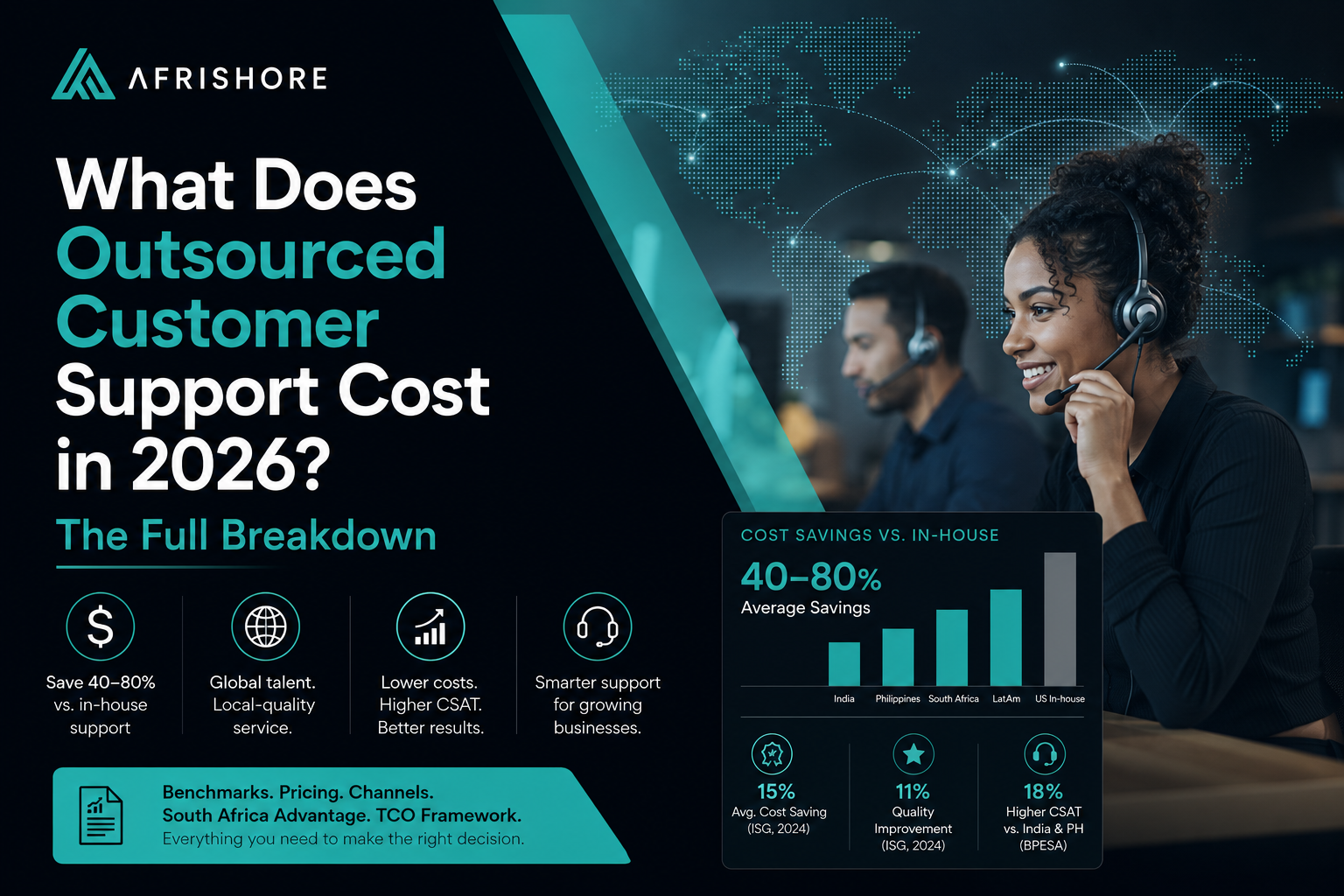
In 2026, a fully loaded US customer support representative costs between $53,000 and $80,000 per year before management overhead, technology, or facilities. The equivalent outsourced seat in South Africa or Latin America runs $16,000–$40,000 annually. In the Philippines or India, it runs $12,000–$25,000. That cost differential — 40–80% depending on destination — is why the global BPO market has reached $328 billion in 2025 and is projected to approach $696 billion by 2033.
But hourly rates only tell part of the story. The real question for US and UK operations leaders is what the total cost of ownership looks like once you include the cost structure of in-house support (hidden in headcount budgets), the channel-level economics (voice costs 3–4× what chat costs per resolved ticket), and the quality risk premium that comes with getting outsourcing wrong.
This article gives you the full breakdown: in-house benchmarks, outsourced pricing models, channel-by-channel economics, the South Africa positioning versus Philippines and India, and a TCO framework you can use.
Key Takeaways
- A US customer support rep costs $38,020 median base salary (BLS OEWS May 2024), rising to $53k–$80k fully loaded once benefits, tools, management, and overhead are added.
- Outsourced support rates (2026): India/Philippines $8–$15/hr, South Africa/LatAm $11–$20/hr, US onshore $28–$65/hr. Monthly per-FTE: SA $2,000–$3,500, Philippines $1,500–$3,000, US $5,500–$12,000.
- A 20-agent US in-house program costs $2.4M–$3.6M/year. Outsourcing to South Africa, Colombia, or Mexico reduces that to $500k–$1.04M — 65–80% savings.
- ISG (2024) found enterprise BPO programs deliver an average 15% cost saving alongside 11% quality improvement. Deloitte estimates up to 50% savings once all overheads are included.
- Channel costs: voice $8–$17+ per contact; email $5–$15; live chat $3–$9; social/async $1–$4; self-service $0.10–$2.00.
- South Africa delivers 55–65% cost savings versus UK/US and 18% higher CSAT scores versus India and the Philippines, per BPESA and independent comparisons.
- Gartner (2026): gen-AI per-resolution costs could reach $3+ by 2030 — higher than offshore human agents. AI supplements, not replaces, the offshore model.
What In-House Customer Support Actually Costs (US)
The starting point for any outsourcing evaluation is a clear-eyed picture of current in-house cost. Most businesses underestimate this significantly because the costs are distributed across multiple budget lines.
Base salary: The US Bureau of Labor Statistics OEWS data for May 2024 puts the median annual wage for Customer Service Representatives (SOC 43-4051) at $38,020 ($18.28/hr). By 2026, with mid-single-digit wage growth, this tracks toward $42,830 (~$20.59/hr).
Fully loaded cost (BLS ECEC multiplier): The BLS Employer Costs for Employee Compensation data for March 2026 shows private-industry total compensation at $46.60/hr ($32.60 wages + $14.01 benefits), meaning benefits equal approximately 43% of base wages and total employer cost is approximately 1.43× base salary.
- At 2024 median wage: ~$53,000–$55,000 per year fully loaded (wages + standard benefits).
- At 2026 wage: ~$60,000–$62,000 per year.
These figures exclude management overhead, technology, facilities, and recruiting — the costs most budget models bury.
The hidden cost layer: Industry analyses of actual in-house support operations consistently find the fully loaded cost is materially higher than HR models suggest:
- A 2026 breakdown puts a single US support agent at $60,000–$80,000 per year once benefits, training time, taxes, and tools are combined. A lean 4-agent team runs approximately $147,000 per year total.
- A 2025 SaaS-oriented analysis estimates the average US business pays approximately $77,000 per year per in-house support rep, combining salary, tools, and overhead.
- Technology stack alone runs $80–$120 per agent per month (helpdesk/CRM, telephony/CCaaS, QA, analytics) plus $100–$250 per seat for facilities or remote stipends.
- Recruiting and ramp adds approximately $7,000 per seat annually in high-churn US teams, covering sourcing, background checks, HR processing, and reduced productivity during the 80–120-hour training period.
- Management and QA overhead adds 10–20% on top of direct agent costs.
Support cost as % of revenue: Across mature businesses, support cost typically sits in the mid-single to low-double digits as a percentage of revenue. SaaS and subscription businesses run 3–8% for efficient operators and 8–15% for complex offerings. Financial services and fintech: 3–10%+. E-commerce: 1–4%. Telecom/utilities: 5–10%+.
Outsourced Customer Support Pricing Models in 2026
Outsourced support is priced in three primary ways: per-FTE, per-interaction, and per-minute (voice). Understanding all three is important because providers structure their contracts differently.
Per-FTE / Seat Pricing (Monthly Rates)
| Location | Hourly rate | Monthly per-FTE |
| India | $8–$15/hr | ~$1,300–$2,500/month |
| Philippines | $8–$15/hr | ~$1,500–$3,000/month |
| South Africa | $11–$20/hr | ~$2,000–$3,500/month |
| Latin America (Colombia, Mexico) | $12–$22/hr | ~$1,800–$3,500/month |
| US onshore | $28–$65/hr | ~$5,500–$12,000/month |
| UK/Western Europe | £16–£36/hr | ~£3,000–£6,000/month |
Sources: HiveDesk 2026 BPO Pricing Guide, CloudTalk 2025, Insignia Resource 2026.
One 2026 benchmark puts average US-based outsourced support at $29.40–$42 per agent hour, while Asia-based providers charge $7–$16 per hour, and Latin American providers fall between $12 and $19.
Per-Interaction / Per-Ticket Pricing
Per-interaction pricing is more common in shared-agent models and outcome-focused contracts:
- Phone tickets: $8–$12 per resolved ticket
- Email tickets: $5–$8 per resolved ticket
- Live chat tickets: $3–$5 per resolved ticket
- Self-service: $0.10–$0.50 per resolution
A 2026 outsourcing cost guide puts the blended range at $3–$12 per resolved ticket depending on channel and complexity.
Per-Minute Pricing (Voice)
Inbound voice support:
- Offshore centers: ~$0.35–$0.55 per minute (Contact Babel / CloudTalk 2025)
- US/Canada/Europe: ~$0.75–$1.35 per minute
For a typical 5–7-minute support call: $2–$8 per interaction offshore, $4–$12 per interaction onshore.
Managed Service / Outcome-Based Pricing
Performance-based contracts are growing. Structures typically include:
- Per-call/per-resolution models with KPI-linked bonuses
- Performance premiums of 10–20% tied to FCR or CSAT thresholds
- Program-level retainers: $1,500–$8,000/month for SME programs; $10,000–$25,000/month for enterprise
- Gartner commentary identifies growing use of managed outcome models in mature CXM deals, though time-based billing still dominates
Everest Group Pricing Index H1 2024 noted BPO pricing remained “muted” over the prior 12 months, with flattish trends in major offshore/onshore locations and marginal increases in the UK due to minimum wage increases.
What Does Outsourcing Actually Save? The TCO Comparison
The headline hourly rate comparison understates the real savings. The Total Cost of Ownership (TCO) comparison is more instructive.
In-house per seat (North America) — full TCO:
- Direct labor (loaded): $55,000/year
- Technology and telecom: $3,200/year
- Compliance and QA: $2,500/year
- Recruiting and churn: $7,000/year
- Facilities and utilities: $5,000/year
- Total: ~$72,700 per seat per year
Nearshore outsourced per seat — full TCO:
- Direct labor (loaded via provider): $26,000/year
- Technology, compliance, recruiting, facilities: bundled into per-seat rate
- Total: ~$28,000 per seat per year
Result: ~61% reduction per FTE. For a 20-agent program:
- US in-house: $2.4M–$3.6M per year
- South Africa/Colombia/Mexico: $500k–$1.04M per year
- Saving: 65–80% of program cost
Published third-party data on savings:
- ISG (2024): enterprise BPO programs deliver an average 15% cost saving alongside an 11% quality improvement
- Deloitte: outsourcing customer service often results in up to 50% cost savings once all overheads are included
- One 2026 comparison: US in-house at ~$77,000/year per rep versus $10,000–$17,000/year per outsourced rep — 60–80% labor cost reduction
- Ryan Strategic Advisory 2024: India is the most-favored offshore CX location; Philippines and South Africa tied for second
Channel-by-Channel Cost Economics
Channel choice has a bigger impact on per-contact cost than geography. Moving volume from phone to chat or self-service reduces cost per interaction dramatically — and combining channel shift with offshore delivery compounds the saving.
Cost per contact by channel (blended in-house and outsourced, 2026):
| Channel | Cost per contact |
| Voice/phone | $8–$17+ per contact (most expensive assisted channel) |
| $5–$15 per contact; $24–$60 per full resolution (due to multiple exchanges) | |
| Live chat | $3–$9 per contact (20–40% cheaper than phone) |
| Social/async messaging | $1–$4 per contact |
| Self-service/AI chatbot | $0.10–$2.00 per resolution (7–20× cheaper than human-handled phone) |
Multi-channel pricing models: Offshore providers typically price blended multi-channel seats at the same rate as single-channel seats but with different productivity assumptions — more contacts per hour on chat/email than on phone. Voice-heavy or complex technical queues carry higher rates. Regulated-industry queues (banking, healthcare) typically carry 15–30% premiums.
Gartner’s 2026 warning on AI: Gartner’s 2026 commentary suggests gen-AI per-resolution costs could reach $3+ by 2030 — higher than many offshore human agents once infrastructure and talent costs are included. The practical implication: AI-assisted offshore support, not full AI replacement, is the near-term optimum.
South Africa vs Philippines vs India: Cost and Quality Compared
For US and UK buyers, the three primary offshore options are South Africa, the Philippines, and India. The cost differences are real but smaller than the headline rate gap suggests when quality is factored in.
Cost:
- South Africa: $12–$20/hr; monthly FTE $2,000–$3,500; 55–65% savings vs UK/US
- Philippines: $10–$18/hr; monthly FTE $1,200–$1,800; slightly cheaper than SA
- India: $8–$15/hr; monthly FTE $1,300–$2,500; typically the lowest headline rate
South Africa is 10–15% more expensive per agent-month than the Philippines and 15–25% more expensive than India at equivalent skill levels.
Quality: BPESA and independent comparison data report South African CX and operations outcomes approximately 18% higher than India and the Philippines on CSAT and complex interaction quality. Ryan Strategic Advisory’s 2024 Front Office CX Omnibus Survey ranks India first for offshore CX overall but the Philippines and South Africa tied for second. For UK-specific programs, South Africa’s accent neutrality, UK business culture familiarity, and GMT+2 timezone (1–2 hours ahead of UK, no night shifts) give it structural advantages that narrow the cost gap to near-zero on TCO.
For a direct comparison including attrition data and sector fit, see the best outsourcing destinations for UK companies guide or the South Africa vs Philippines cost comparison.
The Hidden Costs That Drive Up Effective Outsourcing Cost
Understanding what drives up effective outsourcing cost is as important as knowing the base rates.
Ramp and knowledge transfer: Moving to a new provider requires documentation, training, and co-managed transition periods. Mis-managed ramp can temporarily increase handle times and contact volumes — costing more than the rate savings in the first 60–90 days.
Attrition: Many offshore markets experience higher baseline attrition than the rates suggest. South Africa typically runs 20–30% annual attrition; India (ITeS/BPO broad) 11–18%; Philippines 25–35%+, rising to 35–50% at some sites. Replacing outsourced agents still incurs training and lost productivity costs, even if direct recruiting costs are lower. Lower-attrition destinations — including leading South African and LatAm providers — reduce this compounding cost.
Process complexity and failure demand: If upstream product, billing, or UX issues are not fixed, outsourced teams face high contact rates and repeat contacts, inflating both per-contact cost and quality risk.
Data and compliance overhead: Regulated industries — fintech, healthcare, insurance — incur additional costs for data residency, audit frameworks, and compliance reviews with offshore partners. For UK-regulated programs, IDTA/UK GDPR compliance adds vendor onboarding time. For US health-adjacent support, HIPAA BAAs require legal review. Factor these into program economics from the outset.
A TCO Formula for US and UK Buyers
Three calculations give you the information you need:
1. Cost per contact: Total Support Center Costs ÷ Total Number of Contacts = Cost per Contact
Calculate this for each model (in-house vs outsourced) and each major channel. Compare at the same contact volume baseline.
2. Support cost as % of revenue: (Total Support Costs ÷ Revenue) × 100
Compare in-house vs outsourced scenarios over the same revenue base. Best-in-class SaaS runs below 5% of ARR.
3. TCO per seat: Direct Labor + Benefits + Tools + Facilities + Recruiting/Churn + Management/QA = TCO per Seat
For outsourced seats, most terms are bundled into the per-FTE rate. For in-house, they are separate line items. The full in-house cost is almost always materially higher than the HR budget model suggests.
FAQs
What is the average cost of outsourced customer support in 2026? Outsourced customer support typically ranges from $8–$15/hr in India and the Philippines, $11–$20/hr in South Africa and Latin America, and $28–$65/hr for US onshore providers. Per-interaction, expect $3–$12 per resolved ticket depending on channel — $8–$12 for phone, $5–$8 for email, $3–$5 for live chat. Monthly fully managed FTE costs run $1,500–$3,000 offshore and $5,500–$12,000 onshore.
How much does it cost to outsource customer support to South Africa? South Africa-based outsourced customer support typically runs $12–$20/hr or $2,000–$3,500 per month for a fully managed FTE. This represents 55–65% savings versus UK or US in-house operations. Afrishore BPO’s call centre outsourcing service provides detailed pricing based on volume, channel mix, and service hours.
What is the total cost of in-house customer support in the US? A US customer support rep costs approximately $38,020–$42,830 in base salary (BLS OEWS 2024–2026). Fully loaded with benefits (1.43× ECEC multiplier), that rises to $54,000–$62,000. Adding technology ($3,200/year), management overhead (10–20%), recruiting and churn ($7,000/year), and facilities ($5,000/year), the realistic total per-seat cost is $72,000–$80,000 per year.
What are the pricing models for outsourced customer support? Three primary models: per-FTE (hourly or monthly seat rate, most common for dedicated programs); per-interaction (per resolved ticket, common in shared-agent models); per-minute (billing for inbound voice). Most enterprise programs use a hybrid: a dedicated FTE base rate plus per-interaction pricing for overflow or specific channels. Performance-based contracts add 10–20% premiums tied to FCR or CSAT thresholds.
Is South Africa more expensive than the Philippines for customer support? On a pure per-agent monthly basis, South Africa is approximately 10–15% more expensive than the Philippines ($2,000–$3,500/month SA vs $1,500–$3,000 Philippines). However, South Africa delivers approximately 18% higher CSAT outcomes, carries lower average attrition (~20–30% vs ~25–50%), and provides better timezone alignment for UK programs (GMT+2 vs GMT+8). On a total cost of ownership basis — factoring in attrition, quality outcomes, and UK management visit practicality — the differential narrows significantly.
What are the hidden costs of outsourcing customer support? The main drivers of effective cost above the headline rate: transition and ramp time (60–90 days before steady-state productivity); attrition and retraining (compounding cost if not managed); failure demand (repeat contacts driven by upstream product/billing issues); multi-vendor coordination overhead; and compliance costs for regulated industries. A well-run transition with documented SOPs, clear SLAs, and a phased go-live mitigates most of these.
How does AI affect outsourced customer support costs? AI-assisted support — chatbots for self-service, copilots for agents — reduces per-contact cost at the deflection layer ($0.10–$2.00 per AI-handled interaction versus $8–$17 for human phone). However, Gartner’s 2026 commentary notes that gen-AI per-resolution costs could exceed $3 by 2030 once infrastructure and talent are included — higher than offshore human agents. The practical near-term model is AI-assisted offshore support, not full automation.
The Numbers Point to Offshore, Not In-House
The total cost of ownership gap between in-house US/UK customer support and well-managed offshore programs is not marginal. It is 40–80% depending on destination, channel mix, and program design. The data from ISG, Deloitte, Ryan Strategic Advisory, and BLS all point in the same direction: for businesses spending $1M+ annually on customer support operations, offshore delivery is no longer a cost-cutting tactic — it is the standard operating model for competitive operations.
South Africa’s combination of 55–65% cost savings, 18% higher quality outcomes than India and the Philippines, GMT+2 timezone advantage for UK programs, and established UK client base makes it the natural choice for UK-centric programs and a strong alternative to pure Asia-Pacific delivery for US programs. Afrishore BPO’s business process outsourcing service covers the full range of customer support outsourcing — voice, email, live chat, social, and back-office — with ISO 27001 and PCI-DSS certification. For a program cost model based on your current support volumes and channel mix, speak to the Afrishore BPO team.