Quick Answer: Customer experience outsourcing hands a partner shared responsibility for results across the customer journey. Those results include fixing the issue, low effort, high satisfaction and keeping the customer. It is not just renting agents to answer contacts. It usually covers every channel, quality checks, analytics and AI working alongside people. The stakes are high: the Institute of Customer Service says poor service costs UK organisations £7.3 billion every month.
Key Takeaways
- CX outsourcing buys results, not seats. Classic customer service outsourcing is paid per agent or per contact. CX outsourcing is judged on resolution, effort, satisfaction and retention.
- Poor service is expensive: £7.3 billion a month for UK organisations, says the Institute of Customer Service (2025).
- Customer effort predicts loyalty better than satisfaction or NPS. That finding comes from a study of over 75,000 customers in Harvard Business Review. Contract on effort and first contact resolution. Treat handle time as a guardrail.
- AI works when it fixes the issue. Satisfaction tops 90% when AI fully resolves a problem, but NPS can drop by up to 70 points when it fails (COPC, 2026).
- Customers told they are talking to AI report satisfaction 34 points higher than those who are not told (COPC). Put disclosure in the contract.
- Most results-based CX deals are hybrids: a base fee plus bonuses or penalties tied to results.
How CX Outsourcing Differs From Customer Service Outsourcing
Customer service outsourcing is about capacity. A provider supplies trained agents, hits service levels and is paid per seat, per contact or per minute. CX outsourcing goes further. The partner shares responsibility for the whole journey: fixing issues, cutting effort, keeping customers and stopping problems from coming back.
In practice, a CX partner takes on much more than the queue. It owns parts of the journey and runs voice, chat, email and messaging as one service. It handles quality checks, customer analytics and CX technology. It works to prevent complaints and keeps improving the service. The difference is clearest in what each model is paid for.
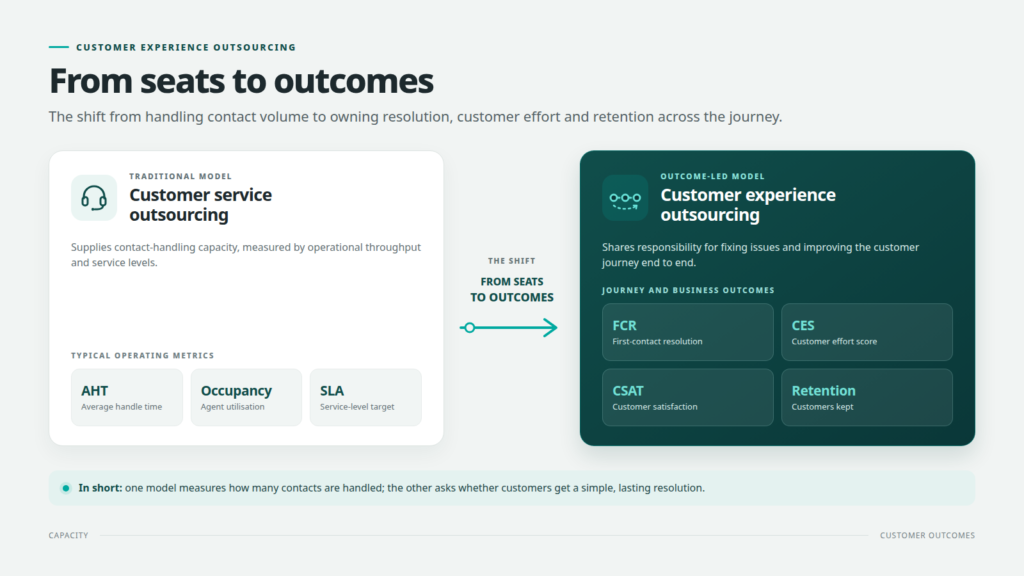
Table: Traditional customer service outsourcing vs CX outsourcing vs in-house CX
| Dimension | Traditional customer service outsourcing | CX outsourcing | In-house CX |
| Core scope | Contact handling, queues, scripted support | Journey ownership, omnichannel delivery, analytics, QA, retention and improvement | Full strategic control and internal capability |
| Pricing model | Per seat, per contact or per minute | Base fee plus outcome-linked fees; gain-share in mature deals | Fixed internal cost centre |
| Metrics owned | Handle time, occupancy, SLA, quality score | FCR, CES, CSAT, NPS, retention, cost per resolved contact | All CX and commercial metrics |
| Technology | Provider telephony and CRM | CX platform, analytics, VoC and AI orchestration integrated with yours | Company-owned stack |
| Main risk | Cost focus erodes experience | Metric gaming and attribution disputes if governance is weak | Higher fixed cost, slower scaling |
Still comparing providers on seat price? Our guide to choosing a customer service outsourcing company covers vendor checks. This guide is about building the deal around results.
The Business Case for Outsourcing Customer Experience
The case for CX outsourcing rests on the cost of getting service wrong. Repeat contacts, complaints, refunds and lost customers all cost money. The goal is a lower cost per fixed issue while keeping customers, not a lower cost per agent hour.
The scale of the problem is clear in the UK. The Institute of Customer Service’s UK Customer Satisfaction Index puts the cost of poor service at £7.3 billion a month. Much of that is staff time spent fixing service failures. There is no matching government figure for the US, but the mechanism is the same. Every unresolved contact creates another one.
The market is growing around this model. Grand View Research values the global CX outsourcing market at about $113 billion in 2025 and about $126 billion in 2026. It forecasts 13% yearly growth to 2033. Estimates vary with definitions, so treat any one figure as a guide. The lesson for buyers is to contract on cost per fixed contact, repeat contacts avoided and retention, not cost per seat. Our outsourced customer support cost guide breaks down the unit costs.
Which CX Metrics Should an Outsourcing Contract Use?
Contract on first contact resolution, customer effort, complaint handling and retention. Use average handle time only as a guardrail. Each metric measures something different. Only a balanced scorecard stops a provider from improving one number at the customer’s expense.
The research behind this is long-standing. A Corporate Executive Board study of more than 75,000 customers, published in Harvard Business Review, found that effort predicts loyalty better than satisfaction or Net Promoter Score. Customers mostly want a quick, simple fix, not over-the-top service.
| Metric | What it measures | How to use it in a contract |
| FCR (first contact resolution) | Issue resolved without a repeat contact | Primary outcome; strongest proxy for effort and repeat-contact cost |
| CES (customer effort score) | How hard it was to get the issue resolved | Primary experience measure for journey friction and escalation quality |
| CSAT | Satisfaction with a specific interaction | Team and agent quality; sensitive to survey design |
| NPS | Willingness to recommend | Relationship health; a broad indicator, not diagnostic |
| Retention and complaint rate | Customers kept and complaints resolved | Commercial outcome, often tied to bonuses |
| AHT (average handle time) | Time spent per contact | Guardrail only; pair with FCR to stop rushed closures |
The rule is simple. Pay for resolution, effort, complaint handling, retention and a verified cost per fixed contact. If handle time becomes the main target, a provider can hit it by closing contacts early. That creates repeat calls. Our guide to quality and training in outsourced support covers how scorecards are built.
Outcome-Based and Gain-Share Pricing
Results-based CX pricing ties part of the provider’s fee to proven results. Common examples are first contact resolution, effort, retention or fewer complaints. Gain-share goes a step further. Buyer and provider split a measured saving, such as a lower cost to serve.
These models are growing, but they are not yet the norm. Everest Group notes that most results-based BPO deals are still hybrids. They combine a base fee with bonuses and penalties tied to results, rather than paying only for results.
Both sides carry risk. Buyers face gamed metrics, arguments over who caused a result and premiums for results the provider cannot fully control. Providers face product faults, price changes and demand spikes that put targets out of reach, so they add a risk buffer. The fixes are well known:
- Set a baseline first: measure cost per contact, FCR, CSAT, CES, quality, staff turnover and complaints before handover.
- Write one metric dictionary: define each metric’s source, formula, exclusions and dispute process.
- Separate what the provider controls: keep product defects and billing errors out of results-based fees.
- Cap both sides: limit the upside and the downside so no one faces a runaway result.
- Keep guardrails: never trade compliance, quality or accessibility for savings.
Our guide to BPO contracts and SLAs covers the contract terms in more detail.
AI Plus Human: Where Each Belongs in CX
AI now fixes a real share of routine contacts. But it only improves the experience when it actually solves the problem, and hands over cleanly when it cannot. The right design routes for resolution. AI takes high-volume, simple work. People take empathy, judgement and recovery.
COPC’s 2026 research surveyed more than 1,000 consumers across the US, UK, Australia, China, Malaysia and Singapore. It found 74% were satisfied with their last AI interaction. Satisfaction rose above 90% when AI fully fixed the issue. But NPS could drop by as much as 70 points when it failed. Customers who knew they were talking to AI were 34 points more satisfied than those who did not. And the handover to a human was still the weakest link, with context often lost on the way.
People remain essential for complaints, vulnerable customers, money worries, emotional issues and problems spanning several accounts. As Afrishore founder Sean Effune put it on CNBC Africa, “clients are not coming to us for people, they’re coming to us for a solution.” The human qualities clients still pay for, he said, are empathy and reason. We explore this further in our articles on human and AI hybrid CX and AI in call centres versus humans.
In UK financial services, the FCA’s Consumer Duty requires firms to deliver good customer outcomes, including in customer support. So outsourced AI and human support must be judged on outcomes, not on how many contacts were deflected.
Voice of the Customer, Quality and Analytics
The best CX programmes run voice of the customer, quality checks and speech and text analytics as one loop. They capture every interaction and find the root causes of repeat contacts and complaints. They fix those causes, then check that resolution and effort actually improve.
The loop has four steps:
- Capture interaction and survey data across voice, chat, email, social and self-service.
- Analyse it to find what drives complaints, repeat contacts, churn risk and compliance breaches.
- Fix the root causes in knowledge, coaching, process and product.
- Check that FCR, CES, CSAT and retention move.
Academic work backs the value. A 2025 study in the Journal of Business Research sets out a way to capture and analyse agent voice performance automatically with speech recognition. Be wary of tool vendors’ claims about specific satisfaction or retention gains unless they are independently checked. The contract lesson is clear. Ask your partner for monthly root-cause insight, such as the top drivers of repeat contacts, complaint themes and failed handovers, not just quality scores. Afrishore’s IT Outsourcing division runs the AI and business intelligence layers behind this kind of reporting.
Why CX Outsourcing Relationships Fail
CX outsourcing fails for the same reasons most outsourcing fails: vague contracts, weak measurement and poor communication. The damage is bigger in CX, because results depend on product, billing and policy choices the provider does not control.
The habits that prevent failure are:
- One accountable executive for the CX result, with authority across customer operations, finance and IT.
- Shared data: linked ticketing, knowledge, quality and analytics so both sides see the same numbers.
- Regular reviews: weekly on operations, monthly on performance and cost, quarterly at executive level.
- AI controls: disclosure, handover with full context, human override and complaint monitoring.
- Improvement written into the contract: root-cause reports, named owners for fixes and verified gain-share.
Choosing a Location for Outsourced CX
For voice-led CX, especially complaints, retention and complex service, culture, clear English, empathy and time zone matter more than the hourly rate. So test a location with a pilot on your own customers. Do not pick one from marketing claims.
South Africa is a strong fit for UK-facing CX. It offers cultural familiarity, good English and near-full overlap with the UK working day. Its time zone also reaches into US mornings. The sector is growing fast, with BPESA reporting 26,346 net new international jobs in 2025. The items to check are backup power, each provider’s continuity plans and scale for very large programmes. Our guides to outsourcing customer support to South Africa, South Africa versus the Philippines and offshore call centre attrition cover the comparison in depth.
Frequently Asked Questions
What is customer experience outsourcing? Customer experience outsourcing hands a partner responsibility for outcomes across the customer journey, such as resolution, effort, satisfaction and retention. Unlike traditional customer service outsourcing, which is paid per seat or per contact, it typically covers omnichannel delivery, quality, analytics and AI, with part of the fee tied to results.
What is the difference between CX outsourcing and call centre outsourcing? Call centre or customer service outsourcing supplies agents to handle contacts and is measured on handle time, occupancy and service levels. CX outsourcing is measured on outcomes such as first contact resolution, customer effort, satisfaction and retention, and includes journey design, analytics and continuous improvement.
Which metrics should a CX outsourcing contract use? Use first contact resolution and customer effort as primary measures, with CSAT, complaint resolution and retention alongside them. Treat average handle time as a guardrail only. A study of more than 75,000 customers found effort predicts loyalty better than satisfaction or Net Promoter Score.
What is outcome-based pricing in CX outsourcing? Outcome-based pricing ties part of the provider’s fee to verified results such as first contact resolution, customer effort, retention or complaint reduction. Most deals are hybrids that combine a base fee with outcome-linked bonuses and penalties, rather than pure payment for results.
How much does poor customer experience cost? The Institute of Customer Service estimates poor service costs UK organisations £7.3 billion every month, largely through staff time spent fixing service failures. The hidden cost shows up as repeat contacts, complaints, refunds and lost customers.
Can AI replace human agents in customer experience? Not fully. COPC’s research found satisfaction above 90% when AI fully resolves an issue, but NPS can fall by up to 70 points when it fails. Humans remain essential for complaints, vulnerable customers, high-emotion issues and complex problems, so the best design combines AI for routine work with people for judgement and recovery.
Should customers be told when they are talking to AI? Yes. COPC found customers who knew they were interacting with AI reported satisfaction 34 percentage points higher than those who were not told. Disclosure, clean escalation with full context and a human override should all be written into a CX outsourcing contract.
Afrishore BPO delivers customer experience from South Africa for UK and US businesses, combining trained teams with the AI and analytics layers of our IT Outsourcing division. Explore our guide to customer support outsourcing in the UK, our explainer on contact centre as a service, or our business process outsourcing services.
Talk to Afrishore about an outcome-based customer experience partnership.