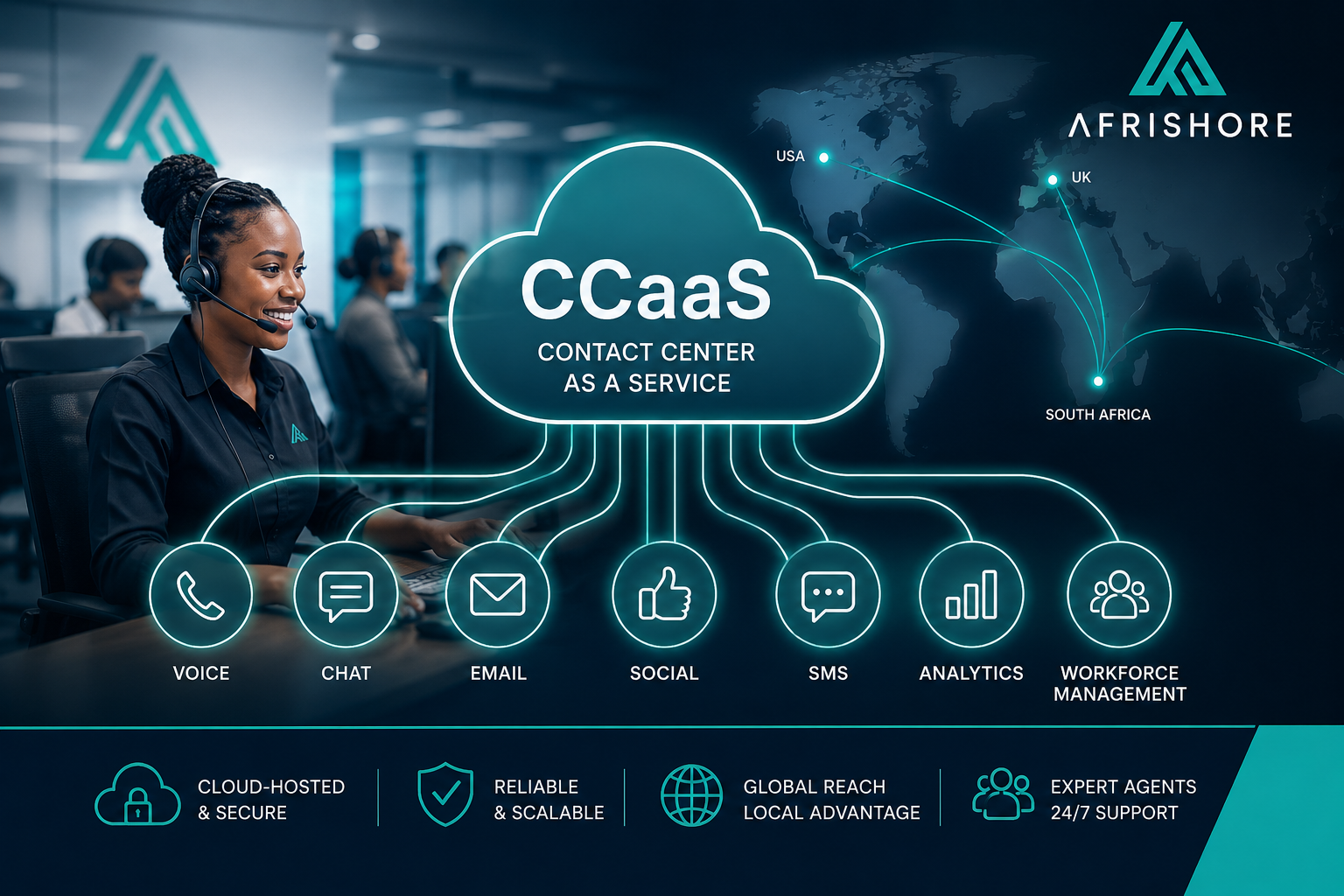
Quick Answer: CCaaS (Contact Center as a Service) is cloud-hosted, subscription-based contact-centre technology, covering routing, IVR, omnichannel queuing, workforce management, and analytics, delivered over the internet instead of run on owned PBX hardware. The bigger decision for most buyers is not which CCaaS platform to license but whether to operate it themselves or bring in a managed, outsourced CCaaS provider that supplies the platform and the staffed agents. Strategic Market Research put global CCaaS revenue at $7.8 billion in 2024, rising toward $23 billion by 2030.
Key Takeaways
- CCaaS is cloud-hosted contact-centre software, IVR, omnichannel routing, workforce management, and analytics, billed as a subscription instead of run on owned PBX infrastructure.
- Global CCaaS revenue sat at roughly $6 billion to $8 billion in 2024 across major research firms, growing at a mid-teens to near-20% annual rate into the early 2030s, per Strategic Market Research.
- Only 36% of contact centres run CCaaS as their primary platform today, per Metrigy’s 2024 MetriCast study, meaning most of the market has not yet migrated off legacy or hosted infrastructure.
- Licensing CCaaS software gets you a platform, not a staffed operation; a managed or outsourced CCaaS provider adds trained agents, 24/7 coverage, and ongoing optimisation on top of the technology.
- Outsourcing the operation, not just the software, typically saves 30% to 50% on labour and operating costs globally, and 55% to 70% when the delivery team is based in South Africa.
- Non-negotiable checks on any CCaaS or outsourced contact-centre partner: published uptime SLAs, ISO 27001 and SOC 2 certification, PCI-DSS where card data is handled, and genuine omnichannel and CRM integration.
- South Africa combines GMT+2 time-zone overlap with the UK and US, a fast-growing global business services sector, and an established base of local and global CCaaS platforms already serving international clients.
What CCaaS Actually Means
CCaaS strips out the PBX room and the capacity-planning headache. Understanding what the technology replaces makes it obvious why the buying decision has shifted from a capital project to an operating expense.
A CCaaS platform centralises voice, chat, email, SMS, and social interactions inside a single cloud subscription, with the vendor hosting and maintaining the infrastructure in its own cloud or a public cloud, according to IBM’s definition of contact centre as a service. Typical features span IVR, skills-based routing, omnichannel queuing, real-time and historical analytics, quality monitoring, and workforce management tools for forecasting and scheduling, as NICE’s glossary explains. This contrasts with traditional on-premise setups, where an organisation owns the PBX switches, voice gateways, and servers, and carries the upgrade and resiliency burden itself, per AWS’s overview of the CCaaS model. Major global CCaaS platform vendors include Genesys Cloud CX, NICE CXone, Five9, Talkdesk, Amazon Connect, and RingCentral, named without endorsement here as reference points for what “the software” looks like.
CCaaS Software vs Managed, Outsourced CCaaS
Buying the platform and running the operation are two different projects, and conflating them is the single most common misunderstanding in this category. Separating the two makes the rest of this guide easier to apply.
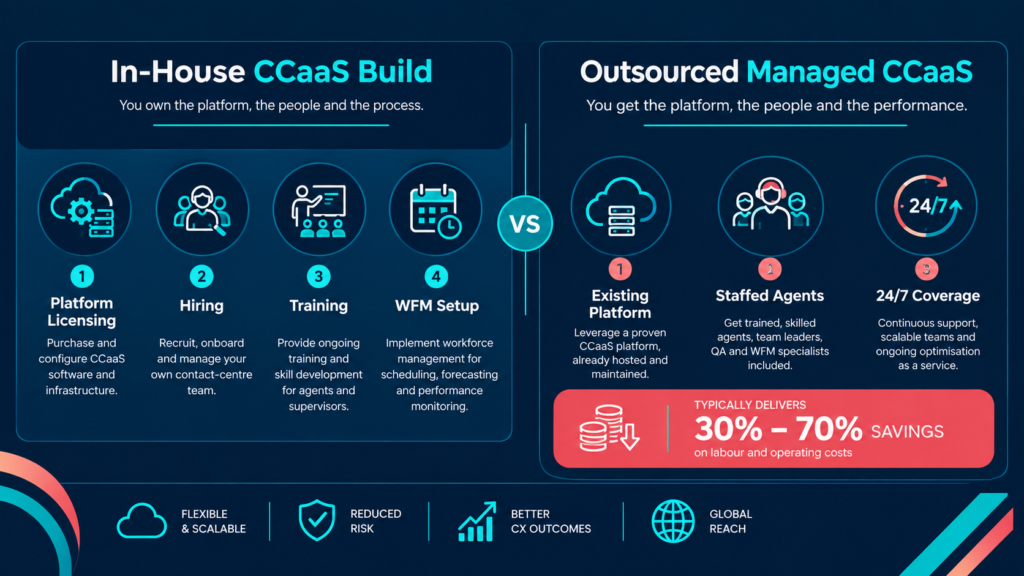
In most analyst definitions, “CCaaS” refers strictly to the software category: a multi-tenant, cloud-delivered platform that your own team configures and your own agents use, with the vendor responsible for hosting, uptime, and new features while you own implementation, staffing, and daily operations. Alongside that, a growing segment of providers deliver managed or outsourced CCaaS, essentially BPO and ITO firms that license or run a CCaaS platform, supply the agents, team leaders, QA analysts, and WFM specialists, and handle 24/7 coverage and optimisation as a service. Analysts describe this as BPOs evolving from pure process outsourcers into CX managed service providers, combining a cloud contact-centre platform with a managed operation and outcome-based contracts. Afrishore’s own IT Outsourcing division is built this way, with CCaaS as one modular layer alongside managed IT services and AI-assisted CX tooling rather than a standalone software resale.
The Shift From On-Premise to Cloud Contact Centres
Cloud is now the default architecture for new contact-centre buying decisions, but a large installed base of legacy systems is still migrating. That gap is exactly where the buyer decision in this article gets made.
Metrigy’s Customer Experience MetriCast 2024 study of 1,566 companies found only 36% of contact centres use CCaaS as their primary platform, with the remaining 64% still on hosted single-server or on-premise systems. A separate 2025 industry synthesis estimates global cloud contact-centre adoption at 62% in 2025, up from 40% in 2022, with enterprise adoption running at 78% and mid-market at 68%. Gartner’s projection, cited in 2025 industry commentary, has on-premise contact-centre seats falling from 59.6% of the installed base in 2024 to 34% by 2028, implying cloud will hold the majority of seats within a few years. Reliability, security, and control over feature timing remain the top reasons organisations stay on-prem, according to a Metrigy-linked study, and IDC’s State of CX in Europe research with Zoom found over 30% of organisations still plan on-prem investment specifically over concerns about transparency and control of data and infrastructure. Buyers should read those two data points together: cloud is winning the migration, but governance and data control are still the deciding factors in how a specific engagement gets structured.
How Much Can You Save With Outsourced CCaaS?
Outsourcing the operation, not just licensing the software, is where the real savings sit, and the gap between global and South Africa-specific numbers is wide enough to change the business case. Building a CCaaS-based contact centre in-house means licensing and implementing the platform, integrating CRM and identity systems, recruiting and training agents, and standing up workforce management, QA, and reporting processes from scratch.
A 2024 worldwide contact-centre outsourcing report estimates companies can save 30% to 50% on labour costs by shifting operations to lower-wage locations, and roughly 30% on overall operational costs once infrastructure, training, and overhead are included. For South Africa specifically, 1840 & Co’s 2025 guide to call-centre outsourcing in South Africa cites tier-1 roles at $10 to $13 per hour and specialised roles at $16 to $19 per hour, delivering roughly 50% to 70% savings versus equivalent US or UK in-house teams. On speed, a 2025 cloud contact-centre study found nearly 49% of small and mid-size businesses adopting cloud platforms go live in under 90 days, aided by subscription pricing and pre-built integrations; a mature outsourced CCaaS partner starting from an existing platform and trained workforce can typically move faster than a greenfield in-house build that still has to procure, hire, and train. Our call centre outsourcing cost guide breaks this same total-cost-of-ownership math down by role and function for a broader outsourcing decision, not just CCaaS specifically.
What to Evaluate in a CCaaS or Outsourced Contact-Centre Partner
Platform capability matters less than what sits underneath it: uptime, security certification, and genuine integration depth. Run any shortlisted partner through the same four checks regardless of which platform they use.
First, platform flexibility: confirm true omnichannel routing across voice, email, chat, SMS, and social with a single agent desktop, and workforce management and quality monitoring built into the platform rather than bolted on. Congruence Market Insights found 62% of new cloud contact-centre deployments in 2024 prioritised unified routing across at least three channels, so “voice-only plus add-ons” is no longer a reasonable baseline. Second, uptime and resilience: ask for published SLAs, redundancy across regions, and incident history, since reliability concerns are still the top reason organisations delay migration. Third, security and compliance: require ISO 27001 for information security management and SOC 2 for trust-services controls at minimum, plus PCI-DSS if the partner will handle card data over voice or digital channels. Our guide to evaluating an outsourcing partner’s data security and compliance posture covers how to verify these claims rather than take a logo at face value. Fourth, operational maturity: ask for vertical experience, language coverage, and historic CSAT, FCR, and SLA hit-rate data; outsourced centres regularly deliver CSAT close to in-house benchmarks (roughly 82% versus 85% in one comparison) while still cutting costs by 30% to 50%.
The most common failure modes are predictable once you know to look for them: underestimating integration complexity when CCaaS gets bolted onto a legacy CRM without proper data design, insufficient change management for agents moving from old tools to an omnichannel platform, treating CCaaS purely as a cost play without funding the AI and analytics that make it pay off, and losing visibility when outsourcing happens without clear governance and reporting cadence.
Why US and UK Companies Choose South Africa for CCaaS
South Africa’s contact-centre sector has grown from a voice-support destination into a genuine cloud CCaaS hub, backed by both local platforms and staffed operations. That combination is what turns the cost numbers above into an operationally credible option rather than a spreadsheet exercise.
South Africa runs on GMT+2 year-round with no daylight saving, giving near-total overlap with UK business hours and a five-to-seven-hour lead over US time zones, which supports follow-the-sun coverage without extreme night shifts. BPESA’s 2024 job-creation report found 71% of new global business services jobs in Q3 FY2024 were frontline, voice-based contact-centre roles, with 48% of that new work serving UK clients and 32% serving US clients. A 2026 statistics roundup citing BPESA data puts sector export revenue at $2.91 billion in 2024, up from $1.04 billion in 2019, with employment growing from 65,000 to 150,000 workers over the same period. The country also has an established CCaaS ecosystem: a 2026 comparison of South African contact-centre software lists local platforms including Euphoria Telecom, 1Stream, Telviva Engage, Saicom OmniContact, and Vox O!Connect, alongside global vendors such as Genesys Cloud CX and NICE CXone running through local BPO operations. For the fuller destination picture, our overview of BPO in South Africa and the wider BPO statistics set out the sector detail, and our managed IT services and infrastructure outsourcing guide covers the adjacent IT operations layer that often sits alongside a CCaaS engagement.
Frequently Asked Questions
What does CCaaS stand for? CCaaS stands for Contact Center as a Service, a cloud-hosted, subscription-based model for delivering contact-centre technology such as routing, IVR, omnichannel queuing, workforce management, and analytics, instead of running that infrastructure on owned, on-premise hardware.
Is CCaaS the same as outsourcing a call centre? No. CCaaS on its own is software licensing, a platform your own team configures and staffs. Outsourcing a call centre or contact centre means a provider supplies trained agents and operational management. Managed or outsourced CCaaS combines both, with a provider running the platform and the staffed operation together.
How big is the CCaaS market? Global CCaaS revenue was estimated at roughly $6 billion to $8 billion in 2024 across major research firms, with growth forecasts ranging from mid-teens to near-20% CAGR, reaching an estimated $23 billion to $32 billion by the early 2030s.
How much does outsourced CCaaS save compared to building in-house? Global outsourcing studies put typical savings at 30% to 50% on labour and operating costs versus an in-house build. For South Africa-based delivery specifically, savings of 55% to 70% versus US or UK in-house teams are commonly cited, based on tier-1 and specialised agent hourly rates.
What certifications should a CCaaS or outsourced contact-centre partner have? At minimum, look for ISO 27001 for information security management and SOC 2 for trust-services controls, plus PCI-DSS if the partner handles payment-card data over voice or digital channels. Also confirm published uptime SLAs and data-residency practices for your jurisdiction.
Why are companies still moving off on-premise contact-centre systems? On-premise systems require the organisation to own and maintain PBX hardware, plan capacity, and manage resiliency itself. Gartner projections cited in 2025 industry analysis show on-premise seats falling from roughly 60% of the installed base in 2024 to 34% by 2028, as cloud CCaaS becomes the default for new deployments.
Is South Africa a good location for CCaaS or outsourced contact-centre operations? Yes. South Africa offers GMT+2 time-zone overlap with the UK and reach into US mornings, an established base of local and global CCaaS platforms, and a global business services sector that grew export revenue from $1.04 billion in 2019 to $2.91 billion in 2024, with the majority of new frontline roles serving UK and US clients.
Afrishore BPO’s IT Outsourcing division delivers CCaaS as one layer of the AfriCX Intelligence Stack, combining cloud contact-centre platforms with staffed, trained agents, 24/7 coverage, and ongoing optimisation rather than software alone. For the wider buyer picture, see our IT outsourcing services guide and our managed IT services outsourcing guide for the adjacent infrastructure layer.
Speak to Afrishore’s IT Outsourcing team about a managed CCaaS model for your contact centre.