Quick Answer: IT outsourcing services hand day-to-day responsibility for your IT support, infrastructure, security, and cloud operations to a specialist provider under formal SLAs, usually through a managed services, offshore, or hybrid model. For a US or UK mid-market company, the question in 2026 is no longer whether to outsource but which functions and which delivery model give the best balance of cost, control, and coverage. A 2026 synthesis of CompTIA, Gartner, IDC, and Deloitte data found that 76% of mid-market firms already outsource at least one IT function.
Key Takeaways
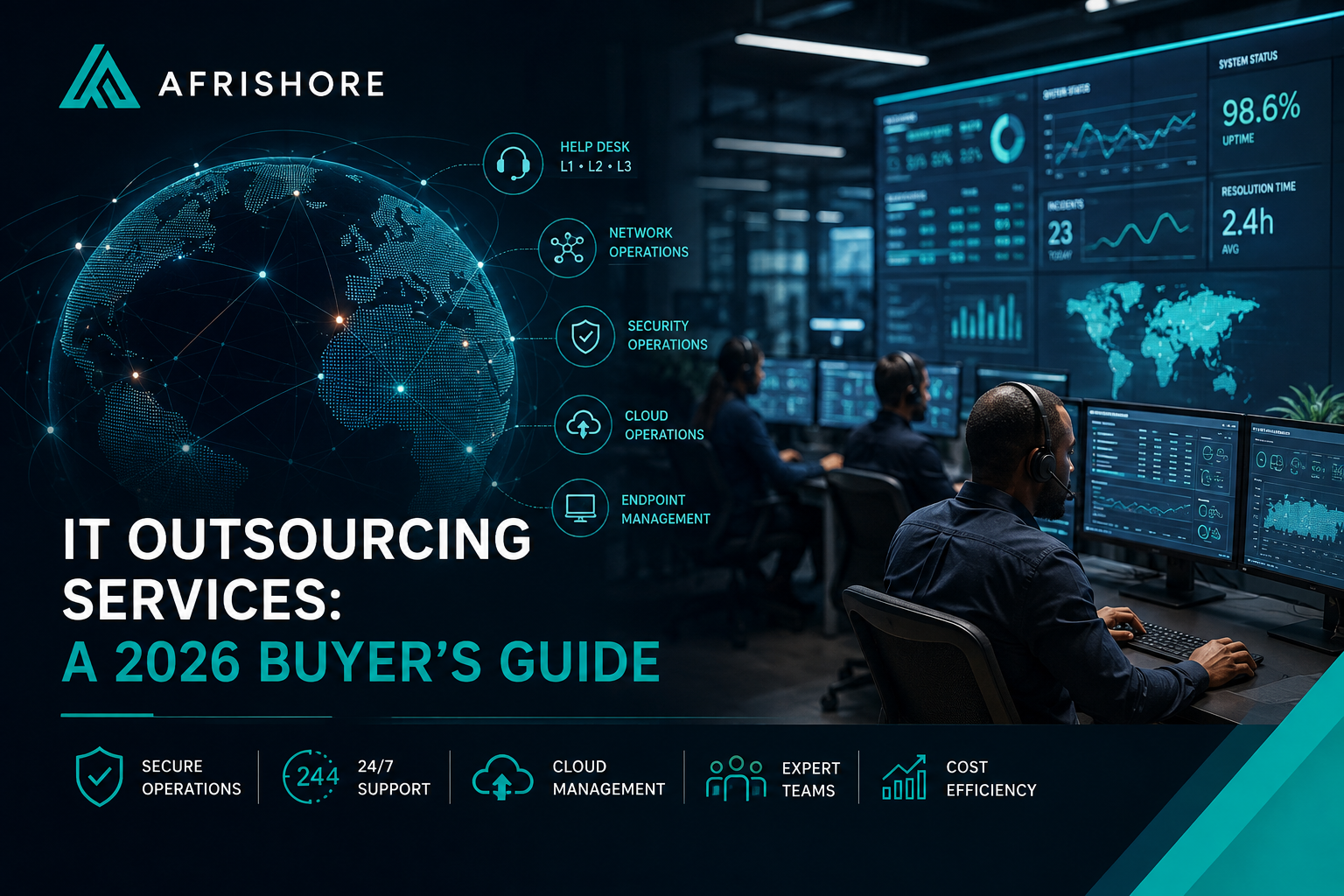
- IT outsourcing in 2026 spans managed IT services, tiered help desk (L1 to L3), network operations (NOC), endpoint management, security operations (SOC), cloud operations, and contact-centre technology (CCaaS), not bespoke software development.
- 76% of mid-market firms (500 to 4,999 employees) outsource at least one IT function, and Deloitte’s 2024 Global Outsourcing Survey found over 70% of organisations outsource critical technology functions including cybersecurity and IT infrastructure.
- Managed IT is most often priced per user (roughly $100 to $300 per user per month in the US) or per device, while offshore teams are usually billed per dedicated FTE.
- Well-structured IT outsourcing typically saves 15% to 30% net; offshore and nearshore managed models for IT support and infrastructure realistically reach 25% to 45%, and South African labour arbitrage can push direct-labour savings to 40% to 60%.
- The single most important buyer decision is managed services (the provider owns outcomes under SLAs) versus staff augmentation (the provider supplies people you still manage). Confusing the two is the most common failure mode.
- Non-negotiable provider checks: clear SLAs on response and resolution, ISO 27001 and SOC 2 certification, transparent tooling access, a documented escalation matrix, and clean exit and data-portability terms.
- South Africa combines High English proficiency (13th globally on the 2025 EF index), a workday that overlaps the UK and reaches US mornings, and a fast-growing ICT talent base, making it a credible base for help desk, NOC, security, and cloud support.
What IT Outsourcing Services Actually Cover in 2026
IT outsourcing is not one service. It is a set of building blocks, from help desk to network and security operations, that you can buy individually or bundle into a single managed contract under one SLA. Understanding those blocks is the first step, because the delivery model and the pricing both follow from which functions you decide to hand over.
Modern IT outsourcing services break down into a handful of well-defined categories. Managed IT services means outsourcing the monitoring, maintenance, and support of defined IT functions to a provider who owns day-to-day delivery and is measured on outcomes such as uptime and resolution times, rather than hours worked. Help desk or service desk support is tiered: L1 handles front-line intake and common fixes such as password resets and connectivity, L2 handles deeper OS, device, and application troubleshooting, and L3 covers expert-level infrastructure and complex incidents, according to Atlassian’s support-tier guidance.
Beyond the help desk sit the operational layers. A Network Operations Center (NOC) provides 24/7 monitoring, patching, backup oversight, and incident response across servers, networks, and endpoints, as IBM describes. Endpoint management handles remote monitoring, patching, and remediation of laptops, desktops, and mobile devices. Security operations (SOC) delivers 24/7 threat detection, triage, and guided response, often framed as a managed SOC or MDR service. Cloud operations cover the provisioning, scaling, and day-to-day management of workloads on AWS, Azure, or GCP. Finally, Contact-Center-as-a-Service (CCaaS) delivers cloud contact-centre platforms for voice, chat, and email without on-premise infrastructure.
For context on where the definitional lines sit, our explainer on what ITO means breaks down the category, and our guide to IT help desk outsourcing from South Africa goes deeper on the support-desk layer specifically. Afrishore’s own IT Outsourcing division is built as a modular stack across these layers rather than a single fixed package. Note that this guide covers ongoing managed IT and infrastructure operations, not bespoke software or web development.
Managed Services vs IT Outsourcing vs Staff Augmentation
Managed services buys you outcomes. Staff augmentation buys you people you still have to manage. Getting this distinction wrong is the most expensive mistake in IT outsourcing, and it is worth slowing down on before you look at any pricing, because the same headline rate means very different things under each model.
Buyers routinely hear three overlapping terms, and they describe very different operating models. With staff augmentation, the provider supplies vetted engineers who join your team, but you still direct their work, own the outcomes, and provide day-to-day management. It bills per person and fits short-term capacity gaps or specific skill shortages where you have internal management bandwidth to spare.
With managed services, you contract a provider to own and operate an entire IT function under defined SLAs. The provider chooses tooling, manages staffing, runs the processes, and is accountable for results rather than hours. It fits ongoing operational functions where you want predictable cost, 24/7 coverage, and clear accountability without micromanaging individual engineers. IT outsourcing (ITO) in the strictest sense refers to handing an entire scoped project, such as a migration or implementation, to a vendor who delivers the outcome end to end.
The practical warning comes from CGI’s analysis: if staff augmentation quietly becomes your default operating model for day-to-day IT, you end up paying high cost for low commitment and high risk, compared with a properly structured managed service. Choose staff augmentation when you mainly need capacity and skills. Choose managed services when you mainly need operational outcomes and always-on coverage.
The IT Outsourcing Market, and Who Is Actually Using It
Outsourced IT is now mainstream, not a cost-cutting last resort. Roughly three-quarters of mid-market firms already run some part of their IT through an external provider, which reframes the buyer question from whether peers are doing this to how the leading ones structure it.
The managed services market is large and growing quickly. MarketsandMarkets puts the global managed services market at $412.7 billion in 2025, rising to $460.6 billion in 2026, while Fortune Business Insights estimates the US managed services market alone will reach $106.8 billion by 2026. Across the major analyst estimates, the global figure sits in the range of roughly $330 billion to $490 billion in 2025, growing at high-single to mid-teens annual rates through the early 2030s.
Adoption data tells the more useful story for a buyer. Deloitte’s 2024 Global Outsourcing Survey reports that over 70% of organisations outsource critical technology functions, including cybersecurity, IT infrastructure, and application development. A 2026 statistics synthesis found that 76% of mid-market firms outsource at least one IT function, with adoption by function running at about 74% for IT help desk and end-user support, 71% for managed infrastructure, 67% for cloud management, and 58% for cybersecurity operations. UK provider Node4 reports that 30% of mid-market firms fully outsource IT operations to an MSP and 45% use a hybrid model, implying that roughly three-quarters already rely on some outsourced IT.
How Much Do IT Outsourcing Services Cost?
Expect per-user pricing around $100 to $300 per user per month onshore, dedicated-FTE pricing offshore, and 25% to 45% net savings when infrastructure and support move to a well-run offshore managed team. The spread is wide because pricing model and location matter more than any single rate card, so it helps to look at the onshore models first and then the offshore comparison.
Onshore MSPs mostly price one of two ways. Per-user pricing runs roughly $100 to $300 per user per month in the US, with comprehensive packages clustering around $150 to $200, according to TechDynamix’s 2025 cost analysis. Per-device pricing typically runs $50 to $150 per workstation, $150 to $500 per server, and $30 to $100 per network device per month. High-volume help desk and CCaaS work is sometimes priced per resolved ticket, in the range covered in our outsourced customer support cost breakdown. Offshore and nearshore providers usually bill per dedicated FTE per month.
The in-house comparison is where the savings appear. A US IT support specialist averages about $51,529 in base salary per Indeed’s 2025 data, and a fully loaded cost runs 1.25 to 1.4 times base once benefits, taxes, and overhead are added. The table below uses NetOps Africa’s published South Africa versus US comparison for equivalent IT roles.

Table: Annual fully loaded IT role cost, South Africa versus US
| Role | South Africa (annual) | US (annual, base) | Typical labour saving |
| L1 Service Desk | $15,000-$25,000 | $40,000-$55,000 | ~50-60% |
| L2 Support Engineer | $22,000-$36,000 | $55,000-$80,000 | ~50-60% |
| L3 Senior Engineer | $34,000-$52,000 | $80,000-$120,000 | ~45-55% |
| NOC Analyst | $18,000-$30,000 | $50,000-$70,000 | ~50-60% |
Sources: NetOps Africa, Indeed. US fully loaded cost adds a further 1.25 to 1.4 times on base.
On published benchmarks, Forrester found IT outsourcing clients realise 12% to 17% commercial savings, an ISG study put average BPO savings near 15% with quality gains alongside, and offshore IT support and infrastructure realistically reaches 25% to 45% net. Afrishore’s own South African IT help desk data shows fully loaded agents billing at $10 to $13 per hour versus $22 to $30 for equivalent UK or US roles, a 40% to 60% direct-labour saving. Our call centre outsourcing cost guide applies the same total-cost-of-ownership logic to voice operations.
How to Choose an IT Outsourcing Provider
Judge providers on the operating model, the SLAs, the security certifications, and the exit terms. Headline hourly rates are the least reliable signal of value, and once the shortlist is drawn up, the same six checks separate a genuine managed partner from a body shop with a nicer deck.
A disciplined evaluation covers six things. First, operating model: confirm whether you are buying managed services (they own outcomes) or staff augmentation (they supply people you manage), and map their catalogue to your actual needs across help desk, NOC, endpoint, cloud, and security. Second, SLAs and coverage: look for clear metrics on response time, resolution time, and uptime, separated by priority and support tier, plus confirmed 24/7 versus business-hours coverage and how major incidents are handled.
Third, security posture: require ISO 27001 and SOC 2, plus PCI-DSS if they will touch payment data, and review their SIEM or XDR tooling and incident-response process for any SOC service. This is important enough that we cover it separately in our guide to evaluating an outsourcing partner’s data security and compliance. Fourth, tooling transparency: ask which RMM, ITSM, and monitoring platforms they use and whether you get tenant-level access to dashboards and logs. Fifth, escalation and governance: request a documented escalation matrix and a named service manager with a regular review cadence. Sixth, exit terms: check contract clauses on termination, data export, and knowledge transfer so you are not locked in. Our checklist on verifying an offshore provider’s references covers the due-diligence layer around all of this.
Red Flags to Watch in an IT Outsourcing Engagement
The recurring failures are predictable: staff augmentation sold as managed services, vague SLAs, thin security maturity, and offshore teams with no planned coverage for your business hours. Knowing the checklist above is only half the job; the other half is recognising the warning signs when a provider fails it.
Research and buyer experience point to the same pitfalls again and again. The most common is shadow staff augmentation sold as managed services: if the provider mainly supplies bodies, bills per resource, and expects you to direct the work, you are not getting the accountability a managed service should provide. Weak or vague SLAs that only promise best effort make it impossible to hold a provider to account and are a leading cause of dissatisfaction.
Watch also for limited security maturity, where a provider offers SOC or monitoring services without recognised certifications, formal runbooks, or genuine 24/7 coverage. Poor documentation and handover leaves your environment dependent on individual engineers and raises risk if the relationship ends. Time-zone misalignment without planned shifts is a specific offshore trap: a team working only its own local daytime while supporting US or UK users creates slow responses and missed coverage windows unless the provider runs deliberate shifts. Finally, be sceptical of over-optimistic savings claims backed by under-resourced teams. Headline 60% to 70% savings can be real, but if they come from thin staffing and minimal training, service quality suffers. Target a realistic 25% to 45% net saving with robust service levels instead.
Why US and UK Companies Outsource IT to South Africa
South Africa pairs High English proficiency and a workday that overlaps the UK and reaches US mornings with a deep, fast-growing ICT talent base and structural labour-cost advantages of 50% to 65%. Those advantages are exactly what turns the cost table above from a spreadsheet exercise into a workable operating model.

South Africa has become a credible destination for managed IT and infrastructure work, not just voice support. On the 2025 EF English Proficiency Index, South Africa ranks 13th globally with a score of 602, classified as High Proficiency, well above the global average. The country runs on South Africa Standard Time (UTC+2) year-round with no daylight saving, placing it one to two hours ahead of London for near-full UK workday overlap and six to seven hours ahead of US Eastern Time, so a standard South African shift covers UK business hours natively and reaches into US mornings.
The talent base is substantial and growing. A 2025 Decoding ICT Job Demand report estimates around 318,000 ICT jobs in South Africa in 2024 with a 27.2% vacancy rate, indicating deep demand for IT support and infrastructure roles. On the sector side, BPESA reports the global business services sector is on track for 500,000 jobs by 2031, and South Africa is now widely cited as the third most attractive offshore destination globally, with GBS employment roughly tripling from 65,000 in 2019 to 150,000 in 2024. Our overview of BPO in South Africa and the wider BPO statistics set out the sector detail, while our destination comparisons of South Africa versus India and South Africa versus the Philippines show how it stacks up against the traditional offshore giants. For buyer-side geography, see our guides for US companies and UK companies.
Frequently Asked Questions
What are IT outsourcing services? IT outsourcing services hand responsibility for defined IT functions, such as help desk, network and infrastructure operations, endpoint management, security operations, cloud operations, and contact-centre technology, to a specialist provider under formal SLAs. Buyers can purchase individual functions or a managed bundle covering several layers under one agreement.
What is the difference between a managed service and IT staff augmentation? A managed service means the provider owns and operates an entire IT function under SLAs and is accountable for outcomes such as uptime and resolution times. Staff augmentation means the provider supplies vetted engineers who join your team, but you still direct their work and own the outcomes. Managed services suit ongoing operations; staff augmentation suits short-term capacity or skill gaps.
How much do managed IT services cost per user? Onshore US managed IT is commonly priced at roughly $100 to $300 per user per month, with comprehensive packages clustering around $150 to $200. Per-device pricing runs about $50 to $150 per workstation and $150 to $500 per server per month. Offshore providers usually bill per dedicated FTE instead.
How much can you save by outsourcing IT support offshore? Well-structured IT outsourcing typically saves 15% to 30% net, and offshore or nearshore managed models for IT support and infrastructure realistically reach 25% to 45%. Direct-labour savings using South African teams commonly run 40% to 60% versus equivalent US or UK roles, though very high headline savings can signal under-resourced teams.
What certifications should an IT outsourcing provider have? At minimum, look for ISO 27001 for information security management and SOC 2 for trust-services controls, plus PCI-DSS if the provider will handle payment card data. For security operations specifically, also review their SIEM or XDR tooling, documented runbooks, incident-response process, and genuine 24/7 coverage.
What IT functions can be outsourced? Commonly outsourced functions include tiered help desk (L1 to L3), network operations and monitoring (NOC), endpoint management, security operations (SOC and MDR), cloud operations, and contact-centre technology (CCaaS). Ongoing managed operations are the usual scope, distinct from one-off bespoke software or web development projects.
Is South Africa a good location for IT outsourcing? Yes, for support, infrastructure, security, and cloud operations work. South Africa offers High English proficiency (13th on the 2025 EF index), a workday overlapping the UK and reaching US mornings, a growing ICT talent base of around 318,000 jobs, and labour-cost advantages of roughly 50% to 65% versus US and UK operations.
What are the biggest risks in IT outsourcing? The main risks are staff augmentation sold as managed services, vague SLAs with no clear metrics, thin security maturity without certifications or real 24/7 coverage, weak documentation and handover, and offshore teams that run only their local daytime without planned shifts to cover your business hours.
Afrishore BPO’s IT Outsourcing division delivers managed IT support, infrastructure and network operations, endpoint and security monitoring, and contact-centre technology from South Africa, built as a modular stack you can start small and scale. For the operational deep dive, see our companion guide to managed IT services and infrastructure support outsourcing, and for the wider picture, our business process outsourcing hub shows how IT sits alongside the rest of the offering.