


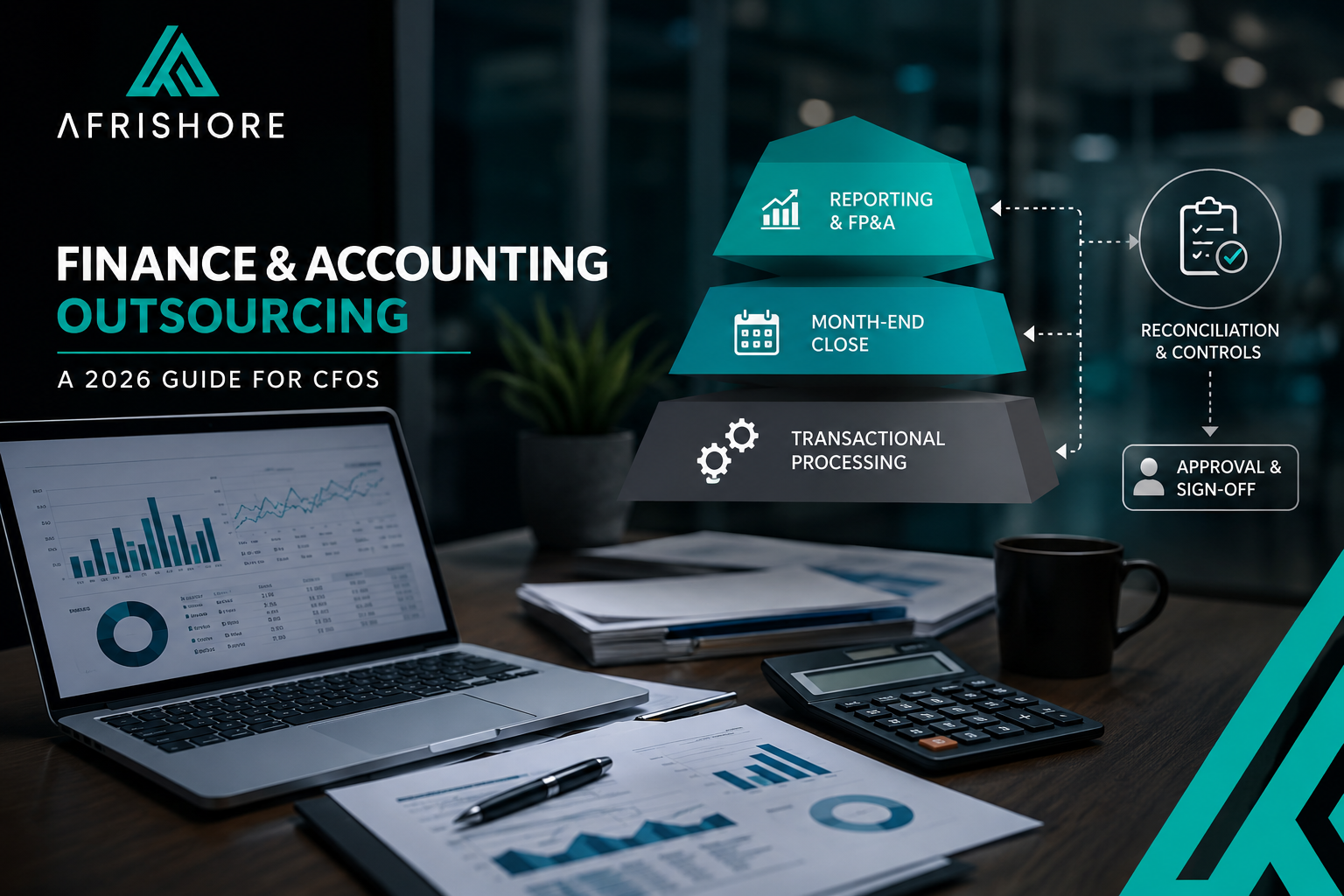
Quick Answer: Finance and accounting outsourcing (FAO) delegates part or all of the finance function, from transactional work like accounts payable and reconciliations through to month-end close and reporting, to a specialist provider, while your finance leadership keeps policy, approvals, and final sign-off. It has moved from cost-cutting tactic to mainstream operating model: a 2024 UHY survey of middle-market firms reported by CFO Brew found 45% now outsource their accounting either partially or entirely.
Key Takeaways
- FAO spans three layers: transactional processing (AP, AR, payroll support, reconciliations), core accounting and month-end close, and higher-value work such as management reporting and FP&A support.
- The global finance and accounting outsourcing market sits in the region of $50 billion to $70 billion in 2025 depending on how it is scoped, growing at mid-single to low-double-digit rates through the early 2030s.
- 45% of middle-market firms now outsource accounting partially or entirely, up from a 2022 position where nearly 80% had not even explored it, and around 31% of US mid-sized enterprises specifically outsource accounts payable.
- A fully loaded US bookkeeper costs roughly $80,000 to $95,000 and a corporate controller $240,000 to $260,000 once benefits and overhead (30% to 40% of base) are added; comprehensive outsourced accounting is often cited as 40% to 60% cheaper.
- The safe control pattern is “provider prepares, client approves”: the outsourced team processes and reconciles, while your signatories retain payment release, key journals, and final reporting.
- Require SOC 1 and SOC 2 reports and ISO 27001 certification, plus explicit GDPR and POPIA commitments and data-location clauses, from any FAO provider.
- South Africa pairs a deep chartered-accountant pipeline (many holding SAICA, ACCA, or CIMA credentials) with near-full UK working-day overlap and fully loaded finance costs of roughly $14,000 to $22,000 versus $68,000 to $92,000 in the US.
What Finance and Accounting Outsourcing Actually Covers
FAO is not all-or-nothing. It runs in three layers, and most companies start with the transactional work where the savings are clearest before moving up to the close and reporting. Knowing which layer you are handing over frames every later decision on cost, control, and provider fit.
Finance and accounting outsourcing works across three layers. The first is transactional finance: accounts payable (invoice capture, three-way matching, coding, payment-run preparation), accounts receivable (invoicing, cash application, collections), expense management, payroll processing support, and bank and balance-sheet reconciliations. This is where standardisation is highest and savings are most visible, which is why most programmes begin here. Our dedicated guide to accounts payable outsourcing goes deeper on that specific process.
The second layer is core accounting and month-end close: general ledger maintenance, trial-balance preparation, close orchestration with cut-off enforcement and intercompany matching, and management-accounts production. The third is higher-value finance work, including financial reporting support, FP&A tasks such as budgeting and variance analysis, and compliance and regulatory reporting data preparation, usually delivered as an extended team under an in-house or fractional finance leader. It is worth distinguishing FAO from adjacent models: an outsourced finance function owns defined processes and outcomes under SLAs, a fractional controller (typically $2,000 to $6,000 per month versus $90,000 to $130,000 a year for a full-time US controller) owns review and sign-off part-time, and staff augmentation supplies individual hires who work under your management. Many scaling companies combine all three. For the broader knowledge-work context, see our explainer on what KPO is.
The FAO Market, and Who Is Using It
Outsourced accounting is now a peer behaviour, not a fringe one. Close to half of middle-market firms already run some part of finance externally, which reframes the CFO question from whether this is respectable to how to do it well.
The market is large and growing. Estimates vary by definition, but Business Research Insights puts the global finance and accounting outsourcing market at $46.17 billion in 2024, rising to $48.82 billion in 2025 and a projected $76.36 billion by 2033, while Grand View Research places finance and accounting BPO revenue higher, at $70.19 billion in 2025. The spread reflects different scopes (pure FAO versus broader F&A BPO including technology platforms), but the direction is consistent: strong, sustained demand in North America and Europe.
Adoption data is the more useful signal for a CFO. The 2024 UHY middle-market survey found 45% of firms now outsource accounting partially (26%) or entirely (19%), a sharp shift from 2022 when nearly 80% had not explored it. Around 31% of US mid-sized enterprises specifically outsource accounts payable, and more than 68% of multinationals outsource at least one finance process. Everest Group’s finance and accounting outsourcing commentary identifies first-generation adopters in small and mid-market segments as a major growth driver, seeking both cost savings and value-added capabilities such as analytics and process improvement.
How Much Does Finance and Accounting Outsourcing Cost Versus In-House?
The base salary is only part of the in-house bill. Once benefits and overhead are loaded on, outsourced finance commonly lands 40% to 60% cheaper, with the biggest gains in transactional work. The comparison only holds up, though, when you load both sides fully, so it is worth walking through the real in-house number first.
In-house finance is more expensive than the headline salary suggests. In the US, Robert Half’s data lists a bookkeeper mid-range salary of $62,750 and corporate controllers around $185,000. Adding benefits, taxes, software, and overhead at 30% to 40% of base pushes a bookkeeper to roughly $80,000 to $95,000 fully loaded and a corporate controller to $240,000 to $260,000. In the UK, the Hays accountancy and finance salary guide shows management accountants commonly in the £42,000 to £65,000 range, with employer National Insurance, pension, and overhead adding a further 20% to 35% on top.
Outsourced pricing scales with scope. SDO CPA’s 2026 outsourced accounting cost guide cites basic bookkeeping at $500 to $1,500 per month, full outsourced accounting at $1,500 to $3,500, and controller-level support plus CFO advisory at $3,500 to $7,500. On savings, Stealth Agents’ 2026 FAO statistics report average cost reductions of 30% to 40% versus in-house operations, with AP, AR, and transaction processing delivering the largest gains, and CPA-economics analysis puts total accounting-cost reductions at 40% to 60%. The value extends beyond labour arbitrage: outsourced teams with industrialised workflows often compress the month-end close by several days, run structured QA that reduces mis-postings and duplicate payments, and convert fixed headcount into variable capacity. Our breakdown of the real cost of running a finance function in-house works through the full comparison.

Table: Fully loaded finance and accounting role cost by market (annual)
| Market | Fully loaded annual cost per FTE | Typical saving vs local in-house |
| United States | $68,000-$92,000 | baseline |
| United Kingdom | $42,000-$58,000 | baseline |
| South Africa (offshore) | $14,000-$22,000 | 50-60% vs UK, 55-65% vs US |
| Philippines (offshore) | $11,000-$16,000 | comparison point |
Source: Stealth Agents South Africa BPO statistics (2026).
How to Keep Control of an Outsourced Finance Function
Done well, outsourcing tightens control rather than loosening it. The rule is simple: the provider prepares, your people approve anything that moves money or hits the financials. That single design choice is what lets a CFO capture the savings above without ceding oversight of the numbers.
Effective FAO arrangements preserve, and often strengthen, control. The core design principles are clear process boundaries and a documented RACI, least-privilege access with named users and no shared logins, segregation of duties so no single person can create a vendor, approve an invoice, and release payment end to end, tiered approval workflows aligned to materiality, and tamper-resistant audit trails that record who approved what and when. The practical pattern for mid-market buyers is “provider prepares, client approves”: the outsourced team processes invoices, proposes payments, posts journals, and prepares reconciliations, while internal signatories approve payments, key journals, and final reporting.
Data security standards back this up. Finance data is among the most sensitive information a company holds, so US and UK buyers commonly require SOC 1 reports (controls relevant to financial reporting) and SOC 2 reports (security, availability, and confidentiality), alongside ISO 27001 certification. The AICPA’s SOC suite of services sets out the distinction. Add explicit GDPR and POPIA commitments, data-location clauses, retention terms, breach-notification obligations, and sub-processor controls to the contract. We cover the full evaluation in our guide to assessing an outsourcing partner’s data security and compliance.
Why South Africa Is a Strong Fit for Finance and Accounting Outsourcing
South Africa brings genuine chartered-accountant depth, not just a low-cost labour pool, plus near-full UK working-day overlap and finance costs well below US and UK levels. For finance work specifically, that combination of qualification depth and time-zone fit matters more than raw wage arbitrage.
South Africa has evolved from a contact-centre destination into a broader global business services hub with real finance and accounting capability. The chartered-accountant pipeline is substantial: SAICA’s 2024 APC results show 3,147 candidates (73% of those who sat) passing the final Assessment of Professional Competence in December 2024, feeding audit firms, corporate finance teams, and BPO providers. Many South African accountants hold SAICA, ACCA, or CIMA credentials and convert to ICAEW membership through mutual recognition, enabling direct support for UK statutory accounts and IFRS reporting, a point the ACCA’s own analysis of South Africa’s evolving BPO offering makes directly. On communication, the 2025 EF English Proficiency Index ranks South Africa 13th globally with a score of 602, above both the Philippines and India.
Time-zone fit matters more for finance than for many functions, because month-end close and real-time issue resolution need same-day collaboration. South Africa runs on UTC+2 year-round, giving six to seven hours of overlap with the UK working day and four to five hours of live overlap with the US morning, a structural advantage over India and the Philippines for UK-aligned close cycles, as ITWeb’s case for South African F&A BPO sets out. On cost, Stealth Agents’ South Africa BPO statistics put fully loaded finance and accounting roles at $14,000 to $22,000 in South Africa versus $68,000 to $92,000 in the US, with buyers typically citing 50% to 60% savings against UK in-house and 55% to 65% against US. For the wider destination picture, see our guides on BPO in South Africa, outsourcing finance and operations to South Africa for UK companies, and destination comparisons for US and UK buyers, plus the related banking and financial services outsourcing and fund administration outsourcing breakdowns.
Frequently Asked Questions
What is finance and accounting outsourcing (FAO)? FAO delegates part or all of the finance function to a specialist provider, spanning transactional work (accounts payable, accounts receivable, payroll support, reconciliations), core accounting and month-end close, and higher-value tasks such as management reporting and FP&A support. Finance leadership retains policy, approvals, and ultimate accountability for financial reporting.
How much can you save by outsourcing finance and accounting? Companies typically report 30% to 40% average cost savings versus in-house operations, with total accounting-cost reductions of 40% to 60% in many cases. The largest savings come from transactional processing such as accounts payable and reconciliations, and offshore delivery in South Africa can push fully loaded role costs 55% to 65% below US equivalents.
What is the difference between FAO and a fractional controller? An outsourced finance function (FAO) owns defined processes and outcomes under SLAs and does the production work. A fractional controller is a part-time senior accounting leader who owns the close, controls, and management reporting, usually overseeing bookkeepers rather than processing transactions. Many companies use both together.
Can you keep control of finances when outsourcing? Yes. The standard pattern is “provider prepares, client approves”: the outsourced team processes invoices, proposes payments, posts journals, and prepares reconciliations, while your internal signatories retain payment release, key journals, and final reporting. Segregation of duties, least-privilege access, approval workflows, and audit trails preserve control.
What data security certifications should an FAO provider have? US and UK buyers commonly require SOC 1 reports (controls relevant to financial reporting) and SOC 2 reports (security, availability, confidentiality), plus ISO 27001 certification, alongside explicit GDPR and POPIA commitments, data-location clauses, breach-notification terms, and sub-processor controls in the contract.
How large is the finance and accounting outsourcing market? Estimates place the global finance and accounting outsourcing market in the region of $50 billion to $70 billion in 2025, depending on scope, growing at mid-single to low-double-digit annual rates through the early 2030s. Around 45% of middle-market firms now outsource accounting partially or entirely.
Why is South Africa a good destination for finance and accounting outsourcing? South Africa offers a deep chartered-accountant pipeline (many holding SAICA, ACCA, or CIMA credentials and able to work in IFRS and UK GAAP), High English proficiency (13th on the 2025 EF index), six to seven hours of UK working-day overlap, and fully loaded finance costs of roughly $14,000 to $22,000 versus $68,000 to $92,000 in the US.
Afrishore BPO’s Financial Services Outsourcing (FSO) division provides dedicated offshore finance and accounting teams for US and UK mid-market companies, working inside your existing systems and controls, from accounts payable and reconciliations through to month-end close support. See our related guides to the real cost of running a finance function in-house, accounts payable outsourcing, and outsourced accounting services.
Speak to Afrishore’s FSO division about outsourcing your finance and accounting function.


