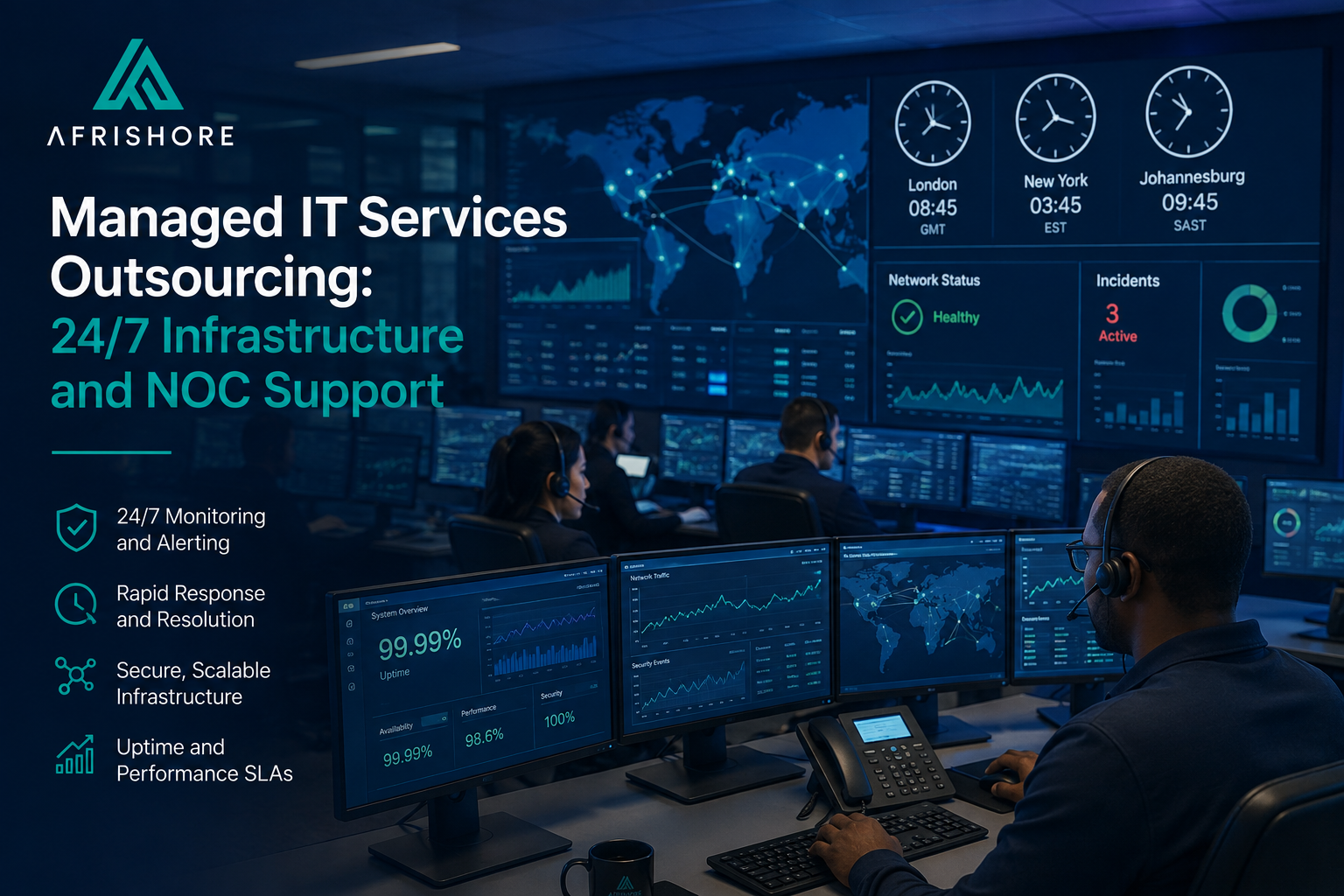
Quick Answer: Managed IT services outsourcing hands the always-on layer of your IT, monitored infrastructure, network operations, endpoint management, and security governance, to a specialist provider running a 24/7 Network Operations Center (NOC) under uptime and resolution SLAs. It exists because downtime is now a high six-figure risk per hour and true round-the-clock in-house coverage is expensive to staff. ITIC’s 2024 Hourly Cost of Downtime survey found that more than 90% of mid-size and large enterprises now put their average cost of a single hour of downtime above $300,000.
Key Takeaways
- More than 90% of mid-size and large enterprises put average hourly downtime above $300,000, and roughly 41% of large enterprises report losses between $1 million and $5 million per hour, per ITIC’s 2024 survey.
- Covering a single always-on seat 24/7/365 takes about 4.2 full-time staff at minimum, and closer to 5 to 6 once leave, sickness, and training are included; a four-person night team for one NOC seat commonly runs $240,000 to $300,000 a year.
- A follow-the-sun model spreads coverage across time zones so each team works normal daytime hours, cutting reliance on domestic night shifts and reducing mean response times by up to 40%.
- Offshore support rates of roughly $5 to $10 per hour and nearshore rates of $8 to $15, versus $25 to $40 for US in-house, translate to 30% to 70% labour savings while still delivering 24/7 availability.
- Managed infrastructure SLAs should specify 99.95% or higher uptime for core workloads, P1 response in minutes and resolution in 1 to 4 hours, a critical-patch cadence, and service credits for breaches.
- For infrastructure work, insist on ISO 27001 and SOC 2 Type II, plus GDPR and POPIA alignment, with named individual admin accounts, MFA on all privileged access, network segmentation, and tamper-resistant logging.
- South Africa runs on UTC+2 year-round, sharing most of the UK working day and reaching US mornings, and has a mature data-centre ecosystem where a handful of operators carry roughly 90% of IT load capacity.
How Much Does IT Downtime Actually Cost Mid-Market Companies?
Downtime is no longer a productivity annoyance. For most mid-size and large firms it is now a six-figure loss per hour, which is exactly why always-on monitoring pays for itself. The scale of that number is what justifies everything that follows, so it is worth grounding in the current data before looking at coverage models.
The cost of unplanned outages has climbed sharply. ITIC’s 2024 survey of over 1,000 organisations found that more than 90% of mid-size and large enterprises now put average hourly downtime above $300,000, with around 41% of large enterprises reporting losses between $1 million and $5 million per hour. Only about 4% of firms, mostly the smallest, report under $100,000 per hour. Independent outage-cost research puts current averages even higher, around $14,000 to $15,000 per minute, which is roughly $840,000 to $900,000 an hour, making the older and widely quoted figure of $5,600 per minute look conservative.
The picture scales down for smaller firms but stays painful. The Erwood Group’s 2025 downtime analysis by business size shows mid-market downtime commonly in the $200,000 to $500,000 per hour range for transaction-heavy industries. The July 2024 CrowdStrike update incident, which crashed millions of Windows devices worldwide, showed the systemic edge of the risk, with analyst estimates of Fortune 500 losses in the billions over just a few days. For an infrastructure leader, this is the core reason uptime, WAN stability, and monitored operations are non-negotiable rather than nice to have.
Why 24/7 In-House IT Coverage Is So Hard to Staff
The arithmetic of a 168-hour week is unforgiving. Keeping one seat continuously staffed takes four to six people, and the overnight premiums push the cost of a domestic night shift toward a quarter of a million dollars. That staffing math is the hidden reason so many firms carry gaps in their overnight cover, and it is where an outsourced model earns its keep.
The scheduling maths is simple and stubborn. A week has 168 hours and a full-time employee covers about 40, so continuous coverage of a single always-on seat needs roughly 4.2 full-time equivalents before you account for vacation, sick leave, and training. Once those are included, the practical rule of thumb rises to about 5 to 6 people per continuously staffed position. Aress’s 2026 MSP margin analysis puts it plainly: you need a minimum of 3.5 to 4 full-time engineers just to keep one person reliably working at 3am on a Tuesday, and a four-person night team for a single NOC seat often runs $240,000 to $300,000 per year in salary, benefits, shift premiums, and overhead.
Night-shift and critical-shift premiums make it worse. Off-hours differentials commonly add 0.5 times the base rate or more on top of normal pay, so staff working the hardest-to-fill overnight windows can earn well above their standard hourly rate. This is the same underlying economics we cover in our analysis of the offshore customer service night-shift differential: paying a domestic premium for overnight cover is one of the most expensive ways to buy availability.
What Managed IT and Infrastructure Outsourcing Includes
Managed IT and infrastructure outsourcing is the always-on operations layer: a 24/7 NOC watching your networks, servers, and endpoints, plus patching, backup, WAN management, and the security governance that sits alongside a SOC. Where the staffing problem above explains the why, this is the what you actually contract for.
It goes well beyond help-desk ticketing, which we cover separately in our guide to IT help desk outsourcing from South Africa. The always-on stack centres on a 24/7 Network Operations Center that continuously monitors servers, networks, applications, and endpoints, handling incident response, patch management, and performance tuning. Around it sit endpoint and patch management (remote monitoring and remediation of devices), backup and disaster recovery with tested restores, network and WAN management, and security governance and monitoring that operates adjacent to, or as part of, a security operations centre. For the wider definitional map of these layers, see our IT outsourcing services buyer’s guide and our explainer on what ITO means.
Engagements are measured, not open-ended. SLAs for infrastructure services usually centre on uptime and availability, response and resolution times, and incident-lifecycle metrics such as mean time to detect (MTTD) and mean time to resolve (MTTR). AWD’s 2026 guide to evaluating MSP reliability recommends uptime targets of 99.95% for core services and 99.99% for mission-critical workloads, noting that 99.9% uptime still allows about 8.7 hours of downtime a year, while 99.99% trims that to roughly 4.32 minutes a month. UnderDefense’s 2026 SLA guidance sets MTTD under 10 minutes and MTTR under 1 hour for critical incidents, with service credits of about 5% per 0.1% shortfall below the agreed uptime threshold.
Table: Typical SLA metrics for managed infrastructure services (2025-2026)
| Metric | Typical benchmark |
| Uptime for core workloads | 99.95%+ (about 4.32 min downtime/month at 99.99%) |
| P1 response (acknowledge) | 5 to 15 minutes, 24/7 |
| P1 MTTR / containment | 1 to 4 hours |
| P2 MTTR | 4 to 8 hours |
| Critical patch cadence | Within 48 hours of release |
| SLA compliance rate | Target 95%+ (industry average nearer 80%) |
| Service credits | ~5% per 0.1% uptime shortfall |
Sources: AWD, UnderDefense.
How the Follow-the-Sun Model Delivers 24/7 Coverage Without Night Shifts
Follow-the-sun spreads coverage across time zones so every engineer works normal daytime hours. You get genuine 24/7 support and faster resolution without asking anyone to carry the graveyard shift, which is the model that turns the staffing problem above into a solved one.

The follow-the-sun model passes open work between regional teams at the end of each shift, so collective coverage runs around the clock while each team keeps daytime hours. Salesforce’s overview of the model notes that it improves resolution times, reduces burnout, and adds resilience because no single region has to carry nights, weekends, and holidays. Reported implementations cut mean response times by around 40% by avoiding overnight backlogs.
The economics are compelling. SupportSave’s 2025 analysis of follow-the-sun tech support shows nearshore rates around $8 to $15 per hour and offshore rates around $5 to $10, compared with typical US in-house support at $25 to $40 per hour, translating to 30% to 70% labour-cost savings while still hitting 24/7 availability. The point is not pure wage arbitrage. A well-designed follow-the-sun roster replaces expensive, hard-to-staff domestic night shifts with a partner team working its own daytime, which stabilises attrition and removes the burnout that erodes overnight service quality.
Security and Compliance for a Managed Infrastructure Provider
Anyone holding privileged access to your networks and endpoints must prove it. ISO 27001 and SOC 2 Type II are the baseline, backed by MFA, least privilege, segmentation, and real logging. This is where a managed relationship is won or lost, because the provider you pick inherits a seat at the centre of your security posture.
Certifications matter for exactly that reason. Buyers increasingly expect ISO 27001 for information security management and SOC 2 Type II for trust-services controls. ISMS.online’s guidance on ISO 27001 for MSPs stresses strong identity and access management, secure configuration, network segmentation between management and customer networks, centralised logging, and documented change, backup, and incident processes. SOC 2 scoping guidance for MSPs focuses on the provider’s management plane and expects enforced MFA on all remote and privileged access, least-privilege role separation, and tamper-resistant logging of privileged sessions, with a Type II report proving those controls operated effectively over 6 to 12 months rather than merely existing on paper.
Data-protection law applies wherever the work happens. GDPR requires appropriate technical and organisational measures and a 72-hour breach-notification deadline, while South Africa’s POPIA imposes parallel obligations around lawful processing, security safeguards, and breach notification. We go deeper on this in our companion guide to evaluating an outsourcing partner’s data security and compliance. In practice, buyers should contractually require named individual admin accounts (no shared logins), MFA on all privileged access, role-based access with just-in-time elevation and quarterly reviews, network segmentation under change control, centralised logging with at least 12 months of retention, and tested backup and recovery with clear RTO and RPO targets. Our due-diligence process includes verifying an offshore provider’s references—a step also recommended when choosing and working with an overseas BPO company
Why South Africa Works for 24/7 Infrastructure Operations
South Africa runs on UTC+2 all year, so it covers late UK and overnight US windows on normal daytime shifts, and it has a genuinely mature data-centre and network ecosystem to run operations from. It is, in other words, a natural home for the follow-the-sun model described above.
The time-zone fit is the structural advantage. South Africa operates on South Africa Standard Time (UTC+2) year-round with no daylight saving, placing it one to two hours ahead of London and six to seven hours ahead of US Eastern Time, per time-zone overlap analysis. That means a South African team can cover late-evening UK and overnight US windows using ordinary daytime or early-evening shifts rather than hard-to-fill domestic night shifts, while keeping several hours of live overlap for handover and escalation. Because the clocks never change, these overlap patterns stay stable all year, which simplifies roster design compared with locations that run daylight saving.
The infrastructure underneath is real. MarketsandMarkets estimates South Africa’s data-centre services market at $850.1 million in 2025, growing to about $2,246.2 million by 2030 at a 21.4% compound annual rate, and MyBroadband reports that Teraco is the country’s most trusted data-centre operator, with a handful of carrier-neutral operators carrying roughly 90% of national IT load capacity. The talent base is deep, if in demand: a 2025 Decoding ICT Job Demand study estimates around 318,000 ICT jobs with a 27.2% vacancy rate and IT support technicians among the most sought-after roles. For the wider destination case, see our guides to BPO in South Africa and outsourcing for US and UK companies, plus the broader BPO statistics.
Frequently Asked Questions
What is managed IT services outsourcing? Managed IT services outsourcing hands the ongoing operation of defined IT functions, typically 24/7 network and infrastructure monitoring, endpoint and patch management, backup and disaster recovery, WAN management, and security governance, to a specialist provider running a Network Operations Center under uptime and resolution SLAs. The provider owns day-to-day delivery and is measured on outcomes rather than hours.
How much does IT downtime cost per hour? Per ITIC’s 2024 survey, more than 90% of mid-size and large enterprises put average hourly downtime above $300,000, and roughly 41% of large enterprises report losses between $1 million and $5 million per hour. Mid-market downtime commonly falls in the $200,000 to $500,000 per hour range for transaction-heavy industries.
Why is 24/7 in-house IT coverage so expensive? Continuously staffing one always-on seat requires about 4.2 full-time staff at minimum, and 5 to 6 once leave, sickness, and training are included. A four-person night team for a single NOC seat commonly costs $240,000 to $300,000 a year once night-shift premiums, benefits, and overhead are added.
What is a follow-the-sun support model? Follow-the-sun spreads coverage across regional teams in different time zones, each working normal daytime hours and handing open work to the next region at shift end. It delivers genuine 24/7 coverage, reduces engineer burnout, and can cut mean response times by around 40% by avoiding overnight backlogs.
What SLAs should a managed infrastructure contract include? Look for 99.95% or higher uptime for core workloads (99.99% for mission-critical), P1 acknowledgement in 5 to 15 minutes with resolution in 1 to 4 hours, a defined critical-patch cadence, an SLA compliance target of 95% or higher, and service credits of around 5% per 0.1% uptime shortfall.
What certifications should a managed IT provider have? At minimum, ISO 27001 for information security management and SOC 2 Type II for trust-services controls, plus documented GDPR and POPIA compliance. For any provider holding privileged access, also require MFA on all admin access, named individual accounts, role-based least privilege, network segmentation, and tamper-resistant logging.
Can South Africa provide 24/7 infrastructure support to US and UK companies? Yes. South Africa runs on UTC+2 year-round, covering late UK and overnight US windows on normal daytime shifts, and has a mature data-centre and network ecosystem plus a large ICT talent base. Several South African providers already deliver managed IT, NOC, and infrastructure services to international clients.
Afrishore BPO’s IT Outsourcing division delivers 24/7 managed IT, infrastructure and network operations, endpoint and security monitoring, and contact-centre technology from South Africa, giving US and UK companies always-on coverage without the cost of a domestic night shift. For the wider category overview, see our IT outsourcing services buyer’s guide, and for how IT fits alongside the rest of the offering, our business process outsourcing hub.