


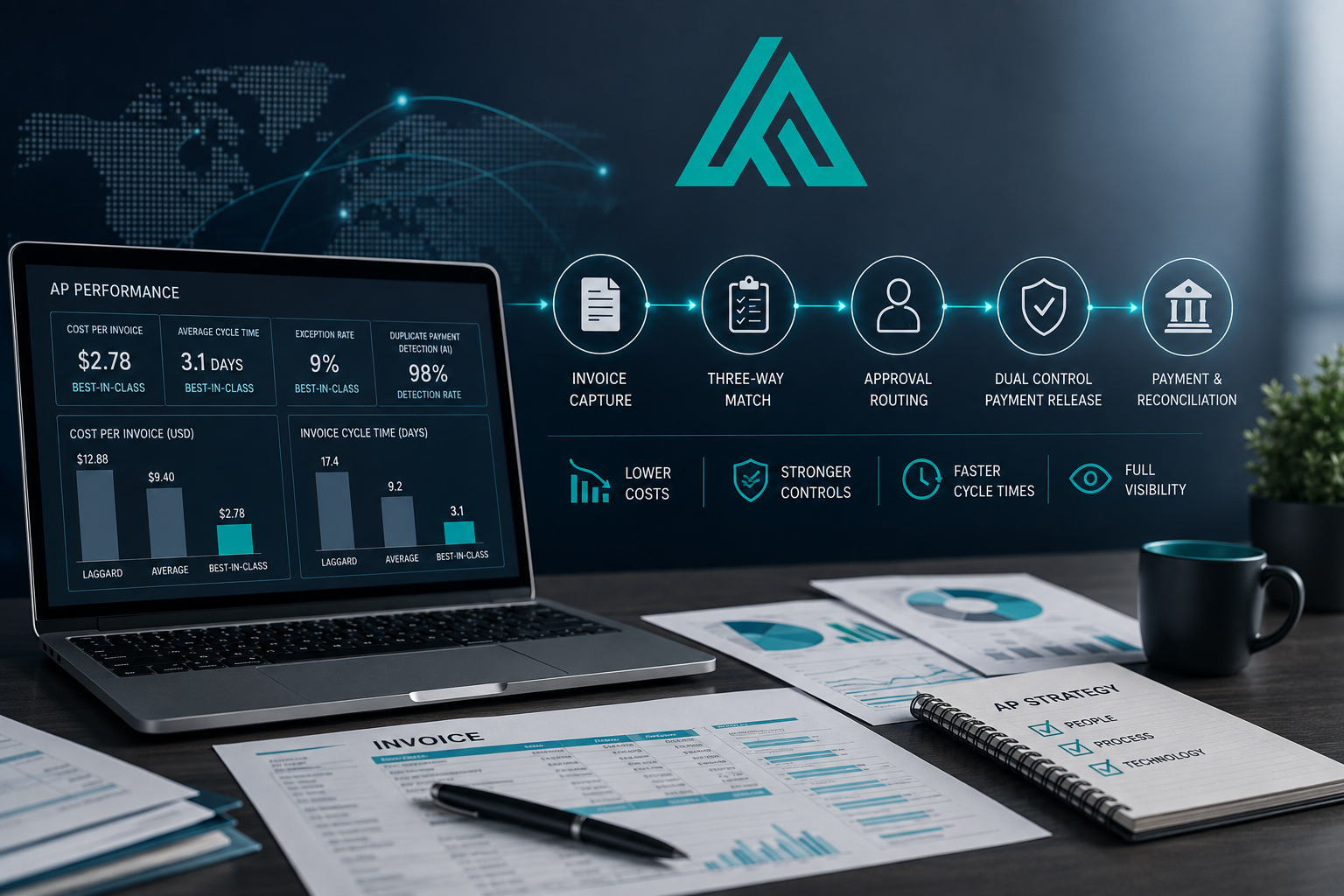
Quick Answer: Accounts payable outsourcing hands the end-to-end invoice workload, capture, coding, two- and three-way matching, exception handling, approval routing, payment preparation, vendor queries, and month-end reconciliation, to a specialist team, while your finance leaders keep approval authority and payment release. The economic case is stark: Ardent Partners’ State of ePayables research puts the average all-in cost of processing one invoice at $9.40, with laggard teams at $12.88 and best-in-class operations at $2.78.
Key Takeaways
- The average organisation spends about $9.40 to process a single invoice and takes roughly 9 days end to end; best-in-class teams hit $2.78 and 3.1 days, and manual paper-heavy teams can reach $15 to $30 per invoice and 17 days.
- Outsourced AP is typically priced at $2 to $6 per invoice (offshore standard processing can run $0.50 to $2.00), against $10 to $30 for manual in-house work, implying 40% to 80% cost savings.
- Duplicate and erroneous payments run at roughly 0.8% to 2% of total disbursements, which is $160,000 to $400,000 on $20 million of annual payables; AI-assisted detection catches about 98% of duplicates versus 63% for manual review.
- 79% of organisations faced attempted or actual payments fraud in 2024 per the AFP, making strong segregation of duties, vendor verification, and audit trails essential in any outsourced model.
- A fully loaded US AP specialist costs roughly $60,000 to $67,000 a year (base plus about 42% for benefits and overhead); a UK AP clerk runs £31,000 to £40,000+ fully loaded.
- The safe control model is “provider prepares, client approves”: the outsourced team processes and proposes payments, your signatories authorise and release funds under dual control.
- South Africa delivers AP work at roughly 50% to 65% below UK and US in-house cost, with ERP familiarity (SAP, Oracle, NetSuite, Sage, Xero, QuickBooks), strong English, and near-full UK working-day overlap for same-day cycles.
Why Manual Accounts Payable Is So Expensive and Slow
Every manual invoice is a small, repeated tax on the finance team. At $9 or more each and over a week to clear, the cost is mostly hidden in labour, rework, and exceptions, which is exactly why it rarely shows up on anyone’s radar until you benchmark it.
The benchmarks are consistent and unflattering for manual AP. Ardent Partners’ State of ePayables reports an average all-in cost of $9.40 per invoice, with best-in-class teams at $2.78 and laggards at $12.88, while fully manual paper-based processing can reach $15 to $30 once error correction, approvals, and overhead are counted. Speed follows the same pattern: Precoro’s summary of the Ardent data shows the average organisation taking about 9.2 days to process an invoice from receipt to payment, best-in-class teams doing it in 3.1 days, and less mature teams stretching to 17.4 days.
Exceptions are where the time and money leak. The average invoice exception rate sits around 14%, with best-in-class teams closer to 9%, and each exception pulls a person into investigation, chasing purchase orders, resolving mismatches, and re-routing approvals. Automation dramatically changes the throughput maths: best-in-class AP operations can process more than 20,000 invoices per FTE per year, versus roughly 1,350 for manual teams. This is the core reason finance leaders look at outsourcing, AP automation software, or a blend of the two. Our guide to finance and accounting outsourcing sets AP in the wider context of the finance function.
What Duplicate Payments and AP Fraud Actually Cost
Duplicate payments are the quiet leak, and fraud is the loud one. Together they are the reason controls, not just cost, belong at the centre of any AP decision, and they reframe outsourcing as a risk question as much as a savings one.
Duplicate and erroneous payments are a larger drain than most CFOs assume. APQC data reported by CFO.com shows even top performers reporting about 0.8% of annual disbursements as duplicate or erroneous, with weaker performers around 2%. On $20 million of annual payables, that is $160,000 to $400,000 walking out the door. SAP Concur data puts the duplicate rate at 1.29% of invoices, with an average duplicate value above $2,000. Encouragingly, AI-assisted detection catches about 98% of duplicates against 63% for manual review, and organisations using AI controls have cut AP fraud losses by nearly half.
Outright fraud has become routine. The Association for Financial Professionals’ 2025 Payments Fraud survey found 79% of organisations experienced attempted or actual payments fraud in 2024, with business email compromise and check fraud the leading vectors, and only 22% of victims recovering 75% or more of lost funds. This is why a serious outsourcing conversation is as much about controls as cost, a theme we develop in our guide to evaluating an outsourcing partner’s data security and compliance.
What Accounts Payable Outsourcing Actually Includes
Scope is modular. You can offload just invoice entry and coding, or hand over the whole cycle through to payment preparation and reconciliation, while keeping payment release in-house. Where you draw that line determines both the saving and the shape of the controls that follow.
A standard AP outsourcing engagement takes over the transactional workload while leaving policy and payment authority with your finance leadership. Typical scope covers invoice capture and digitisation (email, portals, OCR, e-invoicing feeds), coding and validation (GL codes, cost centres, tax treatment), two- and three-way matching against purchase orders and goods receipts, exception handling, approval routing aligned to your delegation-of-authority matrix, payment run preparation and execution under dual control, vendor master data and query management, and monthly AP-to-GL reconciliation. Engagements are governed by SLAs on cost per invoice, cycle time, exception-resolution time, on-time payment rate, duplicate-payment rate, and query response, with the team working inside your existing ERP.
There are three broad delivery models: a dedicated offshore team working only on your AP, a shared-services pool for smaller or more standardised volumes, and a managed AP platform that bundles software with a team that runs and continuously tunes it. That last model matters because it frames the real decision, which is outsourcing versus AP automation software versus a hybrid of both.
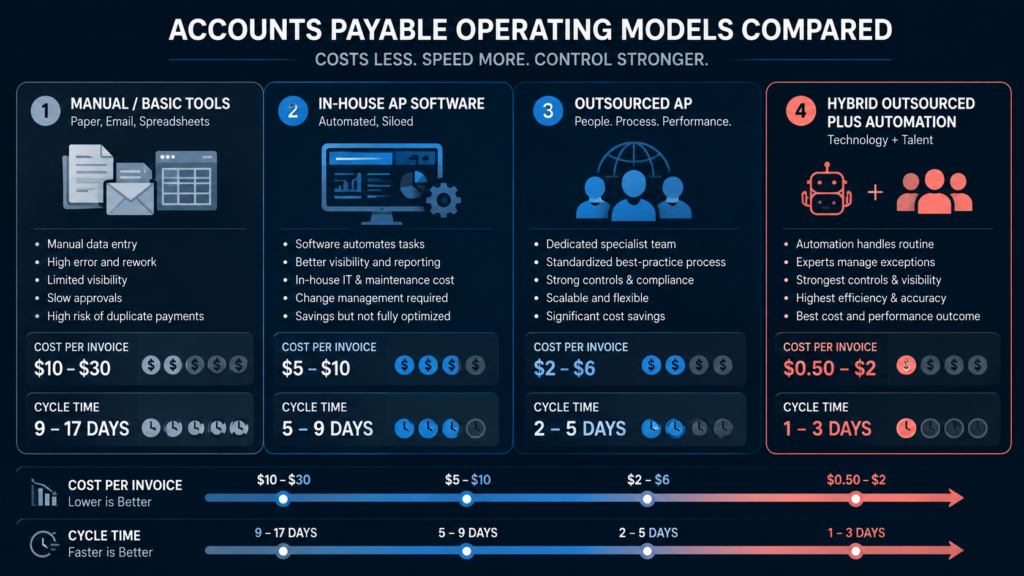
Table: AP operating models compared
| Dimension | Manual / basic tools | AP software (in-house) | Outsourced AP | Hybrid (outsourced + automation) |
| Cost per invoice | $10-$30 | ~$1.50-$3.00 | $2-$6 | $3-$4 |
| Typical cycle time | 10-17+ days | 3-7 days | 2-5 days | 2-3 days |
| Exception rate | 14%+ | 9-14% | 5-10% | 5-9% |
| Internal headcount | High | Moderate | Lower | Lowest |
| Best fit | Small, low volume | Wants control, needs efficiency | Scaling, high manual volume | Cost reduction plus strong controls |
Sources: Ardent Partners / Bottomline, Sage, Clyr.
How Much Does Accounts Payable Outsourcing Cost Versus In-House?
Outsourced AP is usually priced per invoice or per dedicated FTE, and it commonly lands 40% to 80% below manual in-house processing once the full loaded cost of your own team is counted. To compare like with like, it helps to see how providers price and then set that against a fully loaded internal clerk.
Outsourced pricing comes in three shapes. Per-invoice pricing is most common: offshore centres often run $0.50 to $2.00 per invoice for standard processing, nearshore $1.25 to $3.50, and onshore US or UK providers $3.00 to $8.00. Per-FTE pricing suits complex, integrated workflows, with offshore AP resources quoted at roughly $1,800 to $4,500 per month or $6 to $16 per hour, against $28 to $50 per hour onshore in the US. Tiered retainers cover a band of invoices per month, commonly $500 to $3,000 for standard AP. Watch the hidden components, exception handling, vendor setup, statement reconciliation, and normalise every quote to a true per-invoice cost.
The in-house comparison is where savings appear. Indeed’s data puts the average US accounts payable specialist salary at about $48,132, and Bureau of Labor Statistics Employer Costs data shows benefits running near 30% of compensation, so total employer cost is roughly 1.42 times wages, putting a fully loaded US AP specialist around $60,000 to $67,000 a year. In the UK, Indeed lists AP clerk pay around £28,260, which reaches £31,000 to £40,000+ once employer National Insurance, pension, and overhead are added. On savings, Sage’s guidance cites AP outsourcing at $2 to $6 per invoice against $10 to $30 for manual in-house work, and SDO CPA reports reductions of up to 70%. For a company running 50,000 invoices a year at $12 internally ($600,000), moving to a $3 per invoice outsourced model cuts spend to $150,000. Our breakdown of the real cost of running a finance function in-house works the wider numbers.
How to Keep Control and Prevent Fraud in Outsourced AP
The controls are the point. A well-run outsourced AP model separates duties, verifies vendors, and keeps payment release with you, so no single party can take a transaction from invoice to payment. This is how the fraud and duplicate-payment exposure from earlier gets designed out rather than simply moved offshore.
Reputable providers build their operating model around strong segregation of duties. One team handles capture and coding, another manages approval workflows, and a separate group or your own staff authorises and releases payments, so no single operator controls an end-to-end transaction. Approval matrices mirror your delegation of authority, with thresholds for single and dual approval, and outsourced staff route but never override those rules. The practical pattern is “provider prepares, client approves”: the team processes invoices and proposes payments, but funds only move after your sign-off under dual control or bank-level authorisation. This keeps ultimate authority over cash outflows in-house while offloading the heavy lifting. It is the same principle that separates a blog like this from the commercial accounts receivable management side of the ledger, where the counterpart controls apply to collections.
Fraud and duplicate prevention lean on technology plus process. Corcentric’s fraud-prevention analysis emphasises automated three-way matching, duplicate detection across vendor, amount, date, and invoice-number patterns, rigorous vendor onboarding with bank-account verification and watchlist screening, and comprehensive audit trails where every touch is logged and any change to bank details requires elevated authorisation. On security standards, ISO 27001 and SOC 2 Type II are widely treated as the first non-negotiable criteria for an AP partner, given the sensitivity of vendor banking data, with PCI-DSS added where card payments are in scope, and GDPR and POPIA commitments in the contract.
Why South Africa Is a Strong Fit for Accounts Payable Work
South Africa brings finance-literate talent, mainstream ERP familiarity, and a workday that overlaps the UK for same-day AP cycles, at 50% to 65% below UK and US in-house cost. Those three factors are what let the control model above run on the same clock as your own finance team.
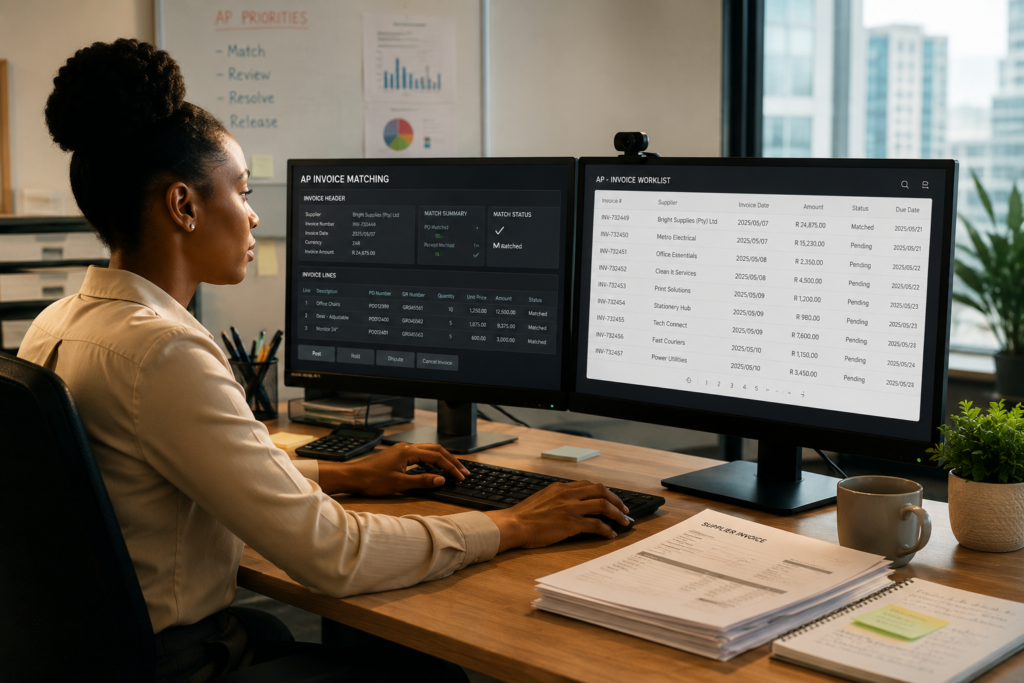
South Africa has become a prominent destination for transactional finance, with deep pools of bookkeeping and accounting talent, strong English with a neutral accent suited to vendor-query work, and hands-on experience across the ERPs AP actually runs on, including SAP, Oracle, NetSuite, Sage, QuickBooks, and Xero. The time-zone fit is a practical advantage: South Africa runs on UTC+2 with no daylight saving, giving near-full working-day overlap with the UK and Europe for same-day AP cycles, and a workable follow-the-sun overlap with US afternoons for end-of-day payment runs and query resolution.
The cost gap is large. Sourcefit’s analysis of outsourcing to South Africa shows finance roles priced well below UK equivalents, with a qualified Johannesburg accountant commanding roughly 35% to 45% of a London counterpart’s compensation and overall savings of 50% to 65% for finance operations. Against a fully loaded US AP specialist at $60,000 to $67,000, a South African AP specialist at roughly $1,800 to $2,800 per month equates to about $21,600 to $33,600 a year for comparable work. For the wider destination picture, see our guides to BPO in South Africa and outsourcing for US and UK companies, plus related finance breakdowns on fund administration outsourcing and banking and financial services.
Frequently Asked Questions
What is accounts payable outsourcing? Accounts payable outsourcing delegates the end-to-end invoice workload, capture, coding, two- and three-way matching, exception handling, approval routing, payment preparation, vendor query management, and month-end reconciliation, to a specialist provider working inside your ERP. Your finance leadership keeps approval authority and payment release.
How much does it cost to outsource accounts payable? Outsourced AP is typically priced at $2 to $6 per invoice, with offshore standard processing as low as $0.50 to $2.00, versus $10 to $30 for manual in-house work. Per-FTE offshore pricing runs about $1,800 to $4,500 per month. Savings against manual in-house AP commonly fall in the 40% to 80% range.
Is AP outsourcing better than AP automation software? They solve different problems and are increasingly combined. Software keeps the process in-house but limits labour savings to your wage market; outsourcing adds specialist teams and cost arbitrage; a hybrid model, an outsourced team operating the automation, can deliver near best-in-class cost, cycle time, and exception rates with minimal internal headcount.
How does outsourced AP prevent fraud and duplicate payments? Through segregation of duties, automated three-way matching, duplicate detection across vendor, amount, date, and invoice-number patterns, vendor onboarding with bank-account verification, and full audit trails. AI-assisted detection catches about 98% of duplicates versus 63% for manual review, and payment release stays with the client under dual control.
What is the fully loaded cost of an in-house AP clerk? In the US, an AP specialist averages about $48,132 in base pay, reaching roughly $60,000 to $67,000 fully loaded once benefits and overhead (about 42% on top) are added. In the UK, an AP clerk averages around £28,260 base, reaching £31,000 to £40,000+ fully loaded with National Insurance, pension, and overhead.
Can you keep control of payments when outsourcing AP? Yes. The standard “provider prepares, client approves” model means the outsourced team captures, codes, matches, and prepares payments, but your signatories authorise and release funds under dual control. Segregation of duties, approval matrices mirroring your delegation of authority, and audit trails keep cash-outflow authority in-house.
Why is South Africa a good location for accounts payable outsourcing? South Africa offers finance-literate talent with mainstream ERP familiarity (SAP, Oracle, NetSuite, Sage, Xero, QuickBooks), strong English, and near-full UK working-day overlap for same-day AP cycles, at roughly 50% to 65% below UK and US in-house cost.
Afrishore BPO’s Financial Services Outsourcing (FSO) division runs dedicated offshore accounts payable and transactional finance teams for US and UK mid-market companies, working inside your ERP with segregation of duties and payment release retained in-house. See our related guides to finance and accounting outsourcing, outsourced accounting services, and accounts receivable management.
Speak to Afrishore’s FSO division about outsourcing your accounts payable function.


