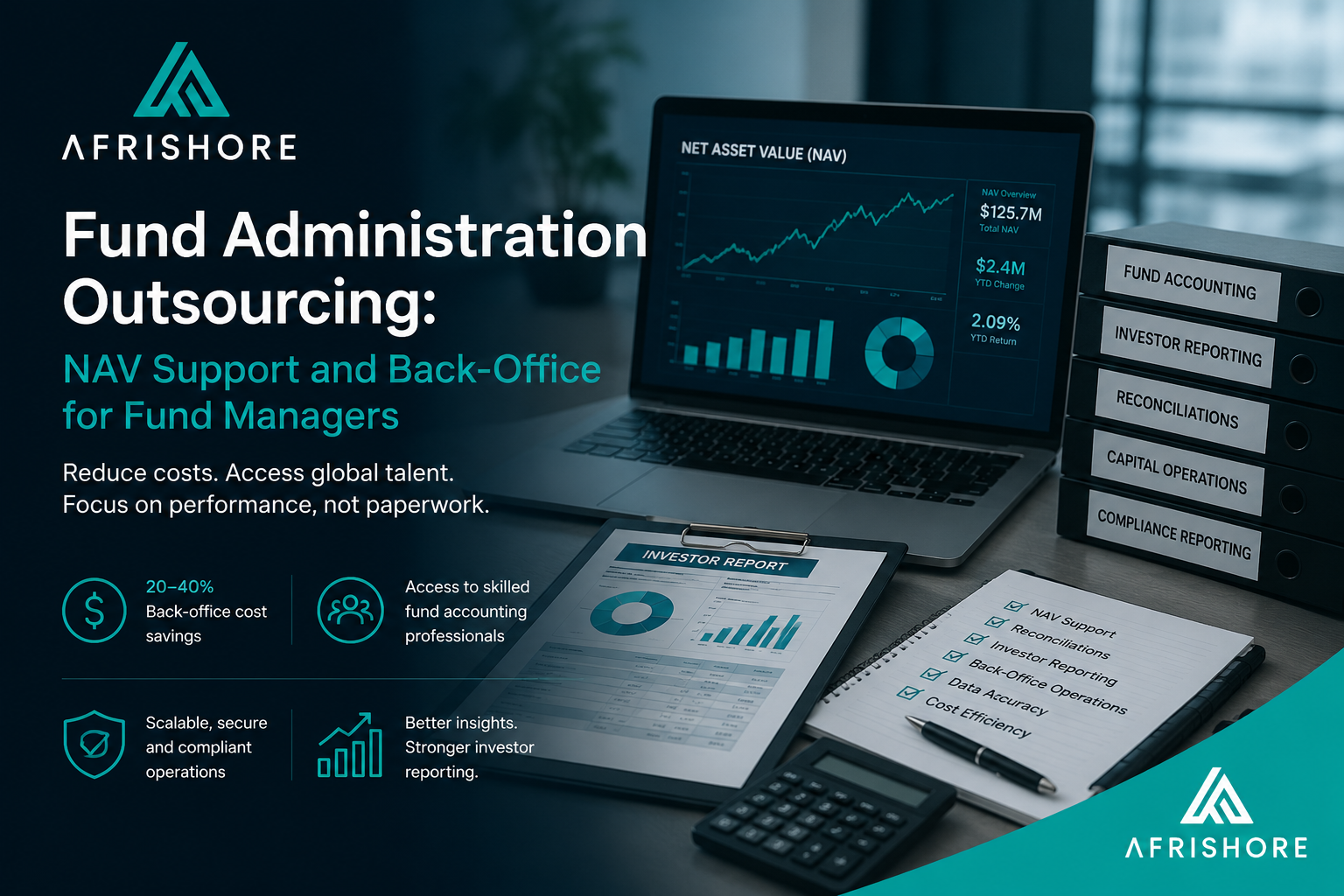
Quick Answer: Fund administration outsourcing delegates back-office fund accounting, NAV calculation support, reconciliations, and investor reporting to an offshore team, while the fund manager keeps sign-off and fiduciary control. A 2025 alternative investment operations benchmark found funds outsourcing administration typically cut back-office costs 20-40%, at a time when a fully loaded US fund accountant now costs $100,000 to $120,000 a year.
Key Takeaways
- A US fund accountant’s base salary averages $58,000-$90,000+ depending on seniority, but the fully loaded employer cost reaches $100,000-$120,000 once benefits (29-31% of compensation, per BLS data) are added.
- UK fund accountants average £40,000-£55,000 base, with employer National Insurance and pension contributions adding 13-18% on top.
- 71% of asset management CEOs believe talent shortages could hurt growth over the next three years, and the US CPA pipeline has fallen from over 100,000 accounting graduates in 2015 to under 80,000, per KPMG’s 2024 Asset Management CEO Outlook.
- Outsourcing fund administration typically reduces back-office costs 20-40%, according to a 2025 Preqin-sourced benchmark, at a moment when ILPA and AICPA fee-transparency initiatives are pressuring managers to justify every line of fund economics.
- 99% of private equity, venture capital, and real estate fund managers plan to increase outsourcing over the next three years, per Ocorian’s 2024 Outlook survey.
- Core fiduciary functions, including checking and releasing final NAVs, cannot be delegated outside the fund administrator under Central Bank of Ireland guidance; offshore staff augmentation supports execution, not sign-off.
- South African fund accounting and operations talent typically costs $14,000-$18,000 per year fully loaded versus $100,000+ for an equivalent US role, a saving in the 55-65% range once management and infrastructure costs are included.
Why Is Fund Administration Getting More Expensive to Staff In-House?
A fund accountant’s salary is the smaller number. Once benefits and hiring difficulty are priced in, the real cost of building an in-house team keeps climbing.
Recent US data puts average fund accountant pay at $58,000-$60,200 for 2024-2025, but a May 2026 ZipRecruiter snapshot shows a considerably higher current market: $86,141 average, with the 25th-75th percentile band at $66,500-$99,000 and senior specialists above $116,000. UK fund accountants average £40,000-£55,000 base pay, according to 2025 data from Jobted and PayScale.
The real cost is higher once benefits are added. US Bureau of Labor Statistics data shows benefits account for roughly 29-31% of total employer compensation cost in private industry, meaning a $75,000-$90,000 US fund accountant can cost the employer $100,000-$120,000 per year once health insurance, payroll taxes, and retirement contributions are included. In the UK, mandatory employer National Insurance and auto-enrolment pension contributions add 13-18% on top of gross salary.
Staffing is also getting harder, not easier. A 2024 report in The Drawdown describes a “great accountant shortage,” noting the US CPA pipeline fell from over 100,000 accounting graduates in 2015 to under 80,000, with attrition in fund administration and related sectors estimated as high as 20%. KPMG’s 2024 Asset Management CEO Outlook found 71% of asset management CEOs believe talent shortages could hurt growth over the next three years, and 89% intend to increase headcount anyway, intensifying competition for the same limited pool of specialized fund accounting and operations talent.
What Fund Administration Work Can Be Delegated Offshore?
Fund accounting, NAV support, reconciliations, and investor reporting are the standard scope, work that is repeatable and rules-based enough to run on a well-supervised offshore team.
Core fund administration and operations functions typically include fund accounting and general ledger maintenance, NAV calculation support (portfolio valuation and investor allocations), cash and position reconciliations, capital call and distribution processing, investor communications and capital account maintenance, and data preparation for regulatory and compliance reporting. Industry commentary describes fund administrators as the operational “engine room” of a fund, handling capital calls and distributions, NAV and waterfall modeling, transaction processing, and regulatory reporting support such as Form PF, FATCA, and CRS data.
Growth in this model is already visible at scale. Citco’s 2024 Middle Office Solutions report found the value of outsourced treasury transactions among alternative fund managers up 27% year-on-year to almost $2 trillion, with collateral and margin-movement transactions rising roughly a third and 75% respectively, as managers push non-core execution work to external partners.
Is Offshore Fund Administration Different From Hiring a Full Third-Party Administrator?
Yes. Offshore staff augmentation adds execution capacity inside your own systems and controls. Appointing a full third-party administrator hands the regulated function to an outside firm entirely.
Traditional fund administration means appointing a regulated, independent third-party administrator to act as an intermediary between the manager and investors, subject to regulatory oversight in the fund’s domicile. Offshore staff augmentation, the model that sits alongside an existing in-house or third-party setup, is different: the fund keeps its own systems, policies, and final sign-off, while an offshore accounting and operations team executes the repeatable work at scale, often working directly inside the manager’s existing technology stack rather than a separate administrator’s platform.
This distinction matters for smaller and mid-market managers specifically. Benchmarking of alternative investment operations shows outsourcing tends to be most cost-effective for funds below roughly $2 billion in AUM, while hybrid models, mixing internal teams with external providers, dominate above $5 billion. Emerging managers in particular can use offshore-supported fund operations to be “audit-ready from day one” without building a full internal team, while established managers use the same model to scale across strategies and jurisdictions without proportional headcount growth.
What Regulatory Requirements Apply to Outsourced Fund Operations?
US and UK regulators do not prohibit outsourcing fund operations, but they require documented vendor oversight, incident response, and clear data-security obligations wherever the work happens.
In May 2024, the SEC adopted amendments to Regulation S-P, updating Gramm-Leach-Bliley-based privacy rules to require incident-response programs, breach notifications, and enhanced vendor oversight for registered investment advisers and related entities. Large advisers must comply by December 3, 2025, and smaller firms by June 3, 2026, with obligations including mapping sensitive customer information, detecting unauthorized access, and notifying affected individuals within 30 days, requirements that flow directly into contracts with any outsourced or offshore fund administration provider.
In the UK, the FCA’s SYSC 8 general outsourcing requirements treat arrangements like fund administration and back-office support as extensions of a firm’s regulated operations, requiring due diligence, risk assessment, and contract provisions that preserve effective supervision and data access. New FCA rules on reporting material third-party arrangements, published March 2026 and effective March 18, 2027, will require in-scope firms to notify the regulator when entering or materially changing outsourcing relationships and to maintain a register of those arrangements.
What Fund Administration Functions Can Never Be Outsourced?
Checking and releasing final NAVs, along with strategy and fiduciary decision-making, must stay with the fund administrator or manager of record, no matter how much execution work moves offshore.
The Central Bank of Ireland’s guidance on fund administrator outsourcing is explicit that core management functions must not be outsourced, and that the administrator must retain adequate and effective control and decision-making over risk strategy, policy, and process oversight. It specifically restricts outsourcing of checking and releasing final NAVs, permitting delegation only within a group structure and under strict conditions, and requires annual on-site due diligence visits to confirm the arrangement remains sound. Broader EU rules under the UCITS Directive reinforce the same principle: liability of the management company is not reduced by delegation, and outsourcing cannot prevent effective supervision of the fund in investors’ interests.
For due diligence purposes, institutional allocators increasingly expect a certified control environment regardless of where execution work sits. SOC 1 reports cover controls relevant to financial reporting, while SOC 2 reports cover security, availability, and confidentiality controls; ISO 27001 provides an internationally recognized information-security management standard. Industry commentary on fund administration notes that institutional allocators increasingly require SSAE 18 SOC 1 Type 2 credentials as part of standard operational due diligence, making certified control environments table stakes for any offshore team touching investor data or transaction flows.
Why Is South Africa a Strong Fit for Fund Administration Support?
Near-full time-zone overlap with the UK, a mature domestic asset-management sector, and roughly 55-65% cost savings make South Africa a practical base for offshore fund operations support.
South Africa has a genuinely deep asset-management ecosystem to draw operations talent from, not just a general BPO labor pool. The 27four DEInvest Annual Survey 2024 reports 93 local asset managers overseeing R8.42 trillion in assets, and South African hedge fund AUM grew 34% to R185.12 billion in 2024, the fastest growth rate on record. The country’s broader GBS/BPO sector has scaled alongside this: workforce roughly tripled from 65,000 in 2019 to 150,000 in 2024, with revenue growing from $1.04 billion to $2.91 billion over the same period and the UK accounting for roughly 55% of headcount.
Table: Fund accountant cost comparison, fully loaded
| Market | Base salary | Fully loaded annual cost |
| United States | $58,000-$90,000+ | $100,000-$120,000 |
| United Kingdom | £40,000-£55,000 | +13-18% (NI + pension) on top of salary |
| South Africa (offshore) | R447,576/year (~$24,000) equivalent | $14,000-$18,000 per FTE (Cape Town benchmark) |
Sources: ZipRecruiter, Jobted UK, US Bureau of Labor Statistics, HireJustNow South Africa salary data, Afrishore BPO BPESA/Everest Group cost benchmarks.
South Africa operates on SAST (UTC+2) year-round, putting it only one to two hours ahead of the UK, close enough for near-full working-day overlap on daily NAV cycles and investor reporting. Against the US East Coast, the six-to-seven-hour gap means a South African team starting at 8am SAST has already produced hours of output before New York’s day begins, and a team working until 5-6pm SAST can reliably join 10-11am ET review calls.
Is the Market Actually Moving Toward Outsourced Fund Administration?
Yes, and the shift is accelerating rather than plateauing. Nearly every major survey of fund managers points the same direction.
Ocorian’s 2024 Outlook survey found 99% of private equity, venture capital, and real estate fund managers plan to increase outsourcing over the next three years, building on a period where 98% already reported rising outsourcing levels. Carne Group’s 2025 Change Research Report found 88% of fund managers expect to increase their use of third-party providers in middle and back offices over the next 12 months, with 49% expecting a dramatic increase. Russell Investments’ 2025 commentary found 60% of asset managers cite corporate-level cost savings as the primary driver behind outsourcing and co-sourcing decisions. Global fund administration outsourcing market estimates vary by scope, but Growth Market Reports puts the market at $12.4 billion in 2024, projecting growth to $24.2 billion by 2033 at an 8.1% compound annual growth rate.
Frequently Asked Questions
What is fund administration outsourcing? Fund administration outsourcing delegates back-office functions, fund accounting, NAV calculation support, reconciliations, capital call and distribution processing, and investor reporting, to an external team. This can mean appointing a full regulated third-party administrator, or using an offshore staff-augmentation model where the fund keeps its own systems and sign-off while an offshore team handles execution.
How much does a fully loaded US fund accountant cost? A US fund accountant’s base salary averages $58,000-$90,000 depending on seniority, but the fully loaded employer cost, including benefits at roughly 29-31% of compensation per BLS data, reaches $100,000-$120,000 per year.
What fund administration tasks can be handled by an offshore team? Standard scope includes fund accounting and general ledger maintenance, NAV calculation support, cash and position reconciliations, capital call and distribution processing, investor communications, and data preparation for regulatory reports such as Form PF, FATCA, and CRS.
What fund administration functions can never be outsourced? Core fiduciary and control functions, including checking and releasing final NAVs and setting risk strategy and policy, must stay with the fund administrator or manager of record. Regulatory guidance in Ireland and under the UCITS Directive confirms liability and effective supervision cannot be delegated away.
How much can a fund manager save by using offshore fund operations support? South African fund accounting and operations talent typically costs $14,000-$18,000 per year fully loaded, versus $100,000-$120,000 for an equivalent US role, a saving in the 55-65% range once management and infrastructure costs are included.
What data security certifications should a fund administration provider have? Institutional allocators increasingly expect SSAE 18 SOC 1 Type 2 credentials as part of operational due diligence, alongside SOC 2 controls for security and confidentiality and ISO 27001 for information-security management, regardless of where execution work is performed.
Is outsourcing fund administration only for smaller funds? No, but the model differs by size. Outsourcing tends to be most cost-effective for funds below roughly $2 billion in AUM, while hybrid models, mixing internal teams with external providers, dominate above $5 billion as managers balance control with scale.
Why is South Africa well positioned for fund administration support work? South Africa combines a mature domestic asset-management sector (93 local managers overseeing R8.42 trillion in assets), near-full time-zone overlap with the UK, and offshore operations costs roughly 55-65% below US/UK equivalents.
Afrishore BPO’s Financial Services Outsourcing (FSO) division provides dedicated offshore finance and operations teams for fund managers, private equity firms, and asset managers, working inside your existing systems and controls rather than replacing your fund administrator. See our related breakdowns of the real cost of running a finance function in-house and outsourcing finance and operations to South Africa for UK companies, plus our guide to banking and financial services outsourcing. Afrishore operates from ISO 27001 and ISO 9001-certified facilities in South Africa, with a track record serving US and UK financial services clients.
Speak to Afrishore’s FSO division about fund administration support for your team.