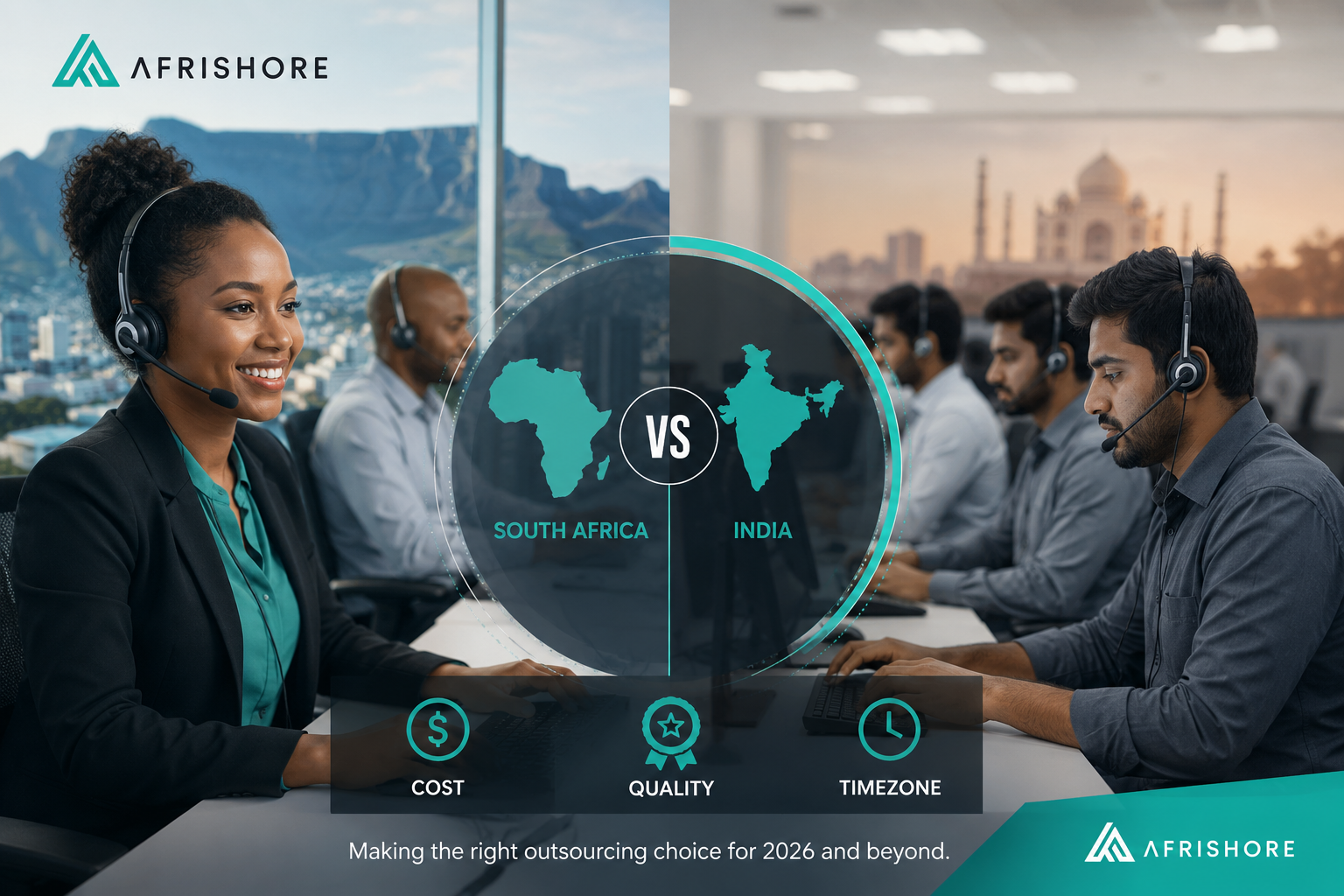
India has been the world’s dominant offshore BPO destination for three decades. South Africa has emerged as the preferred offshore CX destination for UK and US enterprise buyers. For buyers evaluating both in 2026, the decision turns on more than headline agent rates – timezone structure, English proficiency profile, attrition dynamics, and the type of work being outsourced all produce materially different outcomes between the two destinations.

Key Takeaways
- South Africa is rated the #1 offshore CX destination for US enterprise buyers (Ryan Strategic Advisory, 2025); India dominates globally in offshore CX and IT services/back-office processing at scale.
- South Africa ranks 13th globally in English proficiency (EF EPI 2025); India ranks in the Moderate proficiency band – a meaningful gap for voice and live-chat customer service
- South Africa’s GMT+2 timezone covers UK business hours without night shifts; India’s GMT+5:30 requires evening-to-late-night shifts for UK coverage
- South Africa’s BPO attrition rate runs 15-20% annually; India’s BPO sector averages 30-40%
- India is the stronger choice for large-scale back-office processing, IT services, and technical support at volume; South Africa is stronger for English-first CX, voice, live chat, and compliance-sensitive financial services work targeting UK and European buyers
The Case for Comparing South Africa and India
India and South Africa serve different segments of the global outsourcing market with enough overlap that many buyers find themselves evaluating both. India’s BPO and IT services sector is the world’s largest by revenue and headcount – NASSCOM reports the Indian IT-BPM industry at approximately $254 billion in export revenue for FY2024, with BPO representing a significant share of that base. India has the infrastructure, the scale, and the decades of process experience that make it a credible default for many outsourcing categories.
South Africa has built a focused offshore GBS (Global Business Services) sector specifically targeting Western CX – customer service, technical support, and financial services contact. The sector employs 150,000 offshore-facing agents and generated $2.91 billion in export revenue in 2024 (BPESA, 2025). That is smaller than India by an order of magnitude, but it reflects a deliberate positioning around quality-first CX rather than volume processing.
The result: the two destinations are genuinely complementary in some portfolio strategies, and genuinely competing in others. This comparison focuses on the areas where buyers are actually choosing between them.
Cost Comparison: South Africa vs India
On headline agent rates, India and South Africa are closer than buyers often expect – particularly for voice and customer service roles.
India: Voice and customer service agent rates in India’s major BPO hubs (Bangalore, Hyderabad, Pune, Chennai) run approximately $6-9 per hour fully loaded for comparable CX roles. Back-office processing roles run lower; specialised IT support and finance roles run higher.
South Africa: Agent rates in Johannesburg and Cape Town BPO operations run $10-13 per hour fully loaded for comparable CX roles. The headline rate is marginally higher than India for standard voice work.
The headline comparison, however, obscures three factors that close the gap or reverse it for UK buyers:
1. Night shift differential: India sits at GMT+5:30. Covering UK business hours (9am-5pm GMT) from India means agents work 2:30pm-10:30pm local time – partially within evening and approaching India’s night shift threshold for extended coverage. Covering a full 8am-8pm UK window pushes Indian agents into night shift territory, carrying statutory premium obligations and attrition risk. South Africa’s GMT+2 covers the same UK window with agents working 10am-10pm local – a standard extended day shift, no differential required.
2. Attrition: India’s BPO sector averages 30-40% annual attrition across CX and customer service roles, driven by career mobility, night shift conditions for Western-market coverage, and competitive salary pressure in major cities. South Africa runs 15-20%. Attrition is not just a recruitment cost – it erodes institutional knowledge and programme quality. Over 24 months, the compounding attrition cost in an Indian programme serving UK hours can close the rate gap entirely.
3. Productivity in voice CX: The English proficiency gap between the two destinations (13th vs Moderate band globally) has a measurable impact on first-contact resolution rates and CSAT in live voice and chat support. A lower FCR rate means more contacts per issue resolved, which increases cost-per-resolution even when cost-per-hour is lower.
For the full cost modelling framework, see The True Cost of Offshore Customer Service.
English Proficiency: A Meaningful Difference for CX Work

South Africa ranked 13th globally and 1st in Africa in the EF English Proficiency Index 2025. South African agents are English-first speakers in a country where English is the primary language of commerce, education, and media. Accents are near-neutral to UK and US ears, and written communication quality is high.
India ranks in EF EPI’s Moderate proficiency band. English proficiency in India is strong among the urban educated workforce that populates major BPO hubs, but varies considerably by tier of city and individual background. For back-office processing and asynchronous written tasks, the variation matters less. For live voice and real-time chat support – where tone, precision, and comprehension under pressure directly affect CSAT – the gap is operationally relevant.
This does not mean Indian voice agents are poor communicators. It means that sourcing consistent high-quality English voice agents in India requires active filtering and higher-than-average training investment, while South Africa’s labour pool delivers that standard more uniformly.
Buyers running omnichannel programmes with significant voice or live-chat components will typically see better CSAT and lower quality-related escalation rates from South Africa. Buyers running primarily asynchronous programmes – email processing, data entry, back-office – will see less difference.
Timezone: The Structural Advantage South Africa Holds for UK Buyers
This is the clearest differentiator for UK and Northern European buyers.
South Africa (GMT+2):
- UK business hours (9am-5pm GMT): South Africa agents work 11am-7pm. Standard daytime shift. No night shift premium. Natural working hours for agents.
- US East Coast (9am-5pm ET): South Africa agents work 4pm-midnight. Late evening shift, with some overlap into standard shift for the early hours.
India (GMT+5:30):
- UK business hours (9am-5pm GMT): India agents work 2:30pm-10:30pm. Evening shift, extending into night-shift territory for extended UK coverage windows.
- US East Coast (9am-5pm ET): India agents work 7:30pm-3:30am. Full overnight rotation.
For UK buyers, the timezone difference is decisive for voice and live-chat programmes. South Africa agents covering UK hours are working their normal productive day. India agents covering the same hours are working evenings into late night – with the attrition, differential, and productivity implications that follow.
For US buyers, both destinations require late or overnight shifts for full East Coast daytime coverage. India’s deeper overnight requirement makes South Africa structurally preferable even for US programmes, but the gap is smaller than for UK-focused buyers.
For a detailed breakdown of what UK businesses specifically gain from South Africa outsourcing, see outsourcing to South Africa for UK businesses.
Attrition and Workforce Stability
South Africa’s offshore contact centre sector averages 15-20% annual attrition. India’s BPO sector averages 30-40%.
The 20-percentage-point gap has compounding effects over a programme lifetime. On a 50-agent team:
- South Africa at 18% attrition: approximately 9 agent replacements per year. At a conservative $1,000 per hire and 3 months at reduced productivity (estimated at 60% of full output), that is $9,000 in direct recruitment cost plus approximately 270 agent-months of sub-full performance annually.
- India at 35% attrition: approximately 18 agent replacements per year. Same model: $18,000 in recruitment cost, approximately 540 agent-months of sub-full performance annually.
The India programme loses roughly double the institutional knowledge per year and runs more of its programme time in training-ramp mode. For compliance-sensitive programmes – financial services, iGaming, healthcare-adjacent – where the training investment per agent is higher, this gap is amplified further.
See the full analysis of offshore call center attrition rates for the complete compounding cost model.
Compliance and Data Sovereignty
Both India and South Africa have mature data protection frameworks, but with different alignments to European requirements.
South Africa: POPIA (Protection of Personal Information Act) is widely recognised by European data protection authorities as structurally equivalent to GDPR in its data subject rights and security obligations. South Africa is generally treated as a workable data-processing destination for UK and EU organisations operating under GDPR and UK GDPR. South Africa’s leading BPOs hold ISO 27001, PCI-DSS, and ISO 9001 certifications as standard.
India: India enacted the Digital Personal Data Protection Act (DPDPA) in 2023, which is still in implementation. India is not currently on the EU’s adequacy list, meaning EU-origin personal data transfers to India formally require additional safeguards (standard contractual clauses or binding corporate rules). UK adequacy assessment for India is similarly pending. For UK and EU buyers handling significant personal data, this requires legal review and contractual structuring.
For most programmes, the practical compliance requirements can be met in both jurisdictions through appropriate contractual frameworks. The South Africa alignment with GDPR is structurally simpler for UK and European buyers to manage without specialist legal input.
What Each Destination Does Best
| Criterion | South Africa | India |
| English voice quality (consistent) | ✅ Strong | ⚠️ Variable – depends on sourcing |
| UK timezone coverage (no night shift) | ✅ Strong | ❌ Evening/night shift required |
| US timezone coverage | ⚠️ Partial daytime | ⚠️ Full overnight |
| Annual attrition | ✅ 15-20% | ⚠️ 30-40% |
| GDPR / UK GDPR alignment | ✅ POPIA equivalent | ⚠️ DPDPA still implementing |
| Scale (headcount capacity) | ⚠️ 150,000 offshore agents | ✅ Multi-million agent pool |
| IT services and tech BPO at scale | ⚠️ Growing | ✅ Dominant globally |
| Back-office processing volume | ⚠️ Strong | ✅ Strongest globally |
| CX / voice / live chat for Western markets | ✅ #1 for US enterprise (RAS 2025) | ⚠️ Lower buyer satisfaction scores |
| Cost (headline rate) | ⚠️ $10-13/hr | ✅ $6-9/hr |
| Cost (total 12-month including attrition) | ✅ Competitive to lower for UK CX | ⚠️ Higher once attrition modelled |
Choose South Africa when: your programme is voice or live chat CX for UK or European customers; your coverage window is UK or EMEA business hours; your compliance environment requires GDPR-aligned data processing; your work requires consistent high-quality English; you are in a regulated sector (financial services, iGaming, insurance) where training investment makes attrition costly.
Choose India when: your requirement is large-scale back-office processing, IT services, or technical support at volume; your coverage window is primarily US overnight (India is no worse than South Africa for this); your language requirement is non-English South Asian languages; or your scale exceeds what South Africa’s 150,000-agent pool can accommodate.
Frequently Asked Questions
Is South Africa cheaper than India for BPO?
On headline agent rates, India is marginally cheaper for standard voice CX roles ($6-9/hr vs $10-13/hr in South Africa). However, for UK buyers whose coverage windows require evening or night shifts in India, the night shift differential and higher attrition (30-40% vs 15-20%) close the gap and often reverse it over a 12-month period. Total cost modelling – not just rate-card comparison – is necessary to make an accurate determination for your specific programme.
Which has better English for customer service – South Africa or India?
South Africa ranks 13th globally in EF English Proficiency Index 2025, in the Very High proficiency band. India ranks in the Moderate proficiency band. For voice and live-chat customer service requiring consistent neutral English, South Africa delivers that standard more uniformly across the labour pool. India has strong English communicators in its major BPO hubs, but requires more active filtering and training investment to achieve the same consistency.
Does India or South Africa work better for UK business hours?
South Africa works materially better for UK business hours. GMT+2 means UK 9am-5pm coverage corresponds to 11am-7pm local – a standard daytime shift with no premiums and no attrition pressure. India at GMT+5:30 means the same UK window corresponds to 2:30pm-10:30pm local, pushing into evening and night-shift territory for full coverage. The timezone difference is the single strongest reason UK CX buyers choose South Africa over India.
How does attrition compare between South Africa and India BPO?
South Africa’s offshore contact centre sector averages 15-20% annual attrition. India’s BPO sector averages 30-40%. The gap is largely structural: South Africa’s Western-market programmes predominantly run daytime shifts, while India’s equivalent programmes run evenings and overnight rotations which are the primary driver of high attrition in the sector. For programmes where agent training depth is high – financial services, iGaming, complex technical support – South Africa’s lower attrition directly protects the training investment.
Is data transfer to South Africa or India compliant with GDPR?
South Africa’s POPIA is widely recognised as aligned with GDPR in its data subject rights and security requirements, making it a workable destination for UK and EU data processing. India’s Digital Personal Data Protection Act (DPDPA) is newer and still implementing; India does not currently hold EU adequacy status, meaning formal GDPR-compliant data transfers require standard contractual clauses. For UK and EU buyers, South Africa involves a simpler legal pathway for data protection compliance.
Can I split a BPO programme between South Africa and India?
Yes. Hybrid destination strategies are common for large programmes. A practical split would have South Africa handling UK-hours voice and live-chat CX, with India handling overnight US coverage, back-office processing, or technical escalation queues where volume requires scale beyond South Africa’s capacity. Both destinations can operate on common platforms and ticketing systems, with the BPO managing cross-location handoffs. This approach captures each destination’s structural advantage rather than forcing one to cover the other’s weak timezone.
Which BPO destination is better for financial services outsourcing?
South Africa is generally stronger for financial services customer support targeting UK and European markets, for three reasons: POPIA/GDPR alignment simplifies data compliance; GMT+2 covers UK business hours without night shifts; and ISO 27001 and PCI-DSS certifications are standard among South Africa’s established BPOs. India has deep financial services BPO capability at scale for back-office processing and data-intensive functions, but the timezone and compliance alignment is more complex for UK-regulated financial services work.
How does South Africa’s offshore customer service compare within the wider BPO market?
Within the broader BPO landscape, South Africa’s specific strength is voice and live-chat customer service, not back-office or high-volume technical processing at India’s scale. South African teams deliver 18% higher CX satisfaction than India and the Philippines on comparable programmes, driven by neutral English accent and GMT+2 alignment with UK hours. Buyers evaluating “offshore customer service” specifically – rather than BPO generally – should weight South Africa higher than a like-for-like cost comparison alone would suggest.
Conclusion
South Africa and India are not interchangeable – they serve different outsourcing needs with different structural advantages. India’s scale, back-office processing depth, and IT services ecosystem are unmatched globally. South Africa’s English proficiency, UK-timezone alignment, low attrition, and GDPR-compatible data framework make it the superior destination for CX programmes serving UK and European buyers.
For buyers choosing between the two for a customer service or CX programme serving UK or European customers: the timezone alone resolves most of the comparison. South Africa delivers daytime-shift quality without the differential or attrition cost that India’s evening and night shifts produce for the same coverage window.
For programmes at a scale or technical depth that South Africa’s sector cannot support, a hybrid strategy combining both destinations is a practical answer.
To understand what a South Africa-based programme could look like for your operation, contact Afrishore BPO for a no-obligation scope assessment. Afrishore operates from Johannesburg with 750 dedicated seats, over 20 years of BPO delivery experience, and holds ISO 27001, ISO 9001, PCI-DSS, and HIPAA certifications.
Related reading: BPO Companies in South Africa · Outsourcing to South Africa for UK Businesses · Offshore Call Center Attrition Rates