Help desk tickets, server monitoring, cloud migrations, security operations — if the work you’re evaluating for offshore delivery centers on keeping systems running rather than serving customers or producing analysis, you’re looking at IT Process Outsourcing (ITO), not BPO or KPO. It’s the third leg of the outsourcing taxonomy, and knowing which one you actually need changes who you should be evaluating and how you should be pricing the engagement.
Key Takeaways
- ITO is the outsourcing of IT systems and technical operations — help desk, infrastructure management, application development/maintenance, cloud, and cybersecurity — distinct from BPO’s business processes and KPO’s expert analysis
- The global ITO market sits in the $600–750 billion range for 2024–2026, with mid-single-digit overall growth, but cloud managed services and managed security are each growing at roughly 10–15% CAGR
- “Managed IT services” is not a separate category — it’s the ongoing, contract-based delivery model that sits inside the broader ITO umbrella
- ITO pricing runs per-ticket, per-device, per-seat, or as a flat managed-service retainer — a more varied structure than standard BPO’s per-call or per-transaction pricing
- Help desk is the most commonly confused boundary: internal IT help desk is squarely ITO, while customer-facing “how do I use this product” support is customer support BPO
- South Africa’s GBS sector has shifted decisively toward tech-enabled services, with the same 40–60% cost savings and ISO 27001 certification baseline that underpins its BPO positioning
What Does ITO Actually Mean?
ITO is the outsourcing of technology systems and operations — applications, infrastructure, technical support — while BPO outsources repeatable business workflows and KPO outsources judgment-heavy expert analysis.
Information Technology Outsourcing is the practice of contracting external providers to design, run, and manage IT systems and IT-enabled operations. Gartner defines IT outsourcing as “the use of external service providers to effectively deliver IT-enabled business process, application service and infrastructure solutions for business outcomes.” In practical terms, when Gartner’s IT services taxonomy — business process services, application services, and infrastructure services — gets outsourced, the application and infrastructure pieces are what analysts call ITO specifically.
The simplest way to frame it: ITO outsources the technology backbone — applications, infrastructure, and technical support — while BPO outsources repeatable business workflows, and KPO outsources judgment-heavy expert work.
| Dimension | ITO | BPO | KPO |
| Primary focus | IT systems and technical operations | Repeatable business workflows | Expert, judgment-heavy analysis |
| Typical deliverables | Uptime, incident resolution, ticket SLAs, security posture | Volume handled, CSAT, turnaround time | Insight, recommendations, models |
| Talent profile | IT support specialists, sysadmins, developers, cloud/security engineers | Process-trained agents and specialists | Domain experts — analysts, researchers, lawyers |
| Core dependency | Technology platforms and infrastructure | Process maps and SOPs | Domain knowledge and analytical frameworks |
What Falls Under ITO
ITO covers four domains: help desk/service desk, infrastructure management, application development and maintenance, and cloud managed services with cybersecurity operations — with “managed IT services” describing the ongoing, contract-based delivery model inside that broader umbrella.
Across analyst frameworks and provider offerings, ITO typically covers four domains:
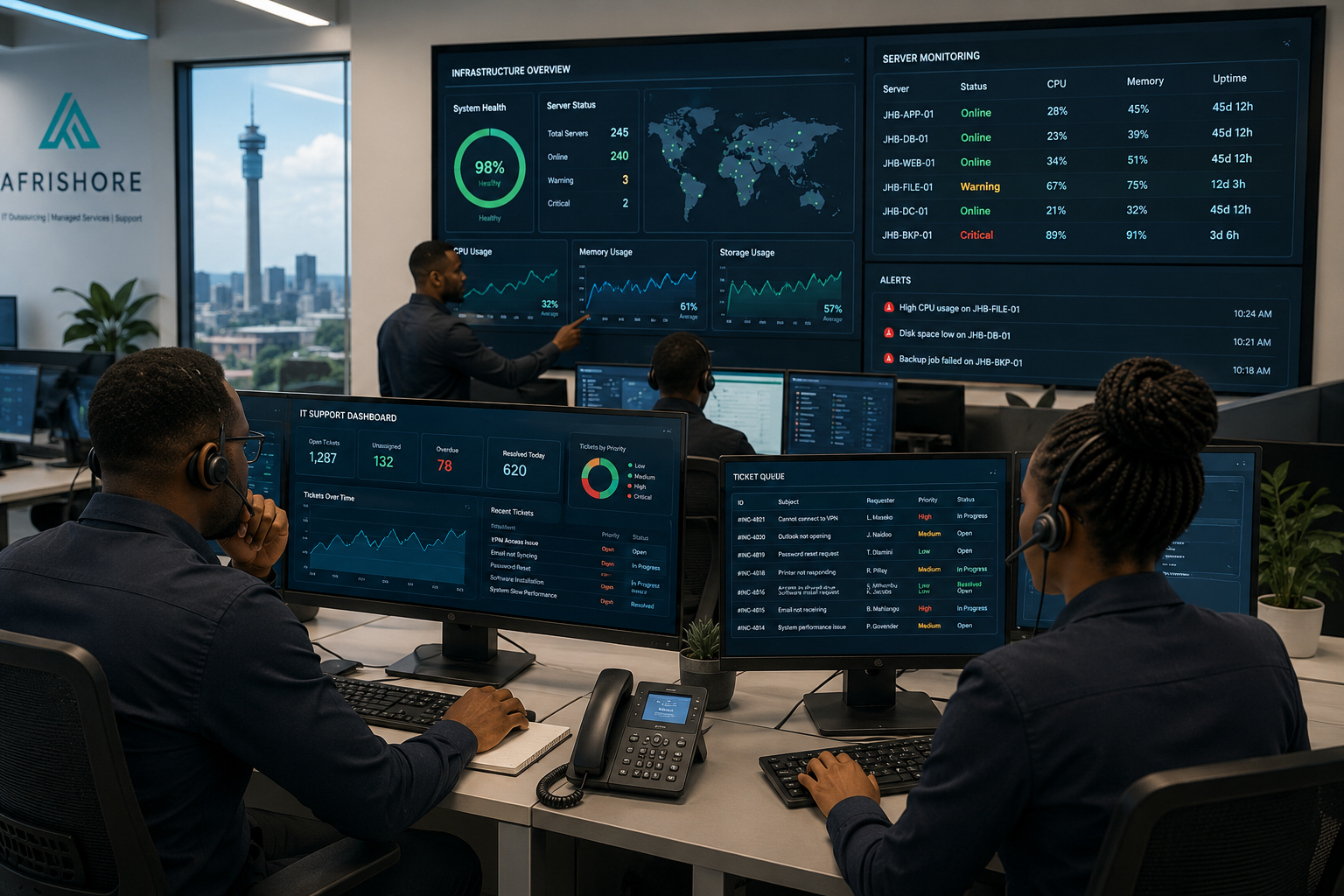
Help desk / service desk. Tier-1 and Tier-2 IT support for end-users — password resets, account access, software installation, device troubleshooting, VPN and connectivity issues — delivered through ITSM platforms like ServiceNow, Jira Service Management, or Freshservice.
Infrastructure management. Server, network, and storage monitoring; data center operations; endpoint management; backup and disaster recovery; database administration.
Application development and maintenance (ADM). New application development, legacy modernization, testing, and ongoing maintenance of packaged or custom applications.
Cloud managed services and cybersecurity operations. Cloud migration, optimization, and ongoing operations across AWS, Azure, and Google Cloud, alongside managed security services — 24/7 monitoring, SOC operations, incident response, and SIEM management.
Is “managed IT services” the same thing as ITO?
Not quite — “managed IT services” describes the ongoing, contract-based operation of a specific IT function (managed network, managed endpoint, managed SOC) with defined SLAs, usually priced per device, user, or month. ITO is the broader umbrella that includes both managed services and project-based work like one-off migrations or development sprints. In practice, when a mid-market IT leader signs an MSP contract, they’re buying the managed-services form of ITO.
How Big Is the ITO Market?
The global ITO market sits in the $600–750 billion range for 2024–2026 with mid-single-digit overall growth, but cloud managed services and managed security are each expanding at roughly 10–15% CAGR — the growth is concentrated in cloud and security, not classic infrastructure support.
Analyst estimates vary depending on scope, but recent reports cluster consistently. Global IT outsourcing sits somewhere in the $600–750 billion range for 2024–2026, with mid-single-digit overall growth — one estimate puts the market at roughly $601 billion in 2024 growing at 3.64% CAGR, while a broader “IT services outsourcing” definition (including application services) puts it closer to $745 billion in 2024, growing at 8.6% CAGR through 2030.
The growth isn’t evenly distributed. Cloud managed services and managed security services are expanding far faster than traditional infrastructure and application maintenance work — cloud managed services estimates range from roughly $43–59 billion in 2024, growing at 11.7–12.5% CAGR, while managed security services sit around $36–39 billion, growing at 10.5–15.4% CAGR depending on the source. Traditional infrastructure outsourcing and application maintenance are growing far more modestly by comparison — the growth in ITO right now is concentrated in cloud and security, not classic infrastructure support.
ITO, BPO, or KPO? A Practical Framework
The decision comes down to what’s actually being outsourced: technical/infrastructure work is ITO, repeatable business workflows are BPO, and judgment-heavy analysis is KPO — help desk is where buyers most often blur the first two.
The decision comes down to what’s actually being outsourced — systems, processes, or judgment:
The need is ITO if: the primary work is technical or infrastructure-based — maintaining servers, networks, devices, or cloud platforms, or responding to IT incidents and tickets. Success is measured in uptime, mean time to resolution, ticket SLAs, and security coverage, and you expect the provider to bring engineering talent and ITIL-aligned processes, not just people following a script.
The need is BPO if: the primary focus is business process execution — customer support, collections, claims processing, order management. The work is rules-based and repeatable, even when complex, and success is measured in CSAT, handle time, and compliance with defined workflows.
The need is KPO if: the core requirement is analysis, research, or expert judgment — equity research, complex valuations, legal review, product design. The work requires advanced credentials, and the deliverable is a decision or insight, not a completed transaction.
Where buyers get confused: help desk
Help desk is the single most commonly blurred boundary between ITO and BPO, and it’s worth drawing the line clearly:
- Internal employee IT help desk — password resets, device troubleshooting, connectivity issues, VPN access — is squarely ITO. Agents work inside the IT operations stack, use ITSM tooling, and get judged on first-contact resolution and mean time to resolution.
- Customer-facing product support — “how do I use this feature,” billing questions, account administration for a SaaS product — is customer support BPO, even though it happens over the same channels and often the same ticketing systems.
The practical rule: if the ticket is about your company’s internal systems, it’s ITO. If it’s about a customer’s experience with your product, it’s BPO — even when both queues sit inside the same helpdesk software.
Other commonly blurred areas worth a quick mental check: back-office IT administration (user provisioning, device enrollment) is often a hybrid of ITO and BPO depending on technical depth; data entry or content moderation is business process BPO even though it runs on IT systems; and analytics on IT operations — capacity planning, incident forecasting — leans toward KPO.
What ITO Costs
ITO pricing runs per-ticket, per-device, per-seat, or as a managed-service retainer — fully-loaded South African IT help desk agents cost $10–13/hour versus $22–30/hour for UK/US in-house roles, a 40–60% saving.
ITO pricing is more varied than standard BPO, reflecting the different assets involved — tickets, devices, servers, users:
- Per-ticket pricing — a unit price per resolved ticket or incident category, common in help desk and incident-response work, often combined with a minimum monthly commitment
- Per-device / per-endpoint — a flat fee per server, VM, workstation, or mobile device under management, covering monitoring, patching, and routine maintenance
- Per-user / per-seat — a fully loaded hourly or monthly rate per dedicated resource, most common for help desk roles tightly integrated with an internal team. Fully-loaded South African IT help desk agent costs typically run $10–13 per hour, versus $22–30 per hour for comparable UK/US in-house roles — a 40–60% cost saving
- Managed service retainer — a bundled monthly fee for a defined scope and SLA, the standard commercial model for managed network, managed cloud, and similar recurring services
Across ITO broadly, typical savings versus fully in-house operations run 30–60%, depending on location and complexity — consistent with the specific help desk benchmarks above.
Staffing and Certifications: ITO vs Standard BPO
ITO delivery needs IT support specialists, sysadmins, and cloud/security engineers with ITIL-aligned processes and ISO 27001 certification — a different talent stack than the communication-and-process training that governs standard BPO staffing.
ITO delivery requires a different talent stack than conventional customer service BPO. Teams are typically built from IT support specialists, system administrators, developers, cloud engineers, and security analysts — not agents trained primarily on scripts and tone of voice.
Buyers evaluating an ITO provider should expect:
- ITIL-aligned service management practices for incident, problem, and change management — often a baseline expectation even when not explicitly marketed
- Security certifications, with ISO 27001 as the minimum bar for any serious IT-adjacent provider
- Vendor and platform certifications — Microsoft, AWS, Cisco, ServiceNow, or relevant security vendor credentials — for teams handling specialized environments
Standard BPO staffing, by contrast, is built around communication skills, process adherence, and customer experience, with quality frameworks leaning on ISO 9001 and CX-specific standards rather than ITIL or security certifications. A genuine ITO provider needs both — the CX discipline of BPO and the technical certification stack of IT operations.
South Africa’s Positioning for ITO
South Africa’s GBS sector has shifted decisively toward tech-enabled services, carrying over the same 40–60% cost savings, ISO 27001 baseline, and low-attrition workforce that underpin its BPO positioning directly into ITO delivery.
South Africa’s Global Business Services narrative has shifted decisively from pure voice BPO toward tech-enabled and digital services. GBS headcount grew from roughly 60,000 in 2019 to approximately 150,000 in 2024, with the sector generating $2.91 billion in export revenue and increasingly positioning itself around digital and ICT-enabled delivery, not just traditional contact centers.
The same factors that underpin Afrishore’s BPO positioning carry over directly to ITO: 40–60% cost savings against US/UK in-house teams, a neutral-English, university-educated workforce, GMT+2 coverage of UK business hours with workable US East Coast overlap, and lower attrition (15–20% versus 40%+ in some competing destinations). ISO 27001 remains the baseline certification for IT help desk and IT-adjacent work — the same standard Afrishore already holds alongside ISO 9001, PCI-DSS, and HIPAA.
For Afrishore specifically, ITO positioning centers on Tier-1 IT support — internal ITSM and product helpdesk work — with a clear scope boundary: Tier-2 investigation, infrastructure decisions, and high-severity security incident response stay in-house with the client, while the outsourced team handles first-line diagnostics, triage, and resolution.
Frequently Asked Questions
What is the difference between ITO and BPO?
ITO (IT Outsourcing) covers technical and infrastructure work — help desk, servers, networks, cloud, application development — measured on uptime, ticket resolution, and security coverage. BPO (Business Process Outsourcing) covers business workflows like customer support, claims processing, and back-office work, measured on CSAT, handle time, and compliance.
Is “managed IT services” a different category from ITO?
No — managed IT services is the ongoing, contract-based delivery model that sits inside the broader ITO umbrella. ITO also includes project-based work like one-off migrations, while managed services specifically refers to continuous operation of a defined IT function under an SLA.
Is IT help desk outsourcing ITO or BPO?
Internal employee IT help desk (password resets, device troubleshooting, connectivity) is ITO — agents work inside the IT operations stack and are measured on resolution time and technical metrics. Customer-facing product support for a SaaS product is customer support BPO, even when delivered through similar ticketing tools.
How much does ITO cost compared to in-house IT support?
Fully-loaded South African IT help desk agent costs typically run $10–13 per hour, versus $22–30 per hour for comparable UK/US in-house roles — a 40–60% cost saving. Broader ITO engagements show similar 30–60% savings depending on location and complexity.
What certifications should an ITO provider have?
ISO 27001 is the baseline expectation for any serious ITO provider, alongside ITIL-aligned service management practices for incident and change management. Providers working in specialized environments should also hold relevant vendor certifications — Microsoft, AWS, Cisco, or major security platforms.
Which is growing faster — traditional IT infrastructure outsourcing or cloud/security outsourcing?
Cloud managed services and managed security outsourcing are growing significantly faster than traditional infrastructure and application maintenance — roughly 10–15% CAGR for cloud and security work, compared to low-single-digit to mid-single-digit growth for the broader ITO market overall.
Conclusion
ITO, BPO, and KPO answer three different questions: is the work about systems, processes, or judgment? Getting that distinction right before you start evaluating providers matters — an IT help desk RFP judged on CSAT alone will miss the ITIL and security-certification questions that actually determine delivery quality, just as a BPO engagement evaluated on uptime metrics is asking the wrong questions entirely. For South Africa specifically, the same infrastructure, certification baseline, and cost advantage that built the country’s BPO reputation now extends directly into ITO delivery.
To scope an IT help desk or IT-adjacent engagement with clear Tier-1/Tier-2 boundaries, contact Afrishore BPO for a no-obligation assessment.
Related reading: IT Help Desk Outsourcing South Africa · What Is KPO? Knowledge Process Outsourcing Explained · What Is a BPO Call Center? · Business Process Outsourcing