Quick Answer: Back office outsourcing moves behind-the-scenes work to an outside provider. That means tasks like invoice processing, reconciliations, payroll inputs, data processing and document handling. The best offshore candidates are high-volume, rules-based tasks with clear outputs. A US bookkeeping clerk earns a median $50,670 and costs about $81,300 a year all in. So the savings case is real. But policy, approvals and control ownership should stay with you.
Key Takeaways
- Back office is a type of work, not a department. Finance, payroll admin, data processing, document handling, order processing and claims admin all count.
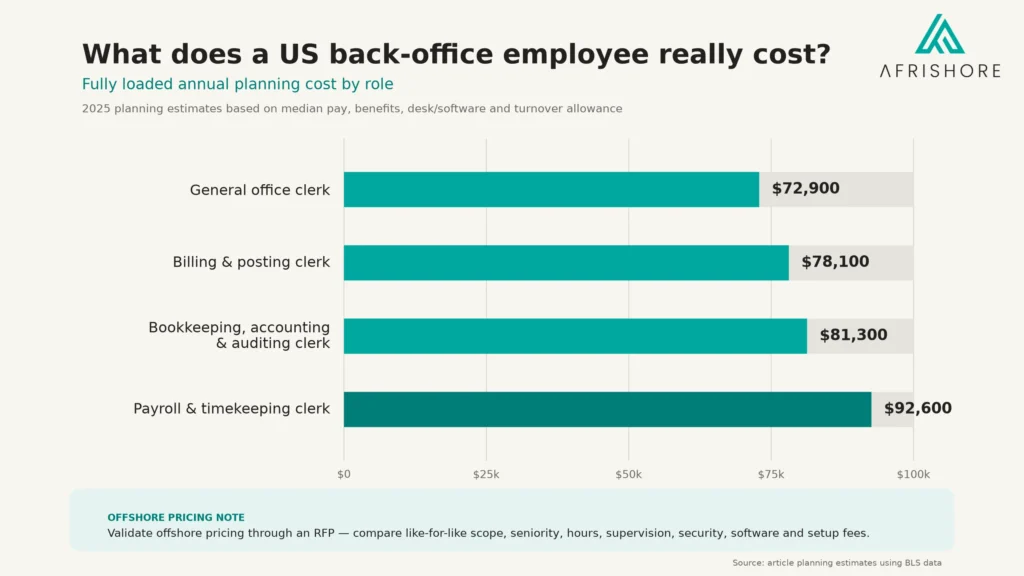
- A US back office employee costs roughly $72,900 to $92,600 a year all in, depending on the role. That is based on BLS pay and benefits data.
- Finance outsourcing is growing. FTI Consulting found finance outsourcing rose 11% from 2024 to 2025.
- Allow 10 to 20 weeks to move one fairly standard function. Watch at least one full month-end before you switch over.
- A SOC 1 report is the key evidence for outsourced work that affects your accounts. SOC 2 covers security and related areas.
- Never let the provider both prepare and approve payments, supplier changes or journal entries.
What Counts as Back Office Work
Back office work is support work that does not sell to, advise or serve customers. Front office teams deal with customers and bring in revenue. Middle office teams manage risk, compliance and control. Back office teams do the admin and transaction work that keeps the business running.
When you plan outsourcing, think in processes rather than departments:
- Finance and accounting: paying invoices, matching invoices, applying customer payments, billing, reconciliations, expenses and month-end support.
- HR and payroll: employee records, timesheet checks, payroll inputs, benefits admin and onboarding paperwork.
- Data processing: data entry, checking, enriching, de-duplicating and keeping master data up to date.
- Document handling: scanning, OCR review, indexing, record keeping and summarising contracts.
- Order processing: order entry, checks, returns admin and status updates.
- Claims and policy admin: intake, document checks, data extraction and eligibility checks.
- Reporting support: scheduled reports, dashboard refreshes and variance packs.
One task can cross the lines. Preparing a credit risk report is back office work. Deciding what the risk means and changing credit policy is middle office. Agreeing terms with the customer is front office. The split matters because it decides what can move offshore. For the customer-facing side, see our guide to front office and back office outsourcing.
The market data is messier than the definition. It is worth knowing why before you quote any figure.
The Back Office Outsourcing Market in 2025 and 2026
No one defines a “back office outsourcing market” the same way. That is why estimates differ so much. Broad BPO estimates for 2025 sit between about $323 billion and $357 billion. Within that, global finance and accounting BPO was worth an estimated $70.19 billion in 2025. Other firms use narrower definitions and put it nearer $49 billion. The $21 billion gap comes from how services are grouped, not from bad maths.
No trusted data shows how many US firms with 50 to 1,000 staff outsource back office work. The direction is clear, though. FTI Consulting’s CFO research found finance outsourcing up 11% between 2024 and 2025. Its mid-market commentary covered firms with $100 million to $1 billion in revenue. For a mid-market buyer, the better question is not market size. It is which of your own processes fit.
Which Back Office Functions to Outsource, and What to Keep
The evidence favours outsourcing some tasks, not all non-core work. Research on outsourcing results finds that complex, variable tasks do worse. Good contracts and good working relationships help, but they do not remove that effect. A review of academic BPO research found most buyers outsource for practical reasons, such as cost, performance, skills and scale. Attempts to transform everything at once were rarer and riskier.
| Process | Suitability | Retain internally |
| Data entry and validation | High | Data standards, access approval, exception policy |
| Document indexing and OCR review | High | Retention policy, privacy classification |
| AP invoice capture and matching | High | Vendor master approval, payment release, fraud controls |
| AR cash application | High | Credit policy, material write-offs, disputes |
| Routine bank reconciliation | High to medium | Approval and unusual reconciling items |
| Billing and order entry | High to medium | Pricing policy and non-standard terms |
| Payroll input processing | Medium to high | Pay policy, tax accountability, final authorisation |
| Claims intake and verification | Medium to high | Coverage interpretation and fraud investigation |
| Month-end journal preparation | Medium | Material judgement and approval |
| Technical accounting and tax positions | Low | Policy, sign-off and auditor interaction |
| Treasury dealing and payment release | Low | Authority and execution |
For more on specific tasks, see our guides to accounts payable outsourcing, outsourced payroll services and claims processing outsourcing. Once you know which processes fit, the business case rests on an honest cost comparison.
What Does Back Office Outsourcing Cost?
Start with the full internal cost, not the salary. The figures below use May 2025 BLS median pay. BLS employer cost data shows private-sector pay averaged $46.15 an hour in December 2025, of which $13.79 was benefits. That makes the total cost about 1.43 times the wage. We then add $6,000 a year for desk space and software. We also add a 6% turnover allowance, based on Gallup’s estimate that replacing a frontline worker costs about 40% of their salary.
| Role | 2025 median wage | With benefits | 2025 planning TCO | 2026 planning TCO |
| Bookkeeping, accounting and auditing clerk | $50,670 | $72,300 | $81,300 | $83,800 |
| Payroll and timekeeping clerk | $58,260 | $83,100 | $92,600 | $95,400 |
| Billing and posting clerk | $48,500 | $69,200 | $78,100 | $80,400 |
| General office clerk | $45,010 | $64,200 | $72,900 | $75,100 |
The 2026 figures add the 3.1% pay growth BLS reported for the year to June 2026, because 2026 job-level pay is not out yet. Costs also vary a lot by region. In June 2026, hourly employee costs ranged from $41.85 in the South to $54.76 in the Northeast.
Offshore price lists are rarely public. Everest Group’s PriceBook benchmarks finance and other outsourced services, but only for subscribers. So test any per-FTE offshore rate through a proper tender. Make every bidder price the same seniority, working hours, supervision, security, shift premiums, software, set-up fees and volumes.
| Pricing model | Best use | Buyer risk |
| Dedicated FTE | Stable recurring work and knowledge retention | Buyer carries utilisation risk |
| Managed service | End-to-end processes with stable boundaries | Scope ambiguity creates change-order disputes |
| Per transaction | High-volume work with clear units | Provider may favour quantity over exception quality |
| Outcome-based | Mature processes with reliable baselines | Attribution disputes and incentive gaming |
| Hybrid | Seasonal or variable work | More complex reconciliation |
A dedicated FTE rate should say exactly what it covers. That means recruitment, benefits, office space, equipment, supervision, QA, security, backup and cover for absences. Set-up work, client-specific software, licences and overtime are often charged separately. And cost only holds up if the move itself goes well. That is where most programmes slip.
Running the Transition Safely
Switch over when the evidence says you are ready, not on a fixed date. Standard practice is to transfer knowledge, train the team, test scenarios, run both teams side by side and then let things settle. Only then does the work pass to your supplier management team.
| Phase | Planning duration | Exit evidence |
| Scope and baseline | 2 to 4 weeks | Process inventory, volumes, current KPIs, control map |
| Documentation and access | 2 to 4 weeks | Approved SOPs, system roles, data flow map |
| Knowledge transfer | 4 to 8 weeks | Shadowing complete, assessment passed |
| Pilot and parallel run | 2 to 4 weeks | Accuracy and turnaround achieved with no critical control failure |
| Cutover and hypercare | 4 to 12 weeks | Stable KPIs and manageable backlog |
Work that runs on a calendar needs at least one full cycle. In one SSON case study, a handover planned for two to three weeks took six. The team needed to watch two month-ends. After shadowing, use reverse shadowing: the offshore analyst does the work while your current person watches. Clear go-live criteria and a completed first month-end should be the gate to switching over.
A sensible pilot covers one entity, one product line or 10% to 20% of volume. Freeze your baseline before you move anything. Agree when you would roll back, such as a failed payment control or a lasting SLA miss. Expand only after two stable reporting cycles.
KPIs and Governance
Measure results, not volume. A provider can hit “invoices processed” while exceptions and unapplied cash pile up out of view. APQC’s definition of total process cost includes people, systems, overheads and outsourcing costs. That makes it the right basis for a fair comparison.
The core KPIs are:
- first-pass accuracy and serious-error rate
- turnaround, at the middle and at the 90th percentile
- SLA hit rate and backlog age
- exception rate and rework rate
- control completion, for audit-relevant work
- escalation age and unit cost
Good programmes keep delivery and control ownership apart. On your side, keep a process owner, a supplier manager, a control owner and a security and privacy owner. Add a senior steering group for big risks. MIT Sloan research stresses matching oversight to how complex the process is. Harvard Business Review puts it simply: outsource the work, not the leadership. Our guide to BPO contracts and SLAs shows how to write these duties into the contract.
Automation and the Changing Back Office
Automation is changing what you buy, from people supplied to transactions completed. But progress is uneven. The best candidates are invoice and document capture, three-way matching, bank matching, data checks, payment matching suggestions and report distribution. People are still needed where documents are poor, rules clash, fraud is possible or a decision has legal or financial weight.
The job market reflects this. BLS expects bookkeeping, accounting and auditing clerk jobs to fall about 6% by 2035, from 1.532 million in 2025. That shows pressure on the role. It does not measure how much work is already automated. Ask providers to share how much work is automated versus manual. Ask who owns the automation if you leave. And ask whether efficiency gains cut your price or only raise their margin. Our piece on AI-augmented offshore operations looks at this model in more depth.
Compliance Controls for Offshore Back Office Work
Outsourcing the work does not outsource your duty over financial controls. For work that affects your accounts, a SOC 1 report is the main evidence. SOC 2 covers security, and can also cover availability, processing integrity, confidentiality and privacy. Check the company and locations covered, any excluded sub-suppliers, whether it is Type 1 or Type 2, the test period, any exceptions and the controls you must run yourself.
Industry rules follow the data. Financial firms must choose and oversee capable providers under the FTC Safeguards Rule. Providers that handle health data for claims work are usually HIPAA business associates. An ISO/IEC 27001 certificate only helps if it covers the delivery centre, systems and company serving you.
The minimum setup includes:
- identity and MFA that you control
- least-privilege access
- separate people for preparing, approving and releasing payments
- managed devices with USB and local storage blocked
- central activity logs
- full disclosure of locations and sub-suppliers
- tested backup plans
- exit support written into the contract
Our guide to outsourcing data security and compliance covers how to check these controls.
Frequently Asked Questions
What is back office outsourcing?
Back office outsourcing is hiring an outside provider to run behind-the-scenes support work. That includes invoice processing, reconciliations, payroll inputs, data processing, document handling, order processing and claims admin. The provider does the work to agreed service levels. You keep ownership of policy, approvals and controls.
Which back office functions are best to outsource offshore?
The best candidates are high-volume, rules-based tasks with steady inputs and clear outputs. Examples are data entry and checking, document indexing, invoice capture and matching, applying customer payments, routine reconciliations, billing and order entry. Technical accounting, tax positions, treasury dealing, payment release and compliance decisions should stay in-house.
How much does an in-house back office employee cost in the US?
Using May 2025 BLS median pay plus benefits, desk space and a turnover allowance, full planning costs are about $72,900 for a general office clerk. A billing and posting clerk costs about $78,100 and a bookkeeping clerk about $81,300. A payroll and timekeeping clerk costs about $92,600. Costs vary widely by region.
How long does a back office outsourcing transition take?
Allow 10 to 20 weeks for one fairly standard function. That breaks down into 2 to 4 weeks for scope and baseline and 2 to 4 weeks for documents and access. Knowledge transfer takes 4 to 8 weeks, then 2 to 4 weeks of pilot and parallel running, then a settling-in period. For calendar-driven work, watch at least one full month-end before switching over.
What KPIs should govern outsourced back office work?
Track first-pass accuracy, serious-error rate, turnaround at the middle and 90th percentile, SLA hit rate and backlog age. Add exception rate, rework rate, control completion, escalation age and unit cost. Avoid SLAs that only reward volume, because exceptions and unapplied items can build up out of view.
Do I need a SOC report from a back office provider?
Yes, for any work that affects your accounts. A SOC 1 report covers controls over financial reporting. SOC 2 covers security and related areas. Check that the report covers the right company and delivery site, that its test period lines up with your financial year, and that you run the controls it says you must.
Will automation replace back office outsourcing?
It is changing it rather than replacing it. Invoice capture, matching, reconciliation and data checks are more and more automated. People are still needed for poor documents, clashing rules, fraud signs and decisions with legal or financial weight. The practical model uses automation for routine transactions and offshore teams for exceptions and quality checks.
What is the difference between front office, middle office and back office?
Front office teams deal with customers and bring in revenue. Middle office teams manage risk, compliance and control around that work. Back office teams handle admin and transaction processing. Back office work is usually the best fit for offshore outsourcing, while middle office policy and risk decisions normally stay in-house.
Afrishore BPO runs offshore back office teams from Johannesburg for US and UK businesses. We cover data processing, document handling, order processing and finance work. Control ownership stays with you, and we report KPIs at transaction level. For finance work see financial services outsourcing and finance and accounting outsourcing. For the wider decision, see our offshore outsourcing guide.
Talk to our team about scoping a back office programme: https://afrishorebpo.com/business-process-outsourcing/