
Quick Answer: Offshore outsourcing means hiring an outside company in another country to run a business process for you. That is different from offshoring, where you own the overseas centre. The market is big. Global BPO was worth about $320.5 billion in 2025. But the savings are only real once you count transition, oversight and exit costs. It works best for high-volume, rules-based work with clear outputs.
Key Takeaways
- Offshore describes location. Outsourcing describes the contract. A company-owned centre in India is offshoring, not offshore outsourcing.
- Estimates put global BPO at roughly $320 billion to $325 billion in 2025. These figures cover all BPO, not just offshore work.
- Customer service is the largest BPO category in North America, at 24.11% of regional BPO revenue in Grand View Research’s 2025 model.
- South Africa’s international GBS workforce grew from about 65,000 in 2019 to 150,000 in 2024. The UK accounts for 55% of that headcount and the US for 33%, according to BPESA.
- Poor quality is the top reason work comes back in-house. One study found it in 65% of cases, with excess cost in 49%.
- UK GDPR duties do not move offshore with the work. Without an adequacy decision, UK firms need an IDTA or UK Addendum plus a transfer risk assessment.
What Offshore Outsourcing Actually Means
Offshore outsourcing is a contract with an outside provider that runs a set business process from another country. It usually sits under a master services agreement, a statement of work and a service level agreement. The provider employs the staff and runs the work day to day. You keep ownership of the process, the regulatory duties and the supplier oversight.
People often mix up the terms, and that causes real confusion in business cases. The simplest way to separate them is to ask two questions. Who employs the staff? And where does the work happen?
| Model | Who employs staff | Where work happens | What the buyer owns |
| Offshore outsourcing | Independent provider | A distant foreign country | Process design, governance, compliance accountability |
| Captive offshoring | The buyer or its subsidiary | A foreign country | The centre, systems, workforce and all operating risk |
| Nearshore outsourcing | Independent provider | A nearby or time-zone-compatible country | Same as offshore outsourcing, with more working-hour overlap |
| Onshore outsourcing | Independent provider | The buyer’s home country | Same, without an international data transfer |
| Staff augmentation | Usually the supplier | Domestic or foreign | Day-to-day direction of named workers |
| Managed service | Provider | Any location | Outcomes against a defined service |
“Nearshore” depends on where you sit. Colombia is nearshore for a US company but offshore for a UK one. Poland is nearshore for the UK but not the US. Our guide to nearshore outsourcing for UK companies covers that choice in more detail.
With the terms clear, the next question is how big this market really is. The honest answer is less precise than most sources suggest.
How Big Is the Offshore BPO Market?
No one publishes a reliable figure for offshore outsourcing on its own. The numbers you see cover all business process outsourcing. Each research firm also draws the line in a different place. Ken Research puts global BPO at $320.5 billion in 2025, growing 8% a year. It leaves out captive centres, core IT services, software and general staffing. TechSci Research puts it at $322.67 billion. Apply each firm’s growth rate and 2026 lands between about $346 billion and $354 billion. Those are forecasts, not reported revenue.
Contract data gives a narrower view. ISG’s index tracks outsourcing deals worth at least $5 million a year. It reported $43.4 billion in managed services contract value across 2,954 deals in 2025. That figure includes IT outsourcing as well as BPO.
There is no solid current figure for how many US or UK mid-market firms outsource offshore. Most quoted adoption rates mix in domestic outsourcing, cloud services and staffing. Be wary of any single adoption statistic unless you can see how it was measured.
Market size tells you little about your own case, though. What matters more is which of your processes belong offshore at all.
Which Functions Move Offshore, and Which Stay
The best offshore candidates share four traits. They are high volume, follow stable rules, have measurable outputs and have few unwritten exceptions. These same functions dominate BPO spending. Global finance and accounting BPO was worth an estimated $70.19 billion in 2025. HR BPO was worth $36.37 billion.
| Function | Offshore suitability | What decides it |
| Customer service | High for voice, email, chat and tier-one support | Language fit, time zone and brand risk |
| Finance and accounting | High for AP, AR, reconciliations and routine reporting | Clean master data and control design |
| HR and payroll administration | High where local statutory rules are documented | Access to employee PII |
| Back office processing | High for claims intake, order entry, indexing and verification | Whether exceptions can be written down |
| IT service desk | High for tier one and monitoring | Privileged access controls |
| Data processing | High for structured work | Whether sensitive data can be masked |
Some work should stay onshore or under tight control. That includes strategy and pricing decisions, work that needs heavy regulatory judgement and work with frequent senior contact at home. It also includes know-how nobody has written down and open access to payment details. Low-volume work rarely pays off either, because transition and oversight costs eat the wage saving.
For the detailed split by process, see our guides to offshore back office outsourcing and offshore administrative services. Picking the right process is half the decision. The other half is being honest about cost.
What Offshore Outsourcing Really Costs
A fair comparison puts your full internal cost next to the full vendor cost. Never compare a salary with an invoice. A provider’s rate has to cover recruitment, office space, supervision, technology, backup and margin on top of the wage.
Your internal cost should include:
- base pay, employer payroll tax or National Insurance, benefits and pension
- paid leave, training time, recruitment and replacing leavers
- hardware, licences and office costs
- team leaders, QA and management time
The offshore cost should include:
- the monthly FTE or per-transaction charge
- set-up and knowledge transfer fees
- your own in-house oversight team
- client-specific software, phone lines and travel
- security upgrades, currency costs and indirect tax
- change requests, minimum volumes and exit support
South Africa shows why headline savings need checking. Harambee’s copy of the 2024 national GBS salary survey gives monthly entry-level pay ranges. Customer service runs R5,825 to R7,900. Back office processing runs R5,678 to R7,700. IT help desk runs R6,757 to R11,200. These are staff salaries, not outsourced seat prices. The dtic’s sector pitch cites savings of 55% to 65%. But it does not show the maths for a given market, or say whether transition and oversight costs are included. Treat it as a claim to test, not a proven saving. Our breakdown of the true cost of offshore customer service shows what a full model looks like.
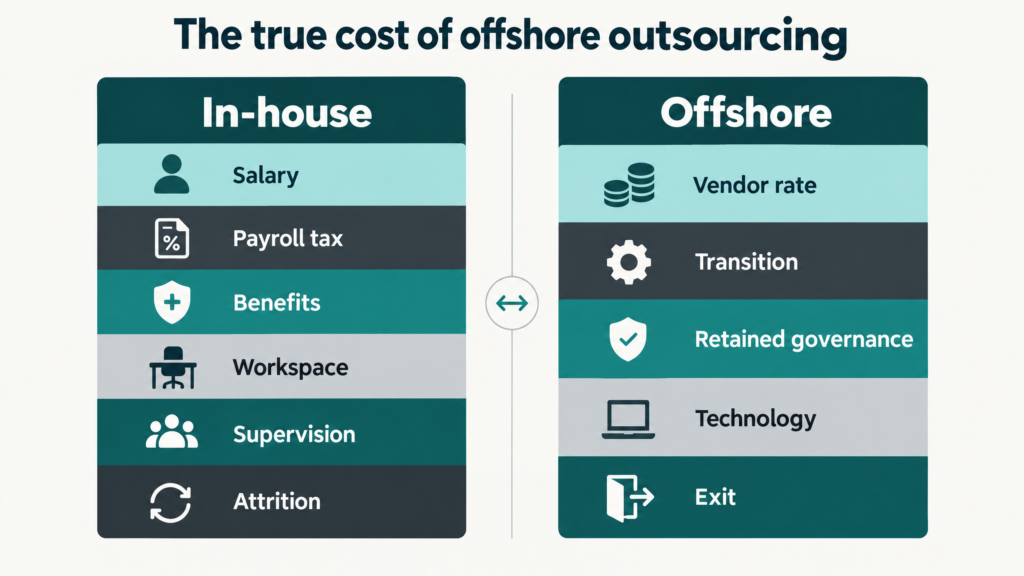
The fix is disciplined buying. Ask every bidder to price the same assumptions. That means productive hours per FTE, occupancy, shrinkage, management and QA ratios, and yearly increases. It also means shift premiums, currency basis, set-up fees, minimum volume and exit charges. Once costs are comparable, the destination becomes the deciding factor.
Choosing an Offshore Destination
Pick a destination on evidence, not reputation. Six factors carry most of the weight: time zone, English skills, size of the talent pool, staff turnover, power and network resilience, and data protection. Each has a common proxy measure. Each proxy also has limits.
| Destination | Working-hours fit | Main diligence risk |
| South Africa | Full UK overlap; partial US East overlap | Power resilience, site security and rand exposure |
| Philippines | Established night-shift delivery for the US; little UK daytime overlap | Weather exposure and site concentration |
| India | Strong UK mornings; US needs night shifts | Communication fit and programme-level attrition |
| Latin America | Strong US overlap; limited UK overlap | Varies sharply by country |
| Eastern Europe | Full UK overlap; partial US overlap | Wage convergence and geopolitical exposure |
On language, the EF English Proficiency Index 2025 ranks South Africa 13th with a score of 602. Poland is 15th with 600 and the Philippines 28th with 569. India scores 484. EF tests people who sign up online, so it reflects the talent market. It does not prove accent or customer satisfaction. On infrastructure, the World Bank’s Logistics Performance Index ranks South Africa 19th, India 38th and the Philippines 43rd. That index measures trade logistics, not call centre uptime.
No trusted index measures accent. A better test is a blind listening trial using your own call types. Compare the results on understanding, first contact resolution and satisfaction. For more detail by country, see the best outsourcing destinations for US companies, South Africa vs the Philippines and South Africa vs India.
South Africa as an Offshore Outsourcing Destination
South Africa is strongest for UK buyers. It also suits US East Coast work that does not need a full night shift. The sector has grown fast. BPESA reports that international GBS headcount rose from 65,000 in 2019 to about 150,000 in 2024. Revenue grew from $1.04 billion to about $2.91 billion.
Read the quality evidence carefully. Ryan Strategic Advisory’s buyer surveys placed South Africa joint second with the Philippines, behind India, in 2024. Its 2025 Offshore CX Confidence Index surveyed more than 220 CX and BPO leaders across 16 countries. These rankings measure buyer confidence. They do not give a customer satisfaction score by country. So if someone claims South Africa delivers a set percentage higher satisfaction than Asian locations, check the original method before you rely on it.
The risks are real, but they have shifted. Eskom reported 462 days in a row without load shedding by 21 August 2026, counting from 16 May 2025. Local load reduction still happens in places. On safety, Statistics South Africa’s 2025/26 survey found 80.7% of people felt safe walking alone by day but only 37.9% at night. That is why safe staff transport for late shifts and controlled site access belong in your checks.
Knowing where to go still leaves the question of what can go wrong once you get there.
Why Offshore Outsourcing Fails
Offshore programmes rarely fail on wages. They fail on quality, hidden cost and lost control. A systematic review of backsourcing found these were the most common reasons work came back in-house. Another study found poor quality in 65% of cases and excess cost in 49%. Poor supplier relationships featured in 41% and regulation in 14%.
| Failure mode | Preventive control |
| Unrealistic saving target | Baseline from fully loaded internal cost; show transition, retained team and exit costs separately |
| Wrong process selected | Move stable, measurable processes first |
| Knowledge transfer failure | Process maps, decision trees, certification tests and a parallel run |
| Weak quality | Measure accuracy, repeat contacts and rework, not just handling time |
| Provider staffing instability | Contract for programme-level attrition reporting by tenure and role |
| Lock-in | Data portability, knowledge escrow and a priced exit schedule |
| Business interruption | Dual power and connectivity, tested recovery seats and annual simulation |
Our guides to verifying offshore provider references and BPO contracts and SLAs cover these controls in depth. The last thing to settle before signing is data protection, because those duties stay with you.
Data Protection When Work Moves Offshore
A UK company stays responsible for UK GDPR when a provider handles its personal data overseas. If the destination has no UK adequacy ruling, you need an approved safeguard. That is normally the UK International Data Transfer Agreement or the UK Addendum to the EU standard contractual clauses. You also need a written transfer risk assessment. The ICO confirms that EU clauses on their own are not valid for a UK transfer.
US rules follow the data too. A provider that handles health data for a covered entity is usually a HIPAA business associate. It needs a compliant business associate agreement. The FTC Safeguards Rule says covered financial firms must choose capable providers, require safeguards in the contract and check them regularly. PCI guidance is clear that using a provider does not remove a merchant’s own duties. Our guide to outsourcing data security and compliance explains how to check these controls yourself.
A Ten-Question Test Before You Sign
Go ahead only if you can answer yes to all ten:
- Is the process written down, including decision rules and exceptions?
- Do you know your current fully loaded cost?
- Do you measure quality and customer outcomes today?
- Is the saving still worth it after transition and in-house oversight?
- Can sensitive data be reduced, masked or kept separate?
- Do you have a lawful way to transfer data abroad?
- Has the provider shown staffing evidence for your site and programme?
- Has backup been proven with test records, not just policies?
- Does the contract split security, compliance and operational duties clearly?
- Could you switch provider or bring the work back without losing data or know-how?
For a first programme, start small. Choose a contained process with steady volume. Run it in parallel for 60 to 90 days, with clear acceptance criteria and an agreed exit. Do not move a whole department at once.
Frequently Asked Questions
What is offshore outsourcing?
Offshore outsourcing is hiring an outside company in another country to run a business process for you. It usually runs under a master services agreement, a statement of work and an SLA. The provider employs the staff and runs the work day to day. You keep ownership of the process, the regulatory duties and the supplier oversight. It differs from captive offshoring, where you own and staff the overseas centre yourself.
What is the difference between offshoring and outsourcing?
Offshore describes location. Outsourcing describes who does the work under contract. A company-owned centre in India is offshoring but not outsourcing. A US company using a US provider is outsourcing but not offshoring. Offshore outsourcing combines both: an outside provider doing the work from another country.
What is offshore BPO?
Offshore BPO is business process outsourcing delivered from another country. Typical work includes customer service, finance and accounting, HR admin, back office processing, IT service desk and data processing. Estimates put the global BPO market at roughly $320 billion to $325 billion in 2025. Those figures include onshore work and do not separate out the offshore share.
How much can a company save with offshore outsourcing?
It depends on the process, the destination and how you build the comparison. Industry bodies cite figures such as 55% to 65% for South Africa. But these are rarely specific to your market, and they often leave out transition, oversight and exit costs. A reliable saving comes from comparing your full internal cost with a vendor price built on the same assumptions for hours, occupancy, shrinkage, supervision and yearly increases.
Which processes should not be outsourced offshore?
Keep some work onshore or under tight control. That includes strategy and pricing decisions, heavy regulatory judgement, frequent senior contact at home, unwritten know-how and open access to payment details. Very low volumes rarely cover the transition and oversight costs. Processes that are still changing fast should be settled before they move.
Why do offshore outsourcing projects fail?
Research points to three causes: poor quality, higher than expected cost and loss of control. One study found poor quality in 65% of cases where work came back in-house. Excess cost appeared in 49% and poor supplier relationships in 41%. Weak knowledge transfer, staff turnover and poor quality checks are the usual root causes.
Is South Africa a good destination for offshore outsourcing?
It is strongest for UK-facing work. It also suits US East Coast programmes that can staff afternoon and evening shifts. South Africa ranks 13th on the EF English Proficiency Index 2025 with a score of 602. Its international GBS workforce grew from about 65,000 in 2019 to 150,000 in 2024. Buyers should still check power backup, staff transport for late shifts and currency exposure.
Does UK GDPR still apply when data is processed offshore?
Yes. The UK company stays responsible. If the destination has no UK adequacy ruling, you need an approved safeguard such as the International Data Transfer Agreement or the UK Addendum. You also need a written transfer risk assessment. EU standard contractual clauses on their own are not valid for a UK transfer.
Afrishore BPO runs offshore customer service, back office and finance teams from Johannesburg for US and UK businesses. We design shifts around your market, and we build cost models on your full internal baseline rather than a headline percentage. For finance work see financial services outsourcing. For voice teams see call centre outsourcing in South Africa.
Talk to our team about scoping an offshore programme: https://afrishorebpo.com/business-process-outsourcing/