Claims processing outsourcing has moved from tactical cost reduction to strategic operations design. For US property and casualty insurers, AM Best’s first-half 2024 data shows a loss adjustment expense (LAE) ratio of 9.4% — meaning for every dollar earned in net premiums, nearly 10 cents goes purely to the cost of processing and adjusting claims, separate from indemnity payments. For UK insurers, FCA DISP compliance imposes additional timekeeping and audit obligations. The result: claims operations are expensive, heavily regulated, and well-suited to structured outsourcing — provided you draw the right line between what goes offshore and what stays.
The global claims outsourcing market was valued at $8.45 billion in 2024 and is projected to reach $15.91 billion by 2033 at a 7.3% CAGR. The adjacent insurance claims management services segment — more narrowly defined — sat at $1.51 billion in 2024, projected to $2.78 billion by 2034. This is not a marginal practice; it is a multi-billion-dollar sector with established delivery infrastructure in South Africa, India, and the Philippines.
Key Takeaways
- US P&C LAE ratio was 9.4% of net premiums earned in H1 2024 (AM Best). McKinsey benchmarks average claims processing cost at $15 per claim, with AI-enabled operations reducing that by up to 31%.
- The global claims outsourcing market reached $8.45B in 2024 and is forecast to hit $15.91B by 2033 (7.3% CAGR).
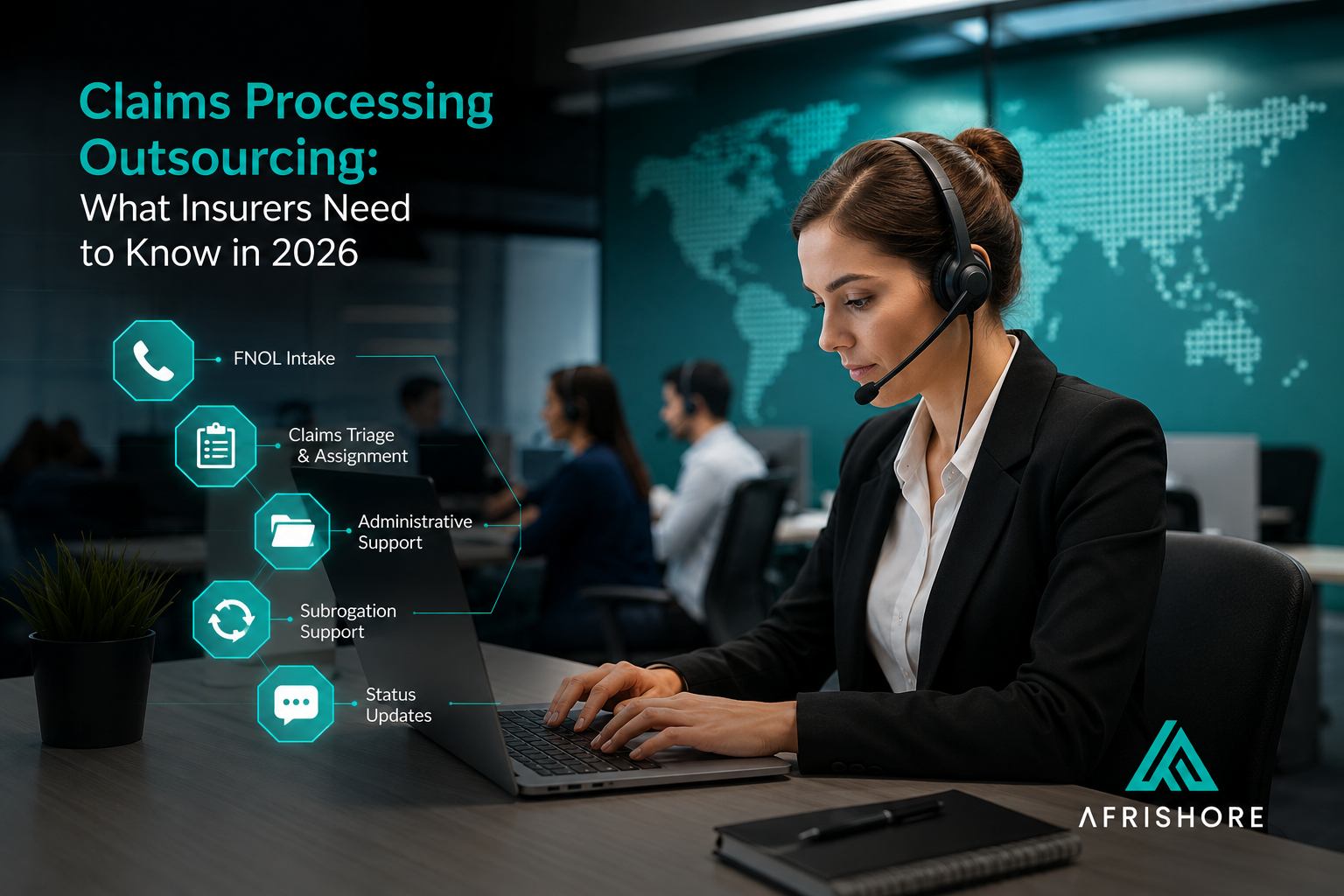
- Routine outsourceable functions: FNOL intake, claims triage, administrative support, subrogation support, outbound status updates. Not outsourceable without close governance: coverage decisions, liability assessment, reserve-setting, litigation strategy.
- South Africa delivers 55–65% cost savings versus US/UK in-house claims teams, with a workforce of 150,000 GBS professionals and the UK as its largest source market.
- Offshore teams operate in core claims platforms (Guidewire, Duck Creek, Majesco) via role-based access with full audit trails — the technology infrastructure already exists to make this work.
- UK DISP requires clean claims responses within defined windows. US state prompt-pay rules typically require electronic claims paid or denied within 30 days. Offshore SLAs must be structured to meet these timelines.
The Cost Reality: Why Claims Operations Are Under Pressure
McKinsey benchmarking data puts the average cost to process a single claim in the US at approximately $15 — against an average payout of $430. That means processing cost is roughly 3.5% of total premiums collected, on top of indemnity. Per-claim cost by complexity:
| Claim type | Processing cost (operations only) |
| Low-complexity: personal auto/home (straight-through) | ~$10–$25 per claim |
| Moderate-complexity: auto injury, small commercial | ~$25–$45 per claim |
| High-complexity: workers’ comp, large commercial, liability | ~$40–$100+ per claim |
McKinsey’s 2025 AI research on insurance operations found that across 190+ processes studied in Europe, insurers can automate up to 70% of straightforward claims tasks and reduce claims service costs by up to 31% when AI is deeply integrated. Aviva’s motor claims transformation deployed over 80 AI models, reducing liability assessment time for complex cases by 23 days, improving routing accuracy by 30%, reducing complaints by 65%, and saving over £60 million in 2024. These gains come from combining AI-assisted decision layers with well-structured offshore operations — not from AI alone.
What Can Be Outsourced in Claims Processing
The framework most claims VPs and COOs use is simple: non-core, high-volume, rules-based work is outsourceable. Core work — where expert judgment, regulatory accountability, or licensed authority is required — is retained in-house. Here is where the practical line sits.
Routinely outsourceable:
- FNOL (First Notice of Loss) intake: Outsourcing providers handle FNOL via phone, web, and digital channels including data capture, document collection, and preliminary status updates. This is among the most common claims BPO functions and one of the highest volume. Afrishore BPO’s dedicated FNOL outsourcing to South Africa service is built on this model.
- Claims triage and assignment: Offshore teams perform severity scoring, basic coverage verification against policy data, and routing to the appropriate adjuster or team using rules engines in Guidewire ClaimCenter or Duck Creek Claims.
- Administrative claims support: Document indexing, data entry into the core system, diary management, follow-up communications, and non-complex adjudication support.
- Subrogation and recovery support: Identifying recovery opportunities, preparing recovery records, and managing routine follow-ups under clear scripts and thresholds set by the carrier.
- Outbound claim status communications: Keeping claimants updated on documentation requirements, timelines, and next steps.
Functions with tighter regulatory constraints:
- Medical bill review and reserving: Healthcare and workers’ compensation claims outsourcing focuses on administrative tasks (eligibility checks, charge capture, basic edits). Clinical review, complex medical necessity determinations, and ultimate reserve decisions must stay with licensed professionals and carrier actuaries.
- Coverage disputes and complex liability: AI and offshore teams can help assemble evidence and draft recommendations, but final liability and coverage determinations in complex or contested cases must remain human-led, as McKinsey’s framing of future claims work confirms.
- Litigation management: Third-party providers may support litigation administration (document handling, scheduling, data entry) but decisions on settlement strategy, legal holds, and negotiation authority sit with in-house claims legal teams.
- Complaints handling under FCA DISP (UK): Offshore teams can log, acknowledge, and support investigation, but the final DISP response and redress assessment carries UK regulatory accountability that must be retained by the FCA-authorised firm.
This distinction — non-core to offshore, core to onshore — is codified in published insurance BPO frameworks. Liveops’ insurance outsourcing model uses the same structure: FNOL, status updates, and non-complex adjudication support go offshore under standardised governance; coverage decisions, reserving, and regulated complaints stay onshore.
Technology Integration: How Offshore Teams Work in Your Claims Platforms
One of the most common objections to claims processing outsourcing is technology integration. In practice, the infrastructure already exists.
Core claims platforms: Guidewire InsuranceSuite (PolicyCenter, BillingCenter, ClaimCenter) serves over 300 carriers globally and is the dominant claims system of record. Duck Creek Claims and Majesco Claims are cloud-native alternatives with pre-configured FNOL, triage, investigation, reserving, and payment workflows. All three support structured claim types with documented workflows that offshore teams can follow using role-based access.
Integration model: Modern claims decision layers now integrate with Guidewire, Duck Creek, and Majesco via APIs and webhooks. Vendors offer pre-built connectors that allow offshore teams to work inside the same workflow environment as onshore adjusters — with role-based access controls, full audit trails, and documented authority matrices. The offshore team sees exactly what the carrier wants them to see, acts within the authority limits the carrier sets, and every action is logged in the same system of record.
What AI is handling vs what still needs humans: McKinsey’s 2025 work describes “augmented claims management” — AI models that ingest adjuster notes, damage images, documents, and claim histories to support decisions, not replace adjusters. By 2030, McKinsey projects more than half of claims activities will be automated, with human adjusters focusing on complex, unusual, contested, or systemic-risk claims. The practical near-term picture: AI automates document verification, OCR-based form validation, data extraction, and initial severity scoring. Offshore teams handle the remaining administrative processing. Onshore teams handle judgment-heavy decisions. This three-layer model is how leading carriers are structuring claims operations today.
Data security for PII/PHI: For US health-adjacent claims, HIPAA Business Associate Agreements (BAAs) govern the offshore team’s access to Protected Health Information. For UK claims, FCA DISP requires complete communications trails and long-term retention of complaint and claim-related records — often three years or more, up to 15 in specific motor finance contexts. Offshore operations must be structured with encryption, controlled access, and rigorous logging from day one.
South Africa’s Claims Processing Capability
South Africa’s Global Business Services sector employs approximately 150,000 professionals as of 2024, up from 65,000 in 2019. The UK accounts for approximately 55% of international GBS headcount, making it the dominant source market. The US has grown to approximately 33% of headcount, up from just 1% in 2019 — significant growth driven partly by US insurance and financial services demand.
BPESA’s value proposition highlights “deep domain knowledge in financial services” and “expertise in voice, omnichannel CX, and complex process management” — the same capabilities that claims intake, triage, and administrative support require. Insurance accounts for approximately 20% of new international GBS jobs created in 2024, second only to energy and utilities.
Cost savings: BPESA’s national value proposition quantifies 55–65% cost savings versus Dallas (US), Manchester (UK), and Sydney (Australia) equivalents for contact-centre and complex process work, with government incentives providing a further 7–10% reduction in operating expenses. For a US claims team where a fully loaded adjuster support role costs $70,000–$90,000 per year, the South Africa equivalent runs approximately one-third of that cost. For UK carriers, the Afrishore BPO insurance claims outsourcing service is built around these economics.
Workforce capability: South African short-term insurers have built claims workflow automation using enterprise claims systems and agile delivery, demonstrating local expertise in the same platforms and process design that international claims work requires. The EF English Proficiency Index 2024 ranks South Africa 11th globally and first in Africa with a proficiency score of 594 — above Romania, Poland, and the Philippines.
Quality, Compliance, and SLA Requirements
US timeliness standards: State prompt-pay and clean-claim laws vary but typically require clean electronic claims to be paid or denied within 30 days (paper: 45 days). Washington requires 95% of monthly clean claim volume paid within 30 days and 95% of all claims paid or denied within 60 days. DOI inquiry deadlines are typically 10–21 business days. Offshore SLAs must map directly to these requirements — not approximate them.
UK FCA DISP: The FCA’s Dispute Resolution sourcebook requires responses to complaints within eight weeks of receipt, either with a final response or an explanation of delay. The three-day rule applies to complaints resolved by close of the third business day. Records must be maintained for at least three years, with longer retention in specific sectors. Offshore claims support teams must operate within DISP documentation and timekeeping requirements, with complete communication trails for all complaint and claim-related interactions.
Audit trails and documentation: Modern claims platforms provide business-critical information in real time, with dynamic workflows, task orchestration, and analytics that make predictable, auditable processes the default — not the exception. Offshore teams working inside Guidewire or Duck Creek with role-based access and documented authority matrices produce the same audit trail as onshore teams.
Vendor selection criteria for claims VPs and COOs:
- Evidence of SLAs aligned with US state prompt-pay requirements and UK DISP timelines
- Documented operation within your core claims platform (Guidewire, Duck Creek, Majesco) with role-based access and full audit trails
- Written authority matrix distinguishing routine rules-based tasks from regulated judgment-heavy tasks
- E&O (errors and omissions) insurance coverage for claims processing activities
- Escalation protocols for fraud referrals, coverage disputes, and complex liability situations
- ISO 27001 or equivalent data security certification; BAA capability for US health-adjacent claims
How to Structure the Outsourcing Engagement
Phase 1 — Scope definition (weeks 1–2): Map every claims workflow by volume, complexity, and regulatory sensitivity. Identify which processes clearly meet the “non-core, high-volume, rules-based” threshold. Define the authority matrix — what the offshore team can decide vs what escalates to onshore adjusters. This phase often reveals that more is outsourceable than initially assumed, once authority limits are clearly written down.
Phase 2 — Platform access and configuration (weeks 2–4): Configure role-based access in the claims platform, set up audit logging, establish VPN or secure access protocols, and complete data security due diligence including BAA (if applicable) and IDTA/data processing agreement (for UK-origin data).
Phase 3 — Knowledge transfer and parallel running (weeks 4–8): Train the offshore team on claim types, product specifics, and escalation protocols. Run the offshore team in parallel with the onshore team for high-volume processes to validate accuracy, turnaround time, and escalation calibration before full handover.
Phase 4 — Steady state (week 8+): Full operations with weekly performance reviews, monthly SLA reporting, and quarterly business reviews. Target accuracy rates of 98%+ on data entry and document processing, sub-24-hour turnaround on FNOL capture and standard documentation workflows, and clear metrics on escalation rates to onshore adjusters.
For business process outsourcing to South Africa, the full engagement structure includes compliance documentation, technology integration, and phased go-live — not a lift-and-shift.
FAQs
What is claims processing outsourcing? Claims processing outsourcing is the delegation of insurance claims administrative and support functions — FNOL intake, triage, documentation, subrogation support, status communications — to a third-party BPO provider, typically in an offshore or nearshore location. The carrier retains authority over coverage decisions, reserving, and litigation strategy. The BPO provider handles volume, rules-based work within defined authority limits and SLAs.
What percentage of claims operations can be outsourced? For most P&C carriers, 60–75% of claims interactions are administrative in nature — FNOL, documentation, status updates, data entry, scheduling, follow-up communications. These are strong candidates for outsourcing. Coverage decisions, reserve-setting, complex liability assessment, and regulated complaints handling must remain with the carrier’s own staff or closely governed captive operations.
How much does claims processing outsourcing cost in South Africa? BPESA’s national value proposition puts cost savings at 55–65% versus US/UK equivalent operations before government incentives, with incentives adding a further 7–10% reduction. A US claims support role costing $70,000–$90,000 fully loaded can be delivered in South Africa for approximately $25,000–$35,000. For UK carriers, Afrishore BPO’s insurance claims outsourcing service provides FCA-compliant delivery at similar cost differentials.
How do offshore claims teams integrate with Guidewire or Duck Creek? Offshore teams access claims platforms via role-based user accounts with documented authority limits — they see the claim data, follow the workflow, and take actions within their defined scope. Modern platforms including Guidewire ClaimCenter and Duck Creek Claims support this model natively with full audit trails, access controls, and workflow management. The offshore team works inside the same system of record as onshore adjusters.
What regulatory standards apply to outsourced US claims processing? US state prompt-pay laws typically require clean electronic claims to be paid or denied within 30 days. DOI inquiry deadlines are 10–21 business days. For health-adjacent claims, HIPAA BAAs govern offshore access to PHI. For workers’ comp, state-specific DOI regulations apply. Offshore SLA structures must map to these requirements, with performance reporting demonstrating compliance.
How does the UK FCA regulate outsourced claims handling? FCA SYSC 8 requires that firms cannot outsource their regulatory obligations — they remain accountable for all outsourced functions. FCA DISP requires complaints and claims to be handled within defined timelines (typically 8 weeks for a final response), with records maintained for at least 3 years. Consumer Duty requires that outsourced support delivers good outcomes. The offshore provider must be integrated into the carrier’s governance, QA, and outcomes monitoring frameworks.
Can South African providers handle US workers’ compensation claims? Administrative and support functions — FNOL capture, documentation, status communications, claims scheduling — can be handled by well-trained South African teams with workers’ comp-specific training. Licensed adjusting functions, reserve decisions, and medical review require licensed professionals — these are typically retained onshore or within captive operations. Afrishore BPO’s call centre outsourcing service for insurance includes workers’ comp support capability with US-trained agents.
Structured Correctly, Claims Processing Outsourcing Reduces Cost Without Transferring Risk
The case for claims processing outsourcing rests on a clear distinction: delegate what is rules-based and high-volume, retain what is judgment-heavy and regulated. With that architecture in place — and with the offshore team operating inside your claims platform, under your authority matrix, and within your SLA framework — you achieve 30–40% cost reduction on claims operations without transferring regulatory accountability.
South Africa’s 150,000-strong GBS workforce, its established track record with UK and US insurance clients, and its cost profile at 55–65% below onshore equivalents make it the most mature offshore destination for this work. Afrishore BPO’s insurance claims outsourcing service is structured for this exact model — FCA-compliant, HIPAA-aware, and built around the claims platform integrations US and UK carriers already run. For a conversation about what your claims operations could look like with South Africa in the delivery chain, speak to Afrishore BPO.