
Quick Answer: Cultural alignment in outsourced customer support is a measurable operational variable, not a soft talking point. It breaks into six testable components: language fluency and accent intelligibility, idiom comprehension, shared consumer reference points, communication style, service expectations, and regulatory familiarity. The evidence matters because peer-reviewed research in the Journal of Service Research found that unfavourable accents reduced customers’ voluntary participation in service encounters even when intelligibility was controlled for, meaning perception, not comprehension, was driving the behaviour.
Key Takeaways
- Treat cultural alignment as six measurable components, each with its own test, rather than as a single vague quality you either have or lack.
- Accent bias and comprehension failure are different problems with different fixes. Research consistently shows that stereotyping mediates customer reactions independently of whether the customer actually understood the agent.
- Listener familiarity moderates the effect. Where listeners are familiar with an accent, negative attitudes substantially diminish, which is why exposure matters as much as elocution.
- Cultural sensitivity varies enormously by contact type. Complex complaints and regulated financial conversations are highly sensitive; back-office non-voice work is barely sensitive at all. Decide process by process, not vendor-wide.
- AI narrows the gap for structured, low-risk interactions and does not close it for emotional or complex ones. Speech recognition also underperforms for non-native accents, which creates its own exclusion risk.
- Test rather than trust. Call samples, mystery shopping and site-level satisfaction reporting are the only reliable evidence; a provider unable to break satisfaction down by delivery location is telling you something.
Six Components You Can Actually Measure
Cultural alignment is the degree to which agents share enough contextual understanding with customers to interpret intent correctly, match tone without scripting, and exercise judgement when a conversation leaves the standard flow. That definition is useful only if it decomposes into things you can test, and it does.
| Component | What it means operationally | How to measure it |
| Language fluency and accent intelligibility | Speaking and comprehending at a level supporting real-time problem solving without repeated clarification | CEFR B2 to C1 thresholds, automated speaking assessments, transcription-based intelligibility scoring |
| Idiom and colloquialism comprehension | Understanding informal expressions and region-specific phrasing | Scenario-based listening tests, QA scoring on idiom handling, customer effort score on clarification loops |
| Shared consumer reference points | Familiarity with brands, holidays, payment methods and shipping norms in the customer’s market | Mystery shopping, calibration on locale-specific scenarios, satisfaction segmented by delivery location |
| Communication style directness | Matching the customer’s expected formality, directness and small talk | QA scorecards with empathy and tone criteria, customer feedback on whether the agent understood their situation |
| Service expectations and norms | Knowing what good service means in that market, including speed versus thoroughness and escalation norms | Market-specific SLA training, first contact resolution and escalation benchmarking by region |
| Regulatory and commercial familiarity | Knowing what agents can and cannot say under GDPR, PCI-DSS, HIPAA or local consumer law | Compliance audits, error rates on regulated scripts, incident tracking |
The practical value of this breakdown is that it separates problems with different solutions. Idiom comprehension responds to training. Regulatory familiarity responds to certification and QA. Accent perception, as the research below shows, responds to neither in a straightforward way.
What the Research Actually Shows
The strongest evidence comes from a study of 1,027 participants across banking, air travel and guided meditation services, published in the Journal of Service Research. Customers contributed less discretionary information and were less willing to co-produce the service when the employee had an unfavourable accent. In a real-world guided meditation task where participation directly improved the service outcome, the effect size was medium.
Two findings from that work deserve particular attention from anyone evaluating a provider. First, accent-based stereotypes around perceived competence, attractiveness and dynamism mediated the effect, which means customers’ biased perceptions rather than comprehension failure drove the behaviour change. Second, and more uncomfortably, intelligibility alone did not neutralise the effect. Even when customers could understand the agent perfectly well, an unfavourable accent still reduced their willingness to engage.
That finding should change how you read vendor claims. A provider demonstrating that its agents are intelligible has not demonstrated that customer behaviour will be unaffected, because those are different variables.
Set against that, research on accent familiarity offers the more actionable finding: when listeners are familiar with an accent or the speaker, prejudice and negative attitudes largely vanish. Related work on accent bias in professional evaluations and on raters’ accent familiarity in assessment settings points the same way, and neurolinguistic work on semantic processing of regional varieties shows that less familiar varieties measurably increase listener processing effort even when the words are understood.
An important honesty note. Most academic work in this area measures attitudes, participation intentions or stereotyping, not hard operational metrics like average handle time or churn. The link from accent to those KPIs is typically inferred from vendor case studies and internal benchmarking rather than established by peer-reviewed causal research. Any provider quoting you a precise percentage improvement in handle time from accent training is citing marketing, not science. A review of accent discrimination at work and research on accents in global virtual teams give a fuller picture of what is and is not established.
Three Terms People Confuse
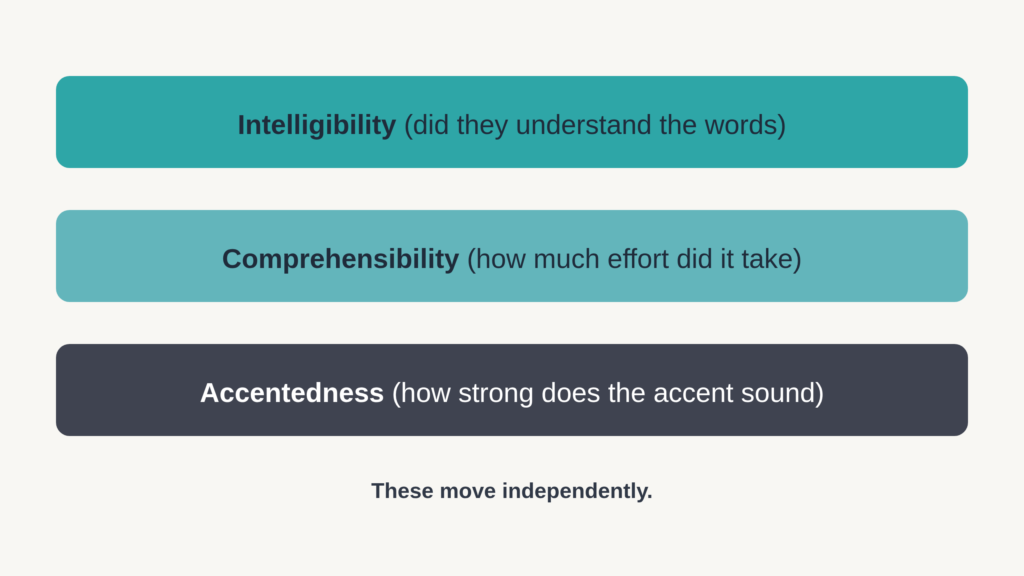
Linguistics distinguishes three constructs that get collapsed in commercial conversations, and separating them clarifies what you are actually buying.
Intelligibility is actual understanding, measured through transcription accuracy. Comprehensibility is perceived ease of understanding, measured through listener ratings. Accentedness is perceived strength of foreign accent, and it is independent of whether the listener understood anything.
An agent can be highly intelligible and strongly accented. A customer can rate a call as hard work while transcribing every word correctly. Work on developing listeners’ receptiveness to varieties of English and on how language experience shapes sociolinguistic judgement shows the gap between these measures is real and moves independently.
The commercial implication is that improving actual intelligibility, whether through training or technology, may not fully neutralise customer bias unless it is accompanied by familiarity-building. That is a genuinely awkward conclusion for the industry, and it is why the honest framing of the South African case below is about familiarity and exposure rather than about the absence of an accent.
Where Cultural Alignment Matters, and Where It Does Not
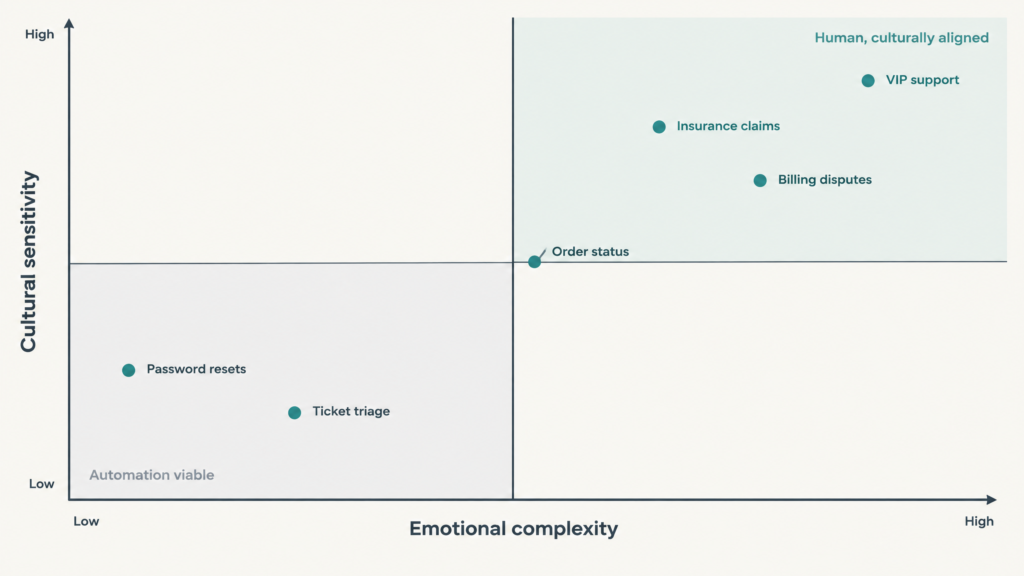
The most expensive mistake in this area is treating cultural alignment as a single vendor-wide requirement. Sensitivity varies enormously by contact type, and the right answer is usually a channel-by-channel and process-by-process split.
| Sensitivity | Contact type | Why | Sensible approach |
| Highest | Complex complaint handling, billing disputes, service failures | Emotionally charged, needs empathy, tone matching and judgement on escalation | Voice with culturally aligned agents, avoid pure automation for escalations |
| Highest | Financial services, banking, insurance | Regulatory sensitivity, high stakes, customers expect familiarity with local products | Culturally trained voice agents, QA on both compliance and tone |
| High | Healthcare, patient support, appointment booking, claims | Empathy and trust critical, regulatory constraints | Culturally trained agents with compliance depth, automation for admin only |
| High | High-value retail, VIP and concierge support | Brand voice and exclusivity expectations, customers detect dissonance fast | Culturally aligned agents, limit automation to FAQs and order tracking |
| Moderate | General retail and ecommerce, order status, returns | Transactional but can escalate, idiom comprehension matters on returns policy | Voice and chat mix, offshore workable with strong QA and idiom training |
| Low | Simple transactional, password resets, tracking, basic FAQs | Low emotional load, script driven, clarification loops cheap | Chat or email, automation viable, alignment less critical |
| Lowest | Back-office non-voice, data entry, ticket triage, email tagging | No direct customer interaction | Any location with strong process discipline, optimise for cost and accuracy |
Read that table as a budget allocation tool. Paying a premium for cultural alignment on back-office ticket triage is waste. Economising on it for complaint handling in a regulated sector is where churn comes from. Our guide to choosing the right call centre service covers how to structure that split across a vendor portfolio.
What AI Changes in 2026, and What It Does Not
Automation genuinely narrows the cultural gap in some places. Agent assist provides script suggestions, knowledge retrieval and compliance guardrails, which improves consistency. Real-time translation makes multilingual coverage economically possible where it previously was not. Accent modification technology, which adjusts phonetic pronunciation in real time while preserving voice timbre, is being deployed at scale.
It does not close the gap in the places that matter most. Automation struggles with complaints, refunds, billing disputes and high-value interactions where cultural judgement and empathy carry the conversation. Literal translation loses a substantial share of contextual meaning and most emotional nuance. Voice multilingual support remains weak on accent quality, code-switching and latency compared with the same platforms’ text performance.
There is also a bias problem running in the opposite direction to the one people expect. Research on AI voice services documents that speech recognition underperforms for non-native accents and dialects, which risks digital exclusion of exactly the customers a multilingual strategy is meant to serve. Work on designing AI agents for many voices sets out the design implications.
Accent modification raises a question you should decide deliberately rather than by default. Customers are rarely told that an agent’s accent is being altered, which raises transparency issues if it is discovered, and critics argue the practice amounts to accentism for commercial benefit that discriminates against the workers whose voices are changed. Whatever position you take, take it consciously and write it into your vendor standards.
The practical guidance is unglamorous: use automation for structured, low-risk interactions, and retain human agents wherever cultural judgement, empathy or high value is in play. Our comparison of AI chatbots against outsourced support agents covers the cost side of that split.
How to Measure It Operationally
Three mechanisms give you evidence rather than assurance.
Language proficiency frameworks give you a floor. The Common European Framework of Reference for Languages sets B2 to C1 as the sensible target band for customer-facing voice roles, and automated speaking assessments screen for fluency, pronunciation clarity and response speed under pressure. At country level, the EF English Proficiency Index is a reasonable workforce-planning input, though it says nothing about any individual agent.
QA scorecards give you ongoing signal, provided they score the right things. Include empathy, tone matching, idiom handling and cultural appropriateness as explicit criteria, not just script adherence, because script adherence is precisely the measure that cannot detect cultural mismatch.
Satisfaction segmentation by delivery location gives you the outcome measure. Track satisfaction and first contact resolution by site rather than in aggregate, because aggregate numbers hide site-level variance, which is the entire thing you are trying to observe. For context on where those numbers should sit, SQM Group’s first contact resolution benchmarking gives cross-industry averages and top-performer levels, and lower resolution rates correlate strongly with repeat contacts and churn.
The South African Case, Stated Honestly
South Africa scores highly on English proficiency, placing in the very high band on the EF index and first in Africa. English is a language of business and instruction, the graduate pipeline is substantial, and the global business services sector has been adding international-facing jobs at pace.
The honest version of the accent argument is not that South African agents have no accent. Everyone has an accent. It is that South African English sits closer to British English in its phonetic patterns, that agents typically have high exposure to US and UK media, brands and consumer norms, and that a large share of the sector’s headcount already serves UK and US clients. In the terms the research uses, this is a familiarity and exposure argument rather than an accentedness one, and familiarity is the variable the evidence says actually moves listener attitudes.
Time zone reinforces it. South Africa runs on UTC+2 year round, giving substantial daily overlap with UK business hours and covering the US East Coast morning and midday without night-shift premiums. That matters for cultural alignment specifically, because agents working the customer’s daytime share the customer’s news cycle and rhythm in a way night-shift teams structurally cannot.
Lower attrition than the largest offshore markets is the underrated factor. Cultural training is an investment that compounds over tenure, and a team turning over rapidly never accumulates the contextual knowledge that alignment depends on. Ask any provider for its attrition figure and treat a number above 30% without a clear retention plan as a warning about cultural fit, not just cost. Our South Africa BPO statistics page covers the sector data, and best outsourcing destinations for US companies compares locations directly.
A Buyer’s Evaluation Framework
Run three tests before signing, in this order.
Request 10 to 20 recorded calls per site for your top three contact types, and listen specifically for clarification loops, idiom handling and tone matching. This is the single most informative thing you can do and it costs nothing.
Run five to ten live mystery-shop calls per site on genuinely complex scenarios such as a complaint, a refund and an escalation, scoring empathy, cultural reference accuracy and whether the matter resolved without unnecessary transfers.
Require documented proof that agents meet a defined proficiency threshold for voice roles rather than accepting a general assurance.
Then write the findings into the contract. Require monthly satisfaction reporting broken down by delivery location, set first contact resolution and handle time targets by contact type and site, track escalation and repeat-contact rates within seven days by site with service credits attached, and require disclosure of attrition and average time to cultural parity per site.
Four warning signs indicate overstated cultural fit. A provider that cannot or will not break satisfaction down by location. Generic global training claims with no market-specific calibration, no UK versus US script variants and no mystery shopping results. High attrition presented without a retention plan. And accent modification technology pitched as the primary solution with no evidence of idiom or cultural immersion training underneath it. Our guide to verifying offshore BPO provider references covers the diligence process, and offshore BPO bait-and-switch covers what happens when the team you evaluated is not the team you get.
Frequently Asked Questions
Is cultural alignment in outsourcing a real, measurable factor or just marketing? It is measurable. It breaks into six components, each with an established test: language fluency and accent intelligibility, idiom comprehension, shared consumer reference points, communication style, service expectations, and regulatory familiarity. Peer-reviewed research in the Journal of Service Research found unfavourable accents reduced customers’ voluntary participation in service encounters with a medium effect size, even when intelligibility was controlled for.
Does accent actually affect customer satisfaction, or is that just bias? Both, and they are separable. Research shows accent-based stereotypes around perceived competence and dynamism mediate customer reactions independently of whether the customer understood the agent. Intelligibility alone did not neutralise the effect in controlled study conditions. So part of the effect is genuine comprehension difficulty and part is listener bias, which is why intelligibility training alone does not fully solve it.
What is the difference between intelligibility, comprehensibility and accentedness? Intelligibility is actual understanding, measured by transcription accuracy. Comprehensibility is perceived ease of understanding, measured by listener ratings. Accentedness is perceived strength of foreign accent, independent of understanding. An agent can be fully intelligible and strongly accented, and a customer can rate a call as hard work while understanding every word. They move independently and need separate measurement.
Does accent neutralisation training work? Independent peer-reviewed evidence on long-term effectiveness is scarce, and most published claims come from vendor case studies rather than controlled research. The stronger evidence points elsewhere: listener familiarity with an accent substantially reduces negative attitudes, which suggests exposure and familiarity-building matter at least as much as pronunciation training. Treat precise percentage claims about handle time improvements with scepticism.
Which contact types most need culturally aligned agents? Complex complaint handling and regulated financial conversations are the most sensitive, followed by healthcare and high-value retail. General ecommerce is moderately sensitive, simple transactional contacts are low, and back-office non-voice work is barely sensitive at all. Allocate budget accordingly rather than applying one standard across every process.
Can AI translation and accent modification solve cultural mismatch? Only partially. Automation helps with structured, low-risk interactions and improves consistency through agent assist and compliance guardrails. It does not handle complaints, refunds or high-value conversations well, literal translation loses substantial contextual and emotional meaning, and speech recognition underperforms for non-native accents, which creates its own exclusion risk. Accent modification also raises disclosure and ethics questions worth deciding deliberately.
How do I test a provider’s cultural fit before signing? Request 10 to 20 recorded calls per site across your top three contact types and listen for clarification loops, idiom handling and tone matching. Run five to ten live mystery-shop calls per site on complex scenarios. Require documented proof of a defined language proficiency threshold for voice roles. Then require monthly satisfaction reporting segmented by delivery location in the contract.
Why is South Africa often recommended for UK and US customer support? It scores in the very high band on English proficiency, English is a language of business and instruction, and agents typically have high exposure to UK and US media, brands and consumer norms. The accurate framing is familiarity and exposure rather than absence of accent, and familiarity is the variable research shows actually moves listener attitudes. Time zone overlap with the UK and the US East Coast, and lower attrition than the largest offshore markets, reinforce it.
Afrishore BPO builds culturally aligned support teams from Johannesburg for UK and US brands, with named agents, recorded calls, QA scoring that includes tone and idiom handling, and satisfaction reporting by delivery location. Our guides to outsourcing customer support to South Africa and why companies outsource to South Africa cover the wider case, and South Africa versus the Philippines compares the two largest options directly.
Ask us for call samples at https://afrishorebpo.com/business-process-outsourcing/.