Quick Answer: Choosing a contact centre outsourcing partner means matching a provider’s channel coverage, technology platform, security posture, workforce practices, and quality framework to your programme, then holding them to a small set of contractual SLAs. The market rewards buyers who look past hourly rates: the global call and contact centre outsourcing market reached $102.59 billion in 2024 and is forecast to grow at roughly 9% a year, driven by rising CX expectations and the shift from voice-only call centres to omnichannel, cloud-delivered platforms.
Key Takeaways
- The distinction that matters most is a call centre (voice only) versus a contact centre (voice plus email, chat, messaging, and social from a unified platform with a shared customer record); modern buyers should specify true omnichannel, not just multiple channels.
- Cloud is now the default: about 34% of companies already use CCaaS and a further 18.9% plan to adopt it by end of 2025, while on-premise platforms are in decline.
- Evaluate on nine dimensions: inbound versus outbound fit, omnichannel capability, CCaaS technology, security and compliance, workforce management, quality assurance, SLAs and reporting, scalability, and pricing model.
- Benchmark performance before you sign: industry-average first contact resolution is about 69% and world-class is 80% or higher, with the 80/20 service level (80% of calls answered within 20 seconds) a common baseline.
- Contractualise only 5 to 8 critical SLAs (service level, FCR, CSAT, quality score, abandonment, cost per interaction, attrition) with defined measurement methods and service credits.
- The recurring failures are predictable: bait-and-switch staffing, under-specified SLAs, hidden ramp costs, high attrition, and misaligned incentives that reward speed over resolution.
- South Africa is a leading English-language destination, with sector headcount around 150,000 and export revenue near $2.91 billion in 2024, strong CSAT and NPS outcomes, and a 1 to 2 hour UK time overlap.
Call Centre vs Contact Centre: What You Are Actually Buying
A call centre handles telephone interactions only; a contact centre manages voice plus email, chat, messaging, and social from a single platform where the customer’s history travels across channels. Getting clear on which one you need shapes every later decision, because the technology and the staffing model both follow from your channel mix.
The industry defines a call centre as a telephony-centric operation built on tools like automatic call distribution, IVR, and diallers, with any digital channels handled in separate, unintegrated systems. A contact centre unifies channels so an agent sees prior contacts regardless of where they happened, which is the difference between true omnichannel and simple multichannel. In practice, most modern contact centres still handle a majority of interactions by voice but supplement it with digital channels, self-service, and AI. For buyers, the practical test is whether the provider runs an integrated omnichannel platform, not just a list of channels. If you want the definitional groundwork first, our explainer on what a BPO call centre is and the BPO versus call centre comparison cover the categories in depth.
The Selection Framework: Nine Dimensions to Score
Judge partners on nine dimensions rather than headline rate, and turn them into a weighted scorecard you apply to every shortlisted provider. The rate is the least reliable signal of value, so the discipline of scoring the operating model is what separates a genuine managed partner from a body shop with a nicer deck.
Begin with inbound versus outbound fit, because the two have different regulatory and operational profiles and few providers excel at both; ask for programme-level data on similar work, not company averages. Next, omnichannel capability: confirm which channels run from one platform with a shared record, and how digital channels are staffed. Third, technology and CCaaS: modern buyers increasingly specify a cloud-native platform recognised in Gartner’s CCaaS Magic Quadrant, such as NICE, Genesys, Amazon Connect, Five9, or Talkdesk, with CRM integration and shared dashboards. Fourth, security and compliance: ISO 27001 as a baseline, PCI-DSS with DTMF masking where agents take card payments, and GDPR or UK-GDPR data-processing terms for UK and EU data. We treat this layer in full in our guide to evaluating a partner’s data security and compliance.
The remaining five dimensions are operational. Probe workforce management (forecasting method, schedule adherence around 85% to 90%, occupancy targets of 75% to 85%), a real quality assurance framework (sampling, client calibration, speech analytics, and coaching that feeds back into training), a disciplined SLA and reporting regime, honest scalability (ramp timelines and maximum surge without breaching SLAs), and a pricing model matched to your demand. Training quality in particular is often the hidden variable behind consistent performance, which is why we cover BPO agent training quality separately. For the customer-service angle specifically, our companion piece on customer service outsourcing companies complements this call-and-contact-centre view.
The KPI Benchmarks That Matter
Hold a provider to a small set of benchmarked metrics: first contact resolution, CSAT, average handle time, average speed of answer, service level, abandonment, and occupancy. Benchmarks give you a defensible target for each, so governance meetings can focus on root causes rather than arguing about what good looks like.
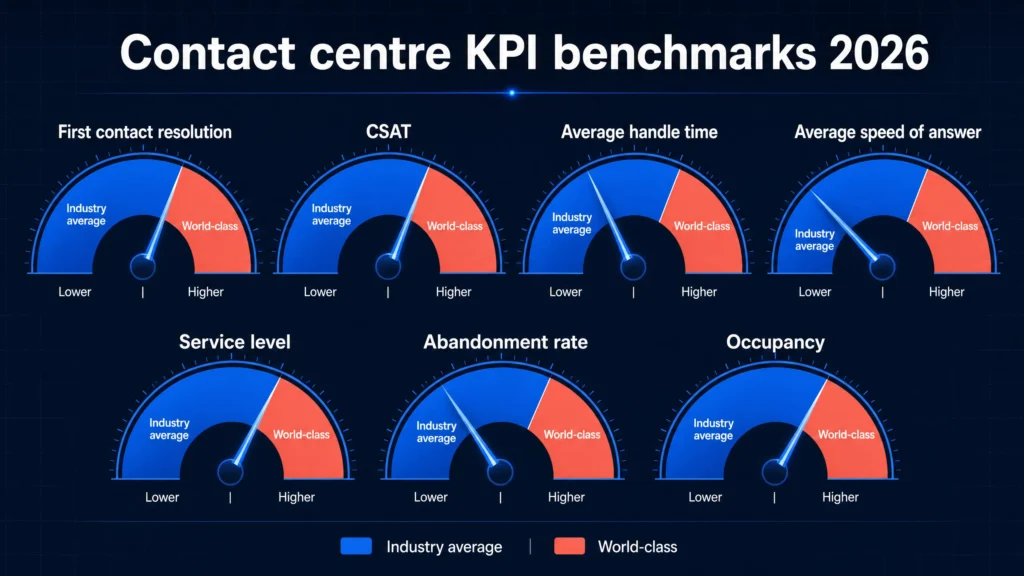
The published benchmarks are consistent across the major sources. SQM Group’s 2024 study of more than 500 North American contact centres puts average first contact resolution at about 69%, with world-class at 80% or higher, and average post-call CSAT at about 78%, with world-class at 85% or higher. Nectar Desk’s 2026 compilation and CallForce’s benchmark tool align on the rest, and Armatis frames how these become contractual SLAs. The table below sets the ranges you can hold a partner to.
Table: Contact centre KPI benchmarks (2024 to 2026)
| KPI | Industry average | World-class / good | What it tells you |
| First contact resolution (FCR) | ~69% | 80%+ | Resolution quality and repeat-contact risk |
| CSAT (post-contact) | ~78% | 85%+ | Customer satisfaction |
| Average handle time (AHT) | ~6 to 7 min | under 5 min | Efficiency, read with FCR |
| Average speed of answer (ASA) | 20 to 30 sec | under 15 sec | Accessibility |
| Service level | 80/20 baseline | 90/30 | Contractual answer speed |
| Abandonment rate | ~5% to 6% | 2% to 5% | Staffing adequacy |
| Occupancy | 75% to 85% | balanced | Utilisation vs agent fatigue |
Sources: SQM Group, Nectar Desk, CallForce, Armatis.
Turn these into contractual SLAs carefully: limit them to 5 to 8 indicators, define the measurement method for each (for example, FCR from post-call surveys versus 48 to 72 hour repeat-contact tracking), and set both floor thresholds and stretch targets. As AI-era metrics such as self-service containment and bot-to-human escalation rate enter the picture, add them to the governance dashboard alongside the traditional set. Pricing itself increasingly leans on outcomes: Deloitte-cited data shows around 67% of organisations use outcome-linked pricing, often tied to CSAT and FCR rather than raw volume. For voice cost specifically, our call centre outsourcing cost guide breaks down per-hour and per-FTE economics.
Red Flags and How to De-Risk the Decision
The recurring failure modes are bait-and-switch staffing, vague SLAs, hidden ramp costs, high attrition, and incentives that reward speed over resolution. Knowing the selection framework is only half the job; the other half is building the contract so these failures cannot take hold.
Watch first for bait-and-switch staffing, where star agents shown during the pilot are quietly reassigned after signing, dragging down FCR and CSAT. Counter it with contractual minimum average tenure and attrition caps for dedicated teams. Under-specified SLAs that measure only call volume let a provider optimise for throughput at the expense of outcomes, so insist on a balanced KPI set. Hidden ramp and transition costs appear when knowledge transfer and integration are under-planned; a time-bound pilot of 3 to 6 months with clear exit criteria surfaces them early. High attrition, which can exceed 40% to 50% in this industry without strong coaching, erodes programme knowledge, so ask for churn metrics by site and campaign. Finally, guard against misaligned incentives by combining speed metrics (ASA, AHT) with quality and outcome metrics (FCR, CSAT, NPS) and business KPIs, and by running dual governance so both sides measure the key numbers independently. Our checklist on verifying an offshore provider’s references covers the due-diligence layer around all of this.
Why UK and US Brands Choose South Africa
South Africa pairs strong English, near-UK time-zone alignment, and high-empathy CX outcomes with a large, fast-growing sector and costs well below UK levels. Those strengths are what make it a credible home for voice-intensive and complex programmes, not just basic inquiry handling.

The sector is now a major node in global CX delivery. BPESA reports GBS headcount grew from about 65,000 in 2019 to roughly 150,000 in 2024, with export revenue rising to around $2.91 billion and over 20,000 net new international-servicing jobs created in 2024. Cape Town alone employs around 90,000 in BPO, adding over 10,000 call-centre jobs in a year, while Durban has become the second-largest hub. On quality, BPESA’s value proposition highlights consistently high CSAT and NPS, including for complex financial services and utilities interactions, and the contact-centre industry report notes strong English, neutral accents, and UTC+2 time-zone fit within two hours of the UK. Cost savings of 50% to 65% versus onshore UK delivery complete the picture. Our overview of call centre outsourcing in South Africa, the BPO companies in South Africa list, and the South Africa versus Philippines comparison go deeper on the destination case, with a dedicated view for UK businesses.
Frequently Asked Questions
What is the difference between a call centre and a contact centre? A call centre handles telephone interactions only, using tools such as automatic call distribution and IVR. A contact centre manages voice plus email, live chat, messaging, and social from a unified platform where the customer’s history travels across channels. The practical test for buyers is whether channels run from one integrated platform (true omnichannel) or from separate, disconnected systems (multichannel).
How do you choose a contact centre outsourcing partner? Score providers on nine dimensions: inbound versus outbound fit, omnichannel capability, CCaaS technology, security and compliance, workforce management, quality assurance, SLAs and reporting, scalability, and pricing model. Request programme-level performance data for comparable work, verify certifications, and run a time-bound pilot with clear exit criteria before committing to a full rollout.
What KPIs should a contact centre partner be measured on? Core KPIs are first contact resolution, CSAT, average handle time, average speed of answer, service level, abandonment rate, and occupancy. Industry-average FCR is about 69% and world-class is 80% or higher; average CSAT is about 78% and world-class is 85% or higher. The 80/20 service level (80% of calls answered within 20 seconds) is a common contractual baseline.
What is a good service level for an outsourced call centre? The 80/20 standard, answering 80% of calls within 20 seconds, is the common baseline, with 90/30 used for higher-priority programmes. Abandonment should sit in the 2% to 5% range, average speed of answer around 20 to 30 seconds, and occupancy between 75% and 85% to balance productivity and agent fatigue.
How should SLAs be structured in a contact centre contract? Limit contractual SLAs to 5 to 8 critical indicators such as service level, FCR, CSAT, quality score, abandonment, cost per interaction, and attrition. Define the measurement method and data source for each, set both floor thresholds and stretch targets, attach service credits to misses, and require shared, near real-time dashboards so governance can focus on root causes.
What are the biggest risks in contact centre outsourcing? The main risks are bait-and-switch staffing after the pilot, under-specified SLAs that reward volume over outcomes, hidden ramp and transition costs, high attrition that erodes programme knowledge, and misaligned incentives that push agents to rush calls. Mitigate them with contractual tenure and attrition clauses, a balanced KPI set, a pilot phase, and dual governance of the key metrics.
Is South Africa a good location for contact centre outsourcing? Yes, particularly for UK-focused and complex programmes. South Africa offers strong English and neutral accents, a UTC+2 time zone within two hours of the UK, and consistently high CSAT and NPS outcomes. Its GBS sector employs around 150,000 people servicing international clients and delivers cost savings of roughly 50% to 65% versus onshore UK operations.
Should an outsourced contact centre run on a CCaaS platform? For most new programmes, yes. Cloud CCaaS platforms offer scalability, geographic redundancy, and faster innovation than legacy on-premise systems, and about 34% of companies already use CCaaS with a further 18.9% planning adoption by end of 2025. Check that the provider runs a recognised cloud platform, integrates with your CRM, and can share dashboards or expose data to your BI tools.
Afrishore BPO runs dedicated, omnichannel contact centre teams from South Africa for UK and US brands, measured against contractual SLAs on service level, FCR, and CSAT. For the voice-led service view see call centre outsourcing in South Africa, for the customer-service angle see customer service outsourcing companies, and our business process outsourcing hub shows how contact centre operations sit alongside the wider offering.
Speak to Afrishore about a managed contact centre team for your business.