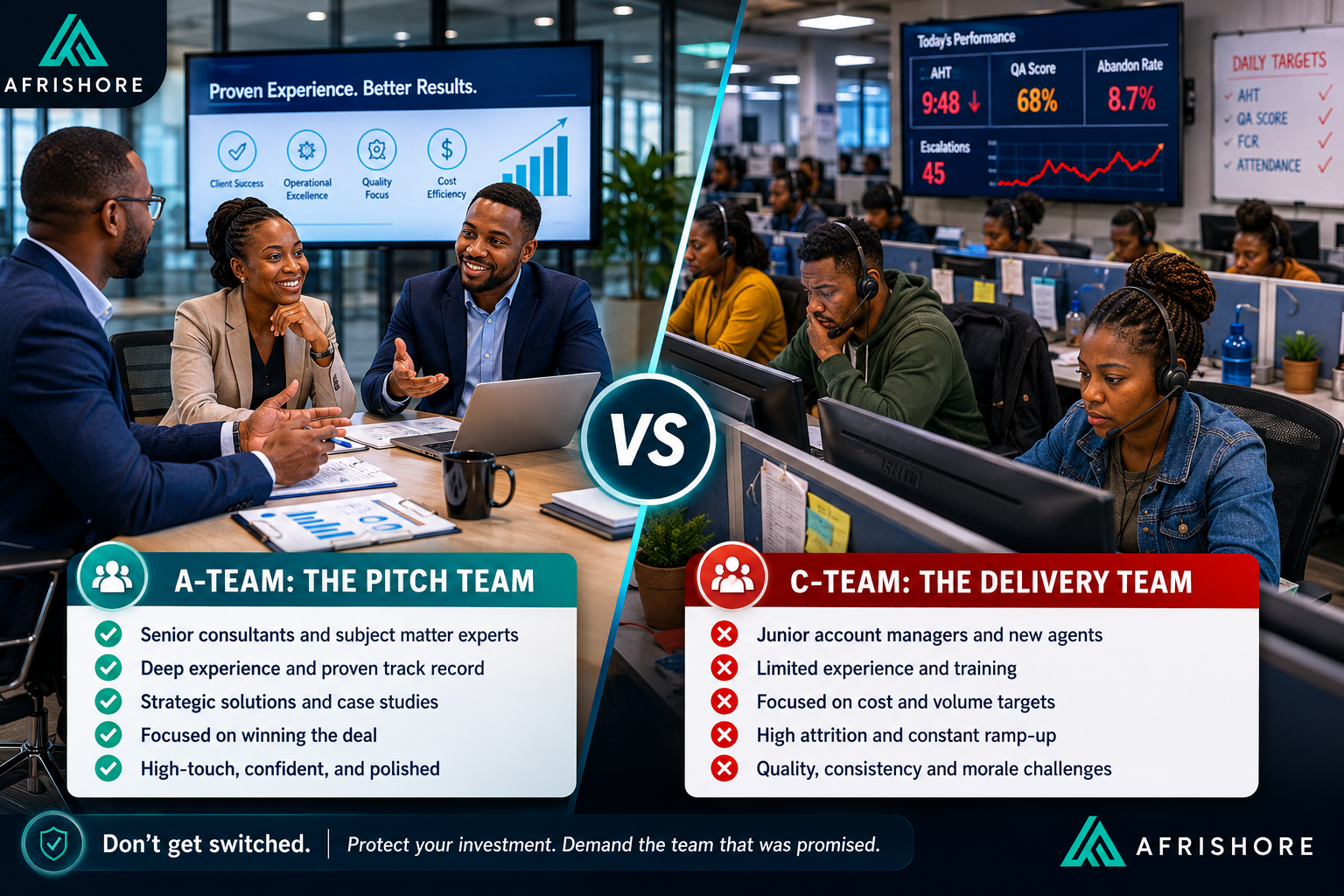
Quick Answer: The offshore BPO bait-and-switch occurs when the experienced team that pitches and closes the deal is replaced by a less qualified team that delivers the service. It is structural, not fraudulent – a predictable consequence of how providers separate sales and delivery incentives. Buyers prevent it with four contractual safeguards: named account ownership, minimum agent standards, QA participation rights, and SLA linkage to outcome metrics. The warning signs are detectable during the sales process.
At a Glance:
- What the BPO bait-and-switch is and why it is structural, not intentional fraud
- The commercial incentive that creates the A-team to C-team problem
- Five warning signs in the sales process that predict bait-and-switch risk
- Four contractual safeguards that work
- Operational monitoring after go-live: the three early warning signals
- Why the dedicated team model reduces this risk structurally
You’ve just signed the contract. The pitch was flawless – a senior consultant walked you through case studies, a solutions architect mapped your workflow, and an account director promised quarterly business reviews. Three weeks into delivery, you’re dealing with a junior account manager who’s never run a contact centre program before, and your agents can’t navigate your CRM without escalating every third ticket.
This isn’t fraud. It’s structural incentive misalignment – and it’s the most common complaint in offshore BPO procurement. The good news? It’s entirely preventable if you know what to look for during the sales process and what to write into the contract. This guide breaks down the commercial mechanics behind the bait-and-switch, the warning signs that predict it, and the contractual safeguards that force delivery teams to match the promises made by sales teams.
According to Deloitte’s 2024 Global Outsourcing Survey, cost reduction and flexibility are the top two reasons companies outsource – but service quality problems are the top reason they switch providers or bring functions back in-house. The gap between those two facts is where the bait-and-switch lives.
What Is the Offshore BPO Bait-and-Switch and Why Does It Happen?
The offshore BPO bait-and-switch occurs when the experienced team that pitches and closes the deal is replaced by a less qualified team that actually delivers the service. The pitch team – typically senior consultants, account directors, and subject matter experts – presents case studies, answers objections, and builds trust. Once the contract is signed, the account transitions to a junior account manager and frontline agents hired specifically for your contract, often with minimal tenure or category experience.
This isn’t always intentional deception. In most cases, it’s a predictable consequence of how BPO providers structure their sales and delivery organizations. Sales teams win business; delivery teams inherit it. The pitch team was never going to run your account day-to-day – that was never the plan. The problem emerges when buyers aren’t told this will happen and don’t negotiate delivery standards that protect against capability gaps.
The distinction matters. Intentional bait-and-switch – where a provider knowingly misrepresents who will deliver the service – is rare and constitutes contractual fraud. Structural misalignment – where the sales team overpromises and the delivery team underdelivers because no one aligned expectations in writing – is common, fixable, and entirely within the buyer’s control to prevent.
What Commercial Incentive Drives the A-Team to C-Team Problem?

BPO sales teams are compensated on deal value and conversion rates, while delivery teams are measured on margin preservation and SLA compliance. There’s no automatic financial penalty for staffing an account with less experienced agents unless the contract explicitly defines agent seniority, training completion, and quality thresholds.
This creates a predictable incentive gap. Sales teams bid aggressively to win the contract, often pricing below sustainable delivery costs to beat competitors. Once the deal is signed, the delivery team inherits a margin target that can only be met by minimizing labor costs – which means hiring less expensive, less experienced agents and reducing supervision ratios. The client typically has no visibility into these staffing decisions because the contract doesn’t require disclosure.
Short-term pricing pressure at the bid stage forces providers to make optimistic assumptions about agent productivity, attrition, and training efficiency. When those assumptions don’t materialize – and they rarely do in the first six months – the delivery team absorbs the variance by stretching resources thinner rather than escalating to the client. By the time quality problems surface in CSAT scores or escalation rates, the contract’s remediation window has often closed, and the buyer is locked in for 12 to 24 months.
According to industry research on BPO attrition (AVOXI, 2024), call center turnover rates typically range from 30% to 45% annually, with some centers reporting figures closer to 50%. Companies with fewer than 1,000 agents average 34% attrition, while those with 5,000+ agents see rates approaching 50%. This structural workforce instability compounds the A-team to C-team problem – even when providers hire qualified agents initially, high turnover means continuous replacement with progressively less experienced staff unless contractual safeguards are in place.
What Are the Warning Signs of a BPO Bait-and-Switch During the Sales Process?
Three signals reliably predict bait-and-switch risk: you never meet the delivery team, the proposal lacks named individuals, and the provider resists committing agent standards in writing.
These signals are identifiable before you sign. Our guide to call centre outsourcing in South Africa outlines the delivery model benchmarks you should hold any provider to during evaluation.
You Only Meet Sales and Leadership
If you only ever meet sales and leadership during the pitch process – and no delivery team member, team lead, or quality manager participates in demonstrations or site visits – the people you’re building rapport with won’t be the people managing your account. Providers with strong delivery cultures routinely introduce the proposed account manager and at least one team lead during final-stage negotiations. If your provider avoids this, it’s often because they haven’t yet hired for your account or because they don’t want you to compare the pitch team’s experience to the delivery team’s profile.
Proposals Without Named Individuals
Proposals that list titles and headcount without naming individuals (“one account manager, two team leads, fifteen agents”) signal that the provider hasn’t yet committed specific people to your contract. This isn’t inherently problematic if the contract includes minimum hiring criteria – tenure, language proficiency, certification requirements – but it becomes a red flag when combined with vague language about “experienced teams” and “proven methodologies.” If the provider can’t or won’t name the account manager before contract signature, insist on a right-of-approval clause that lets you meet and vet the proposed manager within thirty days of go-live.
Resistance to Written Standards
Providers who resist committing agent seniority, training minimums, or team-lead ratios in writing are preserving flexibility to staff your account at the lowest sustainable cost. When you ask for contractual language specifying that agents must complete a minimum of 80 hours of training before taking live contacts, or that team leads must have at least 24 months of contact centre experience, and the provider responds with “we’ll handle that operationally” or “trust our process,” what they’re actually saying is: “we don’t want to be held to a standard that limits our margin.”
Reference Quality Issues
References are another indicator. If all the references the provider offers are C-suite or executive sponsor level – and none are operational contacts who actually managed the account day-to-day – you’re being steered toward people who approved the budget, not people who lived with the delivery. Ask explicitly for operational references: the customer service manager who ran daily stand-ups, the quality lead who calibrated scorecards, the finance analyst who reconciled invoicing. If the provider can’t produce those contacts, it’s worth asking why.
For a full reference verification process, see our companion guide: How to Verify Offshore BPO Provider References Before You Sign.
Below-Market Pricing
Finally, pricing that’s significantly below market is a structural warning. Margin pressure will be passed to delivery. A provider that bids 30% below the median of competing proposals either has a structural cost advantage (rare and usually limited to labor arbitrage in specific geographies) or is planning to make up the difference through lower staffing quality, higher attrition tolerance, or aggressive upselling once you’re locked in. As offshore outsourcing best practices note, cheap BPO is expensive.
Which Contract Clauses Prevent the BPO Bait-and-Switch?
Four contractual mechanisms reliably prevent or mitigate bait-and-switch risk: named account ownership, minimum agent standards, QA participation rights, and SLA linkage to quality metrics.
For service categories where agent quality directly affects financial outcomes – such as accounts receivable management outsourcing, where recovery rates are tied to call quality – these protections are non-negotiable baseline terms, not optional add-ons.
Named Team Leads and Account Manager
The contract should specify by name who will manage your account, or at minimum require the provider to propose a named account manager within 14 days of signature and give the buyer written approval rights. Any subsequent change to the account manager or primary team lead should require 30 days’ notice and client approval. This forces the provider to staff the account with individuals they’re confident will stay for the contract term and gives you a mechanism to escalate if the relationship isn’t working.
Agent Profile and Minimum Tenure
Define minimum standards for agent hiring: language proficiency (e.g., CEFR B2 or equivalent for European customer bases), category experience (e.g., prior experience in SaaS support, financial services, or e-commerce), training completion (e.g., 80 hours of product and process training before taking live contacts), and minimum tenure on the account before eligibility for promotion or transfer. Include a right to audit hiring records quarterly to verify compliance. This prevents the provider from backfilling attrition with progressively less qualified agents over time.
Industry data confirms that BPO quality metrics and SLA standards should explicitly define service quality thresholds tied to agent capability, not just volume targets.
QA Participation Rights
Reserve the right to participate in monthly calibration sessions and review a representative sample of call recordings, chat transcripts, or ticket audits. This isn’t about micromanaging the provider – it’s about maintaining visibility into whether the delivery team is interpreting your quality standards correctly and whether agent performance is improving or regressing over time. Providers with strong quality cultures welcome client participation in calibration; providers who view QA as a “trust us” black box are usually protecting margin, not quality.
SLA Linkage to Agent Quality
Most BPO contracts measure volume metrics – average handle time, contacts per hour, schedule adherence – because those are easy to track and directly affect the provider’s cost to serve. But volume metrics don’t capture whether the agent actually resolved the customer’s issue or left them satisfied. Insist on linking SLA performance fees to outcome metrics: first contact resolution (FCR), customer satisfaction (CSAT), net promoter score (NPS), or quality scorecard averages. If these metrics fall below agreed thresholds for two consecutive months, the contract should trigger financial penalties or require the provider to submit a remediation plan with measurable milestones.
According to research on SLA metrics in call centers, the most effective SLAs balance speed metrics (service level, average handle time) with quality outcomes (FCR, CSAT, quality assurance scores).
Exit Provisions
Build in clear conditions under which you can exit the contract without penalty if delivery standards aren’t met within a defined remediation window. For example: if quality scores remain below 85% for three consecutive months despite a documented remediation plan, the buyer may terminate with 60 days’ notice and no early termination fee. This creates commercial accountability. Providers who are confident in their delivery model will accept reasonable exit provisions; providers who resist them are often protecting contracts they know will underperform.
What Should You Monitor After Go-Live to Detect the Bait-and-Switch Early?

Two operational disciplines surface A-team to C-team problems early: active participation in QA during the first 30 days, and monthly tracking of attrition by account.
For context on what structured delivery governance looks like across a well-run business process outsourcing engagement – including QA frameworks and escalation protocols – see our BPO overview.
First 30 Days: Establish Transparency
The first 30 days are your window to establish expectations before the relationship calcifies. Request access to QA scores, call recordings, and team-lead names for your account before the ramp window closes. If the provider asks you to “trust the process” rather than engage with QA output, escalate immediately to your executive sponsor. Providers with nothing to hide welcome client involvement during ramp; providers who discourage it are usually managing a staffing gap they don’t want you to see yet.
Monthly Calibration: Maintain Alignment
Monthly calibration sessions aren’t optional – they’re the primary mechanism for ensuring your definition of quality matches the provider’s interpretation of your scorecard. If your internal team and the provider’s QA team consistently score the same interaction differently, you have a calibration problem that will compound over time. Participate actively. If the provider cancels or reschedules calibration sessions more than once in a quarter, it’s a signal that quality isn’t a priority at the operational level, regardless of what leadership promised during the pitch.
Attrition Tracking: The Ultimate Early Warning System
Attrition tracking by account is the most underutilized early warning system in BPO. A provider that loses 40% of your team in the first six months has a delivery problem, not a market problem. Industry benchmarks for annualized attrition in mature offshore markets range from 25% to 35% (AVOXI, 2024); anything above 50% in year one suggests poor hiring, inadequate training, or unsustainable working conditions. If your provider can’t or won’t share attrition data segmented by account, it’s often because the numbers are worse than industry average and they don’t want to explain why.
Research confirms that high BPO attrition rates directly correlate with service quality degradation – centers with 50%+ annual turnover struggle to maintain consistent knowledge transfer, tribal wisdom, and customer rapport.
Does the Dedicated Team Model Solve the Bait-and-Switch Problem?
Dedicated-team contracts reduce bait-and-switch risk structurally by aligning the provider’s staffing incentives with the client’s quality expectations. In a dedicated model, agents are hired specifically for your account and don’t work other clients’ programs. This gives you more influence over hiring criteria, onboarding design, and team culture than you’d have in a shared-agent model where your contacts are handled by a rotating pool of generalists.
Dedicated teams create stronger accountability because attrition directly affects the named client – the provider can’t quietly backfill a weak agent from another program without you noticing. This forces the provider to invest more in retention (better training, clearer career paths, more consistent supervision) because high turnover is visible and reputationally costly.
The model does carry a higher base cost, typically 15% to 25% more than shared-agent pricing, because the provider can’t smooth utilization across multiple clients. But that premium is partially offset by lower QA rejection rates, faster ramp-to-proficiency, and stronger tribal knowledge retention. Agents who work the same client month after month develop intuition that generalists never acquire – they recognize patterns, remember edge cases, and solve problems without escalating to documentation.
Industry analysis comparing dedicated teams versus shared services in BPO (Felcorp) confirms that dedicated models deliver measurably higher FCR rates, lower escalation volumes, and more consistent CSAT scores despite the cost premium.
This is the model Afrishore BPO operates. Every agent is hired for a specific client program, trained on that client’s products and processes, and measured on that client’s quality standards. It’s not the cheapest model, but it’s the one that eliminates the structural incentive to swap experienced agents for cheaper replacements once the contract is signed.
For organizations evaluating different outsourcing models, our guide to call centre outsourcing in South Africa provides detailed comparisons of delivery models and their impact on service quality.
FAQ
Many of the issues that surface after go-live are detectable before you sign. See our companion guide: How to Verify Offshore BPO Provider References Before You Sign.
What is the BPO bait-and-switch?
The BPO bait-and-switch occurs when the senior, experienced team that pitches and closes the deal is replaced by a less qualified team that delivers the actual service. The pitch team typically includes account directors, senior consultants, and subject matter experts, while the delivery team consists of junior account managers and newly hired agents. This isn’t always intentional fraud – it’s often a structural consequence of how providers separate sales and delivery organizations.
How common is the A-team to C-team problem in BPO outsourcing?
It’s the most frequently cited complaint in offshore BPO procurement, particularly among first-time buyers. The most commonly cited complaint in offshore BPO procurement surveys is the gap between pitch team quality and delivery team quality – a finding consistent across Everest Group, Ryan Strategic Advisory, and Deloitte’s annual outsourcing research. The severity varies – some buyers experience minor capability gaps, while others face significant quality problems that require contract renegotiation or early termination.
What contract clauses prevent a BPO bait-and-switch?
Four clauses provide meaningful protection: (1) named account manager and team lead requirements with client approval rights for any changes, (2) minimum agent standards covering tenure, language proficiency, and training completion, (3) QA participation rights that let the buyer review call recordings and participate in monthly calibration, and (4) SLA linkage to quality metrics like first contact resolution and customer satisfaction, not just volume metrics. Include clear exit provisions if quality standards aren’t met within a defined remediation window.
How do I know if my BPO provider is using the right team?
Monitor three indicators during the first 90 days: (1) Request access to QA scores and call recordings during the ramp period – providers with nothing to hide welcome transparency. (2) Participate actively in monthly calibration sessions – if your provider cancels or discourages your involvement, escalate immediately. (3) Track attrition by account – if you’re losing more than 40% of your team in the first six months, the provider has a staffing problem that will affect quality. For deeper guidance, see our article on how to verify offshore BPO provider references.
What is a dedicated team model in BPO and does it prevent bait-and-switch?
A dedicated team model assigns agents exclusively to your account – they don’t work other clients’ programs. This gives you more control over hiring criteria, training design, and team culture, and creates stronger accountability because attrition is visible and directly affects your service quality. The provider can’t quietly replace weak agents from a shared pool, which forces better retention practices. Dedicated models typically cost 15% to 25% more than shared-agent pricing but reduce bait-and-switch risk structurally by aligning the provider’s staffing incentives with your quality expectations.
What should I look for in a BPO proposal to avoid the bait-and-switch?
Three warning signs predict risk: (1) You never meet anyone from the delivery team during the pitch – only sales and leadership. (2) The proposal lists titles and headcount but doesn’t name the account manager or team leads. (3) The provider resists committing agent seniority, training minimums, or team-lead ratios in writing. Insist on meeting the proposed account manager before signature, and include contractual language that defines minimum hiring standards and gives you QA participation rights. Pricing significantly below market is also a red flag – margin pressure will be passed to delivery.
For companies evaluating customer service BPO companies, understanding these red flags is essential to selecting a partner that will deliver consistent quality throughout the contract term.
Methodology & Sources
This article draws on industry research into offshore BPO procurement patterns, contract structures, and attrition benchmarks across major outsourcing markets.
Primary sources:
- AVOXI – Call Center Attrition and Turnover Rates – Annual attrition benchmarks for offshore contact centres
- Auxis – SLA Best Practices for BPO Partners – SLA structuring and quality metric frameworks
- Felcorp – Dedicated Teams vs. Shared Services in BPO – Cost and quality comparison of delivery models
- Hunton – Offshore Outsourcing Contract Considerations – Legal and commercial safeguards in outsourcing contracts
The uncomfortable reality is that most bait-and-switch situations are preventable. The warning signs exist in the sales process. The contractual protections exist in standard procurement law. The monitoring disciplines exist in basic account management. What’s missing – in most failed BPO relationships – is the decision to use them before the contract is signed. Every question that feels awkward to ask during procurement is cheaper than the renegotiation you’ll face if you don’t.
Afrishore BPO operates on a dedicated-agent model – every hire is specific to a client program, with named account ownership and client-visible QA from day one. If you’re evaluating providers and want to understand what structured delivery accountability looks like in practice, our business process outsourcing overview covers the operational model in details.