
Quick Answer: US multifamily turn season concentrates in late spring and summer, not a single autumn spike. US Census SIPP data show roughly a third of all household moves happen in June through August, with June and August consistently the single highest months. That means resident-support and maintenance workload peaks months before most property managers start looking for extra help, and by the time the surge is visibly overwhelming a team, the hiring and training window for that season has already closed.
Key Takeaways
- About one-third of all US household moves happen in June-August, with a broader high-pressure window running from March through August (US Census Bureau SIPP data).
- Multifamily resident turnover has run 40-46% annually since 2021, ticking back up to 43% in the latest published data (Zego Resident Experience Management Report).
- Maintenance requests average 3.3 per rental unit per year, and unit turns add an estimated 20-30% seasonal workload variation on top of that baseline (Hemlane, 2024-2026 analysis of 193,000+ work orders).
- A full apartment turn costs $3,800 to $4,000 on average, and the unit sits vacant for 34 to 46 days depending on the source (RapidEye Inspections, 2026 synthesis).
- Residents whose maintenance issues were resolved within a few days renew at 56%, versus 31% for residents who waited weeks (RapidEye Inspections, citing AppFolio’s Renter Preferences Report).
- Onsite multifamily property-management staff turn over at 30-50% annually, and companies with high staff turnover show weaker resident retention, linking the peak-season strain directly to burnout (Zego staff-turnover analysis).
- Answering-service vendors advertise 1 to 4 week setup, but that covers call routing, not a trained resident-support team, which is why the real commissioning window closes earlier than most operators plan for.
Turn Season Is a Spring-and-Summer Problem, Not a Single Autumn Spike
Search-demand data for property management support tools shows a sharp spike every September. It is tempting to read that as proof of when the industry’s real workload peaks. It isn’t. US Census Bureau SIPP data spanning multiple survey panels shows moves are not evenly distributed through the year, with about a third of all moves occurring in summer, June and August consistently the single highest months. A separate Census technical report puts 41 to 54% of interstate moves inside a four-month window running from May through September, depending on the period analyzed, and the 2024 Zillow Consumer Housing Trends Report, surveying over 1,000 renters, finds March through June the most common move-in months, with no evidence of a distinct September spike.
The pattern has also shifted earlier. A recent analysis of post-2021 Census data finds spring now absorbs roughly four percentage points more of annual moves than it did before 2021, while summer’s share has eased slightly, meaning the turn-season pressure that used to build through June and July increasingly starts as early as March. The honest read of the evidence is a broad high-pressure window running from spring through late summer, peaking in June and July, with a secondary wave into August and September, not a single autumn cliff edge. Search interest in staffing help spiking in September likely reflects when a property manager finally notices the volume has become unmanageable, not when the volume itself began. That distinction matters more than it sounds: it means the real commissioning window for peak-season staffing closes earlier than most operators assume, which is the argument the rest of this article builds toward.
What Peak Season Actually Does to a Property Management Team
Resident turnover itself sets the baseline load. Zego’s Resident Experience Management Report series, a recurring survey of 600+ multifamily companies, shows annual resident turnover running 40 to 46% since 2021, with the most recent published figure at 43%. Every one of those move-outs triggers a unit turn, and unit turns are the most maintenance-intensive event a property generates: repairs, cleaning, inspections and make-ready work concentrated into a narrow window before the next resident moves in. On top of that baseline, maintenance requests already average 3.3 per rental unit per year across a 2024-2026 analysis of over 193,000 work orders, and a property-analytics staffing guide estimates that turnover maintenance alone adds a further 20 to 30% seasonal workload variation on top of routine service requests.
Staffing has not kept pace with that load. The long-standing industry rule of thumb was one office staff member and one maintenance technician per 100 units. A more recent NAA analysis argues against that ratio directly, finding operators already running closer to one staff member per 45 to 61 units in practice, and noting the old 1:100 figure was retained mainly for payroll cost control rather than operational adequacy. That gap between the old planning assumption and the real staffing need is exactly where peak season breaks a team: the same fixed headcount absorbing routine work all year suddenly has to absorb a 20 to 30% seasonal spike on top of it, with no additional capacity built into the model. The result compounds on itself, because onsite property-management staff already turn over at 30 to 50% annually, and the same research finds companies with higher staff turnover show measurably weaker resident retention: burnout during peak season is not just a staffing headache, it is a resident-churn driver in its own right.
Why a Slow Response During Peak Season Costs More Than It Looks
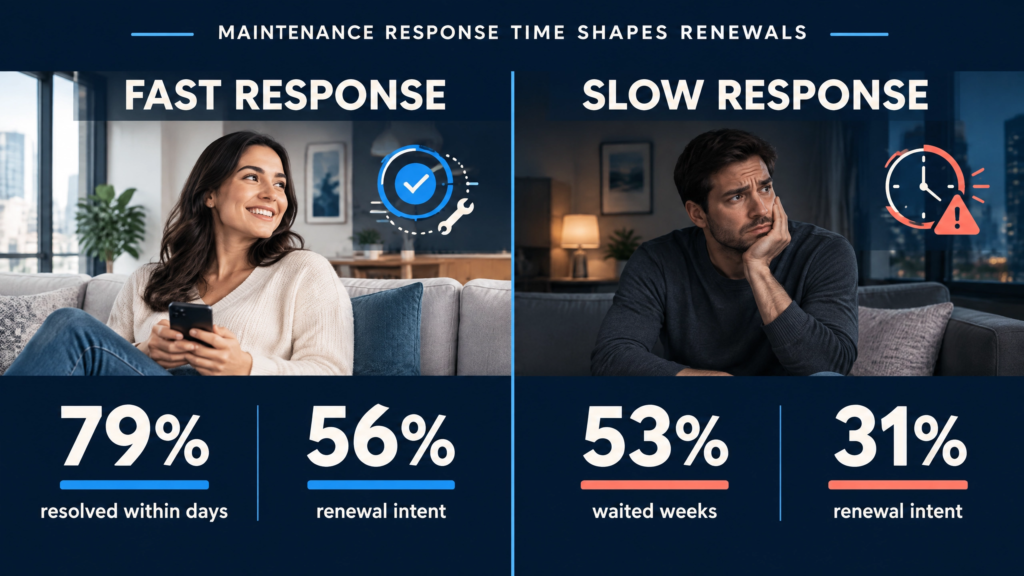
The commercial cost of falling behind during peak season is measurable, not abstract. J Turner Research’s analysis of millions of online reviews finds that comments referencing maintenance speed carry a star-rating gap from 4.59 when residents are complimentary to 2.33 when they are critical, an unusually large swing for a single service dimension, and maintenance-related comments account for roughly 40% of all negative online reviews for apartment communities. A 2026 synthesis of AppFolio’s Renter Preferences Report, reported by RapidEye Inspections, quantifies the downstream effect directly: 79% of renters whose maintenance issues were resolved within a few days or less plan to renew, versus 56% overall satisfied renters, compared with just 31% of residents who waited weeks or more for a response.
That satisfaction gap sits on top of an already expensive event. A full unit turn averages $3,800 to $4,000, based on a survey of 630 property managers at communities of 250 or more units, with the unit typically vacant for well over a month while the meter runs on lost rent, concessions and make-ready labour. A property manager who is already understaffed for peak volume is the one least able to protect that response-time window, which turns a seasonal capacity problem directly into a renewal and revenue problem.
How Long Does It Take to Staff Up for Peak Season?
This is the question that actually decides whether an operator captures the season or misses it. Dedicated property-management answering-service and call-center vendors commonly advertise setup times of one to four weeks for a new client. That figure is real, but it describes something narrower than what peak season actually requires: routing calls to a script is not the same as fielding a resident’s maintenance escalation, understanding a portfolio’s specific policies, or handling the judgment calls that come with a genuine surge in volume. A fully trained, dedicated resident-support team takes longer to stand up properly, Afrishore’s own onboarding runs four to six weeks from kickoff to a trained, live team, not because the process is slow but because it includes portfolio-specific training, not just phone routing.
That timing has a direct consequence given the corrected seasonality picture above. If turn-season pressure genuinely builds from March through peaks in June and July, a team that needs to be fully trained and live for that peak has to be commissioned in late winter or early spring, not in August when the volume has already become impossible to ignore. An operator who starts looking for help in September, following the pattern our own search-demand data shows, has already missed the season the data says actually mattered.
| Staffing approach | Typical setup time | What it actually covers | Flexibility for a 10-week peak |
| Basic answering service | 1-4 weeks (vendor-advertised) | Call routing and message-taking, generic scripts | Low, not trained on portfolio specifics |
| Local seasonal hire | Weeks to months (recruiting + onboarding) | Full resident support, but tied to local labour market and one property | Low, hard to hire and release for just one season |
| Dedicated offshore support team | 4-6 weeks (Afrishore verified) | Trained, portfolio-specific resident and maintenance support | High, sized for the season and scaled down after |
The Structural Problem With Staffing Peak Season In-House
No US operator can economically hire forty additional resident-support and maintenance-coordination staff for a ten-week window and then let them go. Recruiting, onboarding and training cost roughly the same whether the hire lasts ten weeks or ten months, and BLS wage data shows a fully loaded property-management staffing cost already running well above base salary once benefits and overhead are included. Add the seasonal recruiting cycle on top of an industry that already turns over 30 to 50% of its onsite staff every year, and the arithmetic against a purely local, purely in-house peak-season staffing model gets worse, not better, the harder an operator leans on it.
This is a capacity-shape problem, not a cost problem, and it is why the right answer looks structurally different from simply paying local staff overtime. A local team is fixed in size and fixed in location. Peak-season demand is neither. The realistic answer is a support model built to flex with the season rather than staying flat against it year-round, which is a different operating design than adding a few temporary local hires and hoping they are trained in time.
What a Flexible, Offshore-Delivered Support Team Changes

A dedicated offshore resident-support team sized specifically for peak season addresses the capacity-shape problem directly: it scales up ahead of the season and scales back down afterward, without the recruiting, training and severance costs of doing the same thing with local seasonal staff every year. Cost structure reinforces the case. Broader call-center outsourcing benchmarks (not property-specific) put offshore inbound support at $0.45 to $0.80 per minute, against $1.00 to $1.75 per minute for US onshore delivery, with typical dedicated-agent retainers of $1,200 to $4,500 per agent per month, figures that make standing up a properly sized seasonal team materially more affordable offshore than recruiting the same headcount locally for ten weeks.
Agent stability matters as much as cost during a peak, because a provider losing staff through the summer loses them exactly when volume is highest. Afrishore’s own verified attrition figures run 15 to 20% for South African delivery, a meaningful gap against the Philippines, where the Contact Center Association of the Philippines reports total attrition of 43 to 45% in recent years. That comparison is explored in more depth in South Africa vs Philippines for operators evaluating destination as well as staffing model. A support partner is only as useful for a peak as its ability to keep the same trained people through the peak, and a lower structural attrition rate is a direct input into whether that holds.
Frequently Asked Questions
When does property management turn season actually peak?
Independent Census and housing-research data show turn season concentrates in late spring and summer, with June and July carrying the heaviest load and a secondary wave into August and September. It is not a single autumn spike, and the pattern has shifted slightly earlier since 2021, with spring now absorbing more of the annual moving activity than it did before.
How much does maintenance and resident-support workload increase during peak season?
Baseline maintenance already runs about 3.3 requests per unit per year, and turnover-related maintenance adds an estimated 20 to 30% seasonal workload variation on top of that, concentrated in the same months as lease expirations and moves.
Why can’t a property manager just hire seasonal local staff for peak season?
Recruiting, onboarding and training cost roughly the same whether a hire stays for ten weeks or ten months, and onsite property-management staff already turn over 30 to 50% annually. Adding a short-term local hiring cycle on top of that turnover rate makes the economics worse rather than better, without solving the underlying capacity-shape problem.
How long does it take to stand up a dedicated support team for peak season?
Basic answering services advertise one to four week setup, but that covers call routing rather than trained resident support. A fully trained, portfolio-specific offshore support team takes four to six weeks from kickoff to live delivery, which means the commissioning decision needs to happen in late winter or early spring for a summer peak, not once volume has already become overwhelming.
Does slow maintenance response really affect lease renewals?
Yes. Renewal intent runs 56% among residents whose maintenance issues were resolved within days, compared with 31% among residents who waited weeks, and maintenance-related complaints account for roughly 40% of all negative online reviews for apartment communities.
Is South Africa a lower-risk staffing option than the Philippines for peak-season support?
Attrition is the key variable, since a provider losing agents through the summer loses them exactly when client volume peaks. Afrishore’s own verified South African attrition runs 15 to 20%, compared with total attrition of 43 to 45% reported for the Philippine BPO sector by its own industry association, meaning a South African team is structurally more likely to stay intact through an entire peak season.
What does an apartment unit turn actually cost if it isn’t handled quickly?
A full unit turn averages $3,800 to $4,000, and the unit sits vacant for 34 to 46 days depending on the source, so every week that response time slips during peak season directly extends vacancy and the associated lost rent.
Afrishore’s business process outsourcing delivery supports resident communication, maintenance coordination and after-hours call handling for property management peak season operations from a call center outsourcing base in Johannesburg, with satellite offices in Dallas, London and Cape Town. Afrishore launched in 2016, building on the Norton-Lambrianos Group’s three-decade operating lineage, and runs 1,000+ seats today under ISO 27001, ISO 9001, HIPAA and PCI-DSS. To discuss standing up a flexible team ahead of next season, contact Afrishore BPO for a no-obligation assessment.
Related reading: Property Management Call Center Outsourcing · Business Process Outsourcing · Call Center Outsourcing South Africa · South Africa vs Philippines · BPO in South Africa · Best Outsourcing Destinations for US Companies · Accounts Receivable Management Outsourcing