
Quick Answer: To measure ROI from business process outsourcing, compare your full in-house cost against the full outsourced cost, not the vendor’s hourly rate. The outsourced side must include contract leakage, retained governance and transition. Leakage alone averages 8.6% of contract value (WorldCC, 2025). Then track a fixed KPI set from day one so the savings claim still holds at renewal.
Key Takeaways
- Cost is no longer the main reason companies outsource: 34% named cost reduction as a primary driver in 2024, down from 70% in 2020 (Deloitte Global Outsourcing Survey, 2024)
- 70% of executives have selectively brought outsourced scope back in-house over the last five years, a sign that many business cases were scoped badly (Deloitte, 2024)
- Poor contract management erodes 8.6% of expected value on average; the best performers lose about 3% and the worst 15% or more (WorldCC, 2025)
- About 55% of organisations with a global GBS leader have achieved average savings above 20% (Deloitte Global Shared Services Survey)
- For contact centres, every 1% improvement in first contact resolution cuts operating costs by about 1% (SQM Group, 2026)
- Our worked 20-seat UK example nets 28% at run rate and 22% in year one, with payback around month 7 to 8 once a realistic ramp is modelled
Why Most BPO Business Cases Fail Scrutiny
Most BPO business cases fail because they compare a vendor’s quoted rate with in-house salaries and stop there. That leaves out leakage, governance, transition and attrition. The evidence of failure is visible in behaviour: 70% of executives have brought outsourced scope back in-house in the last five years (Deloitte, 2024).
Only 39% of commercial practitioners believe their contracts deliver the outcome they were signed for (WorldCC, 2025). That gap usually opens on day one, when the baseline is weak. If the in-house cost was never fully loaded, the savings claim cannot be defended later. And if no KPI was locked before transition, nobody can prove quality held.
The motive for outsourcing has also shifted, which changes what ROI should measure. Deloitte found cost reduction fell from 70% of respondents in 2020 to 34% in 2024 as a primary driver, with access to talent and agility now ranking alongside it (Deloitte, 2024). FTI Consulting’s 2026 survey of 700 CFOs found 68% have key finance activities outsourced, in development or planned as high-priority initiatives, and frames outsourcing as a capacity strategy as much as a cost lever (FTI Consulting, 2026). A business case that measures cost alone will miss half of what the board actually bought.
So the first job is to agree what a realistic savings number looks like before anyone builds a spreadsheet around it.
What a Realistic BPO Savings Number Looks Like
A realistic net saving for a well-scoped offshore programme sits well below the headline figures in sales decks. The UK contact centre industry body cites analyst estimates of 30% to 70% savings from offshore delivery (CCMA, 2025). Those are gross labour-arbitrage numbers. Net savings are lower once the hidden costs are counted.
The mature-operations benchmark is more sober. About 55% of organisations with a global GBS leader have achieved average savings above 20% (Deloitte Global Shared Services Survey). That is a result for well-governed operations, not a promise for a function in its first year.
Even technology has not shifted the picture much yet. In Deloitte’s 2024 survey, only 26% of organisations reported a reduction in the cost of vendor services from their providers’ AI and GenAI work. Productivity gains were reported by 49% (Deloitte, 2024). Unless the contract includes a mechanism to pass those gains back, they stay with the vendor.
A defensible planning range for a UK voice programme moved offshore is therefore the low 20s to around 30% net, as the worked example below shows. To get there, you need the full equation.
The Full BPO ROI Equation
The full BPO ROI equation compares total in-house cost with total outsourced cost and then measures what the change costs to make. Use three numbers, not one:
- Net annual saving = in-house total cost of ownership minus outsourced total cost of ownership.
- ROI = (gross saving minus cost of change) divided by cost of change, where gross saving is in-house TCO minus the vendor fee, and cost of change is leakage plus retained governance plus transition.
- Payback period = one-off transition cost divided by monthly net saving, adjusted for the ramp.
In-house TCO must include the costs payroll does not show. In the US, benefits made up 29.8% of total private-industry compensation in June 2025: $13.58 of $45.65 per hour, or about 42% on top of wages (BLS, 2025). In the UK, employer National Insurance is 15% on earnings above £5,000 per employee (HMRC). Recruitment, facilities, IT and supervision sit on top.
Outsourced TCO must include more than the invoice. Our guide to the true cost of offshore customer service breaks down the line items buyers most often miss. Here is how they play out in one programme.
A Worked Example: 20 Customer Service Seats
The worked example below models 20 UK customer service seats in-house against the same 20 seats outsourced. Every input is either sourced or labelled as an assumption you should replace with your own figures. Salaries start at £26,000, above the full-time National Living Wage floor of about £24,800 at £12.71 an hour from April 2026 (GOV.UK).
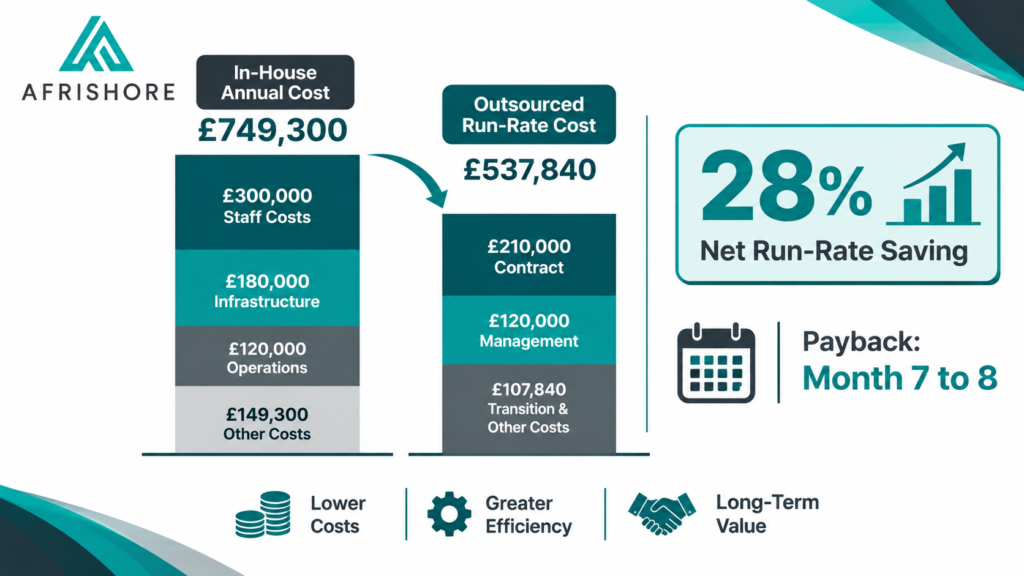
| Line item | Basis | In-house (20 FTE) | Outsourced (20 FTE) |
|---|---|---|---|
| Salaries | £26,000 per adviser (assumption) | £520,000 | Not applicable |
| Employer NIC | 15% above £5,000 per employee (HMRC) | £63,000 | Not applicable |
| Pension and benefits | 5% of salary (assumption) | £26,000 | Not applicable |
| Recruitment to replace leavers | 25.76% attrition (CCMA, 2026) at £2,000 per hire (CIPD, 2026) | £10,300 | Not applicable |
| Facilities, IT and supervision | 25% of salary (assumption) | £130,000 | Not applicable |
| Vendor fee | £22,000 per FTE, fully loaded quote (assumption) | Not applicable | £440,000 |
| Contract value leakage | 8.6% of fee (WorldCC, 2025) | Not applicable | £37,840 |
| Retained governance | One vendor manager, fully loaded (assumption) | Not applicable | £60,000 |
| Annual run-rate cost | £749,300 | £537,840 | |
| One-off transition, year one only | 10% of first-year fee (assumption) | Not applicable | £44,000 |
| Year-one cost | £749,300 | £581,840 | |
| Net saving | Run rate / year one | £211,460 (28%) / £167,460 (22%) |
Applying the equation:
- Gross saving is £749,300 minus the £440,000 fee, or £309,300.
- ROI in year one is (£309,300 minus £141,840 cost of change) divided by £141,840, or about 118%. At run rate, with no transition cost, it rises to about 216%.
- Payback on paper is 2.5 months (£44,000 divided by £17,622 a month). If savings ramp up evenly over the first 12 months, payback lands around month 7 to 8.
Two sensitivities matter more than the rest. If leakage hits WorldCC’s worst-case 15%, the run-rate saving falls to about 24%. At the best-performer level of 3%, it rises to about 32%. And at average leakage, any quote above roughly £31,700 per FTE means the programme loses money. For benchmarks to plug into the vendor-fee line, use our call center outsourcing cost guide and our outsourced customer support cost breakdown.
The example also shows where the money leaks, which is the next thing to control.
The Hidden Costs That Erode Advertised Savings
The hidden costs that erode BPO savings are contract leakage, retained governance, transition, attrition and quality rework. Leakage is the largest and least visible. Poor contract management costs the average business almost 9% of contract value a year (WorldCC, 2025).
- Contract leakage. Missed service credits, unenforced rate cards, scope creep billed as change requests. The fix is a contract with measurable SLAs and a named owner for each one. Our guide to BPO contracts and SLAs covers the clauses that protect value.
- Retained governance. Someone on your side must run the relationship, review reporting and escalate. Budget for that role explicitly, or it gets absorbed by an already busy manager and done badly.
- Transition. Knowledge transfer, process documentation, parallel running and training. It is a one-off cost, but it lands in year one, when the board is watching most closely.
- Attrition. Every leaver costs recruitment and lost productivity while a replacement ramps. UK contact centre attrition averages 25.76% a year (CCMA, 2026). Ask any vendor for its attrition rate and how it is calculated; our analysis of offshore call center attrition rates explains what to look for.
- Rework and repeat contact. A cheap contact that fails to resolve the issue costs twice. That is why quality metrics belong in the ROI model, not in a separate report.
These costs all arrive early, which is why the timeline deserves its own planning.
How Long Does It Take to See ROI From BPO?
Most programmes should plan for 6 to 18 months before full run-rate savings arrive, depending on scope and complexity. This is a planning assumption, not a published industry benchmark. It reflects Deloitte’s finding that benefits depend on governance maturity and contracting quality (Deloitte, 2024).
A practical way to phase the business case:
| Phase | Typical window (planning assumption) | What finance should see |
|---|---|---|
| Transition | Months 1 to 3 | One-off costs land; parallel running may double some costs briefly |
| Stabilisation | Months 3 to 12 | KPIs reach baseline; savings ramp toward run rate |
| Run rate | From month 6 to 18 | Full net saving; renegotiation and productivity gains become possible |
Simple, repeatable work such as inbound customer service reaches run rate fastest. Afrishore typically has new programmes live in 4 to 6 weeks. Judgement-heavy finance work, or anything regulated, takes longer to stabilise. Under the hybrid outsourcing model, you can phase the move and keep complex work onshore while the offshore team proves itself.
How fast value shows up also depends on which function you outsource.
ROI by Function: Where the Value Shows Up
ROI shows up differently by function, so each one needs its own primary measure. Contact centres return value through labour cost and resolution quality. Finance functions return it through capacity, close speed and control quality. Back-office work returns it through throughput and error rates.
| Function | Main value lever | Primary ROI measure | Supporting evidence |
|---|---|---|---|
| Customer service and contact centre | Labour cost plus first contact resolution | Cost per resolved contact, FCR, CSAT | Each 1% FCR gain cuts operating costs about 1% (SQM Group, 2026) |
| Finance and accounting | Capacity and close speed | Days to close, first-time-right rate, DSO | 68% of CFOs have finance activities outsourced, in development or planned (FTI Consulting, 2026) |
| Shared services and back office | Throughput and standardisation | Cost per transaction, backlog, error rate | 55% of orgs with a global GBS leader saved over 20% (Deloitte) |
| Regulated or vulnerable-customer work | Risk reduction and outcomes | Complaint rate, QA pass rate, outcome testing | Measure against your own baseline; no reliable public benchmark |
For accounting and finance, the ROI case often rests on releasing senior staff time rather than cutting headcount. Our outsourced accounting services team supports bookkeeping, AP and AR, and month-end close. For transactional admin, see our offshore administrative services.
Whichever function you outsource, the KPIs must be fixed before the transition starts.
The KPI Framework That Keeps ROI Honest
A defensible ROI framework tracks cost, quality, workforce stability and contract health together, from a baseline locked before transition. Managing one metric in isolation, such as handle time or cost per contact, invites a vendor to hit it at the expense of everything else. Use the same definitions in-house and outsourced, or the comparison is meaningless.
| KPI | What it tells finance | Benchmark | Source |
|---|---|---|---|
| First contact resolution | How much repeat contact you pay for | 71% industry average; 70% to 79% is good | SQM Group, 2026 |
| Adviser attrition | Rehiring and ramp cost | 25.76% UK average | CCMA, 2026 |
| Cost per hire | Price of each leaver | £2,000 median for non-senior roles | CIPD, 2026 |
| Contract value leakage | Value lost to weak contract management | 8.6% average; about 3% best; 15% or more worst | WorldCC, 2025 |
| Days sales outstanding | Collection speed | AR divided by credit sales, times days; set against your own terms | ICAEW |
| AP cost per invoice, cycle time, first-time-error-free rate | Finance process efficiency and control | Benchmarked by APQC; values sit behind membership | APQC |
Report the set monthly in a single scorecard and review it quarterly against the business case. If cost is on track but FCR or attrition is drifting, the saving is borrowed from next year. Our comparison of BPO outsourcing vs in-house teams shows how to keep the in-house baseline honest for that review.
The final variable is where the work is delivered.
How Destination Choice Changes the ROI Math
Destination changes the ROI math through more than the hourly rate. Attrition, time-zone overlap and how much rework a team creates all feed the model. A cheaper location with higher churn and more repeat contact can lose its rate advantage within the first year.
For UK buyers, South Africa is the established near-time-zone option. The UK took 48% of new international jobs created in South Africa’s global business services sector in one quarter of 2024, and the US took 32% (BPESA). The CCMA notes that UK buyers already route routine, overflow and after-hours work to South Africa, Eastern Europe and Asia-Pacific (CCMA, 2025).
The right way to compare destinations is to run the worked example once for each, with each location’s real quote, attrition rate and FCR. Our South Africa vs Philippines comparison sets out the trade-offs for voice work.
Frequently Asked Questions
How do you calculate ROI from business process outsourcing? Calculate in-house total cost of ownership, then outsourced total cost of ownership including leakage, governance and transition. Net saving is the difference. ROI is gross saving minus the cost of change, divided by the cost of change. Payback is the transition cost divided by monthly net saving, adjusted for the ramp.
What percentage cost savings should I expect from outsourcing? Gross offshore savings are often quoted at 30% to 70%, but net savings are lower once hidden costs are counted. About 55% of organisations with a global GBS leader have achieved average savings above 20%. Our worked UK contact centre example nets 22% in year one and 28% at run rate.
How long does it take to see ROI from a BPO programme? Plan for 6 to 18 months to reach full run-rate savings; this is a planning assumption, not a published benchmark. Transition costs land in the first quarter and savings ramp through stabilisation. With an even 12-month ramp, payback in our worked example lands around month 7 to 8.
What hidden costs most commonly erode BPO savings? Contract value leakage, retained governance, transition, attrition and rework. WorldCC puts average leakage at 8.6% of contract value, with the worst performers losing 15% or more. Budget each one as an explicit line item rather than letting it disappear into existing budgets.
What should a CFO look for when assessing the ROI of outsourcing contact centre operations? A fully loaded in-house baseline, a vendor quote with SLAs and service credits, and a locked KPI set covering first contact resolution, attrition, CSAT and cost per resolved contact. SQM Group finds each 1% gain in first contact resolution cuts operating costs by about 1%, so quality belongs inside the ROI model.
How do I measure ROI on outsourced accounting or finance work? Measure released capacity and process quality alongside cost: days to close, first-time-right rate, days sales outstanding and AP cost per invoice. APQC benchmarks the AP measures for members. FTI Consulting found 68% of CFOs have key finance activities outsourced, in development or planned for 2026.
How do I compare ROI across BPO partners? Run the same TCO model for every bidder with identical volumes, KPIs and contract terms. Plug in each quote, attrition rate and leakage protections. The lowest rate does not always win: higher attrition or weaker first contact resolution can cancel a rate advantage within a year.
How do I know if my existing BPO programme is underperforming? Compare current cost and KPIs with the baseline locked before transition. Warning signs include rising change requests, unenforced service credits, attrition above the vendor’s stated rate and falling first contact resolution. If cost is on track but quality is drifting, the saving is being borrowed from future periods.
Afrishore BPO runs outsourced customer service, back-office and finance teams for UK and US companies from its Johannesburg headquarters, with more than 1,000 employees. We build business cases around fully loaded costs and agreed KPIs, so the ROI still stands when the contract comes up for renewal. Explore our business process outsourcing services, our financial services outsourcing division for finance work, or contact Afrishore BPO to stress-test your own numbers.
Building an outsourcing business case? Talk to our BPO team.