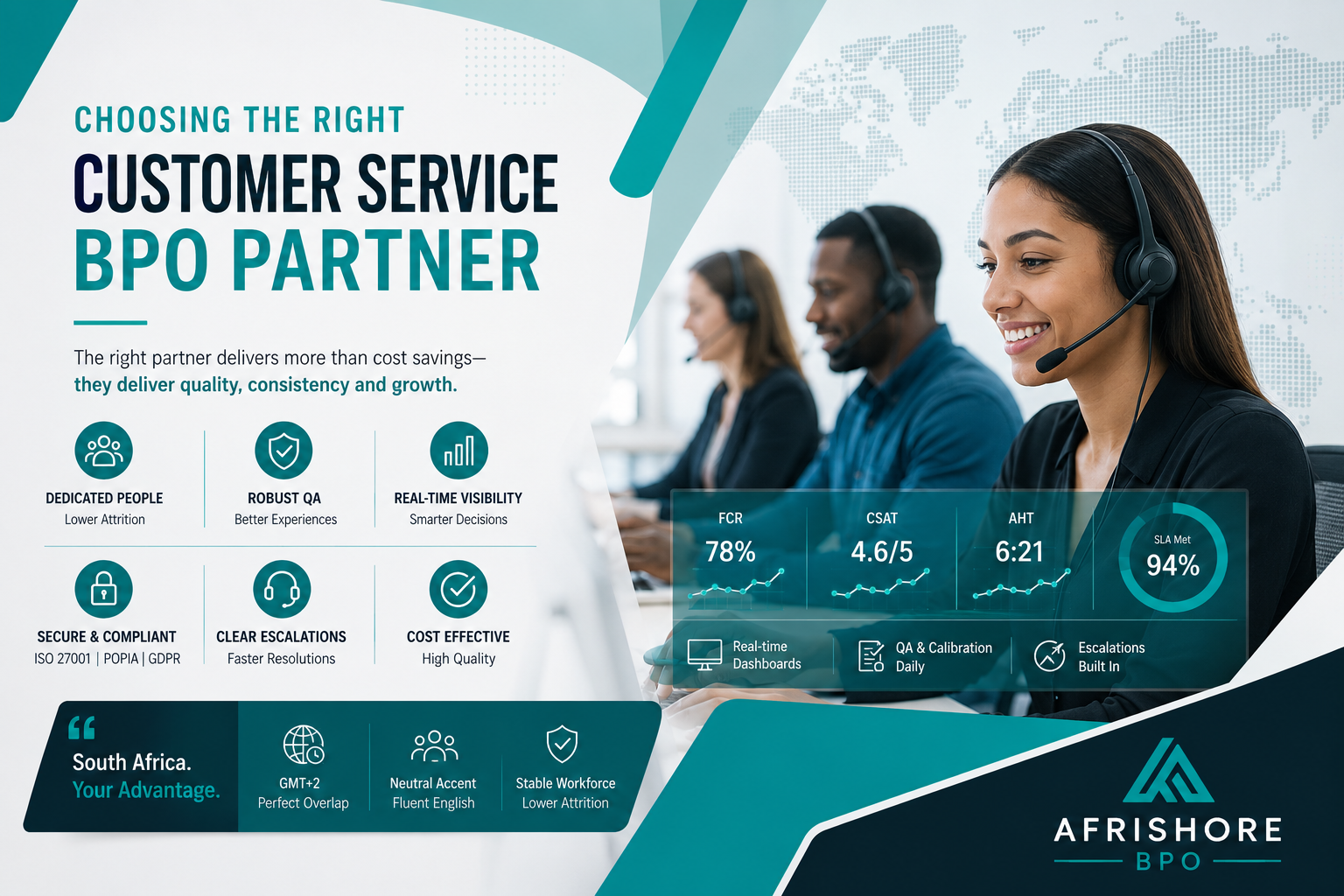
Most buyers shortlist customer service BPO companies on price and case studies, then discover the real differentiators-QA cadence, attrition transparency, escalation design, compliance posture-only after the contract is signed. By then, you’re locked into a twelve-month agreement with a provider whose front-line agents turn over every nine months, whose quality assurance happens in monthly batches rather than daily calibration, and whose escalation path involves forwarding tickets to your own team anyway. This guide provides the evaluation framework you need before the RFP closes. It assumes you already know why to outsource; the question now is which customer service outsourcing companies will perform at the standard your brand requires, and how to tell the difference during procurement.
At a glance – what separates strong customer service BPO companies from weak ones:
- Attrition data by account (not company average) shared before you sign
- QA rubric and calibration schedule provided during the sales cycle
- Escalation SLAs defined in the contract with clear authority limits
- Dedicated vs shared team model confirmed in writing with exclusivity clause
- Compliance certifications (ISO 27001, POPIA/GDPR) verified with current audit summary
- Real-time dashboard access, not weekly PDF summaries
What Separates Strong Customer Service BPO Companies from Commoditised Ones
The core differentiator is not headline agent cost-it’s QA infrastructure, staffing model transparency, and regulatory posture. Strong providers show you attrition by account, not company average. They share calibration schedules and scoring rubrics before you sign. They define escalation paths in the contract, not in a post-launch “optimization” meeting.
Dedicated vs Shared Team Models
A dedicated team works exclusively on your account. Agents learn your product taxonomy, tone guidelines, and edge cases. Knowledge compounds. Attrition still happens, but backfills are trained within the same team culture. A shared or blended team distributes agents across multiple clients, often in the same shift. Lower cost, faster scale, but continuity suffers-agents switch between three different ticketing systems in a single day, and your brand voice becomes generic.
Most contracts use vague language: “sufficient resources allocated to meet SLA.” That’s shared by default. If you want dedicated, the clause should read “agents assigned exclusively to [Client] account, with no concurrent assignment to other clients.” Ask to see turnover data segmented by account, not the company-wide figure. A BPO with 18% company attrition may have 45% attrition on shared accounts and 9% on dedicated ones.
Learn more about offshore call center attrition rates and how they impact service quality.
The Link Between Attrition and Service Quality
According to BPESA (Business Process Enabling South Africa), South African BPO attrition averages 15–20% annually, compared to 30–40% in the Philippines, driven partly by compulsory night shifts for US time zones. High attrition erodes institutional knowledge. Every departed agent takes three months of product training, tone calibration, and customer relationship context with them. The replacement agent starts from zero. First-contact resolution drops. Escalation rates climb. CSAT tracking becomes noisy because half your team is in their first sixty days.
When evaluating customer support outsourcing companies, ask: “What was attrition on your three largest accounts over the past twelve months, and what drove the top two exit reasons?” If the answer is “we don’t track by account” or “confidential,” that’s a structural red flag.
Why “We Have the Technology” Is Not an Answer
Every BPO deck includes slides about omnichannel platforms, AI-assisted routing, and sentiment analysis. The technology is table stakes. The question that matters is: How are escalation paths designed, and who owns the escalation?
If a customer threatens churn, disputes a charge, or reports a safety issue, does the BPO agent have authority to resolve it, or do they create a ticket that lands in your internal queue? If the latter, you haven’t outsourced customer service-you’ve outsourced triage. Strong providers define escalation SLAs in the contract: “Category A escalations resolved by BPO tier-2 within 4 hours; Category B routed to client within 1 hour with full context summary.” Weak providers treat escalation as an exception process with no documented playbook.
Explore BPO solutions that prioritize transparent escalation frameworks.
The Six Criteria That Matter Most in a BPO Evaluation

Six criteria separate functional bpo customer service partnerships from expensive mistakes: staffing model transparency, QA infrastructure, compliance posture, reporting granularity, escalation architecture, and geographic fit. Most RFPs ask for three. Here’s what each one actually tells you.
1. Staffing Model – Dedicated, Blended, or Shared
What transparency looks like: The MSA specifies agent exclusivity. The pricing schedule breaks out the dedicated-team premium (typically 15–25% above shared rates). You receive a team roster with start dates, and the provider commits to a backfill SLA when attrition occurs.
What to ask: “Will agents on my account work other clients concurrently? If yes, which clients and what percentage of their time? If no, show me the contract clause that guarantees exclusivity and the backfill SLA when an agent leaves.”
Red flag: “We allocate resources dynamically based on volume.” That’s shared-team code.
2. Quality Assurance – Calibration, Rubrics, and Client Involvement
What good looks like: QA happens daily or weekly, not monthly. The provider shares the scoring rubric during the sales cycle-before you sign-so you can align it with your internal standards. Calibration sessions (where QA analysts and team leads score the same interaction and reconcile discrepancies) happen at least monthly. You receive access to call recordings or chat transcripts for every scored interaction, not just summary dashboards.
What to ask: “Show me your QA rubric. How often do you calibrate scorers? Will I have access to the interactions you score, or only the score summary? Who designs the rubric-your team or mine?”
Red flag: QA reports that only show percentages (e.g., “92% quality score this month”) without drill-down access to the underlying interactions. You can’t improve what you can’t inspect.
Deep Dive: Read our comprehensive guide on quality assurance in call centre outsourcing.
3. Compliance and Data Security – ISO, POPIA, GDPR
Your compliance requirements depend on where your customers live. If you serve UK or EU customers, GDPR applies, which means your BPO must sign a Data Processing Agreement and prove that data is stored and processed within compliant jurisdictions or under Standard Contractual Clauses. If you serve US customers in California, CCPA considerations apply. South African providers operating under POPIA (Protection of Personal Information Act) have structural alignment with GDPR; many hold ISO 27001 certification for information security management.
What to ask: “Where is customer data stored-geographically and on whose infrastructure? Who has access to it? What background-check and NDA policies apply to agents? Show me your ISO 27001 certificate and the most recent audit summary.”
Red flag: Vague answers like “we take security seriously” or “data is encrypted.” Encryption is irrelevant if the BPO shares database access with third-party QA vendors in unaudited jurisdictions.
Learn about HIPAA compliant BPO services for healthcare organizations.
4. Reporting and Visibility – Real-Time Dashboards vs Weekly PDFs
Strong customer service outsourcing companies provide real-time dashboards with SLA tracking: Average Handle Time (AHT), First Contact Resolution (FCR), Customer Satisfaction (CSAT), and escalation rate. You log in any time and see current-hour performance. Weak providers send weekly PDF summaries with last week’s aggregates, which means you discover a quality collapse five days after it started.
What to ask: “Show me a sample dashboard and a sample weekly report. Will I have login access to the platform, or do I receive exports? What’s the latency between an interaction and its appearance in reporting?”
Red flag: Providers who will “build custom reports based on your needs” but can’t show you an existing client dashboard. If they haven’t built it for someone else, they won’t build it for you on time.
5. Escalation Architecture – Who Owns the Process?
Escalation design determines whether you’ve actually outsourced decision-making or just hired expensive ticket sorters. The contract should define:
- Category definitions: What constitutes a Tier 1 (agent-resolved), Tier 2 (BPO supervisor-resolved), and Tier 3 (client-escalated) issue.
- Authority limits: Can the BPO issue refunds up to $X, waive fees, or extend trials without client approval?
- SLA by category: Tier 1 resolved same-contact; Tier 2 within 4 hours; Tier 3 routed to client within 1 hour with full summary.
What to ask: “Walk me through an escalation scenario: a customer threatens to churn over a billing error. Who resolves it, how fast, and what authority do they have?”
Red flag: “We’ll escalate anything complex to your team.” That means you’re paying BPO rates for L1 triage and handling L2/L3 yourself.
6. South Africa Fit – Accent, Time Zone, Cost Stability

South Africa has become a preferred destination for outsourcing customer service to South Africa for three structural reasons:
- English proficiency and neutral accent: English is the primary business language, and the accent is neutral and easily understood by UK and US customers. University enrollment is high, producing a deep talent pool.
- GMT+2 time zone: Natural overlap with UK business hours (same or +1 hour during UK summer time) and covers US East Coast mornings. No compulsory night shift for UK clients, which reduces attrition. US West Coast coverage requires afternoon/evening shifts, but not the graveyard shifts that drive turnover in Philippines operations.
- Cost stability: Agent rates are 40–60% lower than UK or US in-house teams, and lower than Australia, without the high attrition driven by anti-social hours.
BPESA data shows South African BPO attrition averaging 15–20% annually, compared to 30–40% in offshore markets where night shifts are mandatory. Lower attrition compounds: training costs drop, service consistency improves, and client-side supervisory load decreases.
Explore more about BPO companies in South Africa and why the region is gaining traction.
How to Structure the Due Diligence Process
Due diligence follows a three-stage sequence: brief and RFP, reference validation, and site visibility. Most buyers skip stage two or treat it as a formality. That’s where the gap between sales promise and operational reality hides.
Stage 1: RFP or Brief – What to Ask Upfront
Your RFP should request:
- Attrition data by account (not company-wide average), segmented by tenure cohort (0–6 months, 6–12 months, 12+ months).
- QA rubric and calibration schedule – the actual scoring sheet, not a description of it.
- Escalation playbook – category definitions, authority limits, SLA by tier.
- Compliance certifications – ISO 27001, POPIA/GDPR alignment, background-check policy.
- Sample reporting dashboard – screenshots or login to a demo environment with realistic data.
- Staffing model – dedicated vs shared, and how exclusivity is enforced contractually.
Most buyers ask for case studies and pricing. That’s necessary but not sufficient. Case studies are curated; the metrics you need are in the attrition data and QA rubric.
Stage 2: Reference Calls – Unscripted and Unfiltered
Do not accept a list of three pre-selected reference clients. Ask for five to seven, then choose three yourself. Make the calls unscripted. Questions to ask:
- “What was attrition on your account in the first twelve months, and what drove it?”
- “Show me a QA report or dashboard screenshot. How often do you review it?”
- “Describe an escalation that went wrong. How was it resolved?”
- “What surprised you six months in-good or bad?”
If the reference contact is a salesperson or account manager rather than an operations lead, that’s a curated reference. You want to speak to the person who receives the weekly reports and handles escalations, not the person who signed the contract.
Stage 3: Site Visit or Virtual Floor Tour
Whether in-person or virtual, the tour should include time with floor managers and team leads, not just the sales director. What to look for:
- Agent screens: Are they toggling between one system (good-integrated stack) or three browser tabs (bad-duct-tape integration)?
- Supervisor-to-agent ratio: Industry standard is 1:10 to 1:15. If you see 1:25, supervision is thin.
- QA workflow: Ask a QA analyst to show you how they score an interaction. Do they have rubric access on-screen, or are they working from memory?
What to ask floor managers:
- “What’s the most common reason agents leave in their first six months?”
- “How do you handle a quality dip-what’s the intervention process?”
- “Walk me through yesterday’s escalation log.”
Sales teams optimize for presentation. Floor managers optimize for keeping the operation functional. The latter group tells you what life will look like after go-live.
Additional Resource: Outsourcing to South Africa – comprehensive destination guide.
Red Flags in a BPO Sales Process
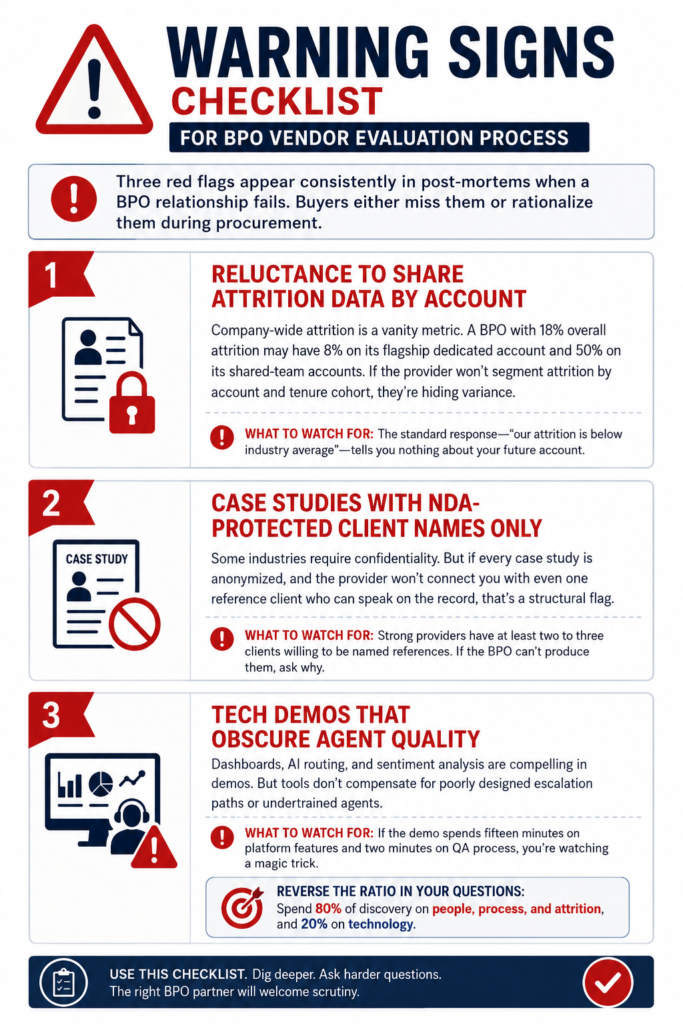
Three red flags appear consistently in post-mortems when a BPO relationship fails. Buyers either miss them or rationalize them during procurement.
Reluctance to Share Attrition Data by Account
Company-wide attrition is a vanity metric. A BPO with 18% overall attrition may have 8% on its flagship dedicated account and 50% on its shared-team accounts. If the provider won’t segment attrition by account and tenure cohort, they’re hiding variance. The standard response-“our attrition is below industry average”-tells you nothing about your future account.
Case Studies with NDA-Protected Client Names Only
Some industries require confidentiality. But if every case study is anonymized, and the provider won’t connect you with even one reference client who can speak on the record, that’s a structural flag. Strong providers have at least two to three clients willing to be named references. If the BPO can’t produce them, ask why.
Tech Demos That Obscure Agent Quality
Dashboards, AI routing, and sentiment analysis are compelling in demos. But tools don’t compensate for poorly designed escalation paths or undertrained agents. If the demo spends fifteen minutes on platform features and two minutes on QA process, you’re watching a magic trick. Reverse the ratio in your questions: spend 80% of discovery on people, process, and attrition, and 20% on technology.
Check out Afrishore’s BPO operations for transparent infrastructure insights.
Vague Answers About Data Storage and Access
“Data is encrypted and stored securely” is not an answer. The questions are:
- In which jurisdiction (geographically) is data stored?
- On whose infrastructure-yours, a third-party cloud provider, or a subcontractor’s?
- Who has access-BPO agents only, or also third-party QA vendors, IT support, or training teams?
If the salesperson can’t answer and promises to “get back to you,” escalate it to a deal-breaker. Data governance isn’t a post-signature workstream; it’s a pre-signature requirement.
Why South Africa Has Become a Preferred Customer Service BPO Destination
South Africa accounted for over 270,000 BPO sector jobs by 2024, with customer contact centers representing the largest vertical, according to BPESA. Three structural advantages explain the growth: language and accent fit, time zone alignment, and cost stability without attrition penalties.
English as Primary Business Language
English is one of South Africa’s eleven official languages and the dominant language of business and higher education. University enrollment rates are high, producing a pipeline of graduates with strong written and verbal English proficiency. The accent is neutral and easily understood by UK and US customers-none of the comprehension friction that sometimes accompanies other offshore destinations.
GMT+2 Coverage and Shift Economics
South Africa operates in GMT+2, which overlaps naturally with UK business hours (no time difference or +1 hour during UK summer time) and covers US East Coast mornings. For UK clients, this eliminates night shifts entirely. For US clients, coverage requires afternoon and evening shifts rather than graveyard shifts, which reduces attrition and wage premiums. According to the same BPESA data, South African BPO attrition is structurally lower than markets where night differential is mandatory, because agents work hours that align with their own circadian rhythm.
Cost Stability Without Attrition Driven by Night Shifts
Agent wage rates in South Africa are 40–60% lower than in-house UK or US teams, and competitive with the Philippines, but without the turnover penalty that comes from forcing agents into permanent night shifts. Lower attrition means lower training costs, better service consistency, and less supervisory overhead on the client side. Ryan Strategic Advisory data shows South Africa’s offshore services export value grew to $2.1 billion in 2023, with customer service and technical support as the primary growth drivers.
For UK and European buyers especially, call centre outsourcing to South Africa offers time zone and language alignment that other offshore destinations cannot match without premium pricing.
Related: Outsourcing from the UK – specific considerations for British businesses.
Summary Evaluation Checklist
Use this checklist during RFP review and contract negotiation. If any item is missing or answered vaguely, escalate it before signature.
- Dedicated vs shared model confirmed in writing – contract specifies agent exclusivity or defines shared-resource allocation transparently.
- Attrition data by account provided – segmented by tenure cohort (0–6 months, 6–12 months, 12+ months), not company average.
- QA rubric shared and calibration frequency defined – you’ve seen the scoring sheet and know how often scorers are calibrated.
- Compliance certifications relevant to your jurisdiction confirmed – ISO 27001, GDPR/POPIA alignment, background-check policy documented.
- Sample reporting dashboard reviewed – you’ve logged into a demo environment or seen screenshots with realistic data granularity.
- Escalation SLA defined with ownership confirmed – categories, authority limits, and resolution timeframes specified in the MSA.
- Three unscripted reference calls completed – you chose the contacts, and you spoke to operations leads, not salespeople.
- Site or floor tour completed – you’ve seen agent screens, asked floor managers about attrition drivers, and reviewed a live QA workflow.
- Data storage and third-party access policy confirmed – you know where data lives, who has access, and how subcontractors are managed.
For a detailed cost breakdown beyond the headline rate, refer to the true cost of offshore customer service, which includes hidden expenses like training attrition, supervisory load, and integration work.
Related Reading:
- BPO trends 2025 – industry evolution and emerging models
- Scaling customer support with strategic outsourcing
- Cultural alignment in customer support outsourcing
Frequently Asked Questions
What is a customer service BPO company?
A customer service BPO (Business Process Outsourcing) company provides outsourced customer support operations on behalf of another business. Services typically include phone, email, chat, and social media support, handled by agents employed by the BPO provider. The client company retains brand ownership and sets service standards; the BPO executes the day-to-day interactions. Learn more about business process outsourcing.
How much does customer service outsourcing cost in 2026?
Costs vary by geography, staffing model, and service complexity. South African providers typically charge $12–$18 per agent hour for dedicated teams with English-language support, compared to $25–$40 for in-house UK or US teams. Shared-team models may start lower, around $8–$12 per hour, but come with higher attrition and lower continuity. Total cost of ownership includes training, QA, reporting infrastructure, and attrition backfill-see the true cost of offshore customer service for a full breakdown. Also explore call center outsourcing cost analysis.
What is the difference between a dedicated and shared BPO team?
A dedicated team works exclusively on one client’s account. Agents learn that client’s product, tone, and processes deeply, and continuity is higher. A shared team distributes agents across multiple clients, often in the same shift. Shared models cost less and scale faster, but agents lack deep product knowledge and brand voice consistency suffers. Contracts should specify which model applies and how exclusivity is enforced.
How do I verify that a BPO company’s reference clients are real?
Ask for five to seven reference contacts, then choose three yourself rather than accepting a pre-selected list. Request to speak with operations leads-people who receive weekly reports and handle escalations-not account managers or salespeople. Conduct unscripted calls and ask about attrition, QA process, escalation failures, and surprises six months post-launch. If all references are anonymized under NDA, ask why the provider can’t produce even one named client willing to speak on the record. For a detailed verification framework, see how to verify BPO provider references.
Is South Africa a good location for outsourcing customer service?
Yes, particularly for UK and European clients. South Africa operates in GMT+2, providing natural overlap with UK business hours and eliminating compulsory night shifts, which reduces attrition. English is the primary business language, and the accent is neutral for UK and US customers. Agent wage rates are 40–60% lower than UK in-house teams, and BPESA data shows attrition averaging 15–20% annually-structurally lower than offshore markets where night shifts are mandatory. For US East Coast clients, South Africa covers morning hours without graveyard shifts. Read more about BPO in South Africa.
What certifications should a customer service BPO company hold?
At minimum, ISO 27001 for information security management. If you serve EU or UK customers, confirm GDPR compliance and ask to see the Data Processing Agreement template. South African providers operating under POPIA (Protection of Personal Information Act) have structural alignment with GDPR. Depending on your industry, you may also require PCI-DSS (payment card data), HIPAA (US healthcare), or SOC 2 Type II (security and availability controls). Ask for the most recent audit summary, not just the certificate.
How long does it take to onboard a customer service BPO team?
Typical onboarding spans six to ten weeks: two weeks for contracting and infrastructure setup, two to three weeks for agent recruitment and initial training, then two to four weeks of supervised live operation before full handover. Complex products or regulated industries (e.g., financial services) may extend training to six weeks. Onboarding duration depends on how well you document processes, tone guidelines, and escalation playbooks before kickoff. Providers who promise “go-live in two weeks” are either using shared teams with minimal training or setting you up for a quality collapse in month two. Learn about long-term BPO partnerships and proper relationship building.
What SLAs should I include in a customer service outsourcing contract?
Core SLAs include Average Handle Time (AHT), First Contact Resolution (FCR), Customer Satisfaction (CSAT), and escalation resolution time. Define thresholds and measurement methodology in the contract-for example, “FCR ≥ 75%, measured as issues resolved in first contact without callback or follow-up ticket within 48 hours.” Include agent attrition SLA (e.g., “monthly attrition not to exceed 3% for agents with 6+ months tenure”) and backfill SLA (e.g., “replacement agent trained and live within 15 business days of departure”). Escalation SLAs should specify resolution time by category: Tier 1 same-contact, Tier 2 within 4 hours, Tier 3 routed to client within 1 hour with full context summary.
Ready to evaluate customer service BPO companies with confidence? Contact Afrishore for a transparent consultation, including attrition data, QA rubrics, and compliance documentation-before the RFP stage.
Additional Industry Resources:
- Global BPO landscape overview
- Offshore outsourcing solutions comparison guide
- BPO services for US businesses