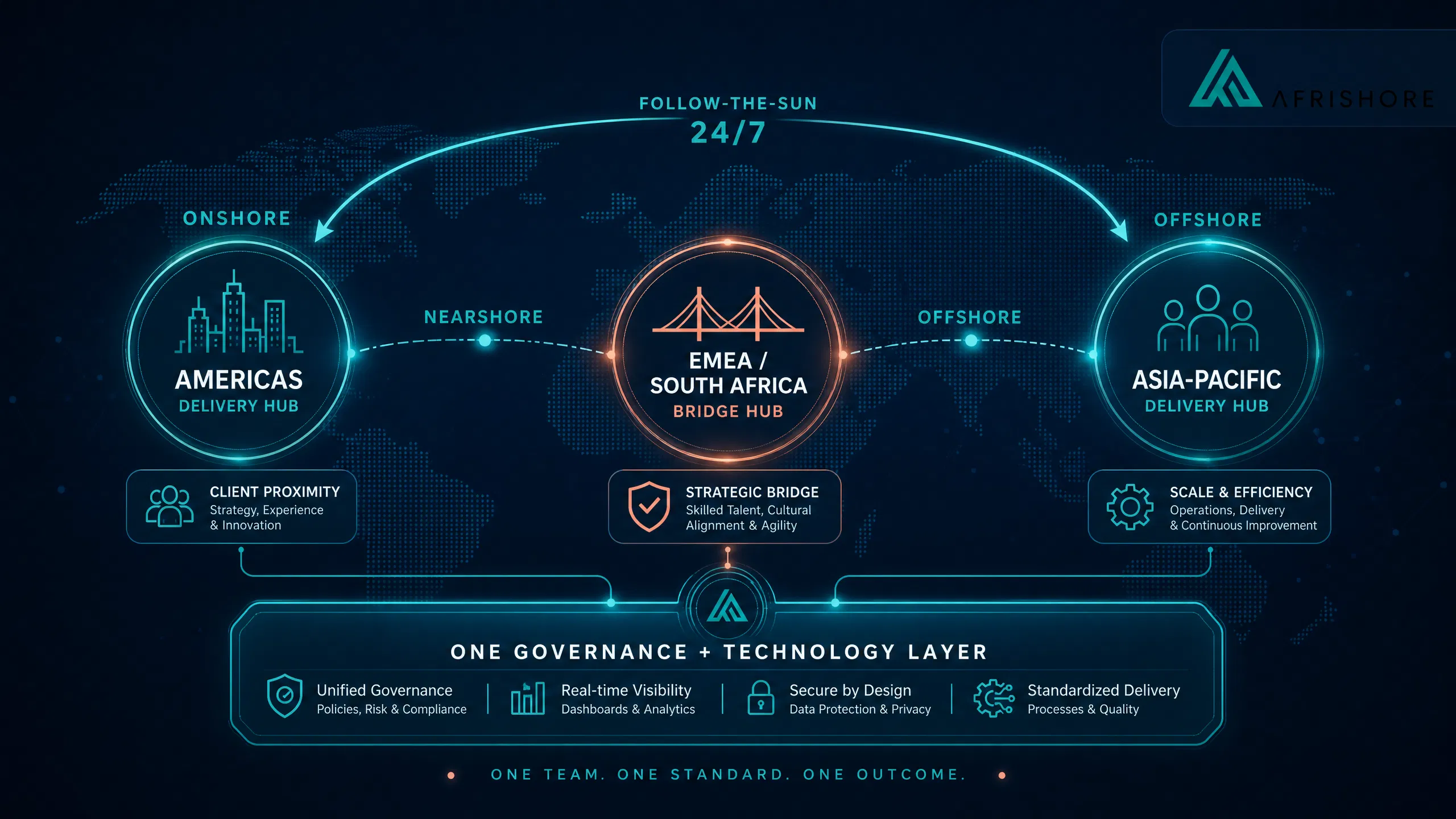
Quick Answer: Global BPO means running business processes across a deliberately chosen mix of onshore, nearshore, and offshore locations under one governance and technology layer, rather than concentrating everything in a single country. The aim is to blend cost, coverage, language fit, and resilience in ways no single geography can. The market is large and expanding: Grand View Research values global BPO at $328.4 billion in 2025, rising to $358.6 billion in 2026 at roughly a 9.9% annual growth rate, with North America the largest demand region.
Key Takeaways
- Global BPO in 2026 usually implies a multi-region delivery footprint, not a single offshore market; Ken Research puts the market at $328 billion in 2025 heading to $574 billion by 2031.
- North America remains the largest buyer, holding about 36.6% of the BPO market in 2024, while India and the Philippines anchor the largest offshore delivery capacity.
- A global delivery model routes work by fit: onshore for governance and client-facing work, nearshore for real-time collaboration, offshore for high-volume standardised execution.
- Offshore customer service typically bills at $6 to $14 per hour versus $25 to $42 onshore in the US, with nearshore in between at roughly $10 to $18.
- Follow-the-sun delivery across two or three hubs provides 24/7 coverage without permanent night shifts and removes the single-point-of-failure risk of one country.
- Single-vendor multi-region models deliver geographic resilience without multi-vendor complexity, provided the provider’s security and governance are strong.
- South Africa fits as a premium EMEA hub and a bridge between US and Asia: export revenue near $2.91 billion and headcount around 150,000 in 2024, with 55% to 65% cost savings and near-full UK time-zone overlap.
What Global BPO Actually Means
Global BPO is not simply having sites in several countries; it is the deliberate distribution of work across onshore, nearshore, and offshore locations under a central orchestration layer. Understanding the three delivery pillars is the starting point, because a global delivery model assigns each pillar the work it does best.
Onshore delivery sits in the same country as the client, giving full time-zone alignment and local regulatory familiarity at the highest cost. Nearshore delivery comes from nearby countries with overlapping hours and cultural affinity, typically saving 40% to 60% versus onshore. Offshore delivery comes from more distant, lower-cost geographies such as India or the Philippines, optimised for high-volume standardised work at the lowest unit cost. A mature Global Delivery Model combines all three: onshore teams handle strategic oversight and compliance-sensitive work, nearshore teams handle collaborative real-time work, and offshore teams provide the scalability engine for transaction processing and routine support. Our guide to the onshore-offshore hybrid team model explores how this blend works in a single programme, and our business process outsourcing hub sets out the function-by-function picture.
The Global BPO Market and Who Uses It
Outsourcing at global scale is now mainstream, and the structural concern for buyers is concentration risk, not capacity. The market is large enough that the real question is how to distribute work across regions, not whether the talent exists.
Analyst estimates cluster tightly. Fortune Business Insights reports $327 billion in 2025 rising to $353.6 billion in 2026, Grand View Research $328.4 billion in 2025, and Ken Research $328 billion in 2025 heading to $574 billion by 2031, all pointing to high-single to low-double-digit annual growth. On the demand side, North America held about 36.6% of the market in 2024. On the delivery side, Quantumrun estimates India’s IT-BPM sector at $283 billion in FY2025 with a workforce around 5.43 million, and the Philippines at about $38 billion with 1.82 million workers. The clear trend among mature buyers is away from single-country sourcing toward multi-region global delivery, precisely because no single location optimally satisfies cost, talent, and time-zone needs at once. Our BPO statistics page tracks the wider numbers.
Onshore vs Nearshore vs Offshore: The Cost and Fit Trade-Off
The three delivery pillars trade cost against collaboration: onshore is the most expensive and the most aligned, offshore the cheapest and the most asynchronous, nearshore the middle ground. Seeing the rate ranges side by side is what turns the model from theory into a sourcing decision.
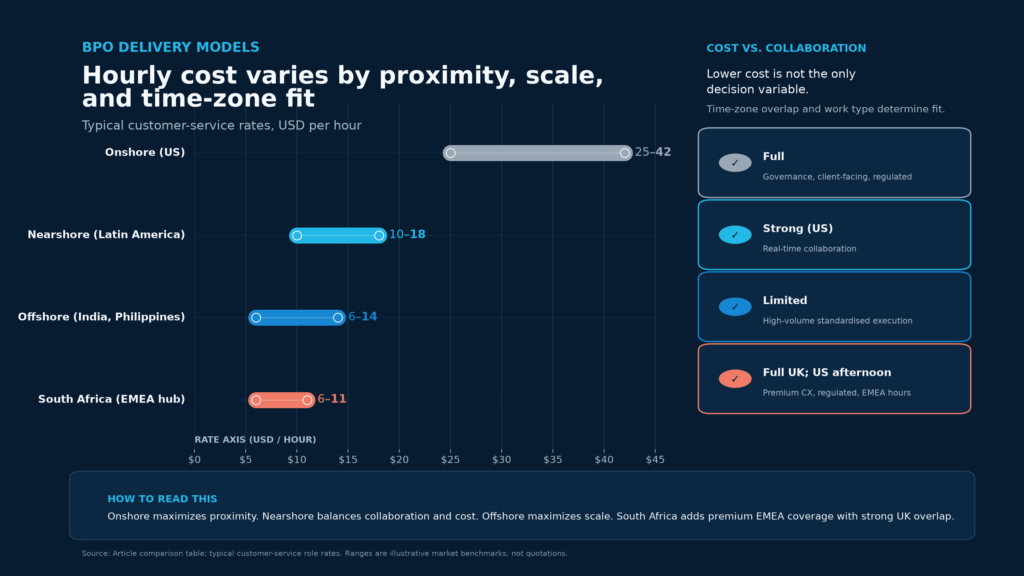
Table: Delivery models compared (customer service roles)
| Model | Typical rate per hour | Time-zone fit (US/UK) | Best-fit work |
| Onshore (US) | $25 to $42 | Full | Governance, client-facing, regulated |
| Nearshore (Latin America) | $10 to $18 | Strong (US) | Real-time collaboration |
| Offshore (India, Philippines) | $6 to $14 | Limited | High-volume standardised execution |
| South Africa (EMEA hub) | $6 to $11 | Full UK, US afternoon | Premium CX, regulated, EMEA hours |
Sources: CallForce BPO services guide, Sourcefit South Africa guide, BPESA via StealthAgents.
These pillars are almost always combined. A follow-the-sun chain hands work sequentially between hubs in different time zones so operations run continuously without any site working permanent night shifts, commonly using an Asia-Pacific hub for APAC hours, an EMEA hub such as South Africa for European hours, and an Americas hub for US hours. Blending offshore and nearshore hubs in a follow-the-sun chain yields a lower blended hourly rate than a fully onshore 24/7 operation while improving resilience. For destination-level comparisons, see our guides on South Africa versus the Philippines and South Africa versus India.
How to Evaluate a Global BPO Partner
Judge a global provider on five things: multi-region footprint and resilience, consistency of QA and training across sites, unified reporting, security and data-transfer compliance, and a consolidated commercial structure. Footprint alone is not resilience; the governance layer that ties the sites together is what a buyer is really buying.
Start with footprint and resilience: how many countries and cities, how mature each site is, and whether the provider can fail over between regions with tested continuity plans. Next, consistency across sites: standardised QA scorecards, centrally managed training and knowledge bases, and one set of global operating procedures so performance data is comparable regardless of location. Third, unified reporting: a single BI platform aggregating SLAs and KPIs across all regions, with drill-down by site and segment. Fourth, security and data-transfer compliance, which has become a gating factor rather than a differentiator: current ISO 27001 and SOC 2 Type II covering the specific in-scope sites, plus GDPR and UK-GDPR transfer mechanisms for cross-border data. We cover this layer in full in our guide to evaluating a partner’s data security and compliance. Finally, a consolidated commercial structure: one master services agreement with regional schedules, consistent SLAs across territories, and a single governance forum. A single-vendor, multi-region model delivers geographic diversification without the overhead of managing multiple vendors, provided that vendor’s controls are robust.
Governance and Compliance in Global Sourcing
Cross-border data transfer and consistent security across sites are the two governance obligations that make or break a global programme. They are not optional add-ons; for regulated or sensitive data they are the entry ticket.
Any global BPO arrangement moves personal data across borders, so the transfer mechanism matters. For EU and UK data leaving for a third country, buyers rely on Standard Contractual Clauses, which the European Commission modernised in June 2021 and which became mandatory for compliant transfers after December 2022, supported by a Transfer Impact Assessment where local laws require it. On security, insist that ISO 27001, based on 93 Annex A controls in the 2022 edition, and SOC 2 Type II certifications explicitly cover every region and system handling your data, not just a subset. In practice, buyers run global security policies with local playbooks, mandate defined recovery objectives and incident-notification timelines, and re-evaluate transfer mechanisms and continuity plans on a regular cadence. Because concentration risk rather than capacity is the main structural concern, the discipline is to quantify the incremental value of going global (cost, coverage, resilience) against this governance overhead.
Where South Africa Fits in a Global Delivery Mix
South Africa’s role in a global mix is the premium EMEA hub and the bridge node between US and Asia in a follow-the-sun chain. It complements rather than replaces India and the Philippines, taking the higher-value and regulated work where CX quality and time-zone fit matter more than the absolute lowest rate.

The sector has scaled fast. BPESA reports GBS headcount grew from about 65,000 in 2019 to around 150,000 in 2024, with export revenue rising from $1.04 billion to roughly $2.91 billion, and the sector added over 14,000 jobs in the first nine months of 2024 on the way to a 500,000-jobs target by 2030. On positioning, Ataraxis’ 2026 Global Outsourcing Talent Index ranks South Africa 5th globally and the top African destination. Its UTC+2 time zone, with no daylight saving, overlaps almost fully with UK and Western European hours and sits 6 to 8 hours ahead of US Eastern Time for a useful afternoon overlap, which is why it anchors the EMEA leg of follow-the-sun networks. On cost, BPESA’s value proposition reports 55% to 65% lower fully loaded costs than equivalent US and UK roles, with strong English proficiency and cultural alignment making it a value rather than pure-cost destination. Our overview of BPO in South Africa and our buyer’s guide to the best outsourcing destinations for US companies set out how it stacks up against the traditional giants.
Frequently Asked Questions
What is global BPO? Global BPO is the practice of running business processes across a deliberate mix of onshore, nearshore, and offshore locations under one governance and technology layer, rather than concentrating all work in a single country. The goal is to blend cost arbitrage, 24/7 coverage, language and cultural fit, and business-continuity resilience that no single geography can provide on its own.
What is a global delivery model? A global delivery model distributes work across international locations under unified governance, routing each task to the location that best fits its cost, sensitivity, and collaboration needs. Onshore teams handle strategic oversight and compliance-sensitive work, nearshore teams handle collaborative real-time work, and offshore teams execute high-volume standardised tasks at the lowest unit cost.
How big is the global BPO market? Analyst estimates cluster around $327 billion to $348 billion for 2025, with Grand View Research at $328.4 billion and forecasts of high-single to low-double-digit annual growth through 2030 and beyond. North America is the largest demand region at roughly 36.6% of the market, while India and the Philippines provide the largest offshore delivery capacity.
What is the difference between onshore, nearshore, and offshore? Onshore delivery is in the same country as the client, with full time-zone alignment at the highest cost. Nearshore is from nearby countries with overlapping hours, typically saving 40% to 60% versus onshore. Offshore is from more distant, lower-cost geographies such as India or the Philippines, optimised for high-volume standardised work at the lowest unit cost.
What is follow-the-sun delivery? Follow-the-sun is a pattern where work is handed off sequentially between teams in different time zones so operations run 24/7 without any site working permanent night shifts. A common chain uses an Asia-Pacific hub for APAC hours, an EMEA hub such as South Africa for European hours, and an Americas hub for US hours, which also removes the single-point-of-failure risk of one country.
Should I use a single vendor or multiple vendors for global BPO? A single-vendor, multi-region model gives one commercial relationship, unified reporting, consistent QA, and geographic diversification without multi-vendor complexity, provided the vendor’s security and governance are strong. A multi-vendor model adds competitive tension and specialist capability but increases coordination, data-fragmentation, and compliance-oversight overhead. Many enterprises use a hybrid of a primary global partner plus a few niche vendors.
Where does South Africa fit in a global delivery strategy? South Africa typically serves as a premium EMEA hub and a bridge between US and Asia in follow-the-sun chains. It offers strong English, cultural alignment, and a UTC+2 time zone that overlaps fully with the UK and reaches US afternoons, plus 55% to 65% cost savings. It complements India and the Philippines by taking higher-value, regulated, and CX-sensitive work.
What compliance is required for cross-border BPO data transfers? For EU and UK personal data sent to a third country, buyers rely on Standard Contractual Clauses (modernised in June 2021) and, where local laws require, a Transfer Impact Assessment with supplementary measures such as encryption. Providers should also hold current ISO 27001 and SOC 2 Type II certifications that explicitly cover the specific sites and systems handling the buyer’s data.
Afrishore BPO operates from South Africa as a premium EMEA hub within a global delivery footprint, combining strong English CX, near-full UK time-zone overlap, and 55% to 65% cost savings under ISO 27001-aligned governance. For the destination detail see BPO in South Africa, for the blended model see the hybrid outsourcing model, and our business process outsourcing hub shows the full service picture.
Speak to Afrishore about building South Africa into your global delivery mix.