
Quick Answer: The BPO industry in 2026 is going through a structural repricing, not a decline. Routine, seat-based volume is being automated out of contracts while demand rises for complex, compliance-heavy, and AI-adjacent human work. The clearest proof is in provider results: Teleperformance’s AI-powered solutions posted double-digit growth even as legacy revenue slipped, and TaskUs grew its AI services revenue 25.8% year-on-year in Q2 2026. For buyers, price-per-seat is no longer the primary axis of comparison.
Key Takeaways
- The market is repricing, not shrinking. Around 8 in 10 enterprises plan to maintain or increase outsourcing over the next 12 to 18 months, and 94% call it key to workforce transformation.
- AI is redistributing demand, not eliminating it. Demand for AI data annotation grew 154% year-on-year on Upwork, the fastest-growing data-science skill, even as AI removes simpler tasks.
- Cost has been demoted. 84% of enterprises still say outsourcing cuts costs, but the leading reasons are now flexibility (78%) and access to specialised talent (60%).
- Outcome pricing is replacing seats. 80% of enterprises expect outcome-based pricing to replace fixed contracts by 2030.
- Compliance-heavy verticals lead. Banking and financial services is the single largest outsourced vertical at roughly 18% of global spend, and finance and accounting outsourcing is forecast to grow to $75.2 billion by 2030.
- South Africa is the standout new destination. Its GBS sector created 26,346 new international jobs in 2025, up 28%, the strongest year on record.
The Big Shift: From Seats to Outcomes
The defining BPO industry trend of 2026 is that the composition of demand has changed, even though headline market growth remains mid-to-high single digit. Buyers are no longer comparing providers primarily on rate-per-hour. The Everest Group 2026 study found that while 84% of enterprises agree outsourcing reduces costs, their stated primary drivers are now flexibility and scalability (78%), access to specialised talent (60%), business-strategy alignment (52%), and process optimisation (49%). Cost still matters. It is simply no longer the decision-maker.
That shift is showing up in how contracts are priced. 80% of enterprises expect outcome-based pricing to replace fixed contracts as the preferred model by 2030, and new agreements increasingly build AI-enabled productivity gains into pricing from day one rather than renegotiating them later. This is the context that every other trend below sits inside: an industry moving from selling time to selling results, which is exactly the logic behind the onshore-offshore hybrid model many buyers now prefer.
Is AI Replacing BPO?
No, and the data cuts against that thesis decisively. AI is taking the simplest work out of BPO contracts, but it is raising demand for the harder, human-led work left behind. This is the most misunderstood BPO trend of 2026, so it is worth grounding in evidence rather than headlines.
Three data points settle it. First, only about 20% of service leaders have cut headcount because of AI, while 71% of customers say it is important for a human to validate AI output. Second, demand for AI data annotation and labelling, which is human work that trains and evaluates models, grew 154% year-on-year on Upwork, the fastest-growing skill in its entire data-science category. Third, adoption is broad but shallow: AI use in customer experience rose from 54% in 2024 to nearly 70% in 2026, yet 70% of AI-using organisations still score in the lowest maturity tier and only 2% reach the top.
The provider financials tell the same story from the revenue side. Concentrix reported its AI solution bookings rose 400% year-on-year in Q2 2026, with management attributing the surge to clients returning for help after not getting the value they expected from earlier AI investments. AI is redistributing BPO demand toward complexity, not deleting it. Our view on the human-plus-AI hybrid model explains why the two grow together rather than in opposition.
Where the Growth Is: Compliance-Heavy and Specialised Work
The fastest-growing demand in 2026 is for work that requires domain knowledge, regulatory expertise, and data security, not commodity call handling. Banking and financial services is already the single largest outsourced vertical at roughly 18% of global outsourced spend. Finance and accounting outsourcing is forecast to grow from $52.3 billion in 2024 to $75.2 billion by 2030, driven by a widening global accounting talent shortage and rising regulatory and ESG compliance complexity.
This is why the growth is concentrating in judgement-intensive functions. In the Everest Group data, the fastest expected growth in outsourcing penetration is in supply chain, data and analytics, and finance and accounting, all data-heavy rather than transactional. It also explains why enterprises are moving up the skill ladder: 76% now outsource mid-level roles, 48% outsource high-skill roles, and 9% outsource managerial roles. Afrishore’s own divisions map directly onto this shift, from finance and accounting outsourcing to IT outsourcing and regulated banking and financial services support.
The 2026 Trends at a Glance
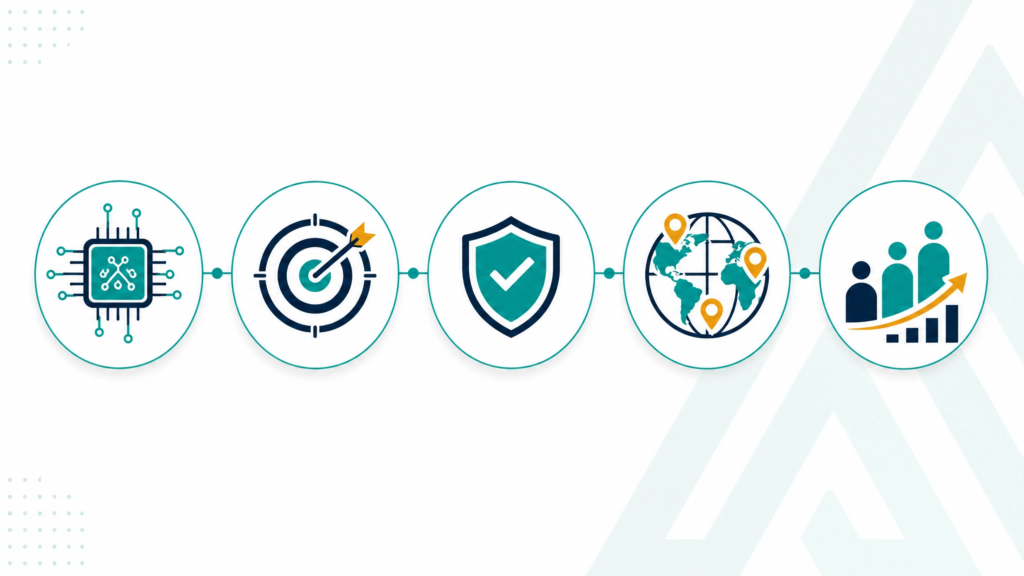
The table below summarises the five structural trends reshaping BPO in 2026 and the single most telling data point behind each.
| Trend | What is happening | Key 2026 data point |
| AI reshaping delivery | Simple work automated, human-led complex work grows | AI CX adoption ~70%, but only 2% at top maturity |
| Outcomes over arbitrage | Pricing moves from seats to results | 80% expect outcome pricing to lead by 2030 |
| Compliance-heavy demand | Regulated, specialised verticals lead growth | BFSI ~18% of global outsourced spend |
| Multi-shoring and nearshoring | Buyers spread risk across regions | 60% now outsource three or more functions |
| Impact sourcing and ESG | Auditable social outcomes become a selection factor | ~90% of SA GBS hires in 2025 were youth |
The through-line is quality. 50% of enterprises cite inconsistent talent quality as their top outsourcing challenge, a problem pure cost arbitrage cannot solve, which is why 49% now use a dedicated staffing model and a further 35% plan to.
The Labour Picture Is Pushing Buyers to Diversify
The traditional offshore destinations no longer offer a stable single-country answer, and that is accelerating multi-shoring. India delivers the highest wage inflation of any major economy at around 9.1% for 2026, though the technology-services increment closest to BPO is a lower 6.6%, while attrition sits at a multi-year low near 17%. The Philippines has lower wage inflation near 5.5% but sits in the highest-attrition service category globally. Contact-centre attrition runs at 38% to 45% annually, three to four times the broader workforce rate, and higher still on night-shift operations that serve US hours.
Neither profile is a clean answer, which is why 60% of enterprises now run three or more outsourced functions and increasingly weigh new destinations. For buyers modelling this, our South Africa versus Philippines comparison and the data on offshore call-centre attrition set out the trade-offs in detail.
Why South Africa Is the Standout 2026 Destination
South Africa has become the clearest live example of the industry’s shift toward quality and auditable outcomes, not just lower cost. Its global-business-services sector delivered its strongest year on record in 2025, creating 26,346 new international-market jobs, up 28%. Around 90% of those hires were young people and close to 30% came from households where nobody was previously employed, which makes its impact-sourcing credentials auditable rather than promotional.

The scale is real: the sector employs around 150,000 people, with close to 100,000 concentrated in Cape Town, and it is targeting 500,000 jobs by 2030. Impact sourcing globally is a measurable movement, with Everest Group tracking 420,000 to 450,000 FTEs and committing to a million impact-sourcing jobs by 2030. For buyers with ESG reporting obligations, South Africa’s incentive-linked youth-employment and B-BBEE conditions are verifiable third-party evidence, not marketing claims. Our deeper look at impact sourcing in South African BPO and the wider BPO in South Africa picture cover this in full.
How to Choose a Provider in 2026
The 2026 data supports a sharper set of diligence questions than the old rate-card comparison. Ask what proportion of a provider’s revenue is outcome-based or AI-enabled versus seat-based, since a provider that cannot answer is likely still volume-dependent in a shrinking part of the market. Ask for attrition against the 38% to 45% benchmark, including 90-day and first-year figures, because sub-25% attrition is achievable and correlates with hybrid work, career pathing, and AI-assisted coaching. And ask how AI decisions are explained to end customers, since transparency is becoming a live compliance exposure.
The arbitrage-only provider is now the highest-risk choice, because the evidence converges from three directions: provider results, buyer surveys, and the fact that the Philippines’ own trade body paused its industry roadmap because AI outran its assumptions. The safer choice is a partner built around dedicated teams, talent quality, and outcomes. For the underlying numbers behind these trends, see our regularly updated BPO statistics and the case for outsourcing to South Africa.
Frequently Asked Questions
Is the BPO industry growing or shrinking in 2026? Growing, but repricing. Headline market growth remains mid-to-high single digit, and around 8 in 10 enterprises plan to maintain or increase outsourcing over the next 12 to 18 months. What is changing is the composition of demand: routine seat-based volume is being automated out of contracts while demand rises for complex, compliance-heavy, and AI-adjacent human work.
Will AI replace BPO jobs? Not on the current evidence. Only about 20% of service leaders have cut headcount because of AI, while demand for human AI-training work such as data annotation grew 154% year-on-year. AI is removing the simplest tasks and increasing demand for higher-skill human work. The industry is redistributing toward complexity rather than disappearing.
What are the biggest BPO trends in 2026? Five stand out: AI reshaping delivery while raising demand for complex human work; a shift from cost arbitrage to outcome-based pricing; rising demand for compliance-heavy and specialised verticals like finance and banking; multi-shoring and nearshoring as buyers spread risk; and impact sourcing with auditable ESG outcomes becoming a selection factor.
Why are buyers moving away from cost as the main factor? Because cost arbitrage cannot solve the quality problem. Half of enterprises cite inconsistent talent quality as their top challenge. As a result, buyers now prioritise flexibility, access to specialised talent, compliance, and continuity, and 84% still get cost savings as a secondary benefit. Dedicated staffing models are being adopted specifically to fix quality and governance.
How is outcome-based pricing changing outsourcing contracts? It ties payment to results rather than headcount or hours. 80% of enterprises expect outcome-based pricing to replace fixed contracts by 2030, and new agreements increasingly build AI-enabled productivity gains into pricing from the start. This favours providers who can demonstrate measurable outcomes over those selling rate-per-seat.
Which destinations are gaining share in 2026? Buyers are diversifying beyond the traditional India and Philippines default. South Africa is the clearest gainer, with its GBS sector creating 26,346 new international jobs in 2025, up 28%, the strongest year on record. Nearshore regions in Latin America and Eastern Europe are also expanding as enterprises spread risk across time zones.
What should I ask a BPO provider in 2026? Ask what share of revenue is outcome-based or AI-enabled versus seat-based, request attrition data against the 38% to 45% industry benchmark including early-tenure figures, and ask how the provider explains AI-driven decisions to end customers. These questions separate a modern, quality-led partner from a legacy volume shop.
Afrishore builds dedicated business process outsourcing teams from South Africa, aligned to exactly the trends this article describes: quality-led delivery, compliance-heavy verticals, and auditable impact sourcing rather than commodity seats. Explore the case for outsourcing to South Africa, or talk to us about a team scoped to your function.