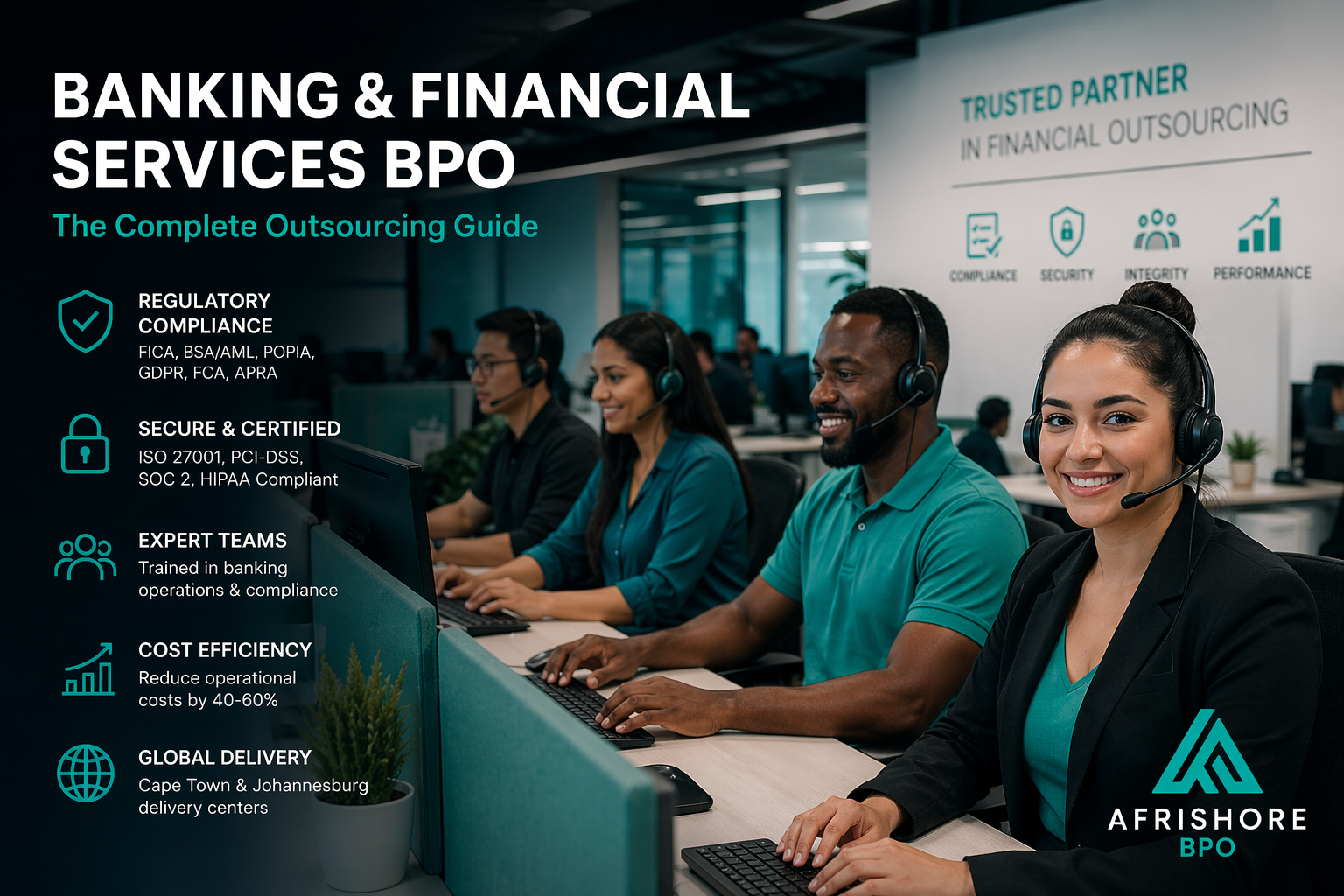
Financial services BPO enables banks, credit unions, fintechs, and payment processors to outsource operational functions – from KYC onboarding to fraud review – while maintaining regulatory compliance. In October 2024, FinCEN imposed a $1.3 billion civil money penalty on TD Bank for systemic BSA/AML violations, the largest in FinCEN history. As compliance operating costs continue to climb, banks and fintechs are outsourcing execution layers to specialist providers rather than building expensive in-house teams that duplicate infrastructure they cannot efficiently scale.
What Is Banking and Financial Services BPO?
Banking and financial services BPO refers to the outsourcing of operational, customer-facing, and back-office functions that support – but don’t replace – a bank’s core risk decisions or lending judgment. Banks and fintechs outsource the execution layer: customer support, KYC document collection, loan application processing, payment reconciliation, fraud alert triage, early-stage collections, and regulatory reporting preparation.
What BPO is not in this context: outsourcing credit decisioning, final AML risk sign-off, or the bank’s fiduciary responsibility. The institution owns the outcome; the BPO provider executes the process. This distinction matters for regulatory accountability under OCC third-party risk management guidance.
South Africa has become a delivery location of choice for financial services BPO. As a FATF member operating under the Financial Intelligence Centre Act (FICA), South Africa offers POPIA-compliant data protection comparable to GDPR and common-law frameworks familiar to US and UK regulators. Banks working with South African providers benefit from agents trained in BSA, FCA, and MLR 2017 requirements – without the overhead of building those teams domestically.
For a broader understanding of how operational functions are structured for outsourcing, see our guide to business process outsourcing.
Why Are Banks and Fintechs Outsourcing Operations?
Banks and fintechs outsource operational functions because compliance and operational costs have increased significantly since the financial crisis, while regulatory complexity demands dedicated specialist teams most mid-size institutions cannot justify building in-house.
Four drivers are accelerating banking outsourcing services adoption:
1. Cost pressure: Compliance operating costs for retail and corporate banks have risen sharply over the past decade, according to Deloitte’s compliance cost research. Mid-size banks face the same regulatory requirements as national institutions but lack the scale to absorb those costs efficiently. Outsourcing provides immediate access to compliance-trained teams at 40-60% lower fully-loaded cost.
2. Regulatory complexity: BSA/FinCEN, FCA conduct rules, CRA exam readiness, and OCC third-party risk management standards require specialised operational teams. Building them in-house means recruiting, training, supervising, and retaining staff for functions that don’t generate revenue. A dedicated BPO provider already has those teams, infrastructure, and audit trails in place.
3. Speed to scale: Challenger banks and fintechs scaling rapidly cannot hire fast enough to match customer acquisition velocity. Outsourcing provides immediate capacity – onboarding dedicated teams in weeks rather than months – allowing product and engineering teams to focus on differentiation rather than operational overhead.
4. Focus: Core banking teams redirected to product development, risk management, and client relationships deliver more strategic value than managing back-office execution. Outsourcing lets institutions deploy senior talent where it creates competitive advantage, not where it replicates commodity infrastructure.
For institutions managing BSA/AML operations specifically, see our dedicated guide to AML outsourcing.
Which Operations Can Banks Outsource to a BPO Provider?
Banks and fintechs can outsource customer-facing, back-office, and compliance support functions – everything except final risk decisions and regulatory sign-off authority.
- Customer support and contact centre: Dispute resolution, account queries, card services, loan enquiries, payment status updates, and general banking support. BPO agents handle tier-1 and tier-2 enquiries; the bank retains escalation paths for complex cases requiring judgment or product expertise.
- KYC and customer onboarding support: Document collection, identity verification, risk tier assignment based on predefined rules, and CIP data entry. The BPO provider gathers and validates information; the bank’s compliance team signs off on final risk acceptance. This division satisfies OCC guidance that accountability remains with the institution.
- Loan processing support: Application intake, document checking, data entry, credit report retrieval, income verification, status updates, and deficiency follow-up. The BPO team prepares the file; the bank’s underwriters make the credit decision. This separation is critical for regulatory exams and investor audits in securitisation.
- Collections and accounts receivable: Early-stage collections (30-90 days past due), payment reminders, cure outreach, promise-to-pay tracking, and payment plan setup. This is distinct from third-party debt recovery and ARM, which is covered in our accounts receivable management outsourcing guide. BPO in banking focuses on customer retention and portfolio curing, not charge-off recovery.
- Fraud review and alert triage: First-pass review of flagged transactions, false positive filtering based on rules engines, case note documentation, and escalation to fraud investigators. BPO teams clear high-volume alert queues so in-house investigators can focus on complex cases. Final fraud determinations remain in-house.
- Back-office reconciliation and data processing: Ledger entries, payment matching, end-of-day balancing, exception research, GL coding, and reporting. These high-volume, rules-based tasks are well-suited for outsourcing. Banks retain oversight and month-end close authority; BPO teams execute daily processing.
- Regulatory reporting support: Data gathering, report preparation, submission formatting, and documentation for BSA, CTR, SAR, OFAC, and prudential reports. The BPO provider prepares; the bank’s compliance officer reviews and signs. This model meets FCA and APRA expectations that regulated entities maintain control over regulatory submissions.
Banks and fintechs can outsource any operational, customer support, or compliance support function where execution can be separated from final judgment, risk acceptance, or regulatory accountability. The institution retains oversight, sign-off authority, and responsibility for outcomes; the BPO provider delivers trained teams, infrastructure, quality control, and audit documentation.
Why South Africa for Banking and Financial Services BPO?
South Africa offers regulatory alignment, English fluency, cultural fit, and 40-60% cost savings – making it a leading BPO destination for banks and fintechs serving US, UK, and Australian markets.
1. Regulatory alignment: South Africa is a FATF member operating under the Financial Intelligence Centre Act (FICA) and POPIA data protection standards comparable to GDPR. South African BPO agents are trained in frameworks that directly mirror US BSA/FinCEN requirements and UK MLR 2017 standards. When your regulator asks about third-party controls during an exam, your provider can demonstrate equivalent jurisdiction compliance – not a regulatory gap requiring mitigation.
2. English proficiency and cultural fit: South Africa ranks 13th globally on the EF English Proficiency Index (2025). Agents speak with neutral accents, use Western banking terminology naturally, and understand US and UK customer expectations around tone, urgency, and complaint handling. For financial services – where empathy, trust-building, and de-escalation matter as much as technical knowledge – cultural alignment is a material operational factor.
3. Cost advantage: South Africa delivers 55-65% cost savings over equivalent US, UK, and Australian in-house roles, according to BPESA’s National Value Proposition. A fully-loaded customer support agent costs $18,000-$24,000 per year in South Africa versus $65,000-$80,000 for a US in-house equivalent. Government incentives through the dtic GBS programme reduce operational expenses by an additional 7-10%.
4. Certified operations: ISO 27001, ISO 9001, HIPAA, and PCI-DSS certified providers are available in South Africa’s financial services BPO market. Banks don’t need to build compliance infrastructure from scratch – certified providers meet financial services security and quality requirements from day one, reducing procurement cycles and satisfying audit requirements without additional overhead.
For a comprehensive overview of South Africa’s BPO ecosystem, infrastructure, and regulatory environment, see our BPO in South Africa guide.
What Compliance Standards Apply to Financial Services BPO?
Financial services BPO providers must comply with the same regulatory frameworks that govern the banks they serve – even though ultimate accountability remains with the institution.
US requirements: Bank Secrecy Act (BSA), FinCEN rules for CTR and SAR reporting, OCC third-party risk management guidance (OCC 2013-29 and the 2024 community bank guide), FDCPA for collections, and GLBA for data privacy. The institution must conduct due diligence, ongoing monitoring, and contingency planning for third-party failures.
UK requirements: FCA Third Party Risk Management (SYSC 8), Money Laundering Regulations 2017, and PRA outsourcing rules (SS2/21). UK banks must demonstrate that outsourced activities remain under effective control, that the provider can be audited, and that the arrangement can be terminated without operational disruption.
Australian requirements: APRA CPS 231 outsourcing standard requires material outsourcing arrangements to be documented, monitored, and tested. Australian banks must maintain a register of material outsourcing arrangements and demonstrate ongoing oversight of provider performance.
Cross-jurisdictional standards: FATF membership of the provider’s jurisdiction (South Africa is a member), POPIA data protection where South African providers handle personal data, GDPR where EU customer data is involved, and ISO 27001 information security management.
Payment card data: PCI-DSS Level 1 or Level 2 certification is non-negotiable where payment card data is stored, processed, or transmitted. Banks must verify annual compliance reports (AOC) and ensure BPO environments meet PCI network segmentation requirements.
The critical principle: ultimate regulatory accountability stays with the bank. The BPO provider executes processes, maintains controls, and produces audit evidence – but the institution owns the outcome. Regulators will hold the bank responsible for third-party failures, which is why OCC, FCA, and APRA guidance all emphasise due diligence, contract terms, and ongoing monitoring as non-delegable responsibilities.
How Do You Choose a BPO Partner for Banking and Fintech?
Choosing a financial services BPO provider requires verifying regulatory readiness, operational security, and delivery model fit – not just cost.
- Verify ISO 27001 and SOC 2 certification: Information security management systems are non-negotiable for financial data handling. Request current certificates, review scope statements to confirm they cover the services you are outsourcing, and verify that surveillance audits are up to date.
- Confirm PCI-DSS certification if payment card data is in scope: Request the current Attestation of Compliance (AOC), verify the service provider level (1 or 2), and confirm that your use case falls within certified scope. Do not rely on “PCI-compliant environment” claims without documentation.
- Demand in-office operating model: Work-from-home arrangements introduce unacceptable risk for banking operations. Verify that agents work in secure, monitored facilities with physical access controls, CCTV, no mobile phones on the production floor, and network segmentation.
- Check OCC/FCA third-party risk documentation readiness: Your provider should be able to supply: SOC 2 reports, business continuity plans, disaster recovery test results, incident response procedures, subcontractor disclosures, and financial stability documentation on request.
- Request dedicated team model with named supervisors: Insist on dedicated teams that work exclusively on your account, with named team leads, QA analysts, and trainers who understand your processes, systems, and regulatory requirements.
- Verify BPESA membership for South African providers: Membership in Business Process Enabling South Africa signals baseline industry quality standards and commitment to skills development – a useful initial filter when evaluating providers.
For institutions specifically evaluating collections and receivables management, see our guide to accounts receivable management outsourcing for function-specific provider selection criteria.
FAQ – Banking and Financial Services BPO
Q1: What is financial services BPO?
Financial services BPO is the outsourcing of operational, customer support, and back-office functions to specialist providers who execute processes on behalf of banks, credit unions, fintechs, and payment processors. Functions commonly outsourced include customer support, KYC document processing, loan application intake, fraud alert triage, reconciliation, and regulatory reporting preparation. The institution retains accountability for outcomes, risk decisions, and regulatory compliance; the BPO provider supplies trained teams, infrastructure, quality assurance, and audit documentation.
Q2: Can banks outsource compliance operations?
Banks can outsource compliance support operations – data gathering, report preparation, document review, alert triage, case documentation – but cannot outsource compliance accountability or final regulatory sign-off. Under OCC, FCA, and APRA rules, the institution remains responsible for compliance outcomes even when execution is outsourced. The bank’s compliance officer must review, approve, and sign regulatory submissions prepared by BPO staff. The provider executes; the institution owns the result.
Q3: What is the cost of outsourcing banking operations to South Africa?
South Africa delivers 55-65% cost savings over US, UK, and Australian in-house operations, with government incentives reducing expenses by an additional 7-10%. A fully-loaded customer support agent costs $18,000-$24,000 per year in South Africa versus $65,000-$80,000 for a US equivalent. Back-office and compliance support roles show similar savings. Total cost of ownership includes agent salaries, facilities, technology, management, training, and quality assurance.
Q4: Is it safe to outsource financial services work offshore?
Yes – when the provider meets regulatory standards, operates in a FATF-compliant jurisdiction, and holds ISO 27001 and PCI-DSS certification. South Africa’s regulatory alignment (FATF member, POPIA data protection, FICA AML framework) makes it jurisdictionally compatible with US, UK, and Australian banking regulations. The risk is provider selection, not geography. Banks that conduct proper due diligence, negotiate strong contract terms, and implement ongoing monitoring mitigate third-party risk effectively whether the provider is domestic or offshore.
Q5: What certifications should a financial services BPO provider hold?
ISO 27001 (information security management), SOC 2 Type II (security and availability controls), PCI-DSS Level 1 or 2 if handling payment card data, ISO 9001 (quality management), and HIPAA certification for US health-related financial products. For South African providers, verify BPESA membership and POPIA compliance. Request current certificates, review scope statements, confirm surveillance audits are up to date, and verify that your specific use case falls within certified scope.
Ready to Outsource Banking Operations with Confidence?
Afrishore BPO delivers ISO 27001, ISO 9001, HIPAA, and PCI-DSS certified financial services BPO from Cape Town and Johannesburg – with 20+ years serving regulated verticals. Our dedicated teams operate exclusively in secure, 24/7 in-office environments, trained in BSA/FinCEN, FCA, and APRA frameworks. We build compliance-ready operations that meet OCC third-party risk management standards from day one.
Contact Afrishore BPO to discuss your specific requirements and see how we can reduce operational costs by 40-60% while maintaining the audit trails and documentation your regulator expects.