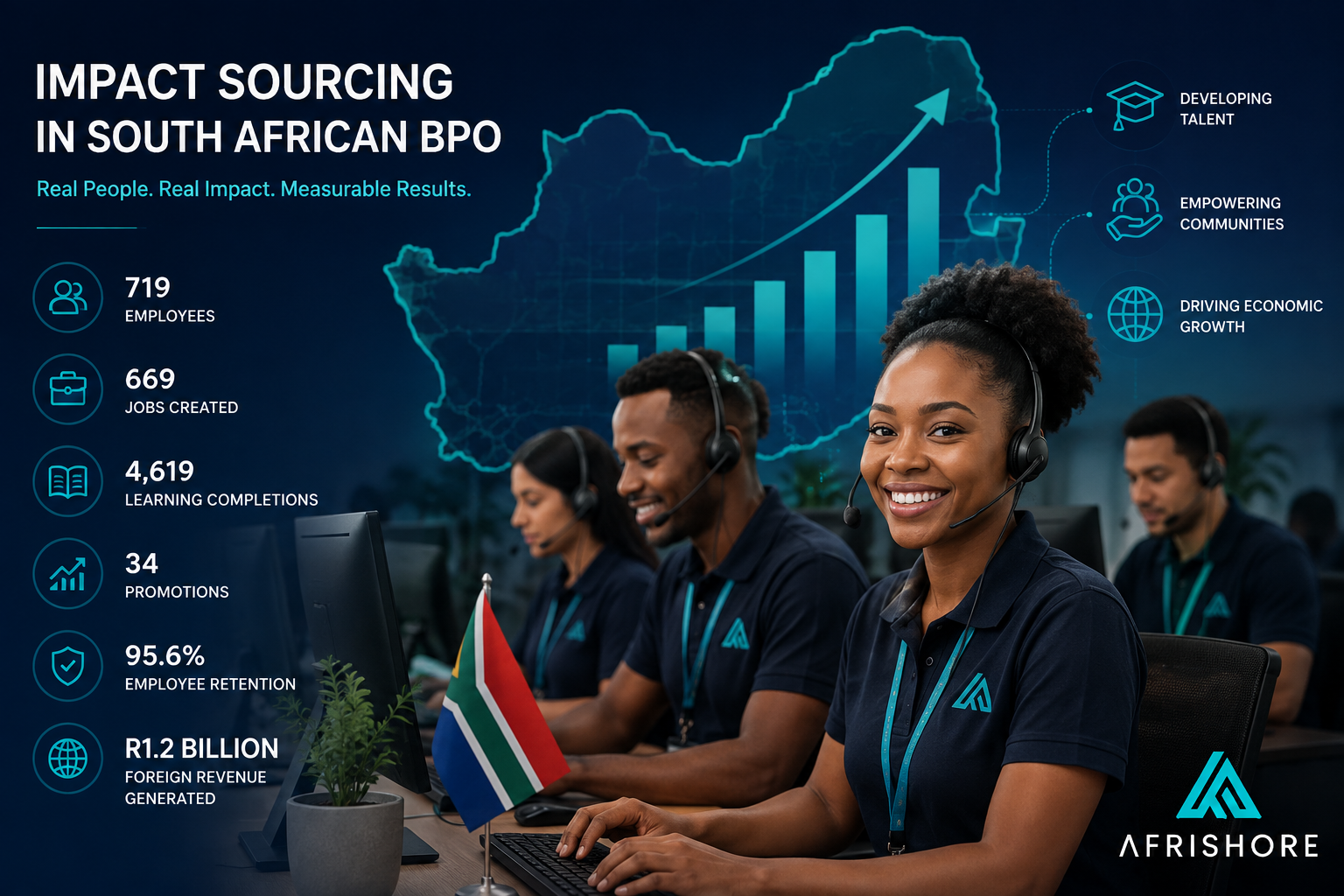
Impact sourcing, once treated as a side project in corporate social responsibility, has become a measurable line item in how enterprises choose an outsourcing partner. Everest Group’s Impact Sourcing State of the Market 2025 report documents that shift directly. Afrishore BPO’s own 2025/26 data, covering 719 employees across Africa, North America, and Europe, gives a concrete answer to what that shift looks like inside a South African delivery hub.

Quick Answer In its 2025/26 reporting year, Afrishore BPO created 669 jobs, logged 4,619 learning completions, and held 95.6% employee retention. That performance sits inside a wider South African Global Business Services (GBS) sector that added a record 26,346 new international jobs in 2025, its highest annual total since 2018 (BPESA data via ITWeb, 2026).
Key Takeaways
- Afrishore BPO’s 2025/26 data: 719 employees, 669 jobs created, 34 promotions, 4,619 learning completions, and 95.6% employee retention across 3 regions.
- South Africa’s GBS sector created 26,346 new international jobs in 2025, its highest total since 2018, with about 90% filled by young people (BPESA/ITWeb, 2026).
- Globally, impact sourcing now employs over 520,000 workers and is growing 4 to 5% a year, with the industry targeting 1 million impact sourcing jobs by 2030 (Everest Group, 2025).
- South Africa’s dtic and BPESA have signed a GBS Masterplan Framework targeting up to 500,000 cumulative jobs in the sector by 2030 (SA Good News, 2026).
- South African call center attrition runs an estimated 13% to 25% depending on model, well below the Philippines’ commonly cited 40%+ range, a gap that shows up directly in training and promotion outcomes (AVOXI, citing Global Call Centre Research Network).
- Independent industry research corroborates the pattern at sector scale: ContactBabel’s Inner Circle Guide to South African Contact Centres 2025-26 found 65% of SA contact-centre operations run a formal impact sourcing programme and 44% of all agents come through one (ContactBabel data via Vox, 2026).
- Afrishore generated more than R1.2 billion in foreign revenue in 2025/26, contributing directly to South Africa’s balance of payments and to further local job creation.
- “Business should leave communities stronger than it found them,” says Kobus Nel, GCEO for Africa at Afrishore BPO.
What Is Impact Sourcing, and Why Are Buyers Suddenly Asking About It?
Impact sourcing means deliberately hiring and developing people who would otherwise struggle to access formal employment, and treating that hiring as a workforce strategy rather than a donation.
Everest Group’s Impact Sourcing State of the Market 2025 research describes a specific shift in how enterprises evaluate this practice. Impact sourcing, the report finds, means intentionally hiring and developing people from marginalized communities, so that a workforce strategy and an ESG or DE&I objective become the same investment rather than two separate budget lines. Buyers are “less interested in symbolic impact stories and more focused on measurable outcomes, resilience, and alignment with ESG goals,” expecting providers to show performance, cost, and social value together rather than a social-impact story sitting apart from a service-level agreement.
That shift is already visible at scale. Global impact sourcing headcount now sits above 520,000 workers, growing 4 to 5% a year, with the industry’s stated goal being 1 million impact sourcing jobs by 2030, up from 350,000 just two years earlier. Generative AI is accelerating that growth on the delivery side: providers are using vernacular digital learning for rural talent, AI-enabled dialers and assistive technologies, and AI-led onboarding to move impact workers into more complex, judgement-intensive roles rather than displacing them with automation. For a business process outsourcing partner, that means the workforce data behind a contract is now as relevant to a buyer’s decision as the pricing sheet.
What Does Afrishore’s 2025/26 Impact Sourcing Report Actually Show?
Afrishore’s own 2025/26 numbers: 719 employees, 669 new jobs, 34 promotions, and 4,619 completed learning interventions across customer experience, collections, IT outsourcing, financial services, direct marketing, healthcare, sports betting and iGaming, and e-commerce.
Afrishore’s Impact Sourcing 2025/26 report lays out a full year of workforce data rather than a single headline figure:
| Metric | 2025/26 Figure |
| Employees | 719 |
| Jobs created | 669 |
| Regions served | 3 (Africa, North America, Europe) |
| Campaigns launched | 8 |
| Learning completions | 4,619 |
| Promotions | 34 |
| Women in leadership | 63% |
| Employee retention | 95.6% |
| Volunteer hours | 97 |
| Community beneficiaries | 300+ |
| Foreign revenue generated | R1.2 billion |

The people behind those numbers are the point of the report: 669 jobs created across customer experience, collections, IT outsourcing, financial services, direct marketing, healthcare, sports betting and iGaming, and e-commerce, with 34 of those employees promoted internally rather than replaced by new hires. Kobus Nel, GCEO for Africa at Afrishore BPO, frames the underlying philosophy directly: “Business should leave communities stronger than it found them.” The R1.2 billion in foreign revenue the company generated over the same period is not incidental to that mission. It is the mechanism, foreign client revenue funding local salaries, training budgets, and further hiring, that lets impact sourcing operate as a business model rather than a subsidized program.
How Does South Africa’s 2025 Job Creation Compare to Its 2030 Target?
South Africa’s GBS sector added 26,346 new international jobs in 2025, its best year since 2018, and is now measurably progressing toward a formal 500,000-job target for 2030.
Afrishore’s individual hiring numbers sit inside a national trend. A July 2026 report on ITWeb, based on data from Business Process Enabling South Africa (BPESA), states that South Africa’s global business services sector created 26,346 new jobs servicing international markets in 2025, the highest annual total since 2018, with just under 23,800 of those roles, about 90%, filled by young people.
That growth is not happening by accident. The South African government’s Department of Trade, Industry and Competition signed a GBS Masterplan Framework with the sector setting a pathway to create between 350,000 and 500,000 cumulative new jobs by 2030. For a company evaluating BPO in South Africa as a delivery location, the sector-wide statistics matter as much as any single provider’s numbers: this is structural job creation, backed by a formal government-industry framework, not a one-off marketing claim.
How Does Impact Sourcing Scale from Global to National to Company Level?
Impact sourcing shows up at three scales at once: a global industry adding hundreds of thousands of workers, a national sector setting formal job-creation targets, and individual providers converting that mandate into hires, training, and promotions.
| Scale | Workforce or job data | Stated 2030 goal | Source (cited above) |
| Global impact sourcing industry | Over 520,000 workers, growing 4-5% a year | 1 million impact sourcing jobs | Everest Group |
| South Africa GBS sector | 26,346 new international jobs in 2025 (highest since 2018) | 350,000 to 500,000 cumulative new jobs | BPESA / dtic |
| Afrishore BPO | 669 jobs created, 34 promotions, 4,619 learning completions in 2025/26 | Continued expansion of international partnerships and learning investment | Afrishore BPO 2025/26 Impact Sourcing Report |
Reading these three rows together answers a question most impact sourcing marketing avoids: is this an industry trend a single provider is riding, or a genuine structural shift? The global growth rate, the national job-creation framework, and a specific provider’s hiring and promotion data all point the same direction. A buyer evaluating any single BPO partner’s impact sourcing claims can use this scaffolding to check whether that provider’s numbers plausibly fit inside the national and global trend, or whether they look inflated against it.
Does Lower Attrition Prove Impact Sourcing Works?
Afrishore’s 95.6% retention rate sits well above the benchmarks reported for South African call centers generally, and workers who stay are the ones who get promoted and trained instead of replaced.
Attrition is the metric that turns impact sourcing from a hiring statistic into a career-development statistic, because a job that lasts three months does not produce 4,619 learning completions or 34 internal promotions. Industry data gives South Africa a real structural advantage here. AVOXI’s analysis of Global Call Centre Research Network data puts South African in-house call center attrition at 21% and subcontractor call center attrition at 13%, broadly consistent with other industry reporting that places the country’s BPO attrition in a 13% to 25% range depending on model and measurement period.
That compares favorably with the Philippines, where multiple industry analyses describe BPO attrition commonly running at 40% or higher, with some segments and years reported closer to 50%. The practical consequence for a buyer: a provider with structurally lower attrition can afford to invest in multi-week onboarding, ongoing skills training, and internal promotion pathways, because the return on that investment is not lost every few months to turnover. Afrishore’s 95.6% retention figure and 4,619 learning completions are two sides of the same operational fact, not two unrelated highlights.
Why Do 4,619 Learning Completions and 34 Promotions Matter More Than Headcount?
Impact sourcing is measured in career development, not headcount alone, and Afrishore’s 4,619 learning completions and 34 promotions in a single year are the workforce-development half of that equation.
A jobs-created number answers “how many people got hired.” It does not answer “what happened to them after.” Afrishore’s 2025/26 data adds that second layer: 4,619 completed learning interventions across leadership development, technical training, and professional coaching, delivered under a stated “agents today, leaders tomorrow” philosophy, and 34 employees promoted into more senior roles rather than the business simply hiring externally for those positions. That pairs with the AI-enabled onboarding and upskilling trend covered above: the industry’s shift is from one-time entry-level training toward long-term employability, and a promotion count is one of the few numbers that actually proves that shift happened rather than describing it in the abstract.
Afrishore’s own reported figure of 63% women in leadership sits inside this same pattern of internal development rather than one-off hiring. Company-reported leadership representation figures are typically the product of years of promotion pipelines and mentorship, not a single hiring cycle, which is why they tend to track more closely with retention and learning investment than with headcount growth alone. Afrishore’s academy-based training model and its broader approach to agent training and quality are the operational mechanisms behind both the promotion and leadership figures reported this year.
What Should Buyers Check Before Trusting a BPO Partner’s ESG Claims?
The credible test is whether a provider pairs social-impact numbers with hard commercial evidence: certifications, retention data, and service-level performance across the specific function being outsourced.
Buyers now expect performance, cost, and ESG alignment together, not a social-impact story presented instead of a service-level agreement. That translates into a practical checklist when evaluating any BPO partner’s impact sourcing or ESG positioning:
- Numbers-based reporting, not adjectives. A credible report states jobs created, retention rate, learning completions, and promotions as specific figures for a specific period, the way Afrishore’s 2025/26 report does, rather than describing “our people-first culture” without data behind it.
- Recognized certifications. Quality management (ISO 9001) and information security (ISO 27001) certifications are standard due-diligence items in outsourcing procurement, alongside data-handling standards like HIPAA and PCI-DSS where relevant to the function being outsourced. Afrishore holds all four.
- Retention as a leading indicator. A provider’s attrition rate is one of the few workforce metrics that predicts service consistency, training return on investment, and account continuity at the same time, which is why it belongs in any ESG or social-impact evaluation, not just an HR appendix.
- Function-specific evidence. A provider’s social-impact claims should be checkable against the specific service line being considered, whether that is accounts receivable and collections or iGaming customer support, rather than a single company-wide statistic standing in for every team a buyer might actually work with.
- Compliance depth, not a logo. A certification badge on a website is a starting point, not proof; buyers evaluating data-sensitive functions should confirm current certification status directly rather than assuming a claimed certification is current or scoped to the relevant service line.
Independent Research Confirms the Same Pattern at Sector Scale
Afrishore’s company-level numbers are not an outlier claim: independent research on South Africa’s contact-centre sector finds the same structural pattern, formal impact sourcing programmes at most operations and a substantial share of the workforce hired through them.
Company-reported data is stronger when an independent, methodologically documented source finds the same pattern across the wider industry rather than at one company alone. ContactBabel’s Inner Circle Guide to South African Contact Centres 2025-26, published November 2025 from fieldwork across more than 100 senior South African CX and contact-centre leaders, found that 65% of South African contact-centre operations run a formal impact sourcing programme, and 44% of all agents nationally come through one of those programmes. The same research links impact sourcing directly to workforce stability, reporting that participants show lower attrition and higher engagement than the sector average.
That sector-wide picture is the context Afrishore’s own 2025/26 figures sit inside: a company reporting 719 employees, 669 jobs created, and 95.6% retention through impact sourcing is not describing an isolated program, it is executing the same model that a majority of the national industry has already adopted, at outcomes that hold up against the country’s own benchmark data.
Frequently Asked Questions
What is impact sourcing in the BPO industry?
Impact sourcing is the deliberate hiring, training, and career development of people who would otherwise have limited access to formal employment, treated as a core workforce strategy rather than a corporate social responsibility add-on. It links social outcomes like job creation and skills development directly to measurable business performance.
How is Afrishore BPO practicing impact sourcing in 2025/26?
In its 2025/26 reporting year, Afrishore BPO grew to 719 employees, created 669 new jobs, delivered 4,619 learning completions, promoted 34 people internally, and held 95.6% employee retention across operations serving Africa, North America, and Europe.
Why are outsourcing buyers now asking about a provider’s social impact?
Enterprise buyers increasingly expect outsourcing partners to demonstrate ESG alignment alongside cost and performance, rather than treating social impact as a separate story. Everest Group’s Impact Sourcing State of the Market 2025 research found buyers are now focused on measurable outcomes and resilience, not symbolic gestures.
How many jobs has South Africa’s GBS sector created recently?
South Africa’s Global Business Services sector created 26,346 new international jobs in 2025, its highest annual total since 2018, with about 90% of those roles filled by young people, according to BPESA data reported by ITWeb.
Is South Africa on track to reach its 500,000-job BPO target by 2030?
South Africa’s dtic and BPESA have signed a GBS Masterplan Framework targeting 350,000 to 500,000 cumulative new jobs in the sector by 2030. The 26,346 jobs created in 2025 alone show the sector accelerating toward that goal.
Does South Africa have lower call center attrition than other outsourcing destinations?
Industry benchmarking places South African call center attrition at roughly 13% to 25% depending on model, compared with 40% or higher commonly reported in the Philippines BPO market, giving South African providers more stability to invest in training and promotion rather than constant replacement hiring.
What should a business check before trusting a BPO partner’s impact sourcing claims?
Look for verifiable, numbers-based reporting on jobs created, retention, learning completions, and promotions, recognized quality and security certifications such as ISO 9001 and ISO 27001, and evidence that social outcomes are reported alongside, not instead of, service-level performance.
Does hiring through impact sourcing cost outsourcing buyers more?
No credible evidence suggests impact sourcing increases buyer costs. Structured, inclusive hiring paired with real training investment is associated with lower attrition, which reduces the hidden costs of constant re-hiring and re-training that erode service quality in high-turnover outsourcing operations.
Is Afrishore’s impact sourcing data consistent with the rest of the South African BPO industry?
Yes. ContactBabel’s independent Inner Circle Guide to South African Contact Centres 2025-26 research found that 65% of South African contact-centre operations run a formal impact sourcing programme and 44% of all agents nationally come through one, with participants showing lower attrition than the sector average. Afrishore’s own 719-employee, 95.6%-retention 2025/26 result reflects the same industry-wide pattern rather than a standalone claim.
Conclusion
Impact sourcing stopped being a side note in outsourcing procurement once buyers started asking providers to show their workforce numbers alongside their pricing sheets. Afrishore’s 2025/26 data, 719 employees, 669 jobs created, 4,619 learning completions, and 95.6% retention, sits inside a South African GBS sector adding a record number of jobs and a global impact sourcing industry scaling toward a million workers by 2030. The numbers are the argument.
To discuss how impact sourcing and workforce development factor into an outsourcing partnership, contact Afrishore BPO for a no-obligation assessment.
Related reading: Business Process Outsourcing · BPO in South Africa · BPO Statistics · Offshore Call Center Attrition Rates · South Africa vs. Philippines · South Africa vs. India · Afrishore BPO’s People