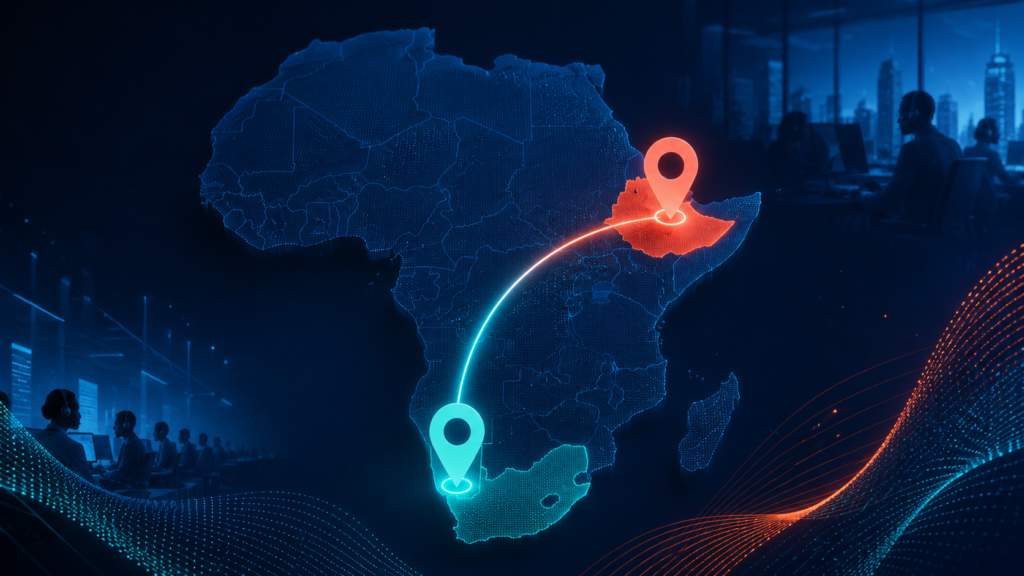
Ethiopia has started showing up in outsourcing conversations as an emerging, ultra-low-cost BPO destination — backed by a government strategy explicitly targeting IT-enabled services and outsourcing. For US and UK buyers evaluating both Ethiopia and South Africa, the decision isn’t really about which country is “better” in the abstract. It’s about which one matches the risk profile and workload you actually have.
Key Takeaways
- Ethiopia’s BPO sector is small and young — roughly 15,000 people across ~25 registered companies generating about $50M annually, versus South Africa’s hundreds of thousands of GBS/BPO workers and $2.91B in export revenue (BPESA, 2025)
- Ethiopian labour costs run 20–40% below mainstream hubs (South Africa, India, Philippines), but the comparison excludes infrastructure and quality risk that offset part of that saving
- Ethiopia suffered roughly 14,910 hours of internet shutdowns in 2023 alone, at an estimated $1.59–1.9B economic cost — the second-highest in the world; South Africa has no comparable history of politically-driven shutdowns
- South Africa’s English proficiency ranks 13th globally (“Very High” band); Ethiopia ranks around 63rd (“Moderate” band) — a meaningful gap for voice and live-chat CX
- South Africa’s POPIA data protection law has been in force since 2013; Ethiopia’s equivalent law (the PDPP) only took effect in July 2024 and is still building enforcement track record
- Analysts (Ryan Strategic Advisory, Everest Group) treat Ethiopia as an early-stage opportunity to watch, while South Africa sits in the established top 3 global offshore CX destinations
Why Ethiopia Is Entering the Outsourcing Conversation
Ethiopia’s government has made BPO and IT-enabled services an explicit national priority under its “Digital Ethiopia” strategy, but the sector remains small — about $50 million in annual revenue and 15,000 workers — next to South Africa’s hundreds-of-thousands-strong, $2.91 billion GBS export sector (BPESA, 2025).
Ethiopia’s government has explicitly targeted business process outsourcing as part of its national digital strategy. The “Digital Ethiopia 2025” plan, and its successor “Digital Ethiopia 2030,” name IT-enabled services — including BPO — as a priority pathway for job creation and foreign exchange earnings. Ethiopia’s ICT Park Corporation is being repositioned to attract and cluster outsourcing firms, and the Ethiopian Outsourcing Association (EOA) is lobbying for special economic zone incentives similar to those that helped build India’s BPO industry.
The intent is real. The market, so far, is not large. Ethiopia’s BPO sector is estimated at around $50 million annually, with roughly 25 registered companies and about 15,000 people engaged in the sector — including remote freelancers. Named providers include R&D, MMCY Tech, Exellerent Solution, and Gebeya, serving a mix of local and international clients. Statista projects the market could grow at roughly 10.4% annually through 2029, but that forecast is contingent on infrastructure and policy execution that hasn’t happened yet.
For scale, compare that to South Africa’s sector: hundreds of thousands of GBS and BPO workers, $2.91 billion in export revenue in 2024, and a government target of 500,000 new jobs by 2030. Ethiopia is a market to watch. South Africa is a market that’s already delivering at scale for UK and US enterprise buyers.
Cost Comparison: Where Ethiopia’s Case Is Strongest
Ethiopian wages undercut South Africa, India, and the Philippines by an estimated 20–40% — a real advantage, but one that isn’t yet backed by the attrition and total-cost data that make South Africa’s $6–11/hour bill rate easy to model with confidence.
Cost is Ethiopia’s clearest advantage, and it’s a real one. Local salary data cited by Ethiopian industry sources puts base call-center pay around 5,500 birr per month, materially below South Africa’s national entry-level contact-center pay of roughly R6,002 per month reported in late 2024. Industry analysis of healthcare BPO specifically suggests moving work from traditional hubs (India, Philippines) to Ethiopia could yield an incremental 20–40% labour cost saving.
For context on where the mainstream destinations sit, fully-loaded BPO bill rates in 2024–2026 typically run:
| Destination | Typical BPO bill rate (USD/hour) |
| India | $6–14 |
| Philippines | $8–14 |
| South Africa | $6–11 |
| Ethiopia | Not yet standardized in global pricing guides; estimated 20–40% below the above |
Ethiopia isn’t broadly represented in global pricing benchmarks yet — the sector is too young and too thinly documented for consistent rate cards. That absence is itself informative: buyers evaluating Ethiopia are pricing an emerging market, not a market with an established cost-to-quality track record.
Attrition matters here too. Well-documented destinations report clear numbers: South Africa’s offshore contact-center attrition runs roughly 15–20% annually, the Philippines 25–35%, and India 11–18% (see the full attrition rate breakdown for the compounding cost model). Ethiopia has no comparable published attrition data, which means the “real” 12-month cost of an Ethiopian program — after training, churn, and ramp-up are factored in — is largely unquantified. A lower headline wage doesn’t guarantee a lower total cost if turnover erases the saving.
Infrastructure and Delivery Risk: The Biggest Gap
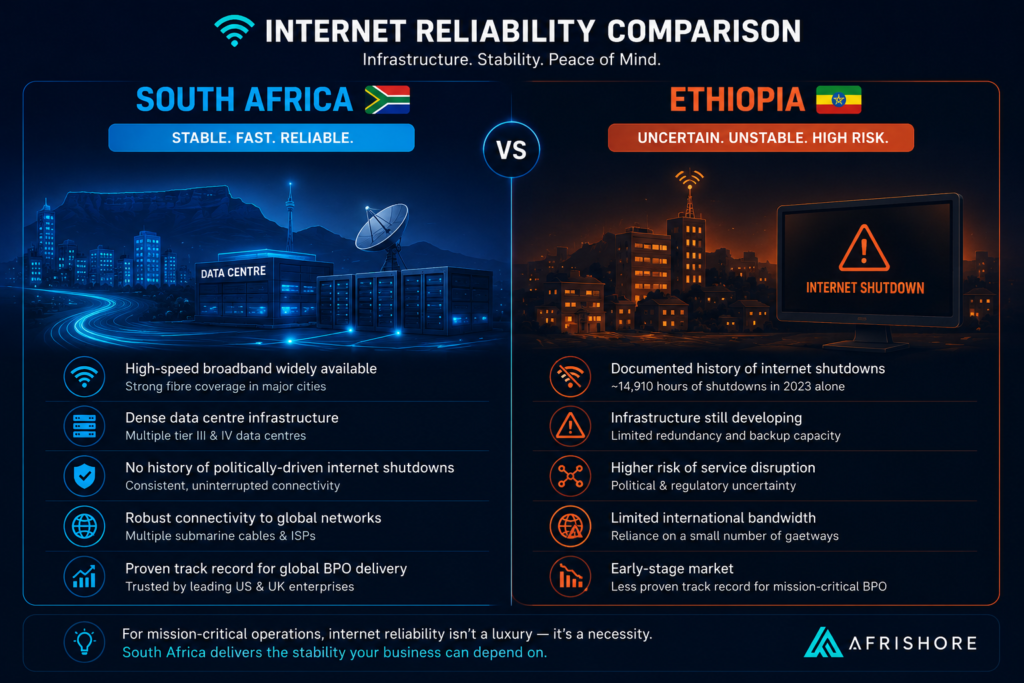
Ethiopia suffered an estimated 14,910 hours of internet shutdowns in 2023 alone — the second-highest economic cost globally that year — while South Africa’s loadshedding fell 82% in H1 2025 and it has no history of politically-driven outages at all.
This is where the comparison becomes less about cost and more about whether a 24/7 program can run reliably at all.
Power. Ethiopia has the third-largest energy access deficit in Sub-Saharan Africa. A 2025 World Bank survey found only about 44% of Ethiopians have Tier 1+ electricity access — roughly 71 million people lack sufficient power, concentrated in rural and peri-urban areas. Urban electrification is much higher (around 94% in cities), but reliability and quality still vary, and businesses commonly run generators as standard backup. The World Bank’s PRIME and ASCENT programs are investing over $900 million to strengthen the grid, but these are multi-year reforms, not an immediate fix.
South Africa’s grid, by contrast, has improved sharply. CSIR data shows loadshedding fell about 82% in the first half of 2025 versus 2024, and Eskom reported more than 275 consecutive days without loadshedding starting March 2024, with only 26 hours of loadshedding across all of 2025. Leading South African BPOs and data centers have also built robust generator and battery infrastructure on top of that improving baseline.
Internet reliability. This is Ethiopia’s most serious operational risk. Ethiopia suffered an estimated 14,910 hours of internet shutdowns in 2023 alone, affecting around 29 million users, at an estimated economic cost of $1.59–1.9 billion — the second-highest shutdown cost globally that year, behind only Russia. These weren’t brief outages: Tigray experienced a near two-year blackout (November 2020–February 2023), and the Amhara region went without mobile data from August 2023 to July 2024. These shutdowns are typically tied to political and security conditions, can be regional or national, and arrive with little warning — a direct threat to any operation depending on continuous CRM, payment, or monitoring access.
South Africa has no comparable history of politically-driven shutdowns. It leads Africa in broadband speed at roughly 42.42 Mbps average, more than double Morocco’s rate, and Johannesburg and Cape Town host around 55 data-center facilities between them — Johannesburg alone accounts for over 70% of national colocation power capacity, anchored by operators like Teraco (Digital Realty), Africa Data Centres, and Vantage Data Centers.
English Proficiency and CX Quality
South Africa ranks 13th globally on the EF English Proficiency Index (“Very High” band); Ethiopia ranks around 63rd (“Moderate” band) — a gap that shows up directly in CSAT and first-call-resolution data for live voice and chat work.
South Africa scores 602 on the EF English Proficiency Index — 13th globally, first in Africa, in the “Very High” band. Ethiopia scores around 498–499, ranked roughly 63rd globally and 6th in Africa, in the “Moderate” band. For back-office and asynchronous work, that gap matters less. For live voice and real-time chat — where tone, comprehension under pressure, and first-contact resolution drive CSAT — it’s operationally significant.
Some Ethiopian commentary describes local agents as “accent-neutral,” which may hold anecdotally, but it isn’t yet backed by the kind of large-scale CSAT benchmarking that exists for South Africa, India, and the Philippines. South Africa, by comparison, has independently documented performance: international buyers outsourcing CX to South Africa achieve first-call resolution and customer satisfaction outcomes roughly 18% higher than other offshore markets, per BPESA and investor-handbook data.
Time Zone: Both Work for Europe, South Africa Edges US Coverage
Both destinations offer workable, no-night-shift coverage of UK business hours; South Africa’s edge shows up on US coverage, where its GMT+2 offset avoids the deeper overnight rotation Ethiopia’s GMT+3 requires for full US Eastern hours.
Ethiopia runs on East Africa Time (UTC+3) year-round; South Africa runs on SAST (UTC+2) year-round — both skip daylight saving.
- UK coverage: South Africa is 1–2 hours ahead of the UK depending on season, giving a clean daytime overlap — see the full breakdown in outsourcing to South Africa for UK businesses. Ethiopia is 2–3 hours ahead — still workable, but slightly less convenient for late-afternoon UK coverage.
- US Eastern coverage: South Africa is 7 hours ahead, so a 2pm–11pm SAST shift covers 7am–4pm ET — solid US daytime coverage without a full overnight rotation. Ethiopia is 8 hours ahead, meaning covering 9am–5pm ET requires a roughly 5pm–1am local shift — closer to genuine night-shift work.
Both destinations require deeper night shifts for full US Pacific coverage, similar to India and the Philippines.
Compliance and Data Protection Maturity
South Africa’s POPIA has been enforced since 2013 and is treated as structurally GDPR-aligned; Ethiopia’s equivalent law only took effect in July 2024, leaving it with barely a year of enforcement track record for regulated industries to rely on.
South Africa’s Protection of Personal Information Act (POPIA) has been in force since 2013, enforced by an independent Information Regulator, and is widely treated as structurally aligned with GDPR. Leading South African BPOs commonly hold ISO 27001, ISO 9001, PCI-DSS, and COPC certifications as standard practice — not exceptions.
Ethiopia’s equivalent, the Personal Data Protection Proclamation (PDPP), only took effect in July 2024. It’s a genuine step forward — it establishes data-subject rights, breach notification requirements, and cross-border transfer restrictions broadly in line with global norms — but it has barely a year of enforcement history. There’s no BPESA-style framework tracking certification prevalence across Ethiopian providers, and analyst commentary notes the country has historically lacked a comprehensive legal structure for data privacy and cross-border digital services. For regulated industries — financial services, insurance, healthcare — that maturity gap is the difference between a well-tested compliance pathway and an unproven one.
What Each Destination Does Best
South Africa wins on English proficiency, CX track record, infrastructure reliability, and analyst positioning; Ethiopia’s only clear edge is headline labour cost — everything else favors the more established destination.
| Criterion | South Africa | Ethiopia |
| Labour cost | ⚠️ Competitive ($6–11/hr) | ✅ Lowest — 20–40% below mainstream hubs |
| English proficiency | ✅ “Very High” (602, 13th globally) | ⚠️ “Moderate” (~498, ~63rd globally) |
| CX track record / CSAT data | ✅ 18% better than other offshore markets (documented) | ❌ Largely anecdotal, no benchmarking |
| Power grid reliability | ✅ Loadshedding down 82% in H1 2025 | ❌ ~71M people lack reliable power access |
| Internet reliability | ✅ No history of political shutdowns | ❌ ~14,910 shutdown hours in 2023 alone |
| Data protection law maturity | ✅ POPIA in force since 2013 | ⚠️ PDPP in force since mid-2024 only |
| Certification ecosystem (ISO, PCI-DSS) | ✅ Standard among leading BPOs | ⚠️ Sparse, no sector-wide tracking |
| Analyst positioning | ✅ Top-3 global offshore CX destination | ⚠️ Early-stage opportunity to watch |
| UK timezone fit | ✅ Strong, no night shift | ✅ Workable, no night shift |
| Workforce scale | ✅ Hundreds of thousands of agents | ❌ ~15,000 people, sector-wide |
Choose Ethiopia when: the workload is non-voice, low-risk back-office processing or annotation work where cost is the dominant factor; you’re running a small, risk-tolerant pilot to test an emerging market ahead of competitors; or you can absorb occasional connectivity and power disruptions without contractual exposure.
Choose South Africa when: the program is voice or live-chat CX for US/UK customers; you operate in a regulated industry (financial services, insurance, healthcare, iGaming) where certification and data protection maturity matter; you need a proven, referenceable track record rather than an emerging one; or continuous 24/7 uptime is a genuine requirement, not a nice-to-have.
Frequently Asked Questions
Is Ethiopia cheaper than South Africa for BPO?
On headline labour cost, yes — Ethiopian wages run an estimated 20–40% below mainstream hubs including South Africa, based on local salary data and industry commentary. However, Ethiopia lacks published attrition and total-cost data, so the full 12-month cost of an Ethiopian program (including training, churn, and disruption from power or internet outages) is largely unquantified, unlike South Africa’s well-documented cost model.
Is Ethiopia a reliable BPO destination for 24/7 operations?
Not yet at the level established hubs offer. Ethiopia suffered an estimated 14,910 hours of internet shutdowns in 2023 alone — the second-highest shutdown cost globally that year — plus meaningful power access gaps outside major cities. South Africa has no comparable history of politically-driven shutdowns and has sharply reduced loadshedding since 2024, making it structurally more reliable for continuous operations.
How does English proficiency compare between Ethiopia and South Africa?
South Africa ranks 13th globally on the EF English Proficiency Index, in the “Very High” band. Ethiopia ranks around 63rd, in the “Moderate” band. For voice and live-chat customer service, South Africa’s higher and more consistent proficiency translates into better first-contact resolution and CSAT outcomes.
Does Ethiopia have a data protection law like South Africa’s POPIA?
Yes, but it’s much newer. Ethiopia’s Personal Data Protection Proclamation took effect in July 2024, compared to South Africa’s POPIA, which has been enforced since 2013. Both establish data-subject rights and cross-border transfer rules, but South Africa’s law has over a decade of enforcement history and a mature ecosystem of ISO 27001, ISO 9001, and PCI-DSS certified providers, while Ethiopia’s compliance ecosystem is still forming.
Is Ethiopia a good fit for voice-based customer support?
It can work for non-critical use cases, but South Africa is the stronger choice for voice CX serving US/UK customers. South Africa’s “Very High” English proficiency band and independently documented 18% better CSAT/first-call-resolution performance versus other offshore markets give it a proven advantage that Ethiopia’s “Moderate” proficiency band and anecdotal accent-neutrality claims don’t yet match.
What kind of work makes sense to outsource to Ethiopia right now?
Analysts and industry commentary point to non-voice, lower-risk work — data entry, annotation, basic back-office processing — or small, deliberate pilot programs where buyers can tolerate infrastructure and regulatory immaturity in exchange for very low labour cost and early-mover positioning in an emerging market.
Which destination has better analyst backing — South Africa or Ethiopia?
South Africa. Ryan Strategic Advisory’s Front Office CX Omnibus Survey has consistently placed South Africa among the top 3 global offshore CX destinations, tying for second in 2024. Ethiopia appears in analyst commentary (Everest Group, industry researchers) as an emerging opportunity to watch, but not yet as a proven, benchmarked destination.
Conclusion
Ethiopia’s outsourcing ambitions are genuine, and its cost advantage is real — but genuine ambition and an early-stage market are not the same thing as a proven delivery destination. The infrastructure gap (particularly around internet shutdowns), the immaturity of its data protection framework, and the absence of independently benchmarked CX performance data mean Ethiopia is currently best suited to narrow, risk-tolerant use cases rather than primary customer-facing programs.
South Africa offers what Ethiopia doesn’t yet have: a decade-plus track record, a mature certification and compliance ecosystem, independently documented CX performance, and infrastructure that has demonstrably improved rather than a strategy that promises to. For US and UK buyers weighing both destinations for anything beyond a small experimental pilot, South Africa remains the lower-risk, higher-performing choice.
To scope what a South Africa-based program could look like for your operation, contact Afrishore BPO for a no-obligation assessment. Afrishore operates from Johannesburg and Cape Town, with over 20 years of BPO delivery experience, and holds ISO 27001, ISO 9001, PCI-DSS, and HIPAA certifications.
Related reading: BPO South Africa vs India · South Africa vs Philippines Outsourcing · Best Outsourcing Destinations for US Companies · Business Process Outsourcing