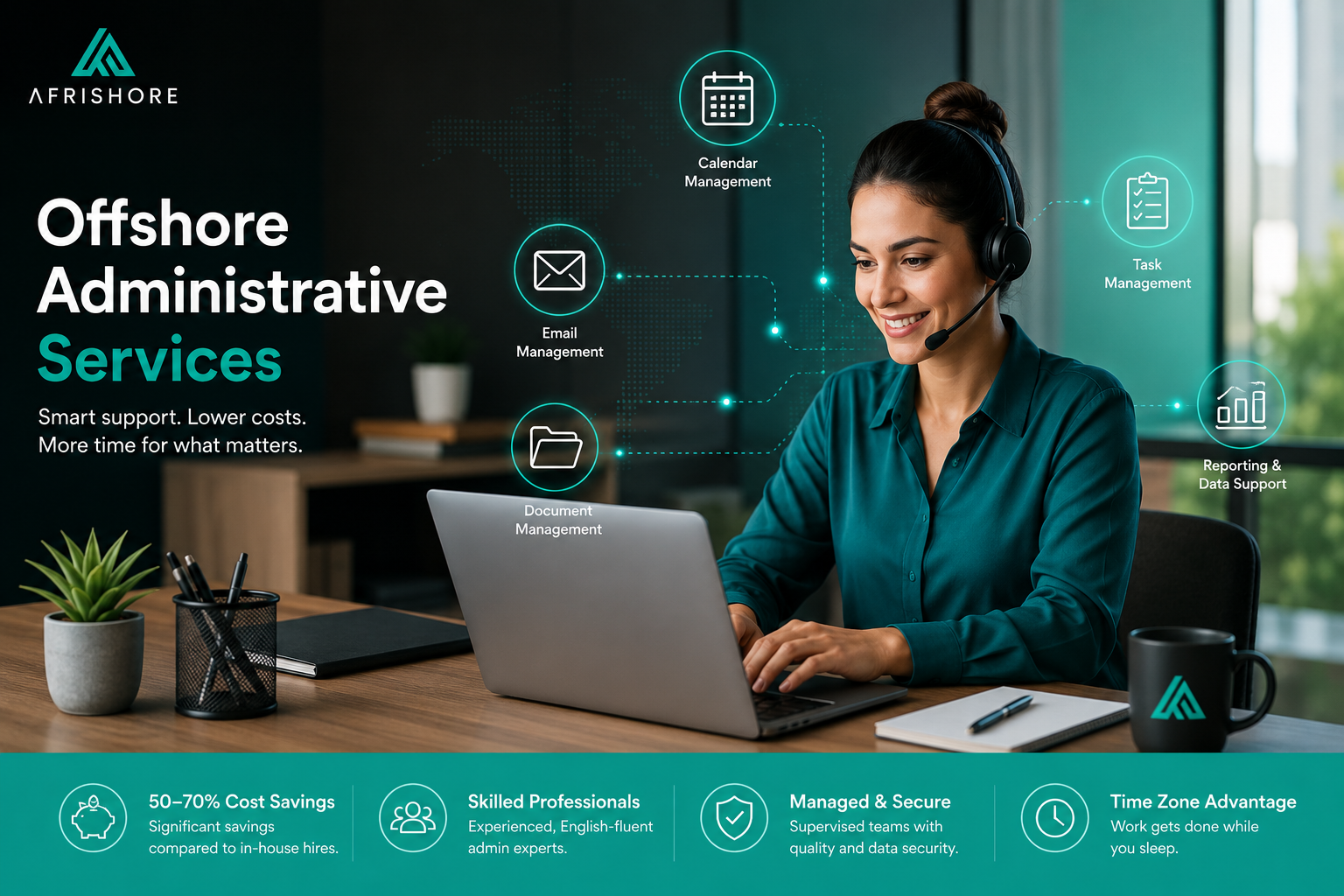
A full-time in-house administrative assistant in the US now costs $65,000–90,000 a year once benefits, payroll taxes, office space, and recruiting are added to the base salary (BLS, 2024). In the UK, a “£25k admin hire” is typically a £30,000–45,000 decision once National Insurance, pension contributions, and setup costs are included (EmployerCosts.co.uk, 2026). Offshore administrative services – a managed provider supplying trained admin and executive assistant staff from a lower-cost location – exist to solve this cost problem without sacrificing the supervision and security a freelance hire can’t offer.

Quick Answer Offshore administrative services are managed, supervised admin and executive-assistant staff delivered from a lower-cost location – typically 50–70% cheaper than an equivalent US or UK hire, without the churn risk of a freelance marketplace VA. A fully-loaded US admin assistant costs $65,000–90,000 a year (BLS, 2024); a managed offshore equivalent typically costs a fraction of that for the same scope of work.
Key Takeaways
- A fully-loaded US admin assistant costs $65,000–90,000+ a year (BLS, 2024); a fully-loaded UK admin assistant costs £30,000–45,000 in year one once National Insurance, pension, and setup costs are added to a ~£25,000 base (EmployerCosts.co.uk, 2026)
- Managers consistently report losing a substantial share of the working week to admin tasks – email management, scheduling, and reporting are the most commonly cited drains
- Offshore administrative support through a managed provider typically costs 50–70% less than in-house hiring, while remaining priced high enough to attract genuinely capable, English-fluent talent
- Freelance marketplace VA arrangements carry real hidden costs – client-side recruiting, training, and management time, plus the risk of losing the assistant with no backup coverage
- South Africa ranks 13th globally (602) on the EF English Proficiency Index – first in Africa – with near-zero time offset to the UK and a 6–7 hour head start on US Eastern Time for same-day turnaround
- The right delegation line isn’t “what can offshore do” – it’s “what needs an onshore signature.” Offshore admin owns the process and the paperwork; onshore leaders keep sign-off rights on regulated or high-risk decisions
What Does In-House Administrative Support Actually Cost?
A US admin assistant’s headline salary is only part of the cost – benefits, payroll taxes, office space, and recruiting typically push the true annual cost to $65,000–90,000. UK figures show the same 30–45% uplift above base salary.
The US Bureau of Labor Statistics puts the median annual wage for secretaries and administrative assistants at roughly $47,460 (May 2024 data). That number understates the real cost once benefits (typically $10,000–15,000), employer payroll taxes, office space and equipment, and recruiting and onboarding are added – pushing a year-one total closer to $66,000–89,000. Executive assistant roles run higher still, commonly averaging $80,000+ before bonuses.
The UK pattern is proportionally identical. UK administrative assistants earn an average base of roughly £25,000–27,000, but employer National Insurance and workplace pension contributions alone add 15–20% on top of salary – and once recruitment fees, workstation setup, software licenses, and initial training are included, the first-year total cost reaches £30,000–45,000. UK executive assistants command meaningfully more, particularly in London or high-demand sectors.
How Much Time Do Managers Actually Lose to Admin Work?
Managers consistently report losing a substantial share of the working week to routine administrative work – email management is the single largest component.
Multiple independent surveys converge on the same broad pattern, even where the exact hours vary by methodology: a large share of a manager’s week – commonly cited in the range of a full working day or more – goes to email triage, scheduling, report preparation, compliance documentation, and expense processing rather than higher-value work. Whichever specific figure a given survey lands on, the direction is consistent: this is time that should be going to sales, strategy, or clients, not inbox triage.
What Does Offshore Administrative Support Actually Cost?
Full-time offshore administrative support through a managed provider typically costs a fraction of an equivalent US or UK hire – commonly the price of a single US salary quarter for a full year of coverage.
Offshore administrative staffing pricing scales with region and skill level, with managed placements generally landing well below onshore equivalents once the full comparison – not just the headline hourly rate – is made. For a US or UK buyer working through a managed BPO rather than hiring directly, a full-time South African admin professional is typically priced materially cheaper than a domestic hire, but high enough to attract genuinely capable, English-fluent talent rather than the bottom tier of a freelance marketplace.
In-House vs. Freelance VA vs. Managed Offshore: A Side-by-Side Comparison
| Factor | In-House Hire | Freelance Marketplace VA | Managed Offshore (e.g. South Africa) |
| Typical annual cost (US) | $65,000–90,000 | $15,000–35,000, highly variable | Materially below in-house, above marketplace floor |
| Supervision & backup | Direct, built-in | None – client manages entirely | Team lead / account manager included |
| Replacement if unavailable | Client re-recruits | Client re-recruits from scratch | Provider guarantees replacement, typically within days |
| Security & compliance | Client-controlled | Client-controlled, rarely formalized | ISO 27001 / SOC 2, POPIA/GDPR contracts |
| Typical engagement length | Long-term | 3–9 months average | 1–3+ years, higher retention |
Is a Managed Offshore Provider Better Than a Freelance VA Marketplace?
Freelance VA marketplaces work well for one-off projects. For ongoing admin workflows, they typically mean higher churn, no backup coverage, and the client doing all the vetting, training, and management work themselves.
This is the comparison most buyers researching offshore admin support are actually trying to make – not “offshore vs. local,” but “managed provider vs. freelancer marketplace.” The failure modes of freelance arrangements are well documented: engagement durations are frequently short, and 12-month retention on directly-hired freelance VAs runs meaningfully below agency-vetted arrangements. When a freelancer becomes unavailable – illness, burnout, a better offer – there is typically no backup, and the client restarts recruitment from scratch, absorbing real hours in re-recruiting, re-onboarding, and lost momentum that rarely gets budgeted for until it’s already happened once.
A managed offshore model is structured differently by design. Leading agencies and BPOs run multiple rounds of screening, well below the acceptance rate of self-reported marketplace profiles; staff work under a supervisory layer – team leads or account managers who coach, monitor, and handle performance issues on the client’s behalf; and most managed providers guarantee replacement, often within days, if a staff member leaves. Regional data shows South African managed placements holding particularly strong tenure relative to more saturated offshore labor markets.
What Does Offshore Administrative Support Actually Cover?
Offshore admin support typically spans four categories: executive/calendar support, data entry and CRM upkeep, travel coordination, and transcription/research – the same scope a domestic hire would own, minus signatory authority.
The scope buyers are searching for maps consistently across job descriptions and role surveys:
- Executive and admin assistant work – calendar and diary management across time zones, inbox triage and email drafting, meeting coordination (scheduling, agendas, briefing packs, minutes), and expense tracking
- Data entry, document processing, and CRM upkeep – inputting and cleaning CRM/ERP data, digital filing and version control, updating deal or customer records
- Travel coordination – booking flights, accommodation, and transfers within company policy; handling re-routes and last-minute changes
- Transcription, research, and reporting support – meeting transcription and summarization, vendor and prospect research, assembling reports and dashboards from existing systems
Email and calendar management, data entry, and research consistently rank among the most commonly delegated administrative tasks in small-business VA usage.
Which Administrative Tasks Should Stay Onshore?
Offshore admin should own the process and the paperwork. Onshore leaders keep sign-off rights on anything regulated, legally binding, or requiring final judgment.
Not every admin task is a candidate for offshore delegation, and the honest answer to “what can offshore do” is “almost everything except the signature.” Inbox triage, calendar management, document formatting, CRM hygiene, travel bookings against a pre-set policy, and reporting assembled from existing systems are all strong candidates for offshore delegation – they’re process-driven, repeatable, and don’t require onshore authority.
What should stay onshore or under tight onshore control: legal and financial sign-off (offshore teams can prepare and route contracts and regulated documents, but only onshore executives should sign them), regulated KYC/AML decisions (offshore support can assist with documentation and backlog clearing, but final responsibility for defining risk appetite and approving high-risk accounts stays with the regulated entity), and sensitive HR decisions (offshore admin can handle onboarding checklists and interview scheduling, but hiring, firing, and compensation decisions remain onshore for legal and cultural reasons).
Offshore admin teams work directly inside the client’s existing technology stack rather than a separate system – Microsoft 365 and Google Workspace for productivity, Salesforce, HubSpot, or Zoho for CRM work, Asana, Trello, ClickUp, or Notion for project tracking, and QuickBooks, Xero, or Sage where admin work overlaps with basic bookkeeping.
What Security Standards Should You Require From an Offshore Admin Provider?
For admin work touching inboxes, contracts, and personal data, buyers should require ISO 27001 or SOC 2 certification, plus POPIA-compliant processing for South African-based work and GDPR-compliant data processing agreements for UK/EU clients.
Admin work inherently touches sensitive information – inboxes, contracts, CRM records, personal data – which makes security posture a non-negotiable buyer requirement, not a nice-to-have. ISO 27001 is the leading international standard for information security management, requiring a structured risk-management framework covering access control, encryption, and incident response; SOC 2 evaluates controls around security, availability, and confidentiality and is widely required by enterprises before signing outsourcing contracts.
For South African-based processing specifically, POPIA requires the “responsible party” (the client) to use only “operators” (the provider) who can maintain equivalent data-protection safeguards under a written contract – covering what data may be processed, for what purpose, required security measures, audit rights, and breach notification procedures. For UK/EU clients, GDPR Article 28 requires an equivalent data processing agreement specifying the same categories, plus restrictions on sub-processors and data deletion or return obligations at contract end. A practical buyer checklist: ISO 27001 and/or SOC 2 Type II certification, POPIA-compliant operator contracts (South African processing) and GDPR-compliant DPAs (UK/EU data), encrypted connections with device management and multi-factor authentication, and a documented incident response process.
Why Is South Africa a Strong Location for Offshore Administrative Support?
South Africa combines a top-15 global English proficiency ranking with near-zero UK time offset and a workable US East Coast overlap – the combination that makes real-time collaboration, not just cost savings, the actual value proposition.
English proficiency and time zone are the two factors that separate South Africa from lower-cost, lower-overlap offshore markets for client-facing admin work specifically. The EF English Proficiency Index ranks South Africa 13th globally out of over 120 countries – first in Africa – with a “very high proficiency” score of 602 against a global average of 488, reflecting the fact that English is an official language used throughout South African education and business.
South Africa Standard Time (UTC+2, no daylight saving) sits 1–2 hours ahead of the UK – close enough to functionally overlap an entire UK business day – and 6–7 hours ahead of US Eastern Time, which supports either full-day real-time collaboration on a shifted schedule or same-day “overnight” clearing of inboxes, CRM updates, and reporting before the US workday begins. For a UK client, that’s near-identical working hours. For a US client, it’s a genuine head start on the day rather than a delayed handoff. This structural fit is part of why Afrishore’s broader BPO delivery and offshore back office outsourcing services are built around South Africa specifically, rather than lower-cost, lower-overlap alternatives.
Will AI Replace the Need for Offshore Administrative Staff?
AI is reshaping admin work, not eliminating it. The most effective model pairs a trained human assistant with AI tools for drafting and data extraction – the human still owns judgment, prioritization, and escalation.
The honest answer to “will AI replace offshore admin support” is: it’s already changing what the role does, not removing the need for it. Routine tasks like drafting correspondence and scheduling carry high automation potential, but the judgment calls, stakeholder coordination, and sensitive conversations that make up the rest of the job remain firmly human territory. Executive adoption of AI tools has grown quickly, but full trust in AI output for anything beyond speed and drafting remains limited – most leaders still rely on a human assistant for judgment and context.
The practical model buyers are converging on is AI-augmented human admin: AI handles drafting, summarization, and data extraction; a trained offshore assistant reviews, prioritizes, and handles anything that needs a judgment call; and only genuinely ambiguous or high-stakes items get escalated to the client. That combination – not AI alone, and not an unassisted human alone – is what actually clears a meaningful share of a manager’s admin backlog.
Frequently Asked Questions
What’s the difference between offshore administrative services and a freelance virtual assistant?
A managed offshore administrative service provides supervision, backup coverage, formal QA, and security infrastructure as part of the engagement – not just a single individual. Freelance VA marketplace arrangements typically leave vetting, training, ongoing management, and finding a replacement entirely to the client, with average engagement durations of just a few months.
How much does offshore administrative support cost compared to hiring locally?
A fully-loaded US admin assistant costs $65,000–90,000 a year; a UK admin assistant costs £30,000–45,000 in year one. Managed offshore administrative support, including South Africa-based staff, typically costs 50–70% less in total annual spend while covering the same scope of work.
What administrative tasks can safely be handled offshore?
Calendar and inbox management, data entry and CRM upkeep, document formatting and preparation, travel booking against a pre-set policy, transcription, and research and reporting are all strong candidates for offshore delegation. Legal sign-off, regulated compliance decisions, and sensitive HR decisions should stay onshore.
Why is South Africa a good location for offshore administrative services?
South Africa ranks 13th globally on the EF English Proficiency Index – first in Africa – and sits 1–2 hours ahead of the UK and 6–7 hours ahead of US Eastern Time, enabling near-real-time collaboration with UK clients and same-day turnaround for US clients.
Is offshore admin support secure enough for sensitive business data?
Yes, when the provider maintains the right certifications. Buyers should require ISO 27001 or SOC 2 Type II certification, POPIA-compliant contracts for South African-based processing, GDPR-compliant data processing agreements for UK/EU clients, and encrypted, access-controlled systems rather than staff working from personal devices.
Will AI replace the need for offshore administrative staff?
Not in the near term. AI tools handle routine drafting, summarization, and data extraction well, but judgment calls, stakeholder coordination, and prioritization still require a human. The most effective current model combines AI tools with a trained offshore assistant who reviews and directs the output.
How quickly can a managed offshore admin team be up and running?
Most managed providers can place a vetted, trained admin professional within two to four weeks of scoping the role, compared with the open-ended timeline of a full local hiring process or the trial-and-error of testing multiple freelancers on a marketplace.
Conclusion
Offshore administrative services solve a cost problem and a time problem at once: they remove the $65,000–90,000 US (or £30,000–45,000 UK) annual cost of an in-house hire, while giving back the hours a week most managers currently lose to admin work – without the churn and management burden that comes with a freelance marketplace arrangement. South Africa’s English proficiency ranking and near-real-time overlap with UK and US business hours make it a proven fit for this work specifically, not just a lower hourly rate.
To scope what offshore administrative support could look like for your team, contact Afrishore BPO for a no-obligation assessment. Afrishore operates from Johannesburg and Cape Town, with over 20 years of BPO delivery experience, and holds ISO 27001, ISO 9001, HIPAA, and PCI-DSS certifications.
Related reading: Business Process Outsourcing · Offshore Back Office Outsourcing · Outsourced Accounting Services · Professional Services Outsourcing · The Onshore-Offshore Hybrid Team Model · BPO vs. In-House Teams