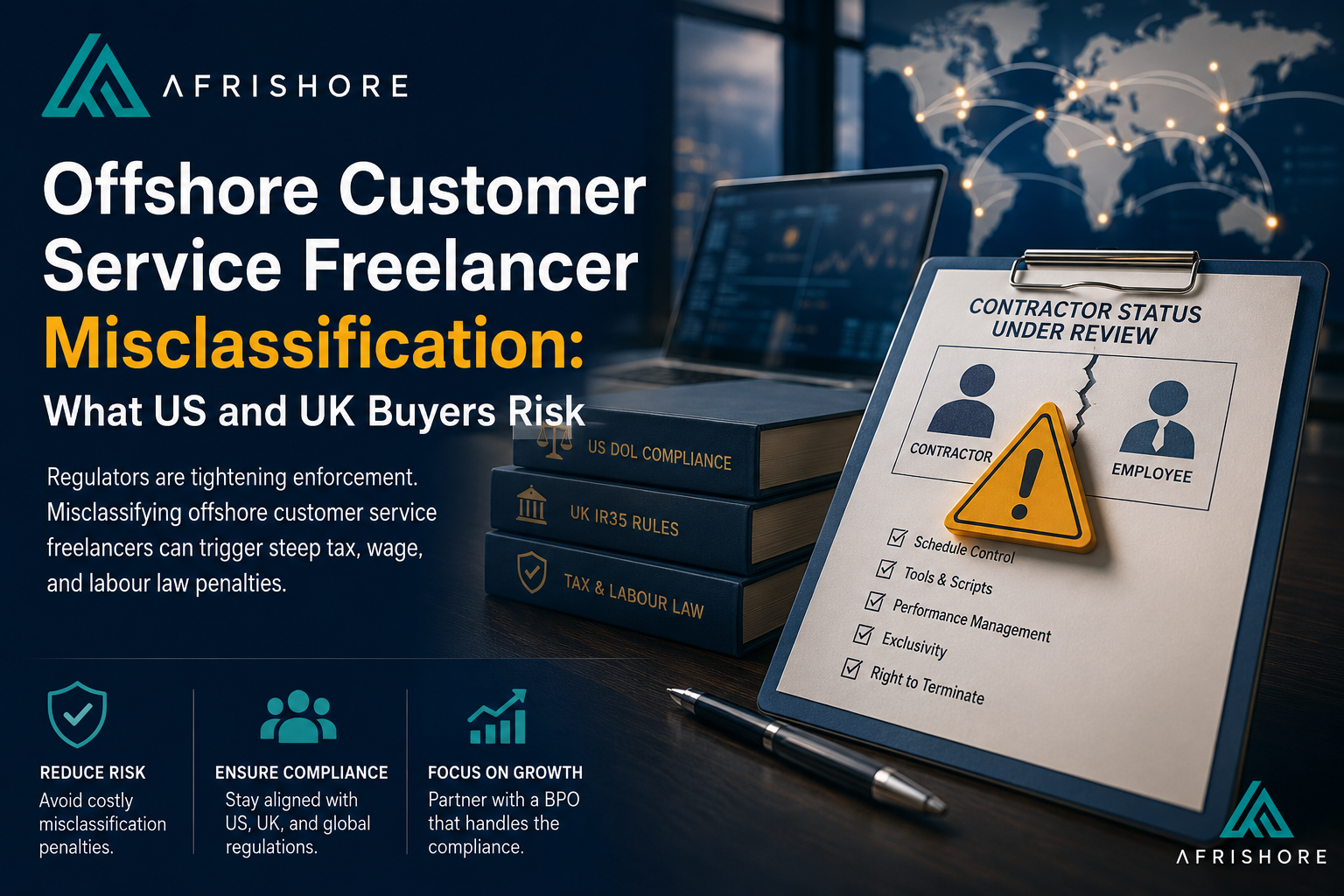
Offshore customer service freelancer misclassification is one of the fastest-growing compliance risks in B2B outsourcing. The US Department of Labor’s investigation into Arise Virtual Solutions, which allegedly involved 22,000 misclassified offshore customer service workers, made clear that regulators treat substance over form. How you manage workers matters more than what your contract calls them.
If your business uses offshore freelancers for customer support, this article explains exactly what you’re exposed to, why the regulatory environment tightened sharply in 2026, and how a properly structured BPO relationship removes the risk entirely.
Key Takeaways
- Offshore customer service freelancer misclassification creates stacked US and UK tax, wage, and labour law penalties that compound year over year.
- The DOL’s February 2026 NPRM signals that regulators are sharpening, not relaxing, the classification tests.
- Controlling an offshore agent’s schedule, scripts, tools, or escalation paths is enough to create an employment relationship, regardless of contract wording.
- The DOL civil penalty alone reaches $2,374 per violation for willful or repeated cases (DOL FLSA, 2024).
- A properly structured BPO agreement eliminates contractor classification risk because no employment relationship exists between the client and the agents.
What Is Offshore Customer Service Freelancer Misclassification?
Offshore customer service freelancer misclassification occurs when a business hires overseas individuals to handle customer support but classifies them as independent contractors, even though the day-to-day working arrangement looks and functions like employment. When regulators apply the economic realities test or the IRS common law test, the legal label in a contract counts for little.
The IRS and the DOL both look at substance, not paperwork. If you set the agent’s schedule, provide their tools, control their scripts, and can terminate them at will, those are employment indicators, and your contract saying “independent contractor” will not protect you.
The same logic applies in the UK, where HMRC’s IR35 off-payroll working rules assess whether the worker would be an employee if they engaged with you directly. Geography is not a shield. Regulators have consistently held that overseas arrangements are subject to the same tests as domestic ones when the hiring company is based in the US or UK.
Why the Risk Is Rising in 2026
The regulatory direction is unmistakable. On February 26, 2026, the US DOL published a Notice of Proposed Rulemaking to revise the FLSA contractor classification analysis, with the comment period closing on April 28, 2026 (DOL 2026 NPRM). The proposed revisions reinforce rather than loosen the six-factor economic realities test that already caught many offshore arrangements off-guard.
In the UK, HMRC is deploying 5,000 new compliance officers as part of its 2026 enforcement push (EWS Limited Contractor Compliance Report, 2026). IR35 off-payroll working rules, which previously applied mainly to UK-based contractors, are now actively scrutinised for offshore arrangements where UK companies are the end clients.
The EU’s Platform Work Directive is tightening contractor definitions across member states, creating a spillover effect for multinationals operating in Europe. When a regulatory change moves in the same direction across three major jurisdictions simultaneously, the compliance risk for offshore buyers is not theoretical — it is a calendar item.
The IRS also shares audit findings with state revenue agencies. A federal misclassification audit does not stay federal. California’s ABC test under AB5, for instance, applies one of the strictest contractor standards in the world, and California-based companies using offshore freelancers face compounded exposure at state and federal level.
The Arise Virtual Solutions Case: A Warning for CS Buyers
The DOL’s investigation into Arise Virtual Solutions is widely cited as one of the largest misclassification cases in the agency’s enforcement history. Arise allegedly hired more than 22,000 workers as independent contractors to perform customer service functions — many of them working offshore or from home — while maintaining the kind of operational control that regulators associate with employment (propublica).
What made the Arise case significant for offshore buyers was the substance-over-form principle it reinforced. The contractual label was “independent contractor.” The operational reality — scripts dictated by Arise, schedules set by clients through the Arise platform, tools provided by the business, escalation paths controlled end-to-end — told a different story.
For any business using offshore customer service platforms or direct freelance networks, the Arise case is a direct warning. If you are managing the agent’s daily workflow, you are not buying a service. You are, in the eyes of the DOL, employing someone.
The distinction matters most when the arrangement has been running for months or years, because penalty exposure is calculated per violation, per period. A two-year misclassification of even a small offshore CS team generates a penalty stack that can exceed the savings that made the arrangement attractive in the first place.
Related reading: How to Spot an Offshore BPO Bait-and-Switch and How to Verify Offshore BPO Provider References Before You Sign.
How Misclassification Happens in Offshore Customer Service
Most misclassification is unintentional. Businesses make reasonable commercial decisions, they find offshore freelancers who are cheaper than a formal BPO, and they manage them the same way they manage in-house staff. The problem is that the management style, not the cost saving, is what determines the legal classification.
Scenario 1: Direct hire via freelance platforms
The most common route. A UK or US buyer hires agents via Upwork, Freelancer, or a similar marketplace, classifies the arrangement as a service contract, and then manages the agents with internal tools, set shift patterns, and branded scripts. The freelance platform label provides no legal protection once the operational arrangement looks like employment.
Scenario 2: BPO platforms that pass workers through as contractors
Some lower-cost “BPO” operators are not employers at all. They connect clients with individual contractors and take a margin, without carrying employment responsibility. For the end client, this is functionally the same as a direct hire arrangement — with the added risk that the intermediary’s contractor-pass-through model may itself be under regulatory scrutiny. See also: The True Cost of Offshore Customer Service.
Scenario 3: Foreign entity setup without proper employment contracts
Some businesses set up a foreign subsidiary or entity to engage offshore workers, but execute the arrangement without legally sound employment contracts in the worker’s jurisdiction. This creates exposure in both the worker’s country and the buying company’s home jurisdiction.
Scenario 4: Pass-through liability from a vendor’s own misclassification
Less commonly understood: a vendor who misclassifies their own workforce can transfer liability to the end client. Joint employment doctrine in the US allows the DOL to pursue the company that benefited from misclassified labour, even if that company believed they were buying from a legitimate B2B service provider.
The Financial Exposure — What US and UK Buyers Actually Owe
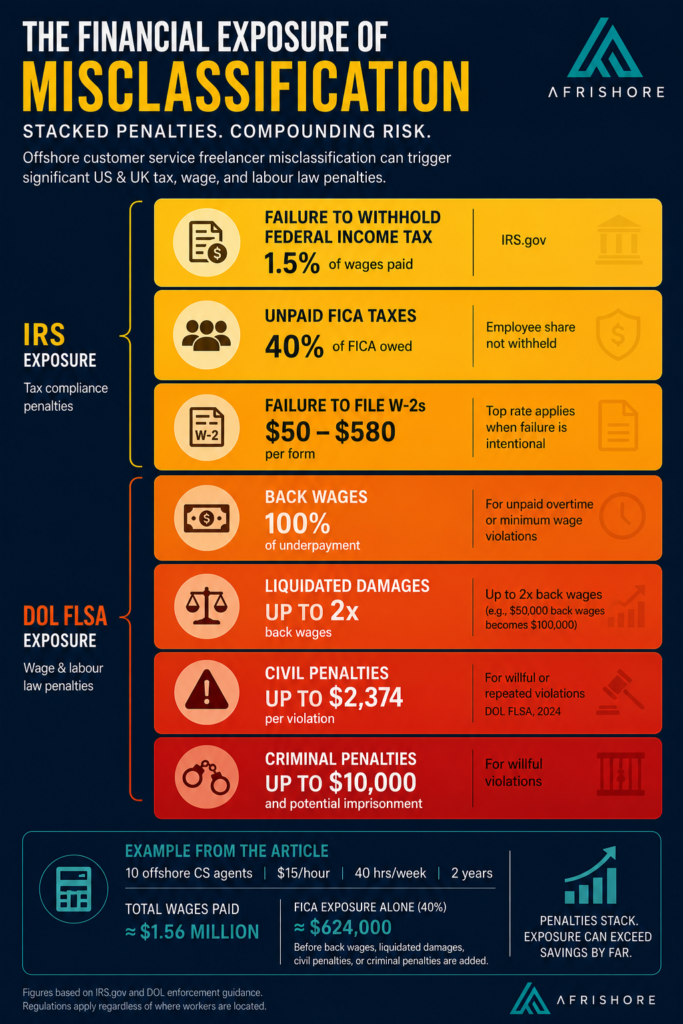
The penalty structure for misclassification is designed to be painful, and it stacks. Here is what the verified figures look like in practice, drawn from DOL and IRS enforcement guidance.
IRS exposure:
- Failure to withhold federal income tax: 1.5% of wages paid (IRS.gov)
- Unpaid FICA taxes (employee share not withheld): 40% of FICA owed
- Failure to file W-2s: $50 to $580 per form, with the top rate applying when the failure is determined to be intentional
DOL FLSA exposure:
- Back wages for unpaid overtime or minimum wage violations: 100% of underpayment
- Liquidated damages: up to 2x back wages (so a $50,000 back-wages finding becomes $100,000 in total exposure)
- Civil penalties for willful or repeated violations: up to $2,374 per violation (DOL FLSA misclassification)
- Criminal penalties for willful violations: fines up to $10,000 and potential imprisonment
A rough illustration: A US-based business running 10 offshore CS agents for two years, paying each $15/hour for 40 hours per week, generates approximately $1.56 million in wages over that period. At 40% FICA exposure alone, that is $624,000 before back wages, liquidated damages, or civil penalties are added. This is not a remote scenario. It is the arithmetic of an arrangement that appeared commercially sensible until it was audited.
For UK buyers, HMRC’s IR35 enforcement means that where an offshore contractor would be classed as an employee under the supervision, direction, and control test, the UK end-client becomes liable for income tax and National Insurance contributions that should have been deducted at source. HMRC’s 5,000 new compliance officers in 2026 are specifically tasked with IR35 enforcement across offshore and remote arrangements.
More detail on how offshore attrition and compliance interact: Offshore Call Center Attrition Rates.
Quick Risk Scorecard — Are You Exposed?
Score 1 point for each YES:
- ☐ You control the agent’s daily schedule or hours
- ☐ You provide the scripts, tools, or software they use
- ☐ You set the escalation paths and can fire them directly
- ☐ They work exclusively (or primarily) for your business
- ☐ You manage their performance directly, not through a vendor
- ☐ They are paid per hour or per shift (not per project or outcome)
Score 0-1: Low risk. Score 2-3: Review your contracts with employment counsel. Score 4-6: You likely have an employment relationship. Get legal advice now before a DOL or HMRC audit forces the conversation.
How a Properly Structured BPO Eliminates the Risk
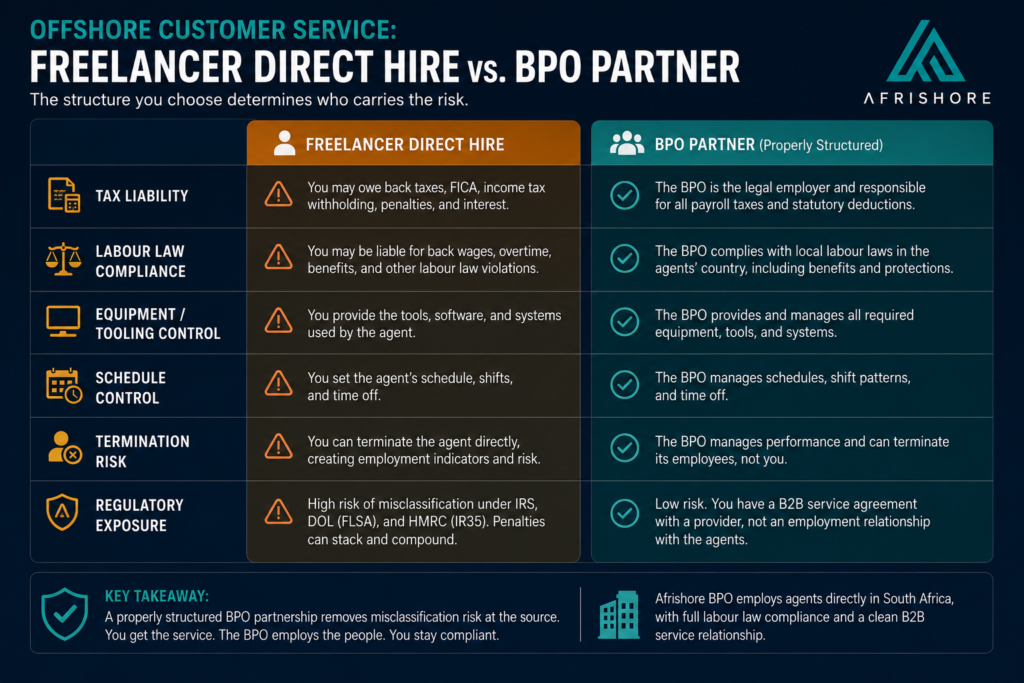
A properly structured BPO engagement is a business-to-business services contract, not an employment arrangement. The BPO employs the agents directly, handles payroll, statutory deductions, and labour law compliance in the agents’ home country, and takes full operational responsibility for the workforce. The client company has a commercial relationship with a supplier — nothing more.
This structure eliminates offshore customer service freelancer misclassification risk at the source. There is no contractor to misclassify because the client company never employs anyone. The agents are employed by the BPO. The client pays invoices. The classification question simply does not arise.
Afrishore BPO operates from a 750-seat facility in Johannesburg with 20 years of experience in BPO service delivery, holding ISO 27001, ISO 9001, HIPAA, and PCI-DSS certification. Agents are employed directly under South African labour law, with all PAYE, UIF, and statutory obligations met. The client relationship is a clean B2B services agreement, structured to give US and UK buyers the operational continuity of an in-house team with none of the employment liability.
The key operational safeguard is separation of control. In a properly structured BPO engagement, the client defines service levels and outcomes. The BPO manages the workforce to deliver them. Clients do not directly manage shift patterns, provide personal equipment, or set individual escalation authorities. That operational separation is precisely what DOL and HMRC look for when they assess whether a relationship is genuine B2B or disguised employment.
Explore how this works in practice: Call Center Outsourcing South Africa, BPO Companies in South Africa, Customer Service BPO Companies, Outsource Customer Support South Africa, and the Business Process Outsourcing hub page for the full picture.
Frequently Asked Questions
What is offshore customer service freelancer misclassification?
Offshore customer service freelancer misclassification occurs when a business engages overseas individuals to perform customer support work but classifies them as independent contractors, even though the working arrangement meets the legal definition of employment. US regulators apply the DOL’s six-factor economic realities test and the IRS common law test. UK regulators apply IR35. If the tests are failed, the classification label in the contract is overridden.
Can I be penalised for misclassifying an offshore contractor I never met in person?
Yes. Neither the IRS nor the DOL limits enforcement to in-person or domestic working arrangements. The Arise Virtual Solutions case involved thousands of workers operating remotely and offshore. Regulators assess the economic reality of the relationship, not the physical location of the worker or the format of the engagement. US companies are liable under US tax and labour law regardless of where the worker is based.
Does IR35 apply if I hire offshore customer service workers outside the UK?
IR35 applies based on where the end client is based, not where the worker is located. A UK company hiring offshore customer service workers is subject to IR35 off-payroll working rules if the arrangement would constitute employment under the supervision, direction, and control test. HMRC’s 2026 enforcement expansion specifically targets offshore and remote contractor arrangements. UK buyers should not assume geographic distance provides IR35 protection.
What is the Arise Virtual Solutions case and what does it mean for my business?
The DOL investigated Arise Virtual Solutions over allegations that the company engaged more than 22,000 workers as independent contractors for customer service functions while maintaining the operational control characteristic of an employment relationship. The case is one of the largest misclassification investigations in DOL history. For any business using offshore CS platforms, the case confirms that substance-over-form analysis applies regardless of how the contract is written or what platform hosts the arrangement.
How do I know if my offshore customer service arrangement is a misclassification risk?
Use the risk scorecard in this article. The core indicators are: control over schedules, provision of scripts or tools, direct performance management, exclusivity of work, and per-hour or per-shift payment. If you answer yes to three or more of those factors, your arrangement is likely to fail the economic realities test. A qualified employment lawyer can assess your specific contracts and working practices before a regulator does.
Does using a BPO company fully eliminate misclassification risk?
A properly structured BPO engagement — where the BPO is the legal employer of the agents, handles all payroll and statutory obligations, and the client relationship is purely a B2B services contract — removes the misclassification risk for the client company. However, not all “BPO” operators are structured this way. Platforms that pass freelance contractors through without employing them directly may create the same exposure as a direct hire. Verify that any BPO partner directly employs their agents and can demonstrate payroll and labour law compliance in their operating country.
What should I do if I think I’ve already misclassified offshore customer service workers?
Act before a regulator does. The IRS Voluntary Classification Settlement Program (VCSP) allows businesses to reclassify workers with significantly reduced penalties compared to an audit-triggered correction. Consult an employment or tax lawyer immediately to assess your back-period exposure, quantify the penalty stack, and determine whether voluntary disclosure is appropriate. Document your corrective steps. Proactive remediation consistently results in materially lower penalties than enforcement-triggered findings (IRS.gov, DOL FLSA, Multiplier misclassification guide).
Conclusion
The financial and legal case against offshore customer service freelancer misclassification has never been clearer. The DOL’s 2026 NPRM, HMRC’s expanded compliance headcount, the EU Platform Work Directive, and the precedent set by the Arise Virtual Solutions case have collectively closed the gap between informal offshore freelance arrangements and formal regulatory scrutiny.
The penalty stack is real: 40% of unpaid FICA, 100% back wages, liquidated damages up to 2x those back wages, civil penalties of up to $2,374 per violation, and potential criminal exposure for willful misclassification. For a team of 10 agents over two years, the numbers are not marginal.
The solution is not to avoid offshore customer service. The cost and quality case for South Africa remains strong. The solution is to structure the arrangement correctly, through a BPO that employs its agents directly, carries the compliance obligations, and operates as a genuine B2B services partner rather than a contractor pass-through.
If your current offshore CS arrangement fails three or more items on the risk scorecard above, get legal advice before your next fiscal year closes.