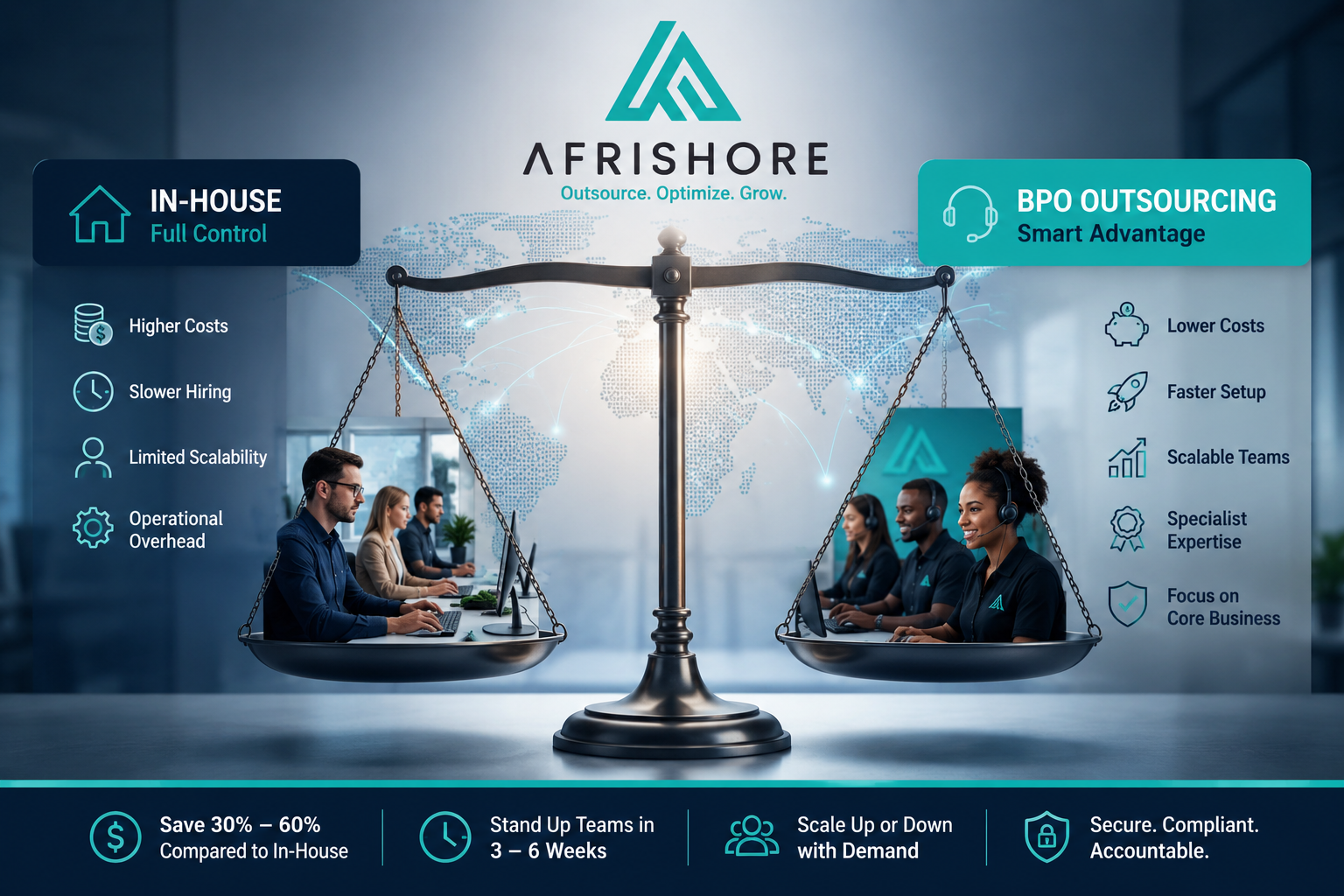
Quick Answer: The BPO versus in-house decision is a total cost of ownership, speed, control, and risk trade-off, not a simple hourly-rate comparison. Keep core, IP-heavy, and high-value work in-house; outsource standardised, high-volume, and scalable work to a specialist. The cost gap is wide once you count everything: US employer compensation averaged $43.78 per hour worked in March 2024, with benefits alone at 29.7% of the total, which is why fully loaded in-house support seats often cost 1.5 to 3 times an equivalent offshore BPO seat.
Key Takeaways
- Headline salary badly understates in-house cost: a US support agent runs $52,000 to $73,590 per year fully loaded, roughly $28 to $48 per agent hour once benefits, facilities, technology, and supervision are added.
- Hiring is slow and churny: SHRM puts average US cost per hire near $5,475, customer service turnover runs 50% to 100% a year, and replacement can cost 6 to 9 months of salary.
- BPO pricing is tiered: offshore support runs about $8 to $15 per hour, nearshore $14 to $22, onshore $30 to $45, or roughly $1,200 to $2,500 per FTE per month offshore.
- The IAOP reports average outsourcing savings of 15% to 30% across functions, rising to 40% to 70% for labour-intensive customer support.
- Speed is a real differentiator: a BPO can stand up a team in 3 to 6 weeks versus 10 to 20-plus weeks to hire, train, and stabilise an in-house team.
- The decision is rarely all-or-nothing: most companies run a hybrid, keeping Tier 2 and Tier 3 escalations and VIP accounts in-house while a BPO handles Tier 1, overflow, and after-hours.
- Outsourcing fails on governance, not geography: weak onboarding, vague KPIs, and no QA calibration, not outsourcing itself, cause breakdowns; you cannot outsource accountability for security.
The Real Cost of an In-House Team
Salary is the tip of the iceberg; benefits, hiring, technology, facilities, supervision, and churn push the fully loaded cost of an in-house seat well above base pay. Seeing the true number is the starting point, because it reframes the comparison from an hourly rate to a total cost of ownership.
The federal data sets the baseline. BLS Employer Costs for Employee Compensation shows total US private-industry compensation at $43.78 per hour in March 2024, rising to $44.67 by December 2024, with benefits consistently around 30% of the total. Layer on the hidden costs and the number climbs: cloud contact-centre and CRM licences, facilities and utilities of roughly $5,000 per seat a year, and a supervision and QA layer that can add around $15,000 a month for a 15-agent operation. Hiring adds more, with SHRM’s average cost per hire near $5,475 and a US time-to-fill of 36 to 44 days. And because customer service turnover runs 50% to 100% a year with replacement costing 6 to 9 months of salary, the churn tax is real. Netting it out, several 2025 to 2026 studies put the annual cost per in-house support agent at $52,000 to over $110,000. Our guide to the true cost of offshore customer service applies the same total-cost lens.
The Cost and Speed of BPO
A BPO converts that fixed, front-loaded cost into a predictable per-FTE or per-hour fee and stands up capacity far faster, because the provider already has the people, training, and technology. Both the cost and the speed advantages are large enough to change the build-vs-buy maths.
On cost, BPO pricing runs about $8 to $15 per hour offshore, $14 to $22 nearshore, and $30 to $45 onshore, with per-FTE monthly equivalents of roughly $1,200 to $2,500 offshore. Against an in-house US seat at $28 to $48 per hour fully loaded, that is a 30% to 60% saving depending on complexity. The IAOP’s 2023 Global Outsourcing Report puts average savings at 15% to 30% across functions, and labour-intensive customer support commonly reaches 40% to 70%. On speed, a BPO maintains talent pools, training academies, and bench capacity, so a new programme can launch in 3 to 6 weeks once processes are documented, versus 10 to 20-plus weeks to hire, train, and stabilise an in-house team, and it can scale from 5 to 50-plus agents in weeks for a seasonal spike. Pricing itself comes in four shapes, per FTE, per hour, per transaction, and outcome-based, often blended. Our guide to measuring BPO ROI shows how to model the full comparison.
A Build-vs-Buy Decision Framework
Keep functions in-house when they are core, IP-sensitive, and hard to standardise; outsource when they are non-core, standardisable, high-volume, and need coverage or speed. Scoring the specific function against a few dimensions turns a gut call into a defensible decision.
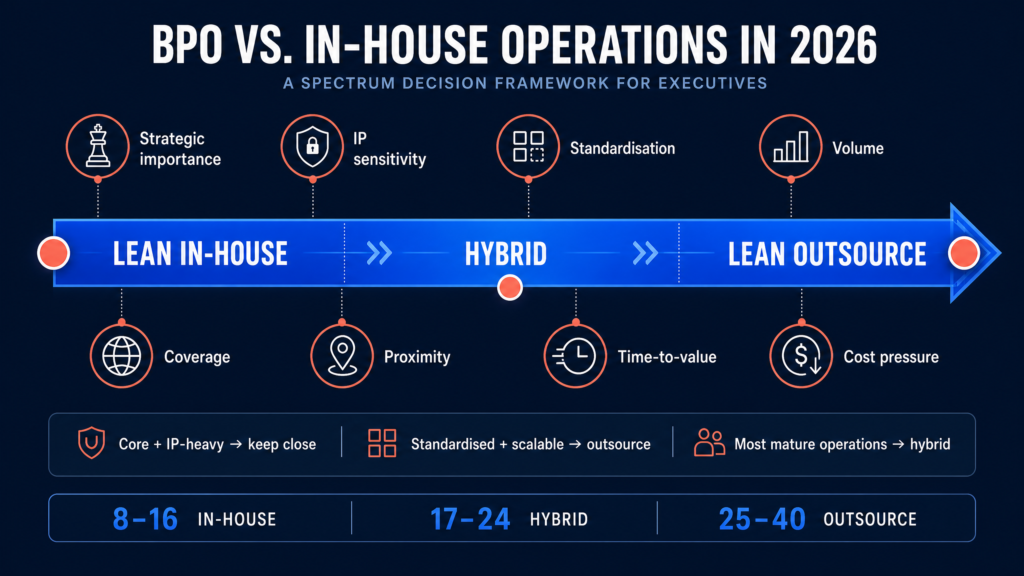
Retain in-house the work that drives differentiation: core product and engineering, strategic and high-value customer relationships, highly regulated or sensitive processes, and functions that depend on deep tacit knowledge. Outsource the work that is standardisable and scalable: Tier 1 support, back-office processing such as data entry and accounts payable, 24/7 or multilingual coverage, and seasonal or volatile volume that would leave an in-house team over-staffed in the off-peak. The table below turns this into a scorecard you can apply to a specific function.
Table: Build-vs-buy scorecard (score each 1 to 5, sum the total)
| Criterion | Lean in-house (1 to 2) | Either (3) | Lean outsource (4 to 5) |
| Strategic importance | Core to differentiation | Important, not core | Supportive or commoditised |
| IP and data sensitivity | Heavy IP or regulated data | Some, with controls | Mostly operational data |
| Standardisation | Bespoke judgement calls | Mixed | Repeatable, rule-based |
| Volume and variability | Low and stable | Moderate | High or seasonal |
| Coverage needs | Business hours, one zone | Some extended | 24/7 or multi-zone |
| Proximity to product | Embedded in squads | Occasional | Loosely coupled |
| Time-to-value | Flexible timeline | Some urgency | Live in 4 to 8 weeks |
| Cost pressure | Control over cost | Balanced | Significant cost-down |
Interpretation: 8 to 16 favours in-house, 17 to 24 favours a hybrid model, 25 to 40 favours outsourcing. Framework synthesised from IAOP and ISO 27001 outsourcing guidance.
The Hybrid Reality
In practice most companies do not choose one or the other; they run a co-sourced model where in-house handles the complex and strategic work and a BPO handles the routine and scalable volume. This is where the majority of mature operations land, and it is the model South African providers most often deliver into.

Common patterns are tiered support (in-house owns Tier 2 and Tier 3 escalations and VIP accounts, the BPO owns Tier 1 and deflection), follow-the-sun (internal teams cover home business hours, the BPO covers nights and weekends), co-sourced back office (FP&A and treasury stay in-house, the BPO runs accounts payable, invoicing, and reconciliations under tight controls), and surge staffing for launches or seasonal peaks. Notably, about 70% of executives report insourcing some previously outsourced scope even as they outsource elsewhere, which underlines that the boundary is a portfolio decision, not a one-time switch. Our guide to the onshore-offshore hybrid team model covers this blend in depth, and BPO versus call centre clarifies the category terms.
Control, Quality, and Risk: How Good BPOs Address the Objections
The standard objections, loss of control, brand and quality fit, and security, are legitimate, and a well-structured engagement answers each with governance rather than hope. The evidence is clear that outsourcing fails on weak governance, not on outsourcing itself.
On control, modern engagements use formal governance (named owners on both sides, weekly operational, monthly performance, and quarterly strategic reviews) and detailed SLAs with shared, real-time dashboards, so management keeps visibility even when execution sits outside. On quality and brand fit, dedicated teams that work exclusively on one brand, co-developed training and playbooks, and joint calibration and shadowing bring external agents up to in-house standards; choosing an English-proficient, culturally aligned location reduces friction further. On security, the Central Bank of Ireland’s cross-industry outsourcing guidance is explicit that a firm cannot outsource accountability, so mature providers demonstrate ISO 27001 and SOC 2, sign GDPR-aligned data processing agreements as your processor, and enforce role-based access, encryption, and environment separation. This matters because third-party compromises accounted for around 35.5% of data breaches in a 2024 analysis. We cover the full control set in our guide to evaluating a partner’s data security and compliance.
When BPO Is the Wrong Call
Outsourcing is not a universal win, and an honest assessment names where it fails or is premature. Recognising these signals up front prevents an expensive, credibility-damaging reversal later.
Some functions should rarely be outsourced: core product strategy and design, key risk-management and compliance roles, work that depends on extreme tacit knowledge, and ultra-high-value relationships worth millions in lifetime value. And outsourcing is often premature when processes are not yet documented (you export chaos, not efficiency), when product and policy still change weekly (training overhead outruns the benefit), when there is no accountable internal owner for the vendor to align with, or when there is no budget for the transition, QA, and governance a good engagement requires. In those cases the better move is to stabilise and document internal processes first, then pilot a small, well-scoped engagement before committing a critical function. For South African BPOs supporting US and UK clients, the winning posture is a co-sourced partnership with shared KPIs, QA, and governance, positioned by total cost of ownership, speed, and risk-managed flexibility rather than headline rate alone. Our business process outsourcing hub sets out how that partnership is structured.
Frequently Asked Questions
Is it cheaper to outsource to a BPO or build an in-house team? For standardised, high-volume work it is usually cheaper to outsource. A fully loaded US in-house support seat costs about $28 to $48 per agent hour, while offshore BPO runs $8 to $15 and nearshore $14 to $22, a 30% to 60% saving depending on complexity. The IAOP reports average savings of 15% to 30% across functions, rising to 40% to 70% for labour-intensive customer support.
What is the real fully loaded cost of an in-house support agent? Well above base salary. US employer compensation averaged $43.78 per hour in early 2024, with benefits around 30% of the total, and once technology, facilities of roughly $5,000 per seat, supervision, hiring at about $5,475 per hire, and 50% to 100% turnover are added, several studies put the annual cost per in-house support agent at $52,000 to over $110,000.
How much faster is standing up a BPO team than hiring in-house? Considerably faster. A BPO maintains talent pools, training academies, and bench capacity, so a new programme can launch in 3 to 6 weeks once processes are documented. Building in-house typically takes 10 to 20-plus weeks to hire, train, and stabilise, given a 36 to 44 day US time-to-fill plus training and ramp, with further delay risk from candidate scarcity and churn.
When should a function stay in-house rather than be outsourced? Keep functions in-house when they are core to competitive advantage, heavily IP-dependent, tightly coupled to internal processes, or dependent on deep tacit knowledge. For customer support that usually means retaining Tier 2 and Tier 3 escalations, complex technical troubleshooting, top-tier relationships, and ownership of CX strategy, even if Tier 1 execution is outsourced.
What is a hybrid or co-sourced model? A hybrid model blends in-house and BPO delivery: internal teams handle complex, strategic, or high-value work while a BPO handles routine, high-volume, or after-hours work. Common patterns are tiered support, follow-the-sun coverage, co-sourced back office, and surge staffing. Most companies land here, and about 70% of executives report insourcing some scope even while outsourcing other work.
How do BPOs address loss of control and quality concerns? Through governance and structure: named owners on both sides, a cadence of operational, performance, and strategic reviews, SLAs with shared real-time dashboards, dedicated brand-exclusive teams, co-developed training, and joint QA calibration. Failed engagements correlate with weak onboarding, vague KPIs, and absent governance rather than with outsourcing itself, so those elements are where control is retained.
Is outsourcing safe for sensitive or regulated data? It can be, provided accountability stays in-house. Regulators are explicit that a firm cannot outsource accountability for security, so mature BPOs hold ISO 27001 and SOC 2, sign GDPR-aligned data processing agreements as your processor, and enforce role-based access, encryption, and environment separation. This discipline matters because around 35.5% of data breaches in 2024 originated from third-party compromises.
When is outsourcing the wrong call? Avoid outsourcing core product strategy, key risk and compliance roles, extreme tacit-knowledge work, and ultra-high-value relationships. It is also premature when processes are undocumented, product and policy change weekly, there is no accountable internal owner, or there is no budget for transition and governance. In those cases, stabilise internal processes first and pilot a small engagement before committing a critical function.
Afrishore BPO works as a co-sourced extension of US and UK teams from South Africa, with shared KPIs, QA, and governance, ISO 27001-aligned security, and 30% to 60% cost savings versus in-house. For the numbers see our guide to measuring BPO ROI, for the blended approach see the hybrid outsourcing model, and our business process outsourcing hub shows the full offering.
Speak to Afrishore about building a co-sourced team that extends your in-house operation.