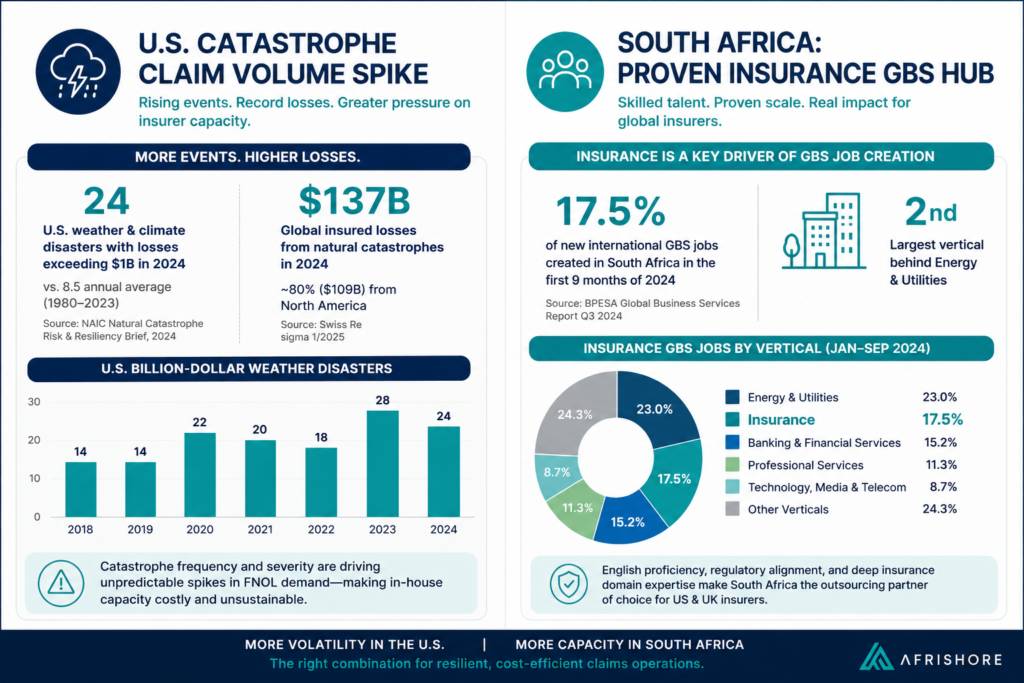
First Notice of Loss is the moment a policyholder tests the promise an insurer made when the policy was sold. It is also, for most carriers, the most resource-intensive point in the claims lifecycle — and the one most vulnerable to capacity failure when catastrophe seasons hit. US insurers faced 24 separate weather events with losses exceeding $1 billion each in 2024 (NAIC Natural Catastrophe Risk brief, 2024), against a historical average of 8.5 per year. Those events do not space themselves evenly across calendar months, and no carrier can profitably maintain permanent headcount sized for the peak.
South Africa has emerged as the primary offshore hub for insurance FNOL and claims administration for UK carriers and a growing number of US insurers — not because it is the cheapest option in isolation, but because it combines English proficiency, regulatory familiarity, and proven insurance delivery capacity at meaningful scale. BPESA data shows insurance accounts for 17.5% of new international GBS jobs created in South Africa in the first nine months of 2024 — the second-largest vertical behind energy and utilities. This is not a speculative capability; it is an established one.
Key Takeaways
- US insured losses from natural catastrophes exceeded $137 billion in 2024, with North America accounting for almost 80% of global losses (Swiss Re sigma 1/2025).
- Human-handled FNOL calls in US personal lines run approximately $7.50–$25 per interaction depending on complexity (McKinsey; 2026 AI voice case studies).
- J.D. Power data shows customers with the highest trust in their insurer renew at 90% — versus 30% for low-trust customers — a 426-point satisfaction gap linked directly to claims experience (J.D. Power US Auto Insurance Study 2024).
- Bain & Company finds that no factor has more influence on P&C customer loyalty than post-loss support and claims settlement.
- South Africa’s insurance BPO delivers FNOL and claims administration at an estimated 40–60% lower cost than onshore operations (offshore insurance claims analysis, 2026).
What Is FNOL and Why Does It Matter So Much for Insurers?
First Notice of Loss is the initial report a policyholder makes when they experience a covered event — a car accident, a house fire, a burst pipe, a storm. It is the trigger for the entire claims process: coverage verification, initial damage assessment, instruction on next steps, and the opening of a claim file.
The quality of the FNOL interaction matters disproportionately to the rest of the claims journey because it sets the policyholder’s expectation of how their claim will be handled. A clear, empathetic FNOL interaction that captures accurate information on the first contact reduces cycle time, improves data quality, and begins the process of maintaining the trust that drives renewal. A poor one — slow to answer, poorly trained, requiring callbacks to correct incomplete information — begins a sequence of friction that J.D. Power, Bain, and Forrester all link directly to elevated churn.
FNOL is also where volume spikes are most acute. A hurricane making landfall in Florida or the Gulf, a wildfire season across the western states, or a severe convective storm complex moving across the Midwest can generate thousands of simultaneous FNOL calls from policyholders who need to reach their insurer immediately. Carriers cannot staff for these peaks in-house without carrying chronic overcapacity in non-peak periods.
What Does an FNOL Interaction Actually Cost?
There is no single published benchmark for FNOL cost per interaction — NAIC, ABI, Verisk, and LexisNexis Risk Solutions publish claim severity and LAE data rather than per-call handling costs — but adjacent data allows a defensible range.
McKinsey research cited in 2026 insurance technology reviews puts the average cost per contact in personal lines insurance at approximately $7.50 per call. A 2026 AI voice case study specific to insurance FNOL puts the cost of a complex, human-handled FNOL call at approximately $25 per interaction — a 15–18 minute call capturing coverage details, event description, and initial damage assessment.
At the portfolio level, BLS-reported loss adjustment expense (LAE) for US P&C represents approximately 13.2% of total insurance losses paid, with LAE running approximately $80.1 billion annually across the industry (NAIC data synthesis, 2025). The Florida Office of Insurance Regulation’s January 2025 report shows average LAE across closed homeowners claims at $2,011 for non-litigated claims and $10,543 for litigated claims in 2023 — giving a per-claim cost envelope for the FNOL-to-closure journey.
Third-party administrators (TPAs) including Sedgwick, Crawford & Company, and Gallagher Bassett typically charge per-claim fees in the $4–$10 range for high-volume programmes, with higher fees in specialty lines (claims management support surveys, 2026). These rates are the benchmark for fully outsourced claims administration pricing.
Why Catastrophe Seasons Are Making In-House FNOL Capacity Unsustainable
The fundamental problem with in-house FNOL capacity for US carriers is that the event frequency and severity data is moving in only one direction.
NAIC‘s Natural Catastrophe Risk and Resiliency brief (2024) records 24 US weather and climate disasters with losses exceeding $1 billion each in 2024, against a 1980–2023 annual average of 8.5 events. In 2023, there were 28 such events. Swiss Re‘s sigma 1/2025 report estimates global insured losses from natural catastrophes reached $137 billion in 2024, with North America accounting for almost 80% — driven by hurricanes Helene and Milton, US severe convective storms, and urban flood events.
Munich Re reports that H1 2024 global insured natural catastrophe losses reached $62 billion — 68% above the 10-year average of $37 billion — with severe convective storms in the US as the primary driver. Swiss Re’s analysis of H1 2024 alone found 12 separate US storms each causing losses of $1 billion or more.
Cat insured losses have now exceeded $100 billion for five consecutive years (2020–2024). Swiss Re projects losses trending toward $145 billion in 2025. The implication for FNOL capacity is that multi-week surges in claim volume — thousands of simultaneous first contacts across homeowners, auto, and commercial lines — are no longer exceptional events. They are the operating environment.
Carriers that staff FNOL capacity for the peak carry unsustainable overhead in the trough. Carriers that staff for the average are under-resourced when it matters most. Flexible offshore capacity that can scale up for catastrophe response and scale back between events is the structural answer.
How FNOL Quality Drives Customer Retention
The operational case for FNOL quality is well-supported by retention data that most insurers understand at a high level but underutilise in vendor selection.
J.D. Power‘s 2024 US Auto Insurance Study found that customers with the highest level of trust in their insurer have an average satisfaction score of 917 out of 1,000, and 90% say they are likely to renew — versus 30% renewal likelihood among low-trust customers, a 426-point satisfaction gap. Trust is built or destroyed in the claims moment, starting at FNOL.
Bain & Company‘s analysis of P&C claims management found that no other factor has more influence on customer loyalty than post-loss support and claims settlement, and that systematically optimising claims management — beginning at FNOL — can save 3–5% of overall costs. A 2025 analysis of claims CX noted that customers with positive claims experiences renew at rates 10–15 percentage points higher than those who have never claimed, while up to 50% of customers switch insurers after a poor claims experience.
J.D. Power’s 2023 Auto Claims Satisfaction Study found that overall satisfaction with claims handling remained relatively high even as repair cycle times increased — because insurers that maintained clear communication from FNOL through settlement preserved satisfaction. The communication quality at first notice sets the expectation for everything that follows.
Forrester‘s US Customer Experience Index for 2023 found that overall CX quality declined for the second consecutive year across US brands, with only 6% of brands improving their CX score despite most claiming CX as a strategic priority. In a market where CX differentiation is narrowing, the claims experience — and specifically the FNOL interaction — is one of the few remaining tangible points of competitive differentiation.
Why South Africa Handles 17.5% of International Insurance GBS Jobs
South Africa’s position as the second-largest offshore insurance delivery hub globally is not accidental. It reflects over a decade of investment by UK insurers — and more recently US insurers — in FNOL, claims administration, policyholder support, and back-office claims processing delivered from Johannesburg, Cape Town, and Durban.
BPESA‘s 2024 GBS Job Creation Report shows that the insurance industry accounted for 17.5% of new international GBS jobs created in South Africa in the first nine months of 2024 (3,590 positions), second only to energy and utilities. An earlier BPESA Quarterly Jobs Report (Q4 FY2023) showed insurance at 17.94% of international jobs — a consistent, not a one-off, representation.
The UK remains South Africa’s largest source market, accounting for approximately 55% of GBS headcount. The US is the fastest-growing source market, and major UK insurers have been running South Africa-based FNOL and claims operations for years. The infrastructure — carrier-trained claims handlers, UK and increasingly US regulatory familiarity, ISO 27001-certified data environments, and 24-hour operational capability — is already in place.
On cost: outsourcing FNOL intake, claims administration, and claims preparation to South African BPOs consistently delivers 40–60% lower administrative cost versus onshore operations (offshore insurance claims analysis, 2026). Insurance-focused BPO pricing from South Africa follows the wider market benchmark of approximately $6–$11/hr for fully managed operations.
South Africa’s GMT+2 timezone is structurally compatible with both UK business hours (natural day shift) and US Eastern morning coverage (a 2pm SAST start covers 7am ET through mid-afternoon ET as a standard afternoon shift).
What Can and Cannot Be Outsourced in the FNOL Process
A common source of confusion in insurance BPO is the difference between what can be handled offshore and what must remain onshore. The dividing line is generally: intake and communication can be outsourced; licensed adjustment and sign-off cannot.
Appropriate for offshore delivery:
- FNOL intake: capturing event details, policy number, contact information, and initial loss description
- Coverage verification: confirming what the policy covers for the reported event
- Initial policyholder communication: explaining next steps, setting expectations on timeline, scheduling inspections
- Claims file opening and documentation
- Vendor dispatch coordination (contractors, repair networks, adjusters)
- Status updates and ongoing policyholder communication through the claims lifecycle
- Back-office claims processing: data entry, document management, payment processing support
Must remain onshore:
- Formal damage assessment and coverage determination (requires licensed adjuster)
- Claim denial decisions (requires licensed professional)
- Regulatory filings and adjuster sign-offs
- Complex coverage disputes requiring licensed legal or actuarial review
The offshore FNOL model handles the intake and communication layer — everything up to and including the hand-off to a licensed onshore adjuster. This is precisely where the volume and the emotional weight of the interaction sit, and precisely where South African providers have built deep capability.
FAQs
Can offshore FNOL agents handle catastrophe surge volume without quality degradation? Yes — with the right operational model. South African BPOs running insurance programmes maintain disaster response protocols that allow rapid redeployment of trained agents from adjacent programmes, combined with pre-approved scaled staffing arrangements for named peril events. Surge capacity agreements should be part of any FNOL outsourcing contract, specifying response time, scale-up limit, and QA protocols that apply during surge.
Do South African FNOL agents understand US insurance products and terminology? Leading South African insurance BPOs invest in US-market-specific training covering line-of-business terminology, common coverage types (homeowners HO-3/HO-5, personal auto, commercial property), state-specific regulatory considerations, and US adjuster interaction protocols. This training is the differentiator between providers — confirm depth of US market training during vendor selection.
What data security standards apply to offshore FNOL and claims processing? HIPAA requires a Business Associate Agreement and demonstrated safeguards for PHI. POPIA (South Africa’s data protection law) is structurally equivalent to GDPR. Leading South African BPOs hold ISO 27001 certification, which covers information security management as an audited standard. For CCPA-covered California policyholder data, the vendor must be contracted as a service provider with data use restricted to specified business purposes. Afrishore operates a dedicated HIPAA-compliant BPO practice covering regulated health and insurance data.
How is policyholder sentiment managed in emotionally difficult FNOL calls? This is where South Africa’s cultural fit with US and UK callers is a practical advantage. South African English is neutral in accent relative to Indian or Philippine variants and is familiar to US and UK ears. Carriers with established South African FNOL operations consistently cite the emotional quality of agent communication as a performance driver — agents trained specifically in claims empathy protocols handle the emotionally charged nature of FNOL calls (which often follow accidents, fires, or storm damage) with the appropriate register.
What is a realistic timeline to stand up an offshore FNOL operation? For a managed transition, allow 12–16 weeks from contract to live handling. This covers process documentation, knowledge transfer from the onshore team, agent recruitment and product training, systems integration (FNOL intake platform, CRM access, telephony), parallel running with quality oversight, and a phased handover. Surge capacity arrangements can be structured to activate at any point post-launch.
Does offshore FNOL work for commercial lines as well as personal lines? Personal lines (homeowners, personal auto) are the most commonly outsourced FNOL function because volume is high and individual claim complexity is generally lower. Commercial lines FNOL is a more specialised use case — it can be outsourced, but requires deeper product and coverage training, more complex triage protocols, and tighter escalation paths for large commercial losses. Confirm specific commercial lines experience with any provider before commitment.
How does catastrophe response triage work in an offshore FNOL model? Pre-event protocols — triggered by named storm declarations, NOAA warnings, or carrier-specific activation criteria — allow offshore FNOL teams to prepare surge staffing, pre-position scripting for the anticipated peril type, and adjust shift schedules in advance of expected volume. Real-time monitoring during surge allows escalation to additional agents from a pre-trained reserve pool. These protocols should be tested in advance, not first deployed during an active cat event.
South Africa Is Where UK and US Insurers Are Solving the FNOL Problem
The combination of rising catastrophe frequency, a tight US onshore labour market for claims handlers, and the proven track record of South Africa’s insurance BPO sector has made FNOL outsourcing to South Africa a mainstream strategic decision rather than an experimental one. BPESA’s data on 17.5% insurance sector representation in South Africa’s international GBS jobs is the clearest evidence of where the market has already moved.
Afrishore BPO delivers insurance BPO services to UK and US carriers from Johannesburg, with ISO 27001, ISO 9001, HIPAA, and PCI-DSS certification, and 750 seats of operational capacity. As one of the leading BPO companies in South Africa serving the insurance vertical, our team handles FNOL intake, claims administration, and policyholder communication for clients across personal lines, commercial lines, and specialty insurance programmes. For a full comparison of South Africa against other offshore destinations on cost, attrition, and compliance, see our outsourcing destinations guide for US companies. To understand how agent training quality affects FNOL performance, see our guide to BPO agent training quality.
Speak to Afrishore about your FNOL and insurance claims requirements.