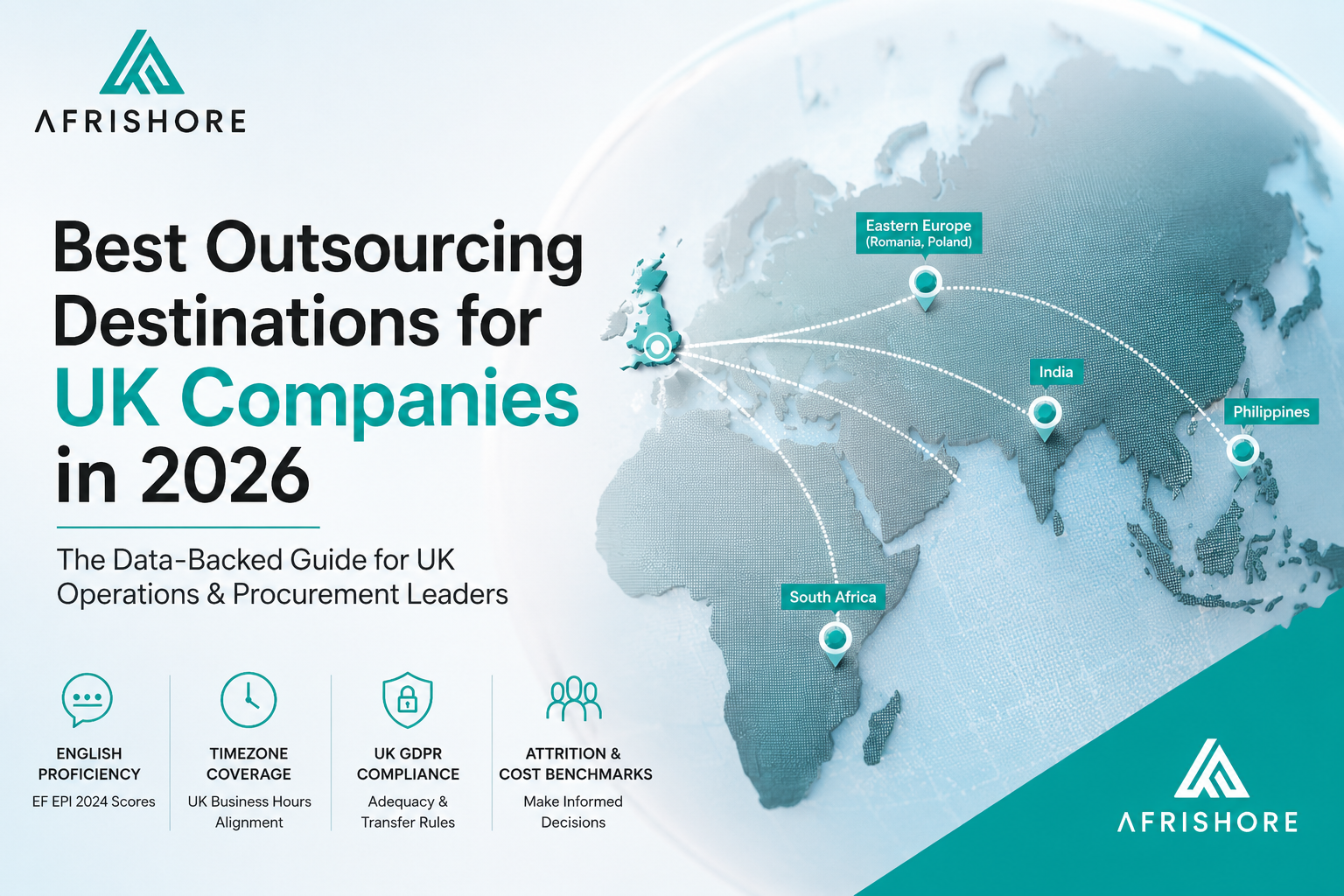
For UK operations and procurement directors evaluating outsourcing destinations, four locations dominate the shortlist: South Africa, India, the Philippines, and Eastern Europe (principally Romania and Poland). Each has genuine strengths. None is the obvious winner across all criteria. The right choice depends on what your programme most needs — and getting that wrong costs more than the rate difference.
This guide gives you the comparison that most vendor-published content avoids: EF English Proficiency Index 2024 scores, timezone coverage maps, UK GDPR adequacy status by destination, attrition benchmarks from Everest Group, agent cost ranges in GBP, and the UK client base breakdown from BPESA and IBPAP.
Key Takeaways
- EF EPI 2024 English proficiency: South Africa 594 (ranked 11th globally, 1st in Africa), Romania 593 (12th), Poland 588 (15th), Philippines 570 (22nd), India 490 (69th).
- Timezone: South Africa (GMT+2) and Eastern Europe (GMT+1/+2) cover UK business hours as a standard day shift. India (GMT+5:30) requires evening shifts. Philippines (GMT+8) requires night shifts for UK daytime coverage.
- UK GDPR adequacy: India, Philippines, and South Africa are all non-adequate. Transfers require IDTA or SCCs+UK Addendum plus Transfer Impact Assessment.
- Attrition: South Africa ~20–30%, India (ITeS broad) ~11–18%, Philippines ~25–35%+, LatAm leading providers <15–20%.
- UK is South Africa’s largest source market — 55% of SA GBS headcount. India and Philippines are US-dominant.
- For UK daytime CX programmes: South Africa and Eastern Europe. For scale and back-office: India. For US-aligned 24/7 or Philippines-native CX: Philippines.
English Proficiency: What the Data Actually Shows
The EF English Proficiency Index 2024 surveyed 116 countries. For UK operations directors, the relevant question is not just overall proficiency but UK-English-specific comprehension, cultural alignment, and accent fit for UK customer service.
| Destination | EF EPI 2024 score | Global rank | Band |
| South Africa | 594 | 11 | High proficiency — #1 in Africa |
| Romania | 593 | 12 | High proficiency |
| Poland | 588 | 15 | High proficiency |
| Philippines | 570 | 22 | High proficiency — 2nd in Asia |
| India | 490 | 69 | Low–moderate proficiency — 10th in Asia |
Global average is 477. All destinations except India sit meaningfully above average.
Beyond the index — UK fit: South Africa’s BPO narrative explicitly positions it as a UK-aligned market. BPESA and regional bodies highlight neutral accents and strong comprehension of UK customer expectations. South African agents handle UK, US, and Australian markets with minimal accent friction and high empathy in complex CX roles. Case studies of British Gas and other major UK brands show that when evaluating offshore destinations, they specifically ruled out India and the Philippines due to concerns about customer acceptance of accents, choosing South Africa for its neutral accent and similar business culture.
The Philippines’ English is strong but more US-influenced — effective for US-centric programmes, less natural for UK tone and idiom. Eastern Europe (Romania, Poland) offers high proficiency with variable accent neutrality, and typically focuses on multilingually-skilled agents rather than UK-specific English. India’s lower average proficiency makes it strongest where scripted or back-office work dominates rather than relationship-heavy UK customer experience.
Timezone: Who Can Cover UK Business Hours Without Night Shifts
The UK operates on GMT (October–March) and BST/GMT+1 (March–October). Standard UK business hours: 08:00–18:00.
| Destination | Time zone | UK offset (winter) | Covers UK 08:00–18:00 without night shifts? |
| South Africa | SAST (UTC+2) | +2 hours | ✅ Yes — UK hours = 10:00–20:00 SA time |
| Eastern Europe (Poland/Romania) | CET/CEET | +1 to +2 hours | ✅ Yes — standard day or late-day shift |
| Latin America (Colombia, Peru) | UTC-5 to UTC-3 | -5 to -3 hours | ⚠️ Early start required for full UK coverage |
| India | IST (UTC+5:30) | +5.5 hours | ❌ UK hours = 13:30–23:30 IST — evening shifts required |
| Philippines | PST (UTC+8) | +8 hours | ❌ UK hours = 16:00–02:00 PHT — night work required |
For UK daytime coverage without night shift costs or morale impact, South Africa and Eastern Europe are the only destinations where agents work standard or late-day shifts to cover UK 08:00–18:00 entirely. India can cover UK hours but requires evening schedules with potential attrition impact. The Philippines is structurally better suited to US overnight and 24/7 follow-the-sun models than to pure UK daytime CX.
South Africa’s GMT+2 advantage is not marginal — it means UK operations directors can have real-time conversations with their South African teams during the working day, and that management visits (11–12 hours’ flight, 2-hour time difference) involve minimal jet lag compared with India (5.5-hour time difference) or the Philippines (8-hour time difference).
UK Data Protection: GDPR Adequacy by Destination
Under UK GDPR, UK adequacy decisions allow free data flows without additional safeguards. Current adequacy covers EEA states plus Andorra, Argentina, Canada (commercial), Switzerland, Israel, Japan, New Zealand, Uruguay, Faroe Islands, Guernsey, Jersey, Isle of Man, South Korea, and US organisations certified under the UK extension to the EU-US Data Privacy Framework.
India, the Philippines, and South Africa do not have UK adequacy status. Transfers from UK organisations to BPO providers in these countries are “restricted transfers” and require an appropriate safeguard.
Standard safeguard route: The ICO’s International Data Transfer Agreement (IDTA) or the UK Addendum to EU Standard Contractual Clauses. Updated ICO guidance published January 2026 introduces a clearer three-step test (is it a restricted transfer? what’s the appropriate safeguard? is a Transfer Impact Assessment needed?). Transfers to India, Philippines, and South Africa require IDTA or SCCs+Addendum plus a documented risk assessment.
Destination-specific data protection laws:
- India DPDPA 2023: India’s Digital Personal Data Protection Act operates a “negative list” regime — transfers are permitted to any country unless specifically restricted by government notification. The Act does not prescribe transfer mechanisms equivalent to SCCs, which is a gap versus GDPR. UK-side IDTA/Addendum and TRA remain mandatory regardless of India’s domestic framework.
- Philippines DPA: The Philippines’ Data Privacy Act allows international transfers with appropriate safeguards, including model contractual clauses published by the National Privacy Commission in 2024. UK GDPR restrictions still apply — Philippines MCCs supplement but do not replace UK IDTA/Addendum.
- South Africa POPIA: POPIA section 72 regulates cross-border transfers, generally requiring the recipient to provide adequate protection, with acceptable grounds including UK GDPR-equivalent contractual clauses. POPIA is actively enforced, with the Information Regulator handling 982 complaints in 2023/24. For UK buyers, the usual approach is POPIA-compliant transfer clauses with the SA vendor plus UK GDPR safeguards (IDTA/Addendum).
Eastern Europe: EEA states (including Romania and Poland as EU members) have full UK adequacy status inherited from the EU-UK adequacy decision — data can flow freely from the UK without additional mechanisms. This is a material compliance simplification for UK organisations operating in highly regulated sectors (financial services, healthcare).
BPO Sector Maturity, Scale, and Attrition
South Africa
- GBS headcount: ~150,000 in 2024, up from 65,000 in 2019 (BPESA)
- Export revenue: ~$2.91 billion (2024), up from $1.04 billion (2019)
- UK is the dominant source market: ~55% of internationally focused GBS headcount
- Target: 500,000 cumulative international jobs by 2030
- Annual attrition (front-office CX): ~20–30%
Philippines
- IT-BPM industry revenue: $38 billion (2024), 1.82 million jobs (IBPAP)
- Primarily US-driven — US clients dominate the sector
- Annual attrition: ~25–35%, rising to 35–50% at some sites
India
- IT/BPM revenue: $54.6 billion BPM segment; total tech sector ~$282.6 billion (NASSCOM FY24–25)
- 5.8 million tech employees
- Annual attrition (ITeS/BPO broad): ~11–18% — lower than Philippines, but contact-centre-specific rates can be higher
- UK and US client base broad — no concentration equivalent to South Africa’s UK orientation
Eastern Europe
- GBS/BPO market: ~$33.4 billion with ~1.4 million professionals
- Romania BPO market: ~€343 million in 2024 with ~6% annual growth forecast
- Primarily serves Germany, Netherlands, and continental EU buyers; UK companies use Eastern Europe mainly for multilingual and specialist back-office
- EU adequacy simplifies UK data transfers significantly
Agent Cost in GBP: What UK Buyers Actually Pay
| Destination | Agent base salary (monthly local) | UK buyer bill rate (approx.) | UK savings vs in-house |
| South Africa | R6,500–R12,900/month (~£270–£540) | ~£6–£11/hr; ~£1,000–£1,500/month per seat | 55–65% vs UK in-house |
| Philippines | PHP 17,000–38,500/month (~£240–£540) | ~£7–£12/hr; ~£900–£1,200/month per seat | 60–70% vs UK in-house |
| India | Wide range; lower headline cost | ~£6–£10/hr | 65–75% vs UK in-house |
| Eastern Europe (Romania/Poland) | RON 2,000–4,000/month (~£330–£660) | ~£12–£18/hr | 40–55% vs UK in-house |
| UK in-house (agent) | ~£22,000–£26,000/year (~£1,833–£2,167/month) | — | Baseline |
Eastern Europe is the most expensive offshore option but still delivers 40–55% savings versus UK in-house, with the compliance simplification of EU adequacy. For multilingual programmes or highly regulated financial services work where EU-side legal risk matters, the premium is often justified.
For broader context on how these figures compare to US market rates, see the best outsourcing destinations for US companies guide.
UK-Specific Considerations: Client Base, Flight Distance, Regulatory Guidance
Existing UK client base:
- South Africa: UK is the single largest source market at 55% of internationally focused GBS headcount. Major UK brands across financial services, energy, and retail operate there. BPESA reports Durban and Cape Town together host a large share of multichannel centres serving UK programmes.
- Philippines: Growth driven by US businesses, especially BFSI and healthcare. UK exposure exists but is secondary to the US market.
- India: Large, broad UK client base but without South Africa’s concentration in UK-specific CX and financial services.
- Eastern Europe: Preferred nearshore option for EU-adjacent UK buyers; Poland and Romania lead for multilingual and specialist back-office work.
Travel and management visit practicalities:
- South Africa: 11–12-hour overnight direct flight (London to Johannesburg or Cape Town). 2-hour time difference. Minimal jet lag for short governance visits.
- India: Longer multi-segment journey (8–11 hours), 5.5-hour time difference — more taxing for frequent visits.
- Philippines: 13–16 hours including connection, 8-hour time difference — significant travel burden.
- Eastern Europe: 2–3 hours direct flight from London to Warsaw, Bucharest, or Prague. Minimal time difference. Day-trip or overnight visits are practical.
UK regulatory guidance on outsourcing: FCA guidance (FG16/5 and related) emphasises that regulated firms cannot outsource regulatory responsibility and should pay particular attention to jurisdictions with less stringent AML/CTF standards. ICO guidance requires IDTA/Addendum and documented TRAs for non-adequate destinations, regardless of location. No FCA or ICO guidance formally endorses specific countries — the differentiator is provider maturity in working under FCA/ICO expectations.
South Africa’s UK BPO Position: Why It Leads the Comparison for Most UK Programmes
Ryan Strategic Advisory’s Front Office CX Omnibus surveys show South Africa consistently ranking among the top three offshore CX destinations globally, tying with the Philippines for second place in 2024. For UK-specific, relationship-intensive CX, South Africa often beats both India and the Philippines on buyer preference.
The compounding case for South Africa in UK programmes:
- English: EF EPI rank 11, score 594 — higher than any other major offshore market except Eastern Europe
- Timezone: GMT+2, covering UK business hours as a standard day shift, no night shift premium
- UK client base: 55% of SA GBS headcount is UK-sourced — the deepest UK market knowledge of any offshore destination
- Data protection: POPIA actively enforced; structurally similar to GDPR; straightforward IDTA/Addendum overlay
- Cost: 55–65% savings versus UK in-house operations
- Quality: 18% higher CSAT outcomes than India and Philippines (BPESA and independent data)
- Attrition: ~20–30% versus 25–50% for Philippines — materially lower compounding training cost
- Travel: 2-hour time difference, no severe jet lag for UK management visits
For further analysis of Afrishore BPO’s UK proposition specifically, see outsourcing to South Africa for UK businesses.
The Comparison Summary
For UK companies seeking the best outsourcing destination:
South Africa: Best fit for UK daytime CX, insurance, financial services, complex voice, and programmes where UK-accent English and timezone alignment matter. The natural choice for most UK-centric programmes.
India: Best fit for large-scale IT/BPM, back-office processing, and scripted CX where cost is the primary driver and UK-accent fit is secondary. Complex data transfer compliance but manageable at scale.
Philippines: Best fit for 24/7 models, US-aligned programmes, and organisations already operating in the Philippines. Less natural for pure UK daytime delivery without night shift overhead.
Eastern Europe (Romania/Poland): Best fit for multilingual support, EU-regulated industries, nearshore governance, and specialist back-office. Higher cost than Asia/SA but EU adequacy simplifies UK data transfer significantly and flight proximity enables hands-on management.
For most UK programmes — CX, insurance, financial services, back-office — South Africa delivers the best combination of English proficiency, timezone coverage, quality outcomes, and cost savings. For the Afrishore BPO view of what that looks like in practice, see our BPO companies in South Africa page or contact the team directly.
FAQs
Which outsourcing destination has the best English proficiency for UK companies? By EF EPI 2024 scores, South Africa (594, rank 11), Romania (593, rank 12), and Poland (588, rank 15) lead the major BPO markets. South Africa combines high proficiency with specific UK English familiarity and cultural alignment, making it the strongest choice for relationship-intensive UK CX.
Does South Africa have UK GDPR adequacy status? No. South Africa, India, and the Philippines are all non-adequate destinations under UK GDPR. Transfers require IDTA or SCCs+UK Addendum plus a Transfer Impact Assessment. South Africa’s POPIA is actively enforced and broadly GDPR-aligned, making the TRA more straightforward than for some other non-adequate destinations.
What are the UK business hours coverage implications of outsourcing to India? India (IST, UTC+5:30) is 5.5 hours ahead of UK winter time. To cover UK 08:00–18:00, Indian teams must work approximately 13:30–23:30 local time — evening shifts. This creates staffing cost, morale, and attrition pressures that erode headline rate savings for UK daytime programmes.
Which destination has the lowest attrition for outsourced UK programmes? Leading Latin American providers often achieve below 15–20% annual attrition. South Africa runs approximately 20–30%. India (ITeS broad) 11–18%, though contact-centre specifics can be higher. Philippines 25–35% on average, rising to 35–50% at some sites. Lower attrition materially reduces training and ramp costs, partly offsetting South Africa’s slightly higher headline rate versus Philippines.
Is Eastern Europe a good outsourcing destination for UK companies? For multilingual support, EU-regulated industries, and specialist back-office work, Eastern Europe (Romania and Poland specifically) is compelling: high English proficiency, EU adequacy (simplifying UK GDPR compliance), short-haul flights enabling regular UK management visits, and strong regulatory maturity. Cost runs higher than Asia or South Africa (40–55% savings versus UK in-house versus 55–65% for South Africa), but compliance and management simplicity can justify the premium.
How does South Africa compare to the Philippines for UK outsourcing? South Africa delivers higher CSAT outcomes (approximately 18% better), better timezone alignment for UK daytime coverage (GMT+2 vs GMT+8 requiring night shifts), stronger UK-accent English fit, and 55% of its GBS workforce is UK-sourced. The Philippines is marginally cheaper per agent-month and better suited to 24/7 or US-aligned models. For pure UK daytime CX, South Africa’s total cost of ownership advantage over the Philippines is meaningful once attrition, quality, and timezone premiums are accounted for.
What UK regulatory guidance exists on outsourcing destinations? FCA guidance (FG16/5) does not specify approved or restricted countries, but emphasises that regulated firms retain full regulatory accountability for outsourced functions and must give particular attention to jurisdictions with less stringent AML/CTF standards. ICO guidance requires IDTA/Addendum plus documented TRAs for all non-adequate destinations. The practical differentiator is provider maturity in working under FCA/ICO frameworks — not geographic certification.