
Fintech customer support outsourcing moves your payment query handling, KYC onboarding calls, fraud alert triage, and account support to a specialist BPO – cutting costs by 40-60% while maintaining the compliance standards your regulators and customers expect. This guide covers what fintech support outsourcing covers, where it works best, and what to verify before choosing a partner.

Key Takeaways
- Fintech customer support outsourcing covers KYC queries, payment disputes, fraud triage, chargeback handling, onboarding support, and account management
- South Africa is rated the #1 offshore CX destination for US enterprise buyers (Ryan Strategic Advisory, 2025)
- Fully-loaded agent costs run 40-60% below equivalent US/UK in-house teams
- A compliant fintech BPO must hold ISO 27001 and PCI-DSS certifications at minimum – confirm these before shortlisting
- South Africa’s GMT+2 timezone gives full UK business hours overlap and 4-5 hours of US East Coast overlap without night-shift premiums
- South Africa’s POPIA legislation is structurally equivalent to GDPR, giving EU and UK fintechs a legally workable data-transfer destination
What Does Fintech Customer Support Outsourcing Actually Cover?
Fintech customer support outsourcing includes any customer-facing contact function that your in-house team currently handles: account onboarding queries, KYC and identity verification guidance, payment and transfer disputes, fraud alert triage, chargeback processing support, card and wallet management, and platform troubleshooting. The scope is broader than most buyers initially assume because fintech users expect financial-grade accuracy alongside fast resolution – not one or the other.
Common contact types handled by fintech BPOs:
- KYC and onboarding support – guiding new users through identity verification, document submission, and account activation
- Payment and transfer queries – failed transactions, pending statuses, recipient errors, and international payment tracking
- Fraud alert triage – first-line handling of suspicious activity flags, account freezes, and card blocks before internal security team escalation
- Chargeback and dispute initiation – collecting dispute details, submitting to the relevant scheme, and communicating timelines
- Card and wallet management – lost/stolen card reporting, PIN resets, limit changes, and virtual card issuance
- Platform and app troubleshooting – login issues, integration errors, and feature navigation queries (Tier 1 resolution; complex bugs escalate to product)
- Regulatory and compliance queries – explaining account restrictions, verification requirements, and AML holds in plain language
What stays in-house: final fraud investigation decisions, AML escalation authority, regulatory filing, and product development feedback loops. The BPO handles the volume and the first-contact resolution. Your internal team handles the judgement calls.
Why Fintech Companies Outsource Customer Support
Fintech companies outsource customer support when three pressures converge: rapid user growth that outruns hiring capacity, 24/7 demand that makes in-house shift coverage economically irrational, and compliance overhead that turns every support agent into a specialist who takes months to train.
Scale pressure: Digital-first financial products grow user bases faster than operations teams can staff for. A neobank launching into a new market can add 100,000 users in weeks. An in-house support function cannot absorb that velocity. A BPO already has trained capacity and can scale up within weeks rather than months.
24/7 demand: Fintech users expect round-the-clock availability because their money is always on. A payment failing at 11pm on a Friday is not a Monday-morning problem – it is an immediate escalation. Maintaining genuine 24/7 in-house coverage in the US or UK requires three full shift rotations, each with its own management overhead. The economics rarely make sense below 200 seats.
Compliance cost: Every fintech support agent who handles account data, payment queries, or identity information touches regulated data. Training, background checking, access controls, and ongoing compliance monitoring add a material cost on top of the base salary. Outsourcing to a certified BPO transfers most of that compliance infrastructure cost – the provider maintains the ISO 27001 certification, PCI-DSS audit cycle, and background screening programme, not you.
Peak volume handling: Product launches, market events, and service outages create support spikes that permanently-staffed teams cannot absorb efficiently. A BPO with flexible capacity handles the spike, then scales back – you are not left paying for headcount after the peak passes.
For context on what a full BPO operating model looks like, see the Afrishore business process outsourcing overview.
What Makes Fintech Support Different from Standard Customer Service
Fintech support sits at the intersection of customer service, financial compliance, and fraud operations. That combination creates training requirements and operational constraints that do not apply to most customer service BPO programmes.
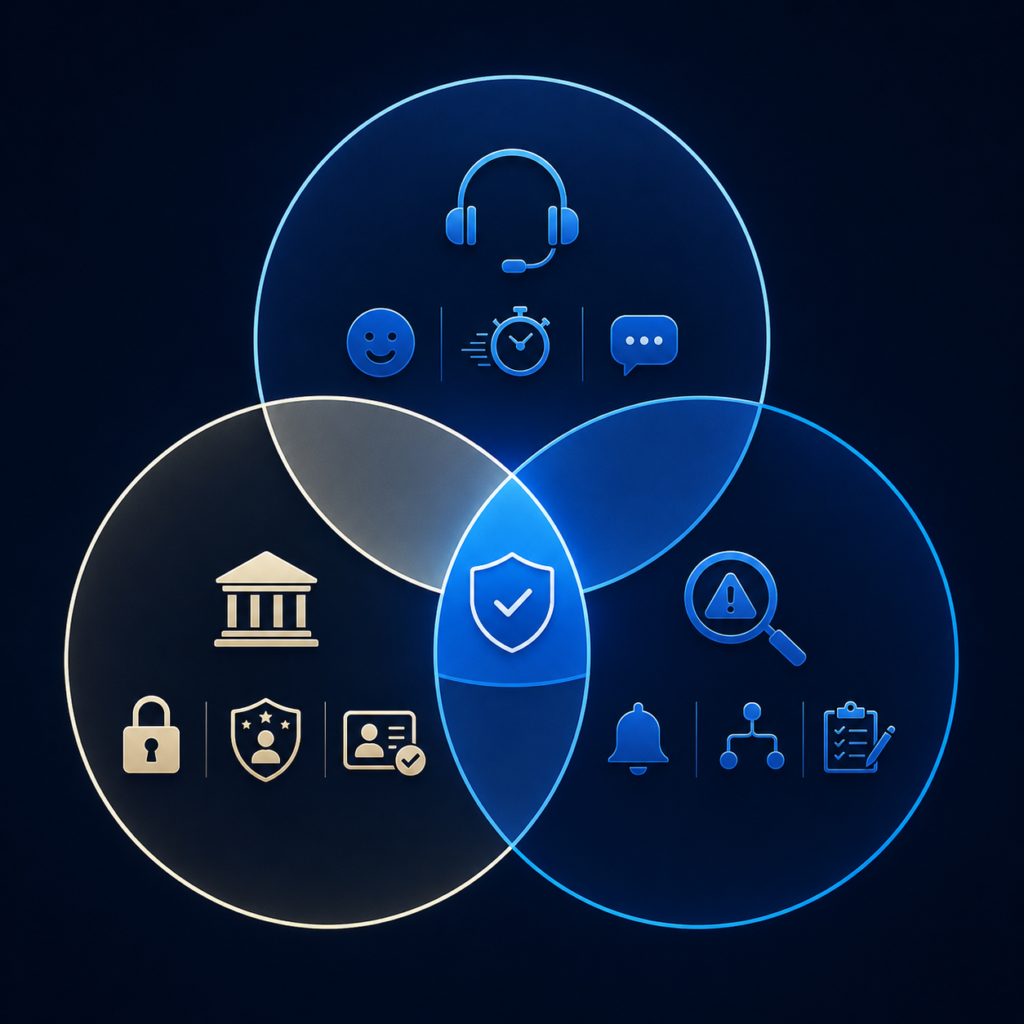
Compliance training depth: Agents handling KYC queries need to understand what information they can and cannot ask for, how to handle incomplete documentation, and how to explain regulatory holds without creating legal exposure. This is not a one-week induction – it is ongoing training against a regulatory framework that updates.
PCI-DSS scope: Any agent who has access to payment card data – even partial card numbers – must be operating within a PCI-DSS compliant environment. That means physical security controls, clean-desk policies, call recording restrictions for PAN data, and annual audit cycles. Non-compliance carries fines of $5,000-$100,000 per month from card schemes (PCI Security Standards Council), plus the reputational damage of a breach disclosure.
Fraud alertness: Fintech support agents are often the first human touchpoint when a fraud event is in progress. An agent who does not recognise social engineering patterns, or who reactivates a frozen account without following the correct escalation protocol, creates financial and regulatory liability. This is not paranoia – it is a known attack vector.
Data handling precision: Fintech support agents access financial account data constantly. Access controls, data minimisation, and clean-desk discipline matter more here than in retail or SaaS support contexts. The wrong data in the wrong place at the wrong time is a breach event, not an inconvenience.
A fintech BPO that treats compliance as a checkbox rather than an operational culture is a risk, not a resource. Ask any provider you shortlist for their most recent PCI-DSS Report on Compliance (RoC) and their ISO 27001 certification status before discussing commercial terms.
Why South Africa Works for Fintech Customer Support
South Africa combines the compliance credentials fintech buyers need with the language quality, timezone fit, and cost position that make outsourcing commercially rational.
Compliance certifications: South Africa’s leading BPOs hold ISO 27001, PCI-DSS, ISO 9001, and – for healthcare-adjacent fintech – HIPAA certifications. These are not self-declared; they are externally audited. A provider like Afrishore can supply certification documentation as part of any RFP response.
POPIA and data sovereignty: South Africa’s Protection of Personal Information Act (POPIA) is a comprehensive data protection law that the UK Information Commissioner’s Office and EU data protection authorities treat as broadly equivalent to GDPR in its data subject rights and security requirements. For UK and EU fintechs, this makes South Africa a legally workable data-processing destination under GDPR’s adequacy and standard contractual clause frameworks – an important advantage over some lower-cost alternatives.
English proficiency: South Africa ranked 13th globally and 1st in Africa in the EF English Proficiency Index 2025, with a 95% national literacy rate. Fintech support requires precision – agents explaining payment holds, fraud procedures, and compliance requirements in language that is both accurate and accessible. Near-neutral English pronunciation and strong written communication are non-negotiable for that brief.
Timezone coverage: GMT+2 gives full overlap with UK business hours and a 4-5 hour overlap with US Eastern time during standard working hours. Shift extensions cover US Central and Mountain. Unlike Philippines-based (GMT+8) or India-based (GMT+5:30) operations, South Africa does not require agent night shifts to cover UK or East Coast US hours – which directly reduces attrition risk. South Africa’s offshore contact centre attrition rate runs 15-20% annually, compared to 40%+ in the Philippines (see our full analysis of offshore call center attrition rates).
Cost savings: Fully loaded agent costs in South Africa run 40-60% below equivalent US or UK in-house teams. A 30-agent fintech support team costs approximately $15,000-$21,000 per month in South Africa, versus $36,000-$48,000 per month for equivalent in-house US headcount. That gap widens further when you factor in the compliance infrastructure the BPO already maintains.
South Africa’s GBS sector employs 150,000 offshore-facing agents and generated $2.91 billion in export revenue in 2024 (BPESA, 2025) – a mature supply chain, not an experimental destination.
What to Look for in a Fintech BPO Partner
Not every contact centre is equipped for fintech work. The shortlist criteria for fintech support are more specific than for retail or SaaS programmes.
Non-negotiable certifications:
- ISO 27001 (information security management – required)
- PCI-DSS (required if agents handle or are adjacent to payment card data)
- ISO 9001 (quality management – confirms structured QA processes)
Dedicated team model: Fintech support requires deep product and compliance training. Shared pool arrangements – where agents rotate across multiple clients – make that training investment economically irrational. Fintech programmes need dedicated agents who own your product knowledge long-term.
Background screening: Agents handling financial account data must have been screened for financial crime history. Ask for the provider’s background check policy – frequency, what they screen for, and what triggers a rescreen. This is an audit requirement under many financial services regulations.
Security controls: Physical security (clean-desk policy, no personal devices on the floor, restricted phone-free zones), logical access controls (role-based access to systems, audit trails, session recording), and network security (segregated environments per client) are the baseline. Tour the floor or request a virtual site visit.
QA infrastructure: What does quality assurance look like? Fintech programmes need call and chat scoring against compliance criteria, not just CSAT. Ask to see a sample scorecard. Ask who reviews it and at what frequency. Ask how compliance errors are escalated versus handled operationally.
Reporting depth: Weekly FCR, CSAT, AHT, and ticket category breakdowns are standard. Fintech programmes should also track first-contact resolution by query type, escalation rates to internal compliance teams, and fraud alert handling times separately from general support metrics.
For a structured framework for evaluating any BPO partner before you sign, see how to verify offshore BPO provider references.
How to Transition Fintech Support Offshore: Five Steps
Fintech support programmes follow the same five-step transition path as other BPO migrations, with compliance preparation as the critical variable that separates smooth launches from troubled ones.
Step 1 – Scope and volume audit: Document current contact volume by channel, query category, and time of day. Identify which categories are Tier 1 (resolvable by a trained agent) versus Tier 2 (require system access, compliance authority, or internal escalation). This determines team size, skill requirements, and what your BPO partner needs to train for.
Step 2 – Compliance due diligence: Before shortlisting providers, define your compliance requirements: PCI-DSS scope, data residency requirements, relevant regulations (FCA, GDPR, POPIA, HIPAA for health fintech), and any client-specific security standards. Share these upfront. A provider that cannot meet them immediately should not progress to commercial discussion.
Step 3 – Model and staffing design: Decide on dedicated versus shared pool (dedicated is strongly recommended for fintech), shift coverage hours, channel mix, and escalation path design. Build the escalation matrix – who in your internal team receives escalations, for which query types, and within what SLA – before onboarding begins.
Step 4 – Pilot: Run a 4-6 week paid pilot before committing full headcount. The pilot should cover live contacts, not simulated queries. Use it to stress-test the knowledge base, identify training gaps, and calibrate QA scoring before scale. Compress this and you discover the same problems under live production conditions instead.
Step 5 – Measure and optimise: From day one, track FCR by query type, CSAT, escalation rate, and compliance error rate. Set a 90-day review checkpoint to renegotiate SLAs, adjust staffing ratios, and update knowledge base coverage based on real contact patterns.
Most fintech outsourcing programmes are fully operational within 8-12 weeks of contract signature. Complex compliance environments or larger team sizes push this to 12-16 weeks.
Frequently Asked Questions
What types of queries can fintech customer support BPOs handle?
Fintech BPOs handle KYC onboarding queries, payment and transfer disputes, fraud alert triage, chargeback initiation, card and wallet management, platform troubleshooting, and account query resolution. Tier 2 items – final fraud investigation decisions, AML escalation authority, regulatory filing, and product bug triage – typically remain with your internal team. The clearer your Tier 1 / Tier 2 boundary is at the start, the higher your offshore FCR will be.
Is outsourced fintech support PCI-DSS compliant?
It can be, but only if the provider holds a current PCI-DSS certification and your programme is scoped correctly within that certified environment. Ask for the provider’s most recent Report on Compliance (RoC) or Attestation of Compliance (AoC). Confirm whether your workload falls within the certified cardholder data environment or adjacent to it – the distinction matters for your own compliance obligations. Non-compliance penalties from card schemes run $5,000-$100,000 per month, so this is not a checkbox question.
How do you handle KYC and identity verification queries in an outsourced team?
Agents are trained on your specific verification workflows, documentation requirements, and the exact language to use when explaining holds or rejections without creating legal exposure. Escalation paths for complex or disputed cases are documented before go-live. Agents do not make final KYC decisions – they guide, collect, and escalate according to defined protocols. The compliance authority stays in-house.
What security measures should a fintech BPO have in place?
At minimum: ISO 27001 certification, PCI-DSS compliance for payment-adjacent roles, role-based system access with audit trails, clean-desk and no-personal-device-on-floor policies, background screening for all agents handling financial data, segregated client network environments, and regular penetration testing. Ask for the security policy documentation and request a floor visit or virtual site tour as part of your evaluation.
How does South Africa compare to the Philippines or India for fintech support?
South Africa’s key advantages for fintech are: near-native English communication (EF EPI 2025: 13th globally, 1st in Africa), a GMT+2 timezone that overlaps UK business hours fully without night shifts, a materially lower attrition rate (15-20% vs 40%+ in the Philippines), and POPIA data protection legislation that aligns with GDPR. India operates at GMT+5:30 and typically covers US night-shift requirements; South Africa covers UK daytime requirements and US morning requirements without the attrition costs of an unsociable-hours workforce.
What is the minimum team size for a fintech customer support BPO programme?
Most providers require a minimum of 5-10 dedicated agents to run a fintech programme economically. Below that threshold, the compliance training investment per agent is difficult to amortise. If your volume is lower than 5 agents, consider whether a hybrid model – outsourcing only specific query categories – or a phased entry with a pilot cohort before full commitment makes more operational sense.
How do you maintain product knowledge with an offshore fintech support team?
Build a structured knowledge base before onboarding begins – not a raw policy document dump but a query-specific KB article for each contact category your agents will handle. Assign an internal product owner who is responsible for updating the KB when product features change. Run weekly or fortnightly calibration calls between your internal product or compliance team and the BPO’s team lead. Agents who stay current on product changes maintain FCR rates; agents who discover product changes from customers do not.
Conclusion
Fintech customer support outsourcing works when compliance is treated as a selection filter rather than an afterthought. The cost savings are real – 40-60% versus in-house US or UK teams – but the operational case is stronger than the cost case alone: 24/7 coverage without shift premiums, scalable capacity that absorbs product launch spikes, and a certified compliance infrastructure you inherit rather than build.
South Africa’s combination of English proficiency, POPIA data protection legislation, ISO 27001 and PCI-DSS certification standards, and GMT+2 timezone makes it the strongest offshore destination for UK and US fintech operators. The low attrition rate – 15-20% versus 40%+ in competing markets – protects the compliance training investment that makes fintech support expensive to set up but valuable to maintain.
If you want to understand what a fintech customer support programme could look like for your operation, contact Afrishore BPO for a scoped proposal. Afrishore operates from Johannesburg with 750 dedicated seats, over 20 years of BPO delivery experience, and holds ISO 27001, ISO 9001, PCI-DSS, and HIPAA certifications.
Related reading: Banking and Financial Services BPO · True Cost of Offshore Customer Service · How to Verify Offshore BPO Provider References