
Quick Answer: Hospitality outsourcing means handing selected guest contact and back-office work, such as reservations overflow, overnight phone cover, guest messaging and reconciliations, to a specialist team that works in your hotel’s name. It works best as a hybrid: the outsourced team captures demand and handles routine requests, while your property keeps the welcome, service recovery and pricing decisions. The commercial case starts with direct bookings, because online travel agencies supplied 63.4% of independent hotel bookings in 2025, according to Cloudbeds data reported by Asian Hospitality.
Key Takeaways
- Hospitality outsourcing is a capacity and responsiveness decision first, and a labour cost decision second.
- Independent hotels lean heavily on OTAs: 63.4% of their 2025 bookings came through online travel agencies, and OTA bookings were cancelled at 21.8%, more than double the 10.6% rate for direct bookings (Asian Hospitality, 2026).
- The phone still sells rooms. Revinate’s analysis of 4.3 million hotel calls from 2025 found reservation conversion rates of 49% to 53% in winter and spring (Revinate).
- Guests want technology in the background, not in charge: 89% of travellers want a hybrid stay or AI limited to background tasks, and 66% prefer a human for the front desk welcome (Mews, 2026).
- UK labour costs keep rising: the National Living Wage reached £12.71 an hour in April 2026, up 4.1% (GOV.UK).
- South Africa pairs strong English with a large tourism workforce: it scored 602 on the EF English Proficiency Index 2025 (EF) and had 953,981 direct tourism jobs in 2024 (SAnews).
What Hospitality Outsourcing Covers
Hospitality outsourcing covers any guest-facing or back-office task that a hotel hands to an external team working under its brand. For most hotels, that means reservations, guest service lines, messaging and a slice of finance work, not the physical front desk.
The guest-facing scope usually includes:
- Reservations and central reservations overflow, so booking calls are answered when the front desk is busy
- After-hours and overnight phone cover, including booking changes, directions and urgent routing to the duty manager
- Guest messaging across email, web chat, SMS, WhatsApp and the OTA inbox
- Loyalty programme support, such as points queries and member benefits
- Group and event enquiries, where the outsourced team captures dates, numbers and requirements before your sales manager takes over
- Review response drafting, with the property approving anything that promises a fix
Behind the scenes, many hotels also outsource night audit support, accounts payable and revenue reconciliations that tie the PMS, point of sale, channel manager and bank records together. Those finance tasks follow the same logic as any finance and accounting outsourcing arrangement: the external team prepares, your finance lead approves.
Hospitality is a slice of the wider travel picture. Airlines and online travel agencies have their own patterns, which we cover in our guides to travel customer support outsourcing and airline customer service outsourcing. Hotels differ because the guest is physically on site, so the line between what a remote team handles and what the property handles matters more.
Why Hotels Are Outsourcing Guest Contact Now
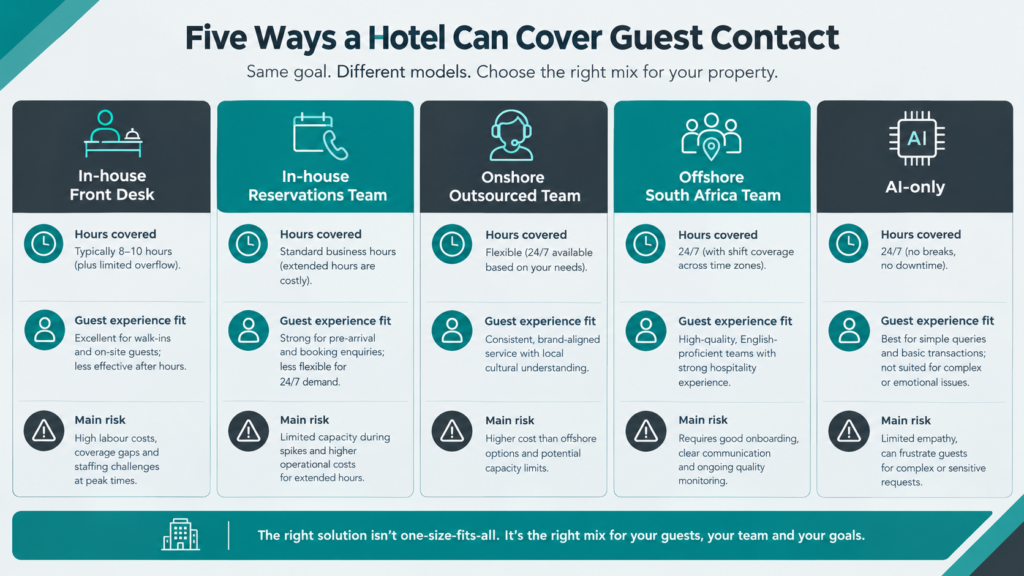
Hotels outsource guest contact for three reasons: labour is expensive and hard to schedule around peaks, OTAs take a large share of bookings, and too many direct enquiries go unanswered. An outsourced team addresses all three by adding trained capacity exactly when demand spikes.
Labour first. In the UK, the National Living Wage rose to £12.71 an hour from April 2026, a 4.1% increase on £12.21 (GOV.UK). That is before employer National Insurance, pension, holiday pay and the premium that overnight shifts usually need. Paying for a full night shift to answer a handful of calls is hard to justify, but leaving the phone unanswered is worse.
Distribution second. Cloudbeds analysed 90 million bookings across 180 countries for its 2026 State of Independent Hotels report and found that OTAs supplied 63.4% of independent hotel bookings in 2025 (Asian Hospitality). OTA bookings also cancelled at 21.8%, against 10.6% for direct bookings. Every direct booking a hotel wins back saves commission and is more likely to stick.
Missed demand third. A caller who cannot get through rarely waits. Many will book the same room through an OTA ten minutes later, or book somewhere else. That is why the strongest starting point for most hotels is overflow and after-hours cover, which we look at next after deciding what should stay at the property.
What to Outsource and What to Keep at the Property
The rule of thumb is simple: outsource work that can be governed by accurate knowledge, clear permissions and a reliable escalation path, and keep work that depends on being physically present or on judgement about money and goodwill.
| Function | Outsource? | Why |
|---|---|---|
| Reservations overflow | Yes, a strong first step | Low risk, measurable, recovers lost bookings |
| Overnight phone cover | Yes, with escalation to the duty manager | Routine changes and enquiries suit a remote team |
| Central reservations | Yes or hybrid | Works well with live inventory and rate access |
| Guest messaging and OTA inbox | Yes | High volume, rules-based, needs speed |
| Group and event enquiries | Capture and qualify only | Pricing and contract terms stay with your sales team |
| Review responses | Draft only | The property approves any promise or apology |
| Night audit support and AP | Yes, with in-house sign-off | Process-driven, suits a finance team with controls |
| Revenue management strategy | Keep in-house | Commercial accountability sits with hotel leadership |
| Physical front desk and welcome | Keep in-house | Identity, payment, safety and first impressions |
| Serious complaints and compensation | Keep in-house | The outsourced team logs and routes, but does not decide |
A useful test for any task is to ask whether a well-trained agent with the right screen in front of them could resolve it without walking to the lobby or deciding what a refund should be. If yes, it is a candidate. That test points straight at the reservations line, which is where the money is.
The Reservations Call Opportunity
Voice reservations still convert at rates websites cannot match. Revinate’s 2026 Hospitality Benchmark Report, built on 4.3 million hotel calls from 2025, found conversion rates of 49% to 53% in winter and spring, and estimates that a standard 100-room hotel can expect around 300 inbound lead calls in peak months (Revinate).
That conversion rate is not like-for-like with a website conversion rate. A caller has usually already researched the property and picked up the phone to book, so they arrive much further down the funnel. The practical lesson is that high-intent calls should never sit in a general switchboard queue behind someone asking about parking.
You can estimate what missed calls cost your property with a simple formula:
Lost booking value = unanswered reservation calls × your normal call conversion rate × your average booking value
For example, 100 missed reservation calls a month at a 45% conversion rate and a $600 average booking value is $27,000 of booking opportunity. Treat this as your own calculation, not an industry benchmark. Measure your real answer rates by hour and day before you decide how much cover you need. Hotels that also want overnight voice cover across other lines can read our guide to after-hours call center outsourcing.
Capturing the call is only half the job. The other half is what happens in the conversation, and that is where the AI question comes in.
Where AI Fits, and Where Guests Still Want People
AI works well in hospitality for fast, factual, round-the-clock tasks, and guests are clear that they want people for everything else. The right model uses AI for triage and simple answers and trained agents for selling, problem solving and anything with emotional weight.
Mews surveyed 3,250 travellers across the US, UK and six European countries in July 2026. 89% wanted either a hybrid stay or AI working in the background on repetitive tasks, 75% said good hospitality depends on human staff, 66% preferred a human for the front desk welcome, and humans were preferred at all nine touchpoints tested (Mews). A University of South Florida study of 145 hotel guests and practitioners found the same pattern: guests valued AI concierges for quick, round-the-clock help but preferred people when a request carried personal meaning, such as planning an anniversary dinner (USF, 2026).
Good uses of AI in an outsourced hotel operation:
- Answering property FAQs from an approved knowledge base
- Detecting booking intent and routing the call to a reservations agent
- Translating routine messages and drafting replies for agent review
- Summarising each conversation into the CRM or PMS
Hand the conversation to a person for complaints, billing disputes, accessibility needs, weddings, bereavements and any request where the answer is uncertain.
Reputation is the reason to get this right. Cornell’s Center for Hospitality Research found that a one-point gain on a 100-point online reputation index was associated with up to a 0.89% rise in average daily rate, a 0.54% rise in occupancy and a 1.42% rise in RevPAR (Hospitality Net). That study dates from 2012, but newer research has not replaced it. Generic, machine-written review replies do not protect reputation; well-handled service recovery does.
How Much Does Hospitality Outsourcing Cost?
Hospitality outsourcing is usually priced per agent per month for dedicated reservations teams, per hour or per contact for overflow, and sometimes per booking for sales-led programmes. There is no reliable public rate card for hotel work, so compare quotes on the same workload rather than on headline hourly rates.
| Pricing model | Best for | Watch out for |
|---|---|---|
| Per agent per month (dedicated) | Steady reservations and guest service volume | Paying for idle time in quiet seasons |
| Per productive hour | Overflow and seasonal peaks | How “productive” time is defined |
| Per call or contact | Simple, repetitive enquiries | Pressure to shorten calls |
| Per booking commission | Sales-led reservations | Discounting to close easy bookings |
| Base plus usage | Seasonal properties and groups | More complex invoices to reconcile |
Location changes the economics. South African contact centers average $3.54 per inbound call, roughly 40% of the UK equivalent, while resolving 86% of calls at first contact (ContactBabel). For a wider view of pricing structures, see our call center outsourcing cost guide.
To compare providers fairly, give every bidder the same case: contact volumes by channel and half-hour, handling times, service levels, languages, operating hours, the systems they must use and your seasonal peaks. Then judge on cost per resolved contact or per converted booking, not hourly rate alone. Price also depends on the controls you need around guest data and payments, which is the next thing to get right.
Protecting Guest Data and Card Payments
An outsourced hotel team handles names, stay details and often card payments, so security has to be designed in from day one. The essentials are PCI DSS controls for payments, a compliant data processing contract and least-privilege access to the PMS.
On payments, the PCI Security Standards Council is explicit: card verification codes must not be kept in call recordings after authorisation, even if the recording is encrypted, and the data should be prevented from being recorded in the first place (PCI SSC FAQ). In practice that means DTMF masking or secure payment links, so agents never hear or see full card numbers.
On guest data, UK hotels sharing personal data with an overseas team are making a restricted transfer under UK GDPR and need an approved safeguard, such as the International Data Transfer Agreement (ICO). South Africa’s POPIA works the same way in reverse, only allowing personal information to leave the country under binding protection or with consent (POPIA section 72).
On systems, give agents individual logins, multi-factor authentication and separate permissions for viewing, changing and cancelling bookings. Keep audit logs, and make sure rate fences stop anyone discounting below what your revenue manager has approved. With those controls in place, location becomes a question of skills and hours.
Why South Africa Works for Hotel Guest Contact
South Africa suits hotel guest contact because it combines strong spoken English, a large tourism workforce and working hours that line up with the UK, Europe and the US East Coast morning. That makes it a good fit for consultative booking conversations, not just scripted calls.
The talent signals are strong. South Africa scored 602 on the EF English Proficiency Index 2025, ranking 13th in the world (EF). Its business services sector created 26,346 international jobs in 2025 (ITWeb). And tourism itself employed 953,981 people directly in 2024, 5.7% of national employment, according to Stats SA data reported by SAnews after the sector added 185,158 jobs that year (Stats SA). Many agents come from hotel, travel and airline backgrounds.
Time zones help too. South Africa runs on UTC+2 all year, one hour ahead of the UK in summer and two in winter, so a normal South African day covers UK and European hotels completely. US East Coast evenings fall in the South African night, so full US evening cover runs on a night shift. Our comparison of South Africa vs the Philippines goes deeper on the trade-offs, and our guide to outsourcing customer support to South Africa covers setup.
How to Start: A 60 to 90 Day Pilot
The safest way to start hospitality outsourcing is a 60 to 90 day pilot on one clearly measurable queue, usually reservations overflow or overnight calls, with a baseline taken before go-live. Scale only when the pilot shows more captured bookings without a drop in guest quality.
A practical pilot plan:
- Pick one queue, such as calls not answered within 30 seconds or all calls after 10pm.
- Record a baseline for answer rate, abandonment, conversion and booking value over the previous period.
- Build the knowledge base property by property, with named owners and expiry dates for every policy.
- Agree the escalation rules: what the team resolves, what goes to the duty manager and what waits for the morning.
- Review weekly on answer rate, conversion, booking accuracy, quality scores and guest feedback.
- Decide on net booking contribution, not labour saving alone.
With Afrishore BPO, a dedicated team is typically live in 4 to 6 weeks, covering recruitment, training on your systems and tone of voice, and a closely supervised go-live.
Frequently Asked Questions
What is hospitality outsourcing? Hospitality outsourcing is handing selected hotel tasks, such as reservations, after-hours phone cover, guest messaging and finance back-office work, to a specialist team that works in your hotel’s name. The property keeps the physical welcome, service recovery and pricing decisions.
Which hotel functions are best to outsource first? Reservations overflow and overnight phone cover are the best starting points. Both are measurable, low risk and directly linked to revenue, because they capture bookings that would otherwise be lost to voicemail, an OTA or a competitor.
Will outsourcing reservations hurt the guest experience? Not if the team is trained property by property, works from an accurate knowledge base and escalates the right issues. Guests mainly notice speed and accuracy. Problems arise when agents lack system access or authority and keep transferring the call.
How much does hotel reservations outsourcing cost? Dedicated teams are usually priced per agent per month, overflow per hour or per contact, and sales programmes sometimes per booking. Compare quotes on the same workload. South African contact centers average $3.54 per inbound call, around 40% of the UK cost.
Can an outsourced team take card payments for hotel bookings? Yes, if the setup meets PCI DSS. Use DTMF masking or secure payment links so agents never hear or see full card numbers, and make sure card verification codes are never stored in call recordings after authorisation.
Should hotels use AI instead of outsourcing? Use both. AI handles simple, factual questions around the clock, while trained agents handle selling, problems and emotional moments. In a 2026 Mews survey, 89% of travellers wanted a hybrid stay or AI in the background, and 66% preferred a human welcome.
Is South Africa a good location for hotel guest contact? Yes, especially for UK and European hotels and the US East Coast. South Africa scored 602 on the 2025 EF English Proficiency Index and has 953,981 direct tourism jobs, so many agents bring hospitality experience to the role.
How long does it take to set up an outsourced hotel reservations team? With Afrishore BPO, a dedicated team is typically live in 4 to 6 weeks. That covers scoping, recruitment, training on your systems and brand voice, and a closely supervised go-live, ideally run as a 60 to 90 day pilot.
Afrishore BPO runs dedicated guest contact and reservations teams from South Africa for travel and hospitality brands in the United States, United Kingdom and Europe. Explore our travel call center outsourcing programmes, read our guide to customer care outsourcing, or see our full range of business process outsourcing services.
Ready to capture more direct bookings? Talk to our travel and hospitality team or contact Afrishore BPO.