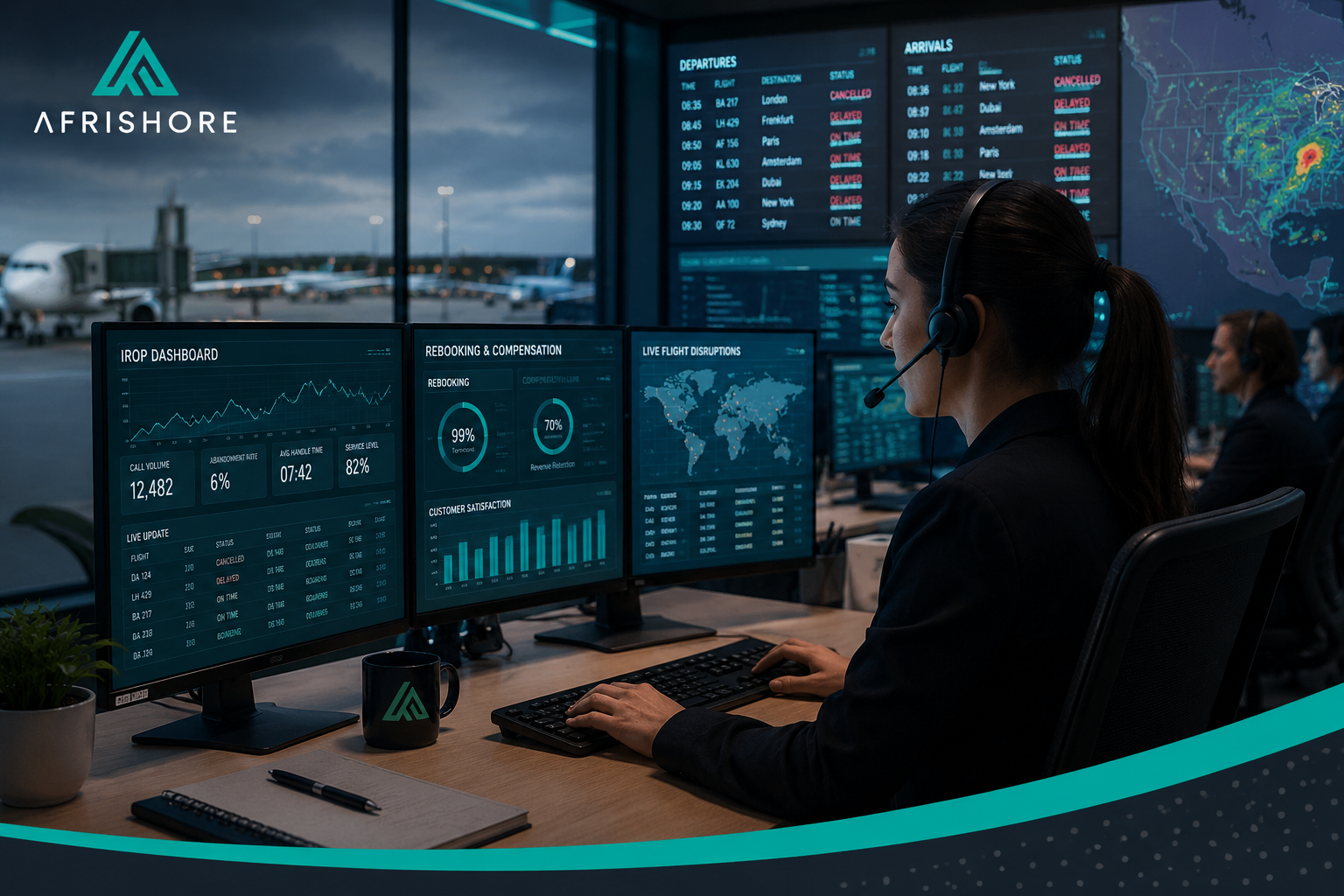
A single bad weather day can turn a call center sized for 2,200 calls into one fielding 12,000 within six hours. That’s not a hypothetical — it’s a documented regional-carrier case, and it’s the defining operational reality of airline customer service: demand isn’t steady, it’s spiky, unpredictable, and brutally unforgiving when it arrives. That’s precisely why airline and airport customer service — irregular operations (IROP) support, rebooking, baggage, and compensation handling — has become its own outsourcing sub-vertical, distinct from general travel or OTA booking support.

Key Takeaways
- Call volumes can surge 10× within the first hour of a mass disruption event — one documented regional-carrier case saw a 60-agent center built for 2,200 daily calls face 8,000–12,000 calls in six hours, with 45+ minute hold times and 60%+ abandonment
- The July 2024 CrowdStrike outage triggered 7,500+ US-linked flight cancellations and 32,500 delays; Delta alone cancelled over 5,500 flights and drew a formal DOT investigation into its customer service failures
- Specialist airline BPO providers report concrete results: one IROPS desk managed 700+ cancelled flights a month at 70% revenue retention and 99% rebooking turnaround; another cut disruption cost per event by 78% using AI-assisted agents
- EU261/UK261 compensation and US DOT’s 2024 automatic-refund rule create a dense regulatory layer — outsourced agents must be trained on both, not just general customer service scripts
- South Africa’s GBS sector added 20,518 jobs and $328M in export revenue in 2024 alone, with the UK and US together accounting for 76.5% of new jobs — and Lufthansa InTouch’s Cape Town center already runs 24/7 multilingual airline support at scale
- Ryan Strategic Advisory’s 2024 Offshore BPO Confidence Index ranks South Africa the #1 globally preferred offshore CX delivery location for front-office work
Why Airline Customer Service Is a Different Problem From Travel Booking
Aviation customer service outsourcing is a distinct sub-vertical from general travel/OTA booking support — built around irregular operations, compensation claims, and multilingual disruption handling, not itinerary planning or reservation assistance.
Most “travel outsourcing” content is really OTA-booking content: itinerary planning, reservation changes, loyalty program questions asked at a steady, predictable pace. Airline and airport customer service is a different animal entirely. It’s built around irregular operations — IROP — the delays, cancellations, and disruptions that generate concentrated, high-stakes surges of demand with almost no warning.
Specialist providers treat this as its own category for a reason. IGT Solutions positions itself explicitly as an “Airline BPO Service Provider”, not a generic contact center vendor, with domain-focused analytics and dedicated centers of excellence for IROPS and claims. Industry roundups like 1Point1’s “10 Best BPOs for Airline Customer Service” frame airlines as a dedicated vertical requiring GDS/host-system fluency and IROPS automation — distinct from generalist travel/hospitality outsourcing. For a US/UK airline, airport operator, or travel-tech ops leader, that distinction matters: the skills, compliance knowledge, and surge-capacity model required for disruption support don’t overlap much with booking-flow customer service.
The Scale of the Disruption Problem
Baseline delay and cancellation rates already generate millions of support interactions a year — roughly 20% of US domestic flights run 15+ minutes late — before accounting for the meltdown events that overwhelm airline contact centers entirely.
The baseline load is bigger than most people assume. US DOT Bureau of Transportation Statistics data shows that from 2024–2026, roughly 20–21% of domestic scheduled flights arrived 15+ minutes late, and between 1.4–2.3% were cancelled, out of 2.85–2.88 million annual operations. In Europe, EUROCONTROL’s 2024 CODA report found an average delay of 17.5 minutes per flight, with only 72.4% of flights arriving within 15 minutes of schedule. Reactionary — knock-on — delay is the largest single cause, accounting for 46% of all delay minutes in 2024.
Then there are the events that turn baseline strain into full-blown meltdowns. The July 2024 CrowdStrike outage triggered more than 7,500 flight cancellations and 32,500 delays within, to, or from the US; Delta alone cancelled over 5,500 flights and at one point accounted for roughly two-thirds of all cancellations worldwide, drawing a formal DOT investigation into its customer service failures — long waits, agents impossible to reach, delayed refund and waiver processing. The December 2022 Southwest meltdown, triggered by winter storms and a crew-scheduling system failure, caused over 16,700 cancellations affecting more than 2 million passengers, and ultimately a $140 million DOT penalty.
The call-volume math behind these events is stark. A Calld.ai analysis reports that call volumes can hit 10× typical levels within the first hour of a mass disruption, with queues exceeding an hour and backlogs taking 48–72 hours to clear. A QuickVoice case study on a regional US carrier documents a 60-agent center sized for roughly 2,200 calls per normal day facing 8,000–12,000 inbound calls within the first six hours of a major weather event — hold times over 45 minutes, abandonment rates above 60%.
What Specialist Aviation BPOs Actually Deliver
Named aviation BPO providers report concrete, published results: one IROPS desk manages 700+ cancelled flights monthly at 70% revenue retention; another reduced a 160,000-case refund backlog by 89%.
This isn’t a theoretical service category — established providers publish hard numbers. IGT Solutions reports partnerships with more than 20 global airlines, citing $20+ million saved annually through IROPS rebooking and $2+ million saved in baggage claim payouts across its portfolio. A case study on a European airline’s IROPS desk describes a centralized rebooking unit managing over 700 cancelled flights per month, achieving 70% revenue retention, 99% turnaround-time adherence, and 30 passengers rebooked per agent per hour. A separate IGT claims center of excellence reduced a 160,000-case refund backlog by 89% while boosting agent productivity 120%.
Fusion CX reports a regional airline lowering support costs by 35% through a flexible outsourcing model, and a European airline reducing complaints by 40% and improving satisfaction during irregular operations by 25% through integrated multichannel disruption handling. A 2025 roundup from 1Point1 lists Teleperformance, Concentrix + Webhelp, WNS, Sutherland, Foundever, Alorica, and TDCX as specialized airline customer-service partners — evidence that this is an established, competitive vendor category, not a niche.
Typical scope across these providers spans rebooking and re-accommodation, proactive passenger notification and duty-of-care coordination, mishandled baggage tracing, refund and compensation processing under EU261/UK261 and US DOT rules, cargo and loyalty program back office, and omnichannel/social media disruption support — often across 5–8+ languages.
The Surge-Staffing Problem — and Why It Justifies Outsourcing
A dedicated in-house team sized for normal-day volume will always be wrong for disruption days — either too small to cope with a 10× surge, or too large to justify on a quiet week. Surge-ready outsourced capacity solves the sizing problem structurally.
This is the core economic argument for outsourcing IROP support specifically: there is no in-house staffing number that’s correct on both a normal Tuesday and a major weather event. Size for peak and you’re paying for idle capacity most of the year. Size for average and you collapse exactly when it matters most — as the QuickVoice, Southwest, and Delta cases all show.
The QuickVoice case illustrates both the limits of ad hoc surge staffing and the payoff of getting it right. The carrier’s original approach — a contract for 15–20 temporary agents activated during disruptions — took 4–6 hours to spin up plus 2 hours of briefing, often arriving too late to meaningfully reduce the early backlog. After introducing AI-assisted voice agents into the disruption workflow, wait times dropped from 45+ minutes to 3 minutes, the share of passengers rebooked within 2 hours rose from 35% to 82%, the need for 15–20 temporary agents per event was eliminated, cost per disruption event fell 78% (from $125,000 to $28,000), and CSAT during disruptions rose from 2.1 to 3.8 out of 5.0.
Fusion CX’s model is built around the same principle — scaling operations up during peak periods and down in quieter months so airlines “only pay for the services they need,” citing a 30% inquiry spike absorbed without service interruption for a major international carrier. Providers consistently report AI-assisted deflection handling 45–60% of routine inquiries, freeing human agents for the complex, high-emotion IROP cases that actually need them.
Regulatory Complexity: EU261, US DOT, and PCI DSS
Outsourced airline agents need EU261/UK261 and US DOT passenger-rights rules embedded directly into scripts, knowledge bases, and QA — this isn’t generalist customer service, it’s a regulated compliance workflow with real financial exposure if it’s handled wrong.
Aviation customer service carries a regulatory weight that generic travel support doesn’t. Regulation (EC) No 261/2004 (EU261) entitles passengers on eligible flights delayed 3+ hours or cancelled to compensation of €250–600 per person depending on distance, plus care and rerouting. Skycop’s analysis estimated nearly 218,000 EU/EEA/UK flights were delayed 3+ hours or cancelled in 2024 alone — about 1.5% of departures — generating up to €6.5 billion in potential compensation, much of it unclaimed. UK261 mirrors these obligations post-Brexit.
In the US, DOT’s April 2024 automatic-refund final rule made it an unfair practice for carriers to refuse timely refunds after a cancellation or “significant change” — domestic delays of 3+ hours, international delays of 6+ hours — with refunds required in the original payment form within 7 business days for credit cards or 20 days otherwise. Delayed-baggage refund rules kick in after 12 hours domestically and 15–30 hours internationally. Denied-boarding compensation, effective January 2025, ranges from 200–400% of one-way fare, capped at $1,075–$2,150.
On the payment side, IATA guidance requires accredited agents to process payments through PCI DSS-compliant systems, and contact-center implementations increasingly use DTMF masking and tokenization so card data never touches call-center infrastructure — descoping architectures that can reduce PCI audit scope by up to 96%. Outsourced agents handling refunds and compensation need all of this — EU261 eligibility logic, DOT refund timelines, PCI-compliant payment handling — built into their training and QA from day one, not bolted on afterward.
Multilingual Support Is the Norm, Not a Premium Add-On
Airlines serving international passengers routinely need support in six or more languages simultaneously — a requirement that outsourced aviation CX providers already deliver at scale from centers like Lufthansa InTouch Cape Town.
International carriers can’t run English-only support and call it complete. Lufthansa InTouch’s Cape Town center runs 24/7 with 260+ consultants supporting Lufthansa Group airlines in English, French, German, Swiss German, Dutch, and Hebrew — part of a seven-country network covering 200 services in more than 30 languages. Air India has expanded its 24/7 support to cover seven additional Indian languages beyond Hindi and English. Global providers like Teleperformance advertise support in 300+ languages as standard.
For a US/UK carrier or airport operator evaluating outsourced IROP support, multilingual capability at scale — not as a premium add-on, but as a baseline expectation — should be part of the vendor scorecard from the start.
South Africa’s Fit for Aviation Customer Support
South Africa’s GBS sector added over 20,000 jobs and $328M in export revenue in 2024, with Lufthansa’s Cape Town center already proving multilingual, 24/7 airline delivery works at scale from the country — and Ryan Strategic Advisory ranks South Africa the #1 preferred offshore CX destination globally.
South Africa’s case for aviation-specific delivery rests on more than general BPO scale. Lufthansa InTouch Cape Town is direct proof that complex, multilingual, 24/7 airline passenger service already runs successfully from South Africa — not a hypothetical fit, an operating one. A Merchants CX case study on South African Airways shows outsourced back-office support for reservations and the Voyager frequent-flyer program achieving a 36% reduction in credit-card chargebacks and a 33% headcount reduction through process optimization — evidence of aviation-specific delivery beyond passenger-facing voice work.
The macro numbers back this up. South Africa’s GBS sector grew from 65,000 workers in 2019 to roughly 150,000 in 2024, with export revenue rising from $1.04 billion to $2.91 billion over the same period. In 2024 alone the sector created 20,518 jobs and generated $328 million in export revenue, with the UK and US together accounting for 76.5% of new jobs — a clear specialization in English-language voice CX for exactly the markets an international airline needs to serve. Ryan Strategic Advisory’s Offshore BPO Confidence Index 2024 ranks South Africa the number-one globally preferred offshore CX delivery location for front-office work, ahead of every other traditional destination.
South Africa’s GMT+2 time zone overlaps naturally with UK and European business hours and extends workably into North American time zones — a configuration that supports follow-the-sun coverage for round-the-clock disruption response. Combined with an EF EPI score of 602 (13th globally, “Very High” band), the underlying fit for aviation CX is the same fit that’s already worked for general CX, applied to a higher-stakes, higher-complexity workload.
Frequently Asked Questions
How much can call volumes really spike during a flight disruption?
Documented cases show 10× surges within the first hour of a mass disruption event. One regional carrier’s 60-agent center, sized for 2,200 calls on a normal day, faced 8,000–12,000 calls within six hours during a major weather event, with hold times exceeding 45 minutes.
Is airline customer service outsourcing different from general travel outsourcing?
Yes. Airline and airport support centers on irregular operations — rebooking, disruption notifications, EU261/DOT compensation, baggage claims — while general travel/OTA outsourcing centers on itinerary booking and reservation changes. Specialist providers treat aviation as a distinct vertical with its own compliance, GDS, and surge-capacity requirements.
What regulations do outsourced airline agents need to know?
EU261/UK261 (compensation for delays of 3+ hours or cancellations, €250–600 per person) and US DOT’s 2024 automatic-refund rule (refunds within 7–20 days for cancellations or significant schedule changes), plus PCI DSS for any payment handling. These need to be built into scripts and QA, not treated as generic customer service knowledge.
Can an outsourced partner actually handle a 10x call surge?
Yes, with the right model. Case studies show combining a baseline aviation-trained team with on-call surge capacity and AI-assisted deflection can cut disruption-response cost by as much as 78% while improving CSAT, versus static in-house staffing that either sits idle most of the year or collapses during major events.
Does outsourced airline support need to be multilingual?
Typically yes. International carriers commonly need support in six or more languages simultaneously — Lufthansa’s Cape Town operation supports English, French, German, Swiss German, Dutch, and Hebrew from a single 24/7 center, reflecting the norm for carriers serving diverse passenger bases.
Is South Africa a proven location for airline/aviation customer support specifically?
Yes. Lufthansa InTouch has run a 24/7, 260+ consultant multilingual operation from Cape Town for years, and South African Airways has used South African back-office teams for reservations and frequent-flyer support. Combined with Ryan Strategic Advisory’s #1 global offshore CX ranking for South Africa, this is an established delivery location, not an unproven one.
Conclusion
Airline and airport customer service isn’t a variant of general travel support — it’s a distinct discipline built around absorbing unpredictable, high-stakes surges without collapsing or over-staffing for a normal day. The evidence from IGT, Fusion CX, and QuickVoice all points the same direction: specialist outsourced teams, combined with surge capacity and AI-assisted deflection, consistently outperform static in-house models on both cost and CSAT during exactly the moments that matter most to passengers and brand reputation.
South Africa’s fit for this work is already proven, not theoretical — Lufthansa’s Cape Town operation and South African Airways’ back-office delivery show the multilingual, 24/7, compliance-literate capability this vertical demands is already running at scale from the country.
To scope what an IROP-ready customer support program could look like for your airline or airport operation, contact Afrishore BPO for a no-obligation assessment. Afrishore operates from Johannesburg and Cape Town, with over 20 years of BPO delivery experience, and holds ISO 27001, ISO 9001, and PCI-DSS certifications.
Related reading: Travel & OTA Customer Support Outsourcing · Travel Call Center Outsourcing · Business Process Outsourcing