
Quick Answer: AI inside a modern outsourced contact centre means four practical tools working alongside human agents, not replacing them: real-time agent assist, automated quality scoring, virtual agents for simple tier-1 tasks, and voice enhancement for clarity and accent neutrality. 88% of contact centres now use some form of AI, but only about 25% have it fully integrated into daily workflows, which is exactly the gap this guide is meant to help you close as a buyer.
Key Takeaways
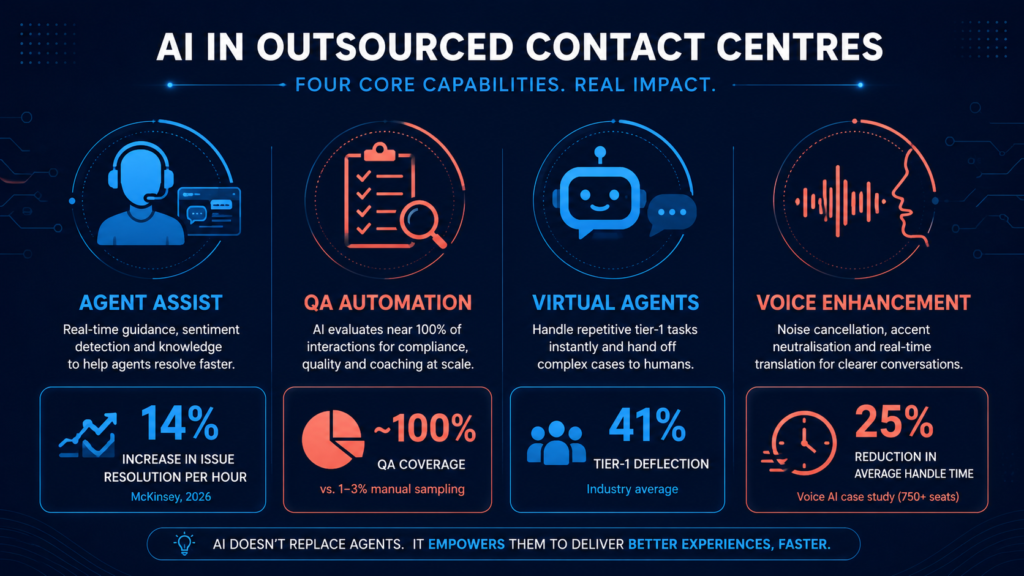
- AI in outsourced CX breaks into four categories: agent assist (live transcription, prompts, sentiment detection), QA automation (near-100% interaction scoring versus the old 1% to 3% manual sample), virtual agents (tier-1 deflection with human handoff), and voice enhancement (noise cancellation, accent conversion, real-time translation).
- 88% of contact centres report using some AI by 2026, but only around 25% say it’s fully integrated into day-to-day workflows rather than run as isolated pilots, per Brilo’s 2026 AI call centre trends synthesis.
- A McKinsey study of a 5,000-agent operation found generative AI agent-assist increased issue resolution per hour by 14%, cut average handle time by 9%, and reduced escalations by 25%, cited via Callforce’s 2026 AI customer service statistics.
- AI is not replacing agents: 64% of customers say they would prefer companies not use AI for service and 79% still want a human option available, per the same 2026 industry synthesis.
- Voice-AI tools matter specifically for offshore delivery: one case study of 750-plus agent seats using AI noise cancellation reported a 25% reduction in average handle time and a 60% improvement in understandability scores.
- Buyers should ask any outsourcing partner what’s actually in production versus on the roadmap, and how they handle POPIA and GDPR requirements for AI-processed call recordings and transcripts.
- South Africa’s contact-centre sector already runs AI-augmented human delivery at scale, ranked the top US outsourcing destination by Ryan Strategic Advisory in 2024, with local voice-AI tooling built specifically for South African accents.
What “AI in the Contact Centre” Actually Means
Marketing copy tends to blur four distinct tools into one vague claim. Separating them is the first step to evaluating any partner’s real capability rather than their slide deck.
Agent assist is the most mature category: real-time transcription and call summaries so agents stop taking manual notes, next-best-action prompts and knowledge-base surfacing driven by speech-to-text and large language models, and sentiment detection that flags rising frustration so a team lead can intervene while the call is still live. Named platforms in this space include Cresta, Observe.AI, NICE CXone, and AWS Contact Lens, cited here only as reference points for what the category looks like in practice, not as endorsements.
QA automation replaces manual sampling with near-full coverage. Traditional quality assurance in a contact centre reviews roughly 1% to 3% of calls because a human can only listen to so many recordings a day, which means a supervisor’s feedback is often based on five to ten calls per agent per month out of hundreds handled. AI-driven scoring pipelines now evaluate close to 100% of voice and digital interactions against a rubric covering compliance, soft skills, and resolution quality, with evidence-linked scores a supervisor can actually verify rather than take on faith.
Virtual agents handle repeatable tier-1 tasks such as password resets, order status checks, and simple troubleshooting, acting as a conversational replacement for old-style IVR menus. They hand off to a human agent when confidence is low, the query is complex or emotionally charged, or the customer asks for a person directly. Voice enhancement sits underneath both human and AI-assisted calls: noise cancellation and voice isolation strip out background chatter, accent conversion softens or neutralises accents while preserving the agent’s own voice and tone, and real-time speech-to-speech translation lets agents and customers speak their own languages. These tools matter disproportionately in offshore operations, where clarity and accent friction directly affect CSAT and handle time. This article is a practical explainer of what these four categories do; for the separate question of AI chatbots versus human agents on pure cost grounds, see our AI chatbots versus outsourced support agents cost comparison.
How Widely Contact Centres Have Adopted AI
Adoption headlines and actual maturity are two different numbers, and the gap between them is where most buyer disappointment comes from. Knowing both figures before you shortlist a partner sets a more realistic bar for what “AI-powered” should mean in a proposal.
By 2026, roughly 88% of contact centres report using some form of AI, up sharply from an estimated 50% to 60% in 2023, according to Brilo’s synthesis of Gartner, McKinsey, and Salesforce data. The more telling number is depth of adoption: only about 25% say AI is fully integrated into day-to-day workflows, with most running point solutions or pilots rather than end-to-end process change. Salesforce’s State of Service data shows AI agents in customer service rising from 39% adoption in 2025 to 66% in 2026, a 1.7-times increase in a single year, while on the QA side, industry research indicates 68% of contact centres plan to deploy AI-powered QA by the end of 2026, up from 32% in 2024. The practical takeaway for a buyer evaluating an outsourcing partner: ask not whether they use AI, since almost everyone now claims to, but which specific workflows it touches and how deeply it’s wired into routing, coaching, and reporting.
The Measured Impact on Handle Time, QA, and Cost
Where AI is properly integrated rather than bolted on, the productivity and cost numbers are substantial and independently verifiable across multiple studies. Treat any partner’s claims against these published benchmarks rather than their own marketing figures.
On agent assist, a McKinsey study of a 5,000-agent customer service operation found that introducing generative AI agent-assist tools increased issue resolution per hour by 14%, reduced average handle time by 9%, and cut escalations, defined as requests to speak to a manager, by 25%, cited via Callforce’s 2026 statistics review. On QA, automated scoring brings the cost per interaction down from roughly $2 to $4 for manual review to $0.10 to $0.30 for AI analysis, according to SIPPulse’s audio-intelligence research, and organisations implementing comprehensive AI QA report 12% to 18% CSAT improvements and 40% to 50% decreases in compliance incidents within the first year, per QEval’s 2026 AI QA tools analysis. On deflection, IT and service desk environments see blended deflection rates of 40% to 60% for common request types, per StealthAgents’ 2026 AI helpdesk automation statistics, while median tier-1 customer service deflection sits around 41.2%, with top-quartile teams reaching 58.7%, based on Digital Applied’s 2026 customer service AI agent data. On cost, Gartner benchmarks a self-service contact at $1.84 versus $13.50 for an agent-assisted one, roughly a seven-times difference.
Why AI Augments Outsourced Agents Rather Than Replacing Them
The gap between AI marketing and AI reality is widest on the question of replacement. The data consistently shows augmentation winning out over full automation, for reasons that matter directly to how a buyer should structure an outsourcing engagement. This is the operating idea behind what’s often called human-in-the-loop customer experience: AI should own the interactions with stable rules and low risk, while a person stays accountable for judgment wherever a confident wrong answer would cost the customer something real.
Despite bullish forecasts, actual automation levels remain modest. Service teams estimate AI handles about 30% of service cases today, with expectations of reaching 50% by around 2027, not full replacement, per Callforce’s 2026 statistics. Customer sentiment reinforces the ceiling: 64% of customers say they would prefer companies not use AI for service, and 79% still want a human option available even where AI is present, according to Brilo’s AI customer service statistics. Containment rates in the 60% to 80% band for well-tuned tier-1 deployments are genuinely strong, but they still leave 20% to 40% of contacts needing a person, typically the multi-issue, emotionally charged, or regulated cases where human judgement and brand nuance matter and fully autonomous handling isn’t yet trusted. McKinsey’s research on building trust in AI-era customer care notes that Gartner forecasts 50% of organisations will abandon plans to cut their customer service workforce specifically because of AI, seeing it instead as a way to make existing agents more productive. For offshore BPO agents specifically, this means routine work increasingly moves to bots and self-service, while human agents focus on higher-value resolution, multi-step journeys, and the empathy-driven interactions that AI still can’t reliably handle, which is the operating model our guide to human-AI hybrid CX covers in more depth.
What to Ask an Outsourcing Partner About Their AI Stack
Marketing claims are easy to make and hard to verify without the right questions. A structured checklist separates a partner with real, deployed capability from one still on the roadmap.
Start with production versus roadmap: ask for specific use cases live today, which queues run agent assist and what capabilities it includes, what percentage of interactions are auto-scored for QA and how humans stay involved, and what containment rates virtual agents actually achieve with which escalation rules. Request metrics with dates, ideally showing a before-and-after baseline from 2023 through 2025 rather than a single current-state number. Then move to data security and compliance, which matters more here than in most outsourcing categories because AI tools process the full content of customer conversations, not just metadata. For US and UK buyers, both POPIA in South Africa and GDPR require a lawful basis and a specific declared purpose for AI-processed recordings, transparency to callers that AI may process the call, and strict controls around cross-border data transfer under POPIA Section 72, per WhichVoIP’s POPIA compliance checklist for call centres. Voiceprints used for speaker verification count as special personal information under POPIA requiring stricter authorisation, and payment-card data spoken during calls needs the same redaction and access-logging controls as any other PCI-DSS-scoped environment, a topic our guide to outsourcing data security and compliance covers at the umbrella level. Finally, check model transparency and escalation design: QA and routing outputs should be evidence-linked, not black-box scores, and virtual agents should expose confidence thresholds with clear rules for handing off to a human, including a simple way for customers to reach a person on request.
South Africa’s Position in AI-Enabled Outsourced CX
South Africa is not simply competing on labour cost anymore; its leading contact-centre operators already run AI-augmented human delivery as standard practice. That combination is what makes the destination case below more than a wage-arbitrage argument.
Ryan Strategic Advisory ranked South Africa the top destination for US call-centre outsourcing in 2024, and local providers increasingly run human-AI hybrid CX stacks, where AI handles routing, real-time transcription, and sentiment flagging while human agents deliver the actual conversation. Agent assist, deflection bots, and AI-led QA scoring are described as native modules in most South African contact-centre platforms by 2026, with real-time agent assist typically yielding a 10% to 15% reduction in average handle time, according to WhichVoIP’s overview of AI in South African contact centres. Voice-AI vendor Krisp has launched accent conversion built specifically for South African English, deployed at scale across global BPOs processing over 80 billion minutes of audio monthly, and one case study of a BPO using Krisp’s noise cancellation across 750-plus agent seats reported a 25% reduction in average handle time, a 60% improvement in understandability scores, and a 70% reduction in call disconnects. South African outsourcers such as EC3 highlight real-time translation, sentiment analysis, and AI chatbots as live capabilities already augmenting a 24-hour agent workforce, not future roadmap items.

Frequently Asked Questions
Is AI replacing human agents in outsourced contact centres? No. Current data shows AI handling roughly 30% of service cases today, with projections of about 50% by 2027, and 64% of customers say they would prefer companies not use AI for service at all. AI is used to augment agent-assist, quality scoring, and simple tier-1 deflection, while humans continue to handle complex, emotional, or regulated interactions.
What is agent assist in a contact centre? Agent assist is real-time AI support during a live call or chat: automated transcription, next-best-action prompts, knowledge-base surfacing, and sentiment detection that flags rising customer frustration so a supervisor can intervene while the interaction is still happening.
How much of quality assurance can AI actually automate? AI-driven QA scoring can evaluate close to 100% of voice and digital interactions, compared with the traditional manual sample of roughly 1% to 3% of calls. This drops the cost per interaction reviewed from around $2 to $4 manually to $0.10 to $0.30 with AI analysis, while humans still review flagged or low-confidence cases.
What is a good containment or deflection rate for a virtual agent? Blended deflection rates of 40% to 60% are typical for common IT and customer service request types, with top-quartile deployments reaching 55% to 80% on narrow, well-structured tiers such as password resets or order status checks. Rates this high still leave 20% to 40% of contacts requiring a human agent.
What should I ask an outsourcing partner about their AI stack? Ask what’s actually in production versus on the roadmap, which specific queues and use cases it covers, what metrics they can show with before-and-after dates, how they handle POPIA or GDPR requirements for AI-processed recordings and transcripts, and how their virtual agents are designed to hand off to a human.
Does AI processing of call recordings create data protection risks? Yes. Under POPIA and GDPR, AI-processed recordings require a lawful basis, a specific declared purpose, and caller transparency. Voiceprints used for speaker verification count as special personal information under POPIA, and cross-border transfer of recordings or transcripts requires additional safeguards under POPIA Section 72.
Is South Africa a strong location for AI-augmented outsourced customer service? Yes. South Africa was ranked the top US call-centre outsourcing destination by Ryan Strategic Advisory in 2024, and its leading contact-centre platforms already run agent assist, AI QA scoring, and accent-conversion voice tools as standard, with real-time agent assist typically reducing average handle time by 10% to 15%.
Afrishore BPO’s IT Outsourcing division embeds AI Studio capabilities, agent assist, QA automation, virtual agents, and voice enhancement, into staffed South African contact-centre operations, so AI augments trained human agents rather than replacing the relationship you’re actually outsourcing for. For the platform layer this sits on top of, see our CCaaS explainer, and for the cost-comparison angle specifically, see our AI chatbots versus outsourced support agents guide. Anton Vukic writes about this operating model weekly in his LinkedIn newsletter, Human in the Loop CX, where he covers where AI should lead in customer service and where human judgment still has to own the outcome.