Quick Answer: Bookkeeping outsourcing hands the recording layer of your finance function, transaction coding, bank reconciliation, accounts payable and receivable data entry, and monthly financial statements, to a dedicated outsourced team instead of an in-house hire. 52% of small businesses surveyed now outsource accounting and bookkeeping, reporting savings of 40% to 88% compared with a fully loaded in-house bookkeeper.
Key Takeaways
- Bookkeeping outsourcing covers transaction recording, bank and credit-card reconciliation, AP/AR data entry, expense categorisation, and monthly financial statements, distinct from controller oversight, strategic CFO work, and tax preparation.
- 52% of small businesses surveyed outsource accounting or bookkeeping, and 98% of UK accounting firms outsource at least part of their work, with general ledger and transaction management the most commonly outsourced task at 55%.
- A US bookkeeper carries a median annual wage of $49,210, and once benefits and overhead are added, a fully loaded in-house hire typically runs $80,000 to $95,000 a year.
- Outsourced bookkeeping is usually priced in monthly tiers: $300 to $800 for basic reconciliation and reporting, $800 to $1,500 with AP/AR support, and $1,500 to $3,000-plus for payroll support and dedicated account management.
- Poor bookkeeping has a real cost: reconstructing a disorganised year of records can run $3,000 to $15,000, and businesses routinely lose $5,000 to $10,000 a year in missed deductions from undocumented expenses.
- A good outsourced bookkeeping workflow runs inside your existing software, QuickBooks Online, Xero, or Sage, with daily or weekly transaction coding, full monthly reconciliation, and a month-end close package delivered every month without exception.
- South Africa combines a deep, SAICA-adjacent accounting talent pipeline with bookkeeper salaries of roughly R15,000 to R30,000 a month, translating to substantial cost savings for US and UK businesses without dropping qualification standards.
What Bookkeeping Outsourcing Covers
Bookkeeping is the production layer of your finance function, and outsourcing it means someone else runs that production line to a consistent standard. Understanding exactly where that layer ends is what keeps expectations realistic on both sides of the engagement.
Standard recurring scope includes transaction recording and coding against your chart of accounts, bank and credit-card reconciliation so statement balances tie out with timing differences and fees properly recorded, accounts payable and receivable data entry with invoice posting and aging reports, expense categorisation and general ledger maintenance, and monthly financial statements: a profit and loss, a balance sheet, and often a basic cash-flow statement. Most providers also handle catch-up and cleanup work, coding historical backlogs and fixing misclassified entries, which is one of the more common reasons a small business first reaches out.
Bookkeeping is about recording and reconciling; accounting and controller work adds oversight and interpretation on top of it. Controller or client-accounting-services engagements layer on internal-control design, close review, and management reporting, typically led by a qualified accountant, which our guide to outsourced controller services covers separately. Strategic CFO work goes further still into forecasting and capital allocation, covered in our outsourced CFO services guide. One distinction worth flagging explicitly: tax preparation and filing are usually not included in a standard bookkeeping package, even when delivered by the same firm, tax returns, tax planning, and representation in front of tax authorities are typically a separate service or add-on.
How Many Small Businesses Outsource Bookkeeping
Outsourced bookkeeping has moved firmly into the mainstream rather than remaining a niche choice for cash-strapped startups. The adoption numbers below are worth knowing before a conversation with your own accountant about whether it’s a normal thing to do.
A 2026 synthesis of small-business outsourcing data found 37% of small businesses outsource at least one function, with accounting and bookkeeping among the top categories and 52% adoption among businesses surveyed specifically for that function, per StealthAgents’ 2026 small-business outsourcing statistics. The same research reports typical savings of 40% to 88% when a small business outsources a bookkeeper or accountant compared with the fully loaded in-house cost. In the UK, an ICAEW study of small and medium-sized businesses found 32% had used external bookkeeping or management-accounts support in the prior 12 months, while QuickBooks’ 2024 UK Accountant Tech Survey found 98% of responding accounting firms outsourced at least part of their own work, with general ledger and transaction management the most commonly outsourced task at 55%, followed by accounts payable and receivable processing at 50%. Bookkeeping outsourcing sits inside the broader finance and accounting outsourcing market, which Mordor Intelligence estimates at $54.79 billion in 2025, growing to $59.05 billion in 2026 at a roughly 7.8% compound annual rate.
How Much Does Outsourced Bookkeeping Cost?
The cost comparison is where most business owners decide, and the gap between an in-house hire and an outsourced package is wide enough to matter even for a very small operation. Both sides of the comparison, plus what bad bookkeeping actually costs, are worth putting side by side.
The US Bureau of Labor Statistics reports a median annual wage of $49,210 for bookkeeping, accounting, and auditing clerks as of May 2024. Once benefits and overhead are layered on at a typical 30% to 40% of base, a fully loaded US bookkeeper runs roughly $80,000 to $95,000 a year. In the UK, Salary.com’s Global IQ data puts the average bookkeeper salary at £32,117 as of April 2025, implying a fully loaded cost in the region of £36,000 to £45,000 once overhead is included.
Outsourced bookkeeping is usually priced in one of three ways: fixed monthly tiers by transaction volume and complexity, hourly billing for cleanup or project work, or per-transaction pricing wrapped into a monthly rate. A 2026 SMB pricing guide describes a common three-tier structure: a $300 to $800 a month “basic” tier covering transaction categorisation, bank reconciliation, and monthly financials; an $800 to $1,500 a month “standard” tier adding AP/AR management; and a $1,500 to $3,000-plus a month “premium” tier with payroll support and dedicated account management, per Sanso’s 2026 outsourced bookkeeping guide. Hourly rates for recurring small-business work typically run $30 to $60 an hour, rising to $75 to $250 an hour for cleanup or project-based engagements.
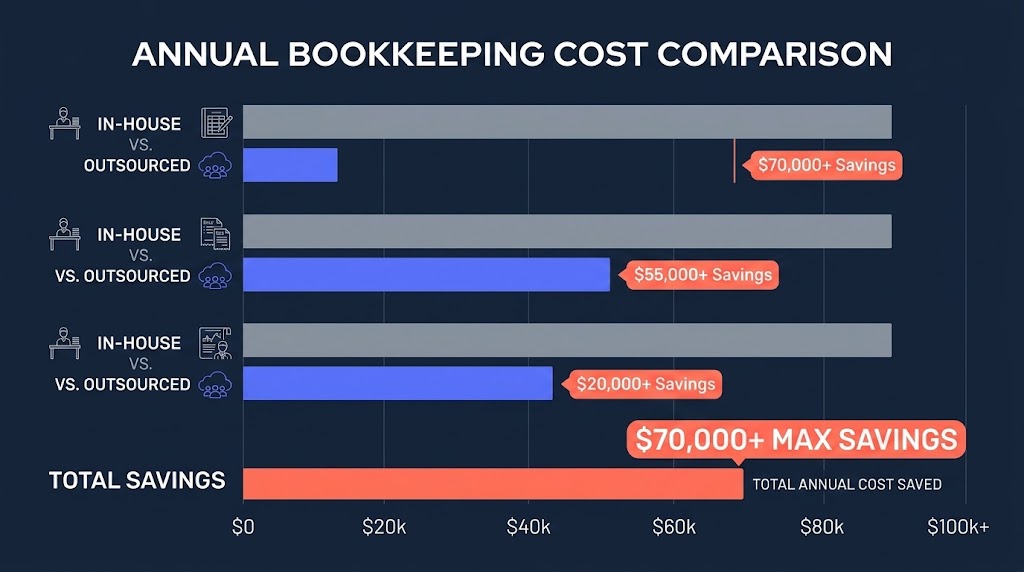
Table: In-house versus outsourced bookkeeping cost comparison
| Option | Annual cost (approx) | What’s included |
| In-house bookkeeper (US, fully loaded) | $80,000-$95,000 | Full-time salary plus benefits and overhead |
| In-house bookkeeper (UK, fully loaded) | £36,000-£45,000 | Full-time salary plus benefits and overhead |
| Outsourced bookkeeping, basic tier | $3,600-$9,600 | Transaction coding, reconciliation, monthly financials |
| Outsourced bookkeeping, standard tier | $9,600-$18,000 | Adds AP/AR data entry and aging reports |
| Outsourced bookkeeping, premium tier | $18,000-$36,000+ | Adds payroll support and dedicated account management |
Sources: BLS, Salary.com UK, Sanso.
The comparison matters more once you factor in what bad bookkeeping actually costs. A Canadian bookkeeping-cleanup guide estimates reconstructing a full year of disorganised small-business records at CAD 3,000 to 15,000, noting many deductions can never be recovered once the documentation is lost, per CustomCPA’s small-business mistakes guide. Several sources estimate small businesses routinely miss $5,000 to $10,000 a year in deductions from poorly documented expenses, on top of standard IRS failure-to-file penalties of 5% of unpaid tax per month, up to 25%. Framed against those numbers, an extra $300 to $800 a month for professional bookkeeping is often cheaper than the cumulative cost of penalties, missed deductions, and a hurried annual cleanup project.
What Good Software and Handoff Looks Like
Outsourced bookkeeping should slot into the software you already use, not force a migration. A clear cadence and clean access controls are what separate a reliable provider from one you have to chase every month.
Modern outsourced bookkeeping is built around the same cloud platforms small businesses already run: QuickBooks Online, Xero, Sage, and FreeAgent are all standard, with the provider working directly inside your file using your existing chart of accounts and close calendar rather than a separate system you have to reconcile against. A good workflow follows a consistent cadence: daily or weekly transaction downloads from bank feeds with basic coding and flagged exceptions, full monthly reconciliation of bank accounts, credit cards, and merchant processors with a complete month-end close package, and quarterly or annual tax-ready bundles, general ledger detail, trial balance, and supporting schedules, handed to your tax preparer or accountant. A complete service should deliver reconciled accounts and core financial statements every month without exception, with explicit confirmation that reconciliation is finished before the close is called done.
Even at this transactional tier, providers are handling bank statements, payroll data, and vendor and customer records, so basic security expectations still apply. Look for encryption in transit and at rest, multi-factor authentication and role-based access control, and, at larger-scale providers, independent certifications such as SOC 2 Type II and ISO 27001, per Madras Accountancy’s vendor due-diligence guidance for accounting outsourcing. Our guide to outsourcing data security and compliance covers how to verify these claims across any finance-function engagement, not just bookkeeping specifically.
Why South Africa for Bookkeeping Outsourcing
South Africa’s accounting talent pipeline is deep enough that cost savings don’t come at the expense of qualification. That combination is what makes the destination case below more durable than a simple wage-arbitrage argument.
South Africa has a large pool of SAICA-registered professionals and BCom-qualified graduates working under IFAC-aligned standards, with finance professionals typically trained to SAICA, CIMA, or ACCA standards and familiar with IFRS and often US GAAP. English is the standard business language, and the country’s GMT+2 time zone gives full overlap with UK working hours and partial overlap with the US East Coast morning. Local salary data show bookkeepers in South Africa earning roughly R15,000 to R30,000 a month, according to the Institute of Certified Bookkeepers’ South Africa salary data, a fraction of the $80,000 to $95,000 fully loaded cost of a US hire. Companies buying finance and accounting BPO from South Africa commonly report 50% to 65% savings versus US or UK in-house costs, without moving down the qualification ladder to reach them. For the broader finance-function picture beyond bookkeeping alone, see our guides to finance and accounting outsourcing and accounts payable outsourcing.

Frequently Asked Questions
What is included in outsourced bookkeeping services? Standard scope includes transaction recording and coding, bank and credit-card reconciliation, accounts payable and receivable data entry, expense categorisation, and monthly financial statements such as a profit and loss and balance sheet. Tax preparation, strategic forecasting, and internal-control oversight are typically separate services.
How much does outsourced bookkeeping cost? Outsourced bookkeeping is typically priced in monthly tiers: roughly $300 to $800 a month for basic reconciliation and reporting, $800 to $1,500 with AP/AR support added, and $1,500 to $3,000-plus for payroll support and dedicated account management. This compares with $80,000 to $95,000 a year for a fully loaded in-house US bookkeeper.
What’s the difference between bookkeeping, accounting, and controller services? Bookkeeping records and reconciles transactions. Accounting and controller services add oversight, internal controls, and interpretation on top of accurate books. Strategic CFO work goes further into forecasting, budgeting, and capital-allocation decisions. Each is typically a distinct service tier, even when delivered by the same provider.
Does outsourced bookkeeping work with QuickBooks or Xero? Yes. Outsourced bookkeeping providers typically work directly inside your existing QuickBooks Online, Xero, Sage, or FreeAgent file, using your chart of accounts and close calendar rather than requiring a separate system or a full migration.
How often should an outsourced bookkeeper reconcile my accounts? A good workflow includes daily or weekly transaction coding from bank feeds, full monthly reconciliation of all bank accounts and credit cards, and a complete month-end close package delivered every month without exception, plus quarterly or annual tax-ready bundles for your accountant.
What does bad bookkeeping actually cost a small business? Reconstructing a year of disorganised records can cost $3,000 to $15,000, and businesses routinely lose $5,000 to $10,000 a year in missed tax deductions from poorly documented expenses, on top of standard late-filing and accuracy-related penalties. These costs regularly exceed what a professional outsourced bookkeeping service charges.
Is South Africa a good source for outsourced bookkeeping? Yes. South Africa has a deep SAICA-adjacent accounting talent pipeline, strong English-language business capability, and a GMT+2 time zone overlapping UK hours and reaching US mornings, with bookkeeper salaries of roughly R15,000 to R30,000 a month translating to substantial savings for US and UK businesses without a drop in qualification standards.
Afrishore BPO’s Financial Services Outsourcing division delivers bookkeeping, reconciliations, AP/AR processing, and month-end close from South Africa for US, UK, and Australian clients, with a clear path to controller and CFO-level support as your business grows. See our guides to outsourced controller services and outsourced CFO services for the tiers above bookkeeping.