Quick Answer: Nearshore outsourcing means working with a team in a nearby country that shares most of your working day, such as Mexico or Colombia for US companies. Offshore outsourcing means working with a team further away, such as the Philippines, India or South Africa, usually with a bigger time difference. For customer service and back office work, the right choice depends on language, the hours you need covered and cost. English skill varies widely: South Africa ranks 13th on the 2025 EF English Proficiency Index, while Mexico ranks 103rd.
Key Takeaways
- Onshore keeps work in your own country, nearshore uses a neighbouring or nearby country with a similar time zone, and offshore uses a distant country, usually with a large time difference.
- Nearshore is mainly about time zone and Spanish. Mexico and Colombia share most of the US working day, and 44.9 million people in the US speak Spanish at home (USAFacts, US Census data).
- Offshore is mainly about scale and English. The Philippine IT-BPM industry ended 2024 with 1.82 million jobs and $38 billion in revenue (IBPAP).
- English proficiency differs sharply on the 2025 EF index: South Africa 602 (13th), Philippines 569 (28th), India 484 (74th), Colombia 480 (76th), Mexico 440 (103rd) (EF).
- Onshore pay keeps rising: the median US customer service representative earned $21.53 an hour in May 2025 (BLS).
- South Africa sits between the two models: offshore costs with a full UK working-day overlap, and a day shift that covers the US night and morning.
What Nearshore, Offshore and Onshore Mean
The three terms describe how far away your outsourced team is, and therefore how much of your working day it shares. Distance matters less than time zone: a team that works your hours behaves like a nearshore team, wherever it sits on a map.
- Onshore: the team is in your own country. Highest cost, full time zone and cultural match, simplest data compliance.
- Nearshore: the team is in a nearby country, usually within a few hours of your time zone. For US companies that typically means Mexico, Colombia, Central America or the Caribbean. For UK and Western European companies it usually means Eastern Europe or North Africa.
- Offshore: the team is in a distant country, such as the Philippines or India for US companies, often with an 8 to 13 hour time difference.
South Africa is a special case. For UK companies it behaves like a nearshore location, because it is only one or two hours ahead of London all year. For US companies it is offshore, but its time zone lines up neatly with the US night and morning. Our guide to nearshore outsourcing for UK companies covers the UK view in depth, and our offshore outsourcing guide covers the offshore model.
Nearshore vs Offshore: Which Is Better for Customer Service?
Neither is better in general. Nearshore usually wins for real-time voice support of US customers who need Spanish, or when your team must work closely with onshore staff during the day. Offshore usually wins on cost and scale, and on English quality in the strongest English-speaking locations.
The deciding factors for customer operations are:
- Language: English level, accent familiarity for your customers, and whether you need Spanish or other languages.
- Hours: whether you need daytime cover in your time zone, 24/7 cover, or both.
- Cost: pay levels and the fully loaded cost per resolved contact, not just the hourly rate.
- Work type: live voice needs agents awake when customers call; email, back office and data work can run asynchronously.
- Risk: data protection law, operational stability and how concentrated your delivery is in one country.
The comparison below puts these side by side for the main locations US and UK buyers consider.
Location Comparison: Mexico, Colombia, Philippines, India and South Africa
The table compares the main nearshore and offshore locations on English skill, time zone overlap and available pay data. Overlap assumes a 09:00 to 17:00 working day in the buyer’s location and a 08:00 to 17:00 day shift at the delivery location.
Table: Nearshore vs offshore locations for US and UK customer operations
| Location | Model for US buyers | EF English score (2025) | Day-shift overlap with US Eastern | Day-shift overlap with UK | Pay data |
| United States | Onshore | Native | Full | Limited | Customer service median $21.53/hour, May 2025 (BLS) |
| Mexico | Nearshore | 440, 103rd (EF) | Full | About 2 to 3 hours | Customer service average MXN 13,667/month certified, MXN 6,858 uncertified (2021 data) (CONOCER) |
| Colombia | Nearshore | 480, 76th (EF) | Full | About 3 to 4 hours | No official customer service figure found |
| Philippines | Offshore | 569, 28th (EF) | None (US cover runs on night shift) | About 0 to 1 hour | National average PhP 21,544/month; information and communications PhP 43,676 (2024) (PSA) |
| India | Offshore | 484, 74th (EF) | None (US cover runs on night shift) | About 2.5 to 3.5 hours | No official customer service figure found |
| South Africa | Offshore | 602, 13th (EF) | 1 to 2 hours; day shift also covers the US night | Full | New contact center agent R122,000/year, about 20% of UK and US (ContactBabel) |
Pay figures are shown as published, in local currency, and measure different things, so compare them with care. Time overlaps are clock calculations and vary by an hour with daylight saving.
Time Zones: Real-Time Voice vs Back-Office Work
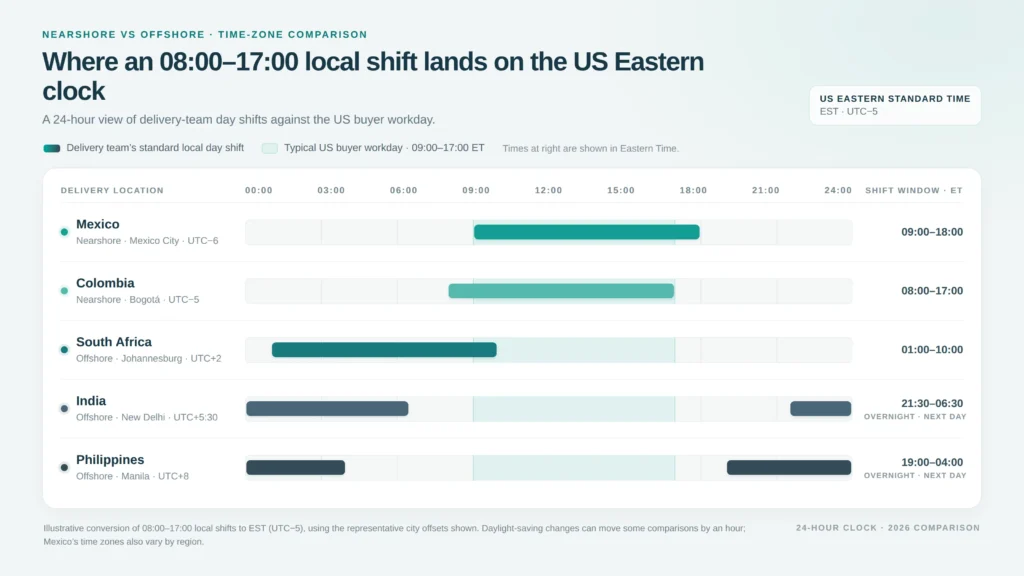
Time zone matters most for live voice and chat, because agents must be working when customers call. It matters far less for email, back office, data processing and other work that can be queued and completed within a service level.
For US live support during the US day, nearshore Mexico and Colombia match the working day. The Philippines and India cover the US day on night shifts. South Africa sits in between: its 08:00 to 17:00 shift runs from about 01:00 or 02:00 to 10:00 or 11:00 US Eastern time, so a South African day team naturally covers US overnight and morning demand, with later shifts covering the US afternoon and evening.
For UK companies, the picture flips. South Africa is one hour ahead of the UK in summer and two in winter, so it shares the whole UK working day, while Mexico and the Philippines overlap for only a few hours. That is why South Africa competes directly with Eastern European nearshore locations for UK customer service.
Night shifts are not free. The UK Health and Safety Executive lists body clock disruption, fatigue and sleep problems among the effects of shift work (HSE, HSG256), and ContactBabel notes that contact centers spread across distant time zones can offer 24/7 service “without the need to increase headcount or bear the costs and inconvenience to staff of working anti-social hours” (ContactBabel). Our call center outsourcing South Africa guide explains how South African teams schedule cover across US and UK hours.
Language: English Proficiency and Spanish Capability
Language is often the deciding factor for customer-facing work. Offshore locations lead on English at the top end, while nearshore Latin American locations lead on Spanish, which matters a great deal for US companies.
On English, the 2025 EF English Proficiency Index ranks South Africa 13th with a score of 602, the Philippines 28th with 569, India 74th with 484, Colombia 76th with 480 and Mexico 103rd with 440. South Africa is also one of only three countries rated “High” for spoken English (EF EPI 2025). For accent and cultural fit, see our guide to cultural alignment in customer support outsourcing.
On Spanish, the US demand is large. About 74.1 million people in the US speak a language other than English at home, 23% of people aged five and over, and 44.9 million of them speak Spanish (USAFacts, 2024 American Community Survey). That is the strongest argument for nearshore Latin America.
It is not the only route, though. Afrishore BPO President and Founder Sean Effune explained on the Outsource Accelerator Podcast that Afrishore moved bilingual Spanish work from an office in Belize to South Africa, and now runs more than 100 bilingual Spanish agents and team leaders there. Offshore and Spanish are not mutually exclusive if the provider recruits for it.
Cost, Scale and Talent
Onshore is the most expensive option, and the gap is widening as onshore pay rises. Between nearshore and offshore, costs vary by country, role and provider, so compare quotes on the same scope.
Onshore costs keep climbing. US customer service representatives earned a median $21.53 an hour in May 2025 (BLS), and UK median full-time weekly earnings in sales and customer service occupations rose 5.8% in the year to April 2025 (ONS).
Offshore scale is large. The Philippine IT-BPM industry closed 2024 with 1.82 million jobs and $38 billion in revenue (IBPAP). South Africa is smaller but growing fast: about 300,000 contact center agent positions (ContactBabel) and 26,346 new international jobs in 2025 (ITWeb, BPESA data). In South Africa, an inbound call costs an average of $3.54, about 40% of the UK cost, with first-contact resolution of 86% against 76% in the US.
The useful comparison is cost per resolved contact, not hourly rate. A cheaper location that needs more repeat calls, more supervision or more rework can cost more overall. Our South Africa vs Philippines guide and South Africa vs India comparison go deeper on two common offshore choices.
Risk, Data Protection and Resilience
Every location carries some risk, and the main ones for customer operations are data protection, operational stability and concentration. A good provider can show how it handles each, wherever it operates.
Data protection. Check how the delivery country’s law handles personal data and transfers. South Africa’s POPIA, for example, only allows personal information to leave the country under binding protection or with consent, which mirrors UK GDPR’s approach (POPIA section 72).
Operational stability. Ask about power, connectivity and continuity plans. South Africa has had no load-shedding since March 2024 (Daily Maverick).
Concentration. Relying on one country or one site creates a single point of failure. Many companies now split work across two locations, for example nearshore for Spanish daytime voice and offshore for English voice, overnight cover and back office. Our guide to global BPO looks at multi-location delivery.
Technology. Deloitte’s 2024 Global Outsourcing Survey found that 83% of executives already use AI as part of their outsourced services (Deloitte). Ask any provider, nearshore or offshore, how it uses AI to support agents.
How to Decide: A Simple Framework
Choose by the work, not the label. Match each type of work to the location whose language, hours and cost fit it best, and accept that the answer may be more than one location.
- US Spanish-language voice during the US day: nearshore Mexico or Colombia, or an offshore provider with a proven bilingual Spanish team.
- US English voice, including overnight and early morning: offshore, with South Africa covering the US night and morning on day shifts.
- UK customer service and extended hours: South Africa, which shares the full UK working day, or Eastern European nearshore.
- Email, chat queues, back office and data work: offshore, where time zone matters least. See our guide to offshore back office outsourcing.
- Highly regulated or sensitive work: whichever location gives you the clearest data protection position and proven certifications.
Frequently Asked Questions
What is the difference between nearshore and offshore outsourcing? Nearshore outsourcing uses a team in a nearby country that shares most of your working day, such as Mexico or Colombia for US companies. Offshore outsourcing uses a team in a distant country, such as the Philippines, India or South Africa, usually with a bigger time difference.
What is onshore vs nearshore vs offshore? Onshore keeps the work in your own country. Nearshore moves it to a nearby country with a similar time zone. Offshore moves it to a distant country. Each step changes how much of your working day the team shares, and how cost, language and risk compare.
Is nearshore or offshore better for customer service? It depends on the work. Nearshore suits US daytime voice support that needs Spanish. Offshore suits English-language support at scale, overnight cover and back-office work. South Africa ranks 13th for English on the 2025 EF index and shares the full UK working day.
Is South Africa nearshore or offshore? For UK companies, South Africa behaves like a nearshore location because it is only one or two hours ahead of London all year. For US companies it is offshore, but a South African day shift covers the US night and morning, from about 01:00 or 02:00 to 10:00 or 11:00 Eastern time.
Which outsourcing location has the best English? On the 2025 EF English Proficiency Index, South Africa scores 602 and ranks 13th, ahead of the Philippines (569, 28th), India (484, 74th), Colombia (480, 76th) and Mexico (440, 103rd). South Africa is also one of three countries rated “High” for spoken English.
Can an offshore team provide Spanish-language support? Yes, if the provider recruits for it. Afrishore BPO’s President and Founder, Sean Effune, has said publicly that Afrishore runs more than 100 bilingual Spanish agents and team leaders in South Africa, after moving that work from an office in Belize.
Is nearshore cheaper than offshore? It depends on the country, the role and the provider, so compare quotes on the same scope. Both are far cheaper than onshore, where US customer service representatives earned a median $21.53 an hour in May 2025. The better measure is cost per resolved contact, which also reflects quality and repeat contacts.
Should I use more than one outsourcing location? Many companies do. A common split is nearshore for Spanish daytime voice and offshore for English voice, overnight cover and back office. Using two locations also reduces the risk of relying on a single country or site.
Afrishore BPO runs dedicated customer service, back office, financial services and IT teams from South Africa for companies across the United States, United Kingdom, Australia and Canada. Read why companies outsource to South Africa, or explore our full range of business process outsourcing services.
Weighing nearshore against offshore? Talk to Afrishore BPO.