
Quick Answer: An outsourced finance function is a provider running some or all of your finance work, from bookkeeping and payables up to month-end close, management accounts and part-time finance leadership. UK businesses usually buy it in layers rather than all at once, and keep a named internal owner because directors stay legally responsible for the accounting records. The driver is talent: 34% of UK employers struggled to recruit for finance and accounting roles in the last year, according to AAT.
Key Takeaways
- Hiring is hard: 34% of UK employers struggled to fill finance and accounting roles, and 78% report at least some skills gap (AAT).
- Base pay is only part of the cost: self-reported 2026 medians are £46,000 for a management accountant and £82,000 for a financial controller (Finance Pay Index), before 15% employer National Insurance above £5,000 a year (HMRC).
- Accountability does not transfer: the Companies Act 2006 requires every company to keep adequate accounting records, whoever does the work (legislation.gov.uk).
- AI is shrinking the manual layer: 98% of UK accounting practices use AI for day-to-day tasks, completing them in 31% less time on average (Xero).
- South Africa is a strong delivery option for UK finance work: one to two hours ahead of the UK, English-speaking, and home to professional bodies such as SAIPA with more than 11,000 members and trainees (SAIPA).
What an Outsourced Finance Function Covers
An outsourced finance function covers whichever layers of finance work you choose to hand to a provider, from transaction processing up to fractional finance leadership. “Outsourced finance department” means much the same thing; a “fractional FD” is narrower, meaning a senior finance leader working part-time.
The clearest way to scope it is by layer:
| Layer | Typical work | Usual owner when outsourced |
|---|---|---|
| Transactional | Bookkeeping, purchase and sales ledgers, accounts payable and receivable, credit control, expenses, payroll support | Dedicated offshore or shared-service team |
| Compliance | VAT returns under Making Tax Digital, payroll filings, statutory accounts support, corporation tax coordination | UK accountancy practice or in-house finance |
| Management reporting | Month-end close, reconciliations, management accounts, cash-flow forecasting, KPI packs | Management accountant or controller |
| Control | Accounting policies, balance-sheet integrity, controls, audit readiness, systems ownership | Financial controller |
| Forward-looking finance | Budgets, forecasts, scenario models, pricing and unit economics, board packs | FP&A or finance business partner |
| Leadership | Finance strategy, fundraising and investor reporting, commercial decisions | Fractional or part-time FD or CFO |
As a rough guide, a company with 20 to 100 employees often outsources everything below a fractional FD. Companies with 100 to 500 employees more often keep an in-house finance manager or controller and outsource transactional processing, payroll support and specialist work. Each layer maps to a specific service, which the sections below link to.
Why UK Businesses Outsource Finance and Operations
UK businesses outsource finance mainly because the people are hard to find and expensive to keep, and because a small team creates key-person risk. Outsourcing turns a fixed headcount problem into capacity you can scale up or down.
The skills data is consistent. AAT’s 2025 to 2026 “Filling the gap” research found that 34% of employers struggled to recruit for finance and accounting positions in the last year, 78% face at least some skills gap, and 26% report gaps across many or all areas of the business (AAT). Losing one experienced management accountant in a team of three can delay month-end for a quarter while you rehire.
Regulation adds a floor of work that cannot slip. Under Making Tax Digital, every VAT-registered business must keep VAT records digitally and file returns through compatible software (HMRC). That makes clean, disciplined transactional processing a requirement, not a nice-to-have, and it is exactly the work that outsources best. For the senior layers, see our guides to outsourced CFO services and outsourced financial controller services.
What It Costs to Build a UK Finance Team In-House
A full in-house finance team costs much more than the sum of base salaries, because employer National Insurance, pension, recruitment, software and management time all sit on top. Model the fully loaded cost before comparing any outsourced quote.
Self-reported 2026 data from Finance Pay Index, based on 456 anonymous packages, puts median UK base pay at £33,000 for an accounts assistant, £46,000 for a management accountant, £82,000 for a financial controller and £115,000 for a finance director (Finance Pay Index). It is a crowd-sourced sample, so treat the figures as planning anchors and check them against a recruiter guide such as Hays for your region.
Employer National Insurance is 15% on earnings above £5,000 a year for 2026 to 2027 (HMRC). On a £46,000 management accountant, that alone adds £6,150 a year, before workplace pension, benefits, recruitment fees and training. A small team of an accounts assistant, management accountant and controller has a median base of £161,000, which becomes well above £180,000 once employer costs are added, and that is before any finance director time.
Your Options: In-House, UK Firm, Fractional or Offshore
There are four common ways to resource UK finance work, and most mid-market businesses end up with a mix. The right blend depends on your transaction volumes, how complex your reporting is and how much control you need day to day.
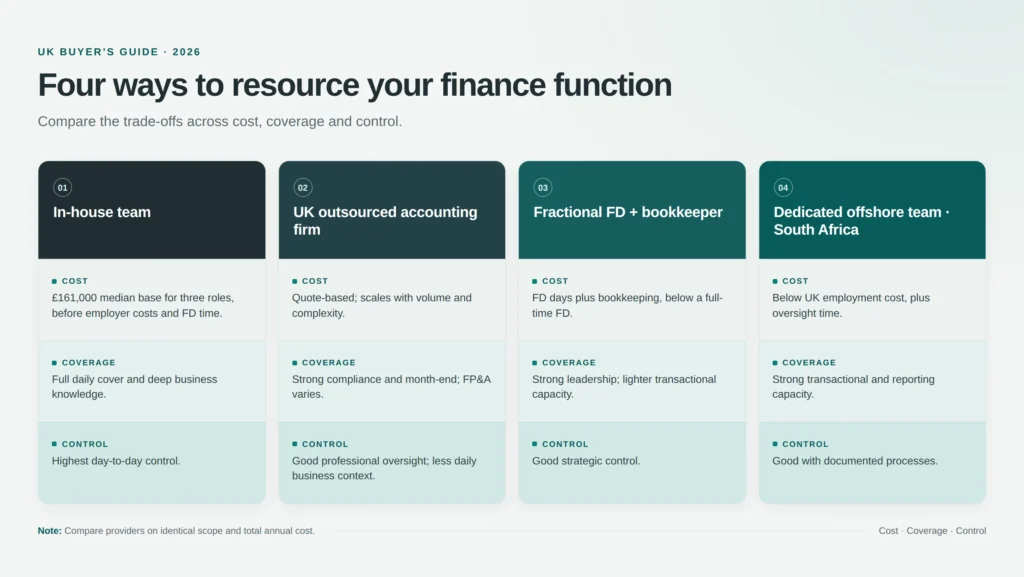
| Option | Indicative cost | Coverage | Control | Main risk |
|---|---|---|---|---|
| In-house team (assistant, accountant, controller) | £161,000 median base, before employer costs and FD | Full daily cover, deep business knowledge | Highest | Recruitment difficulty, key-person risk, fixed cost |
| UK outsourced accounting firm | Quote-based, scales with volume and complexity | Strong compliance and month-end; FP&A varies | Good professional oversight | Less day-to-day business context |
| Fractional FD plus bookkeeper | FD days plus bookkeeping, below a full-time FD | Strong leadership, lighter transactional capacity | Good strategic control | Thin cover if volumes grow |
| Dedicated offshore team in South Africa | Below UK employment cost, plus oversight time | Strong transactional and reporting capacity | Good with documented processes | Data transfer, oversight, attrition |
Independent UK price benchmarks for outsourced bookkeeping and fractional FDs are scarce, and most published prices come from providers. The fairest comparison is to get three quotes on an identical scope: transaction volumes, payroll headcount, VAT returns, close timetable, management account format and FD days. Compare total annual cost, named team members, security controls and exit terms, not just the monthly fee.
Outsourcing Finance and Operations from the UK to South Africa
South Africa works well for UK finance work because it shares most of the UK working day, has a deep professionally qualified accounting base and costs less than UK hiring. It suits the transactional and reporting layers, with UK-qualified oversight kept for tax, statutory sign-off and board accountability.
The time zone fit is close. South Africa runs on UTC+2 all year, so it is two hours ahead of the UK in winter and one hour ahead in British Summer Time, which means a South African team works almost the same hours as your UK office. Month-end calls, approvals and queries happen in real time.
The professional base is substantial. SAICA publishes annual membership statistics for CA(SA), AGA(SA) and AT(SA) designations (SAICA), and SAIPA has more than 11,000 members and trainees (SAIPA). South African finance salaries are also lower: Blue Recruiting’s 2025 benchmarks put management accountants at R600,000 to R850,000 total cost to company a year and CA(SA) financial controllers at R900,000 to R1.3 million (Blue Recruiting).
A dedicated South African team typically handles bookkeeping, reconciliations, accounts payable, credit control, payroll support, month-end close and management account preparation. Our guide to outsourcing to South Africa for UK businesses covers the wider case beyond finance.
What Stays in the UK, and Why
The legal and judgement-heavy work should stay under UK control, even when most of the processing moves offshore. Outsourcing changes who does the work; it does not change who is responsible for it.
Section 386 of the Companies Act 2006 requires every company to keep adequate accounting records that show and explain its transactions and disclose its financial position with reasonable accuracy (legislation.gov.uk). That duty sits with the directors, so you need a named internal finance owner who reviews and signs off the monthly output.
Keep these with UK-qualified people, in-house or through your accountancy practice:
- Final VAT, payroll and corporation tax submissions, and tax advice
- Statutory accounts approval and the audit relationship
- Board reporting, investor communication and funding decisions
- Approval of payments above agreed limits
Everything upstream of those decisions, from ledger work to the first draft of management accounts, can be prepared offshore and reviewed in the UK.
Data Protection, Controls and Contract Terms
Moving finance data to an offshore team is a restricted transfer under UK GDPR, so you need a lawful transfer mechanism and a security schedule before go-live. Strong controls also protect you against payment fraud, which matters more than location.
The ICO’s guidance sets out the routes for international transfers, including the International Data Transfer Agreement or Addendum and a transfer risk assessment (ICO). South Africa’s POPIA works the same way in the other direction, only allowing personal information to leave the country under binding protection or with consent (POPIA section 72).
| Risk | Control to require |
|---|---|
| Directors remain responsible for the records | Named internal owner, monthly review and sign-off |
| Payment fraud or error | Separate initiation, approval and payment; dual authorisation and payment limits |
| Excessive system or bank access | Named users, MFA, least-privilege access, audited logs, immediate revocation |
| Poor month-end quality | Agreed close timetable, reconciliation standards and materiality thresholds |
| Loss of business knowledge | Process documentation, a finance handbook and regular business reviews |
| Provider dependency | Exit assistance, data return and full access to your own ledgers |
| Data protection breach | Data processing agreement, transfer mechanism, breach notification terms |
The contract should also set out services and exclusions, monthly deliverables, key-person clauses, audit rights, professional indemnity cover and an escalation route. Ask any provider which professional body supervises its work.
How AI Is Changing the Finance Function
AI is cutting the human hours needed for capture, coding and reconciliation, which changes what you should buy. Pay for outcomes, such as a clean ledger, a fast close and reliable forecasts, rather than headcount equivalents.
Xero’s November 2025 UK research found that 98% of accounting and bookkeeping practices use AI in some way for day-to-day tasks, 47% use it at least weekly, and they complete those tasks in 31% less time on average (Xero). Xero sells accounting software, so read the productivity figure as a direction rather than a guarantee.
The practical split is that software handles repetitive capture and matching, while people own exceptions, controls, judgement and commercial interpretation. A good outsourced team should already be working this way, and our bookkeeping outsourcing guide shows how the transactional layer is changing.
How to Set Up an Outsourced Finance Function
Start with the transactional layer, prove quality for two or three month-ends, then move up. Most failures come from unclear ownership and excessive access, not from weak accounting skills.
- Map your current work by layer, with monthly volumes and who does each task today.
- Decide what stays in the UK: submissions, sign-off, board reporting and payment approval.
- Fix the systems first: cloud accounting, MTD-compliant links, and documented processes.
- Get three quotes on an identical scope and compare total cost, named staff, controls and exit terms.
- Run a parallel month-end before handing over fully.
- Review monthly: close timetable, reconciliation exceptions, accuracy and response times.
Frequently Asked Questions
What is an outsourced finance function? An outsourced finance function is a provider that runs some or all of a company’s finance work, such as bookkeeping, payables, month-end close, management accounts and part-time finance leadership. Most UK businesses outsource it in layers and keep a named internal owner for sign-off.
What finance work can a UK company outsource? Bookkeeping, accounts payable and receivable, credit control, payroll support, reconciliations, month-end close, management accounts and forecasting all outsource well. Final tax submissions, statutory accounts approval, board reporting and large payment approvals usually stay with UK-qualified people.
How much does a UK in-house finance team cost? Self-reported 2026 medians are £33,000 for an accounts assistant, £46,000 for a management accountant and £82,000 for a financial controller. Employers also pay 15% National Insurance above £5,000 a year, plus pension, recruitment and software costs.
Is an outsourced finance function cheaper than hiring? Often, especially for transactional and reporting work, because you avoid fixed salaries, employer National Insurance, recruitment fees and key-person risk. Compare like for like by getting three quotes on the same volumes, close timetable and reporting scope.
Are directors still responsible if finance is outsourced? Yes. Section 386 of the Companies Act 2006 requires every company to keep adequate accounting records, and that duty stays with the directors. Keep a named internal finance owner who reviews and signs off the provider’s monthly output.
Is outsourcing finance work to South Africa compliant with UK GDPR? It can be. Sending finance data to South Africa is a restricted transfer, so you need a lawful mechanism such as the International Data Transfer Agreement or Addendum, a transfer risk assessment, a data processing agreement and documented security controls.
Why outsource finance and operations from the UK to South Africa? South Africa is one to two hours ahead of the UK, so the team works almost the same hours as your office. It has a large, professionally qualified accounting base, including SAIPA’s more than 11,000 members and trainees, and lower salary costs than the UK.
How is AI changing outsourced finance? AI is cutting the time spent on data capture, coding and reconciliation. Xero found 98% of UK accounting practices use AI for day-to-day tasks, completing them in 31% less time on average, so buyers should pay for outcomes rather than headcount.
Afrishore BPO’s Financial Services Outsourcing division provides dedicated finance professionals in South Africa for UK businesses, covering bookkeeping, accounts payable and receivable, payroll support and month-end close, with your team keeping sign-off and control. Explore the senior layer through our outsourced CFO services guide, or see how the service works on our financial services outsourcing page.
Ready to scope your finance function? Talk to our Financial Services Outsourcing team or contact Afrishore BPO.