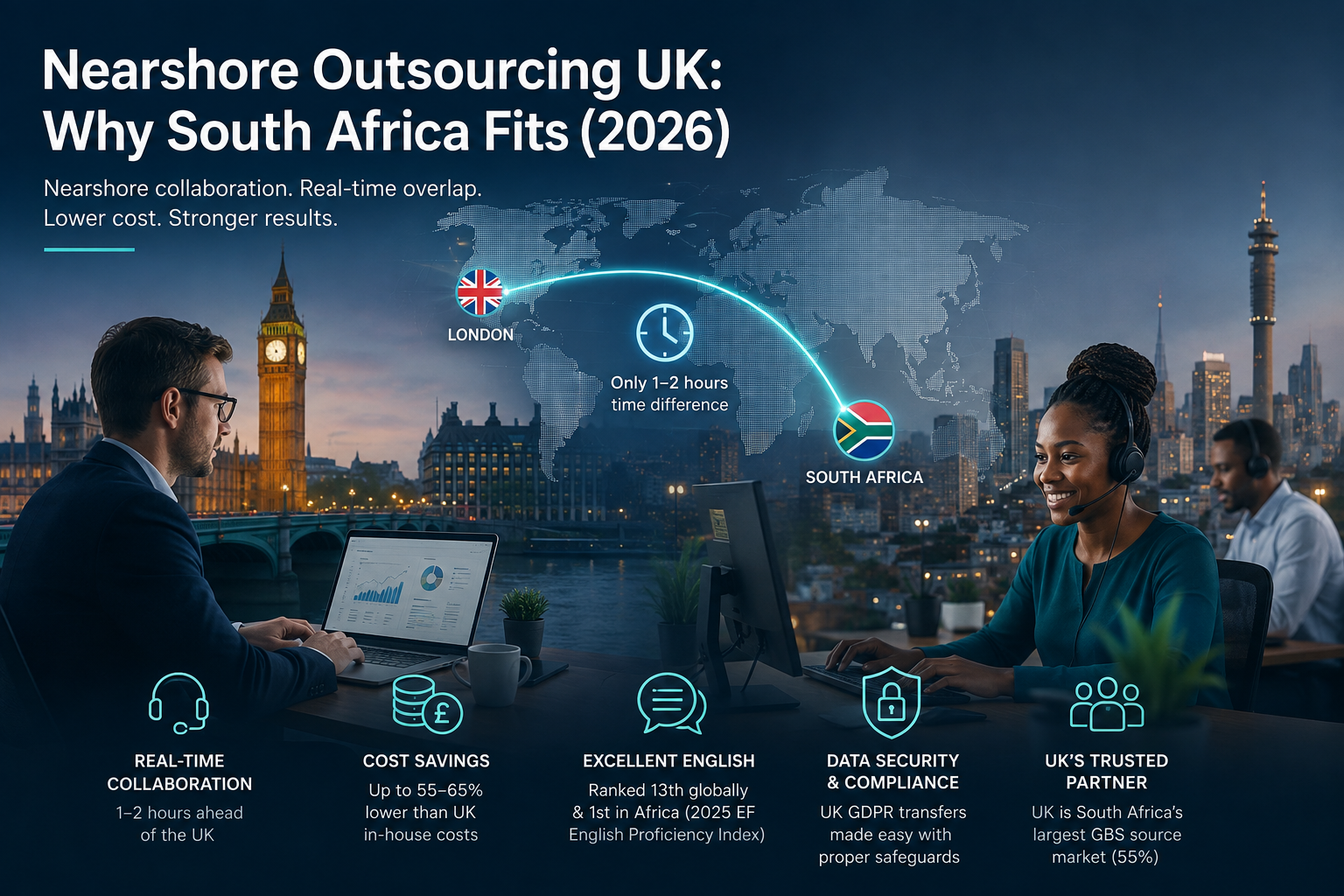
Quick Answer: Nearshore outsourcing means contracting work to a nearby country within roughly one to three hours of your own time zone, so teams share a workday and collaborate in real time. For UK companies this has meant Central and Eastern Europe, but South Africa now qualifies as a nearshore-equivalent: it sits just 1 to 2 hours ahead of the UK with almost a full shared workday, yet delivers deeper savings. BPESA reports South African delivery runs 55% to 65% below equivalent UK in-house costs, with the UK its single largest client market.
Key Takeaways
- Nearshore trades slightly higher cost than far-offshore for much better time-zone overlap and cultural fit; UK buyers typically save 30% to 40% nearshore in Central and Eastern Europe, and more in South Africa.
- South Africa runs on UTC+2 with no daylight saving, only 1 to 2 hours ahead of the UK, giving a shared workday of around 7 live hours, stronger than most Asian offshore options.
- Eastern European nearshore voice support runs about $14 to $22 per hour fully loaded, while South Africa runs $8 to $14 per hour, typically 10% to 30% cheaper for similar or better CX.
- On a per-interaction basis, South African inbound calls cost around £2.68 versus a UK average of £6.17 to £6.26, roughly 40% of the UK cost.
- South Africa ranks 13th globally and first in Africa for English proficiency on the 2025 EF index, with a common-law legal system and governance familiar to UK buyers.
- The UK is South Africa’s largest GBS source market, taking around 55% of internationally focused headcount, so providers already know UK regulatory and CX expectations.
- South Africa is not covered by UK adequacy, so UK buyers transfer data under an ICO International Data Transfer Agreement or the UK Addendum to the EU SCCs, plus a transfer risk assessment.
What Nearshore Outsourcing Means for a UK Company
Nearshore outsourcing sits between onshore (same country, highest cost, full alignment) and offshore (distant, cheapest, largely asynchronous), buying most of the cost saving while keeping a shared workday. Understanding where the line sits is the first step, because South Africa’s time-zone fit is what lets it behave like a nearshore option despite being geographically offshore.
The industry defines nearshore as hiring an external team in a country within two or three time zones, so teams can run same-day stand-ups, live coaching, and real-time escalation instead of overnight handovers. UK buyers choose nearshore specifically to keep that real-time collaboration and cultural fit while still cutting 30% to 40% or more versus in-house teams. Traditional UK nearshore means Central and Eastern Europe (Poland, Romania, Bulgaria, Hungary), Ireland, and Iberia, all on GMT+1 or GMT+2 with EU-aligned law. The point of this guide is that South Africa, on UTC+2, delivers the same collaboration profile at a lower cost, which is why we treat it as nearshore-equivalent rather than conventional offshore. Our guide to the best outsourcing destinations for UK companies sets the wider comparison, and the business process outsourcing hub covers the functions involved.
The UK Nearshore Market and Its Costs
The UK nearshore market is anchored in Central and Eastern Europe, where English-language support runs materially below UK rates but above South Africa’s. Seeing the three cost points together, in-house, CEE nearshore, and South Africa, is what makes the sourcing decision concrete.
UK in-house customer service agents cost roughly £28,000 to £35,000 per year fully loaded, which ContactBabel translates into an average inbound call cost of about £6.17, and onshore UK outsourcing commonly bills £20 to £30 per hour. Central and Eastern European nearshore voice support runs about $14 to $22 per hour fully loaded, delivering the classic 30% to 40% saving while retaining GDPR-aligned processes and minimal time difference. The UK contact centre outsourcing market itself closed 2024 at around £2.9 billion, forecast to reach £3.2 billion by 2026, and CEE remains the most popular nearshore option for Western European buyers. South Africa slots in below CEE on price without giving up the shared workday, which is the crux of the comparison below.
South Africa as a Nearshore-Equivalent: Cost Comparison
South Africa delivers 50% to 65% savings versus UK in-house and typically undercuts Eastern European nearshore by 10% to 30%, while matching or beating it on time-zone overlap and CX quality. The table below sets the three models side by side for customer support roles.
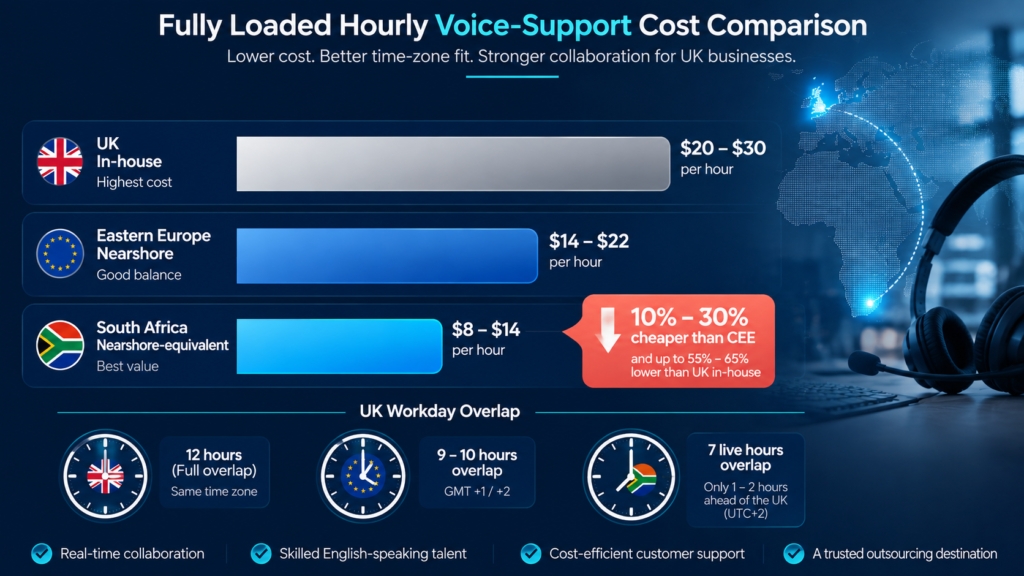
Table: UK in-house vs Eastern Europe nearshore vs South Africa (customer support)
| Model and region | Fully loaded hourly rate (voice) | Typical annual cost per agent | UK time-zone overlap |
| UK in-house / onshore | £22 to £45 | £28,000 to £35,000 | Full |
| Eastern Europe nearshore | $14 to $22 | around $2,770 to $4,160/month FTE | 1 to 2 hours offset |
| South Africa (nearshore-equivalent) | $8 to $14 | £12,000 to £18,000 | 1 to 2 hours offset, ~7 shared hours |
Sources: Global BPO Index, ContactBabel, BPESA via StealthAgents, Afrishore UK guide. Directional ranges, not contractual.
The time-zone case is the differentiator. South Africa runs on UTC+2 year-round with no daylight saving, so it stays 1 to 2 hours ahead of the UK, and a standard South African 08:00 to 17:00 day overlaps almost entirely with a UK 09:00 to 17:00 day for around 7 live hours. That means UK daytime CX and back-office work runs on normal local shifts with no graveyard hours, a profile comparable to CEE and far stronger than Asia-Pacific. On quality, South Africa ranks 13th globally for English proficiency and operates a common-law system aligned to UK governance norms. For voice cost specifics, our call centre outsourcing cost guide and the South Africa versus Philippines comparison go deeper.
Which Functions Suit Nearshore Delivery
Customer support, back office, and finance and accounting are the strongest nearshore candidates, because they benefit from real-time overlap for exceptions and escalations. The common thread is work that needs to happen inside the UK business day, which is exactly where a 7-hour shared window pays off.
Customer support and contact centres are the core case: they need live interaction in UK hours, cultural alignment, and data compliance, and customer service already accounts for around 60% of outsourced CX headcount. South Africa’s sector is heavily weighted to voice and omnichannel CX for UK utilities, insurance, and telecoms. Back office and finance and accounting, including accounts payable and receivable, reconciliations, and month-end close, suit nearshore because the near-identical workday lets teams join daily finance cycles and real-time approvals; our offshore administrative outsourcing solutions page covers this work. HR and payroll support, such as HR helpdesks and employee data management, also benefits from responding within UK hours. GSC demand confirms the pattern, with buyers searching for HR and finance nearshore services specifically, not just contact centre work.
Selection and Risk: How UK Buyers De-Risk the Move
Apply the same or higher due diligence you would use for a European nearshore provider: UK-GDPR transfer mechanics, ISO 27001 security, SLAs benchmarked to UK norms, and a tested exit plan. The one extra step versus CEE is the cross-border data-transfer paperwork, because South Africa is not covered by UK adequacy.
On data, the ICO treats any transfer of personal data outside the UK as a restricted transfer that needs adequacy, appropriate safeguards, or an exception. South Africa has no UK adequacy regulation, so UK buyers rely on the ICO International Data Transfer Agreement or the UK Addendum to the EU SCCs, plus a documented transfer risk assessment and any supplementary measures such as encryption. On security, require ISO/IEC 27001:2022 certification, the internationally recognised standard covering 93 controls, independently audited, plus SOC 2 where relevant. We cover this layer in full in our guide to evaluating a partner’s data security and compliance. Beyond compliance, run standard corporate and financial due diligence, assess team stability and attrition, pilot before scaling, and negotiate SLAs with clear remedies and a tested exit plan. Given that the UK is South Africa’s largest GBS market, most established providers already understand UK regulatory and CX expectations, which shortens the learning curve.
Positioning South Africa in a UK Sourcing Portfolio
For most UK buyers, South Africa works best as the English-language CX and complex-voice hub within a broader portfolio, sitting closer to CEE nearshore than to far-offshore Asia on collaboration and quality. Recognising it as effectively nearshore widens the destination set beyond Europe and allows sharper trade-offs between cost, quality, and resilience.

A common pattern is a multi-location mix: Central and Eastern Europe handles multilingual European coverage, South Africa focuses on English-speaking CX and complex voice, and Asia provides lowest-cost, high-volume overnight work. Because the UK is South Africa’s largest source market at around 55% of international headcount, and UK-South Africa services trade is substantial, the ecosystem is already tuned to UK requirements. Our dedicated guide for UK businesses outsourcing to South Africa sets out the operational detail.
Frequently Asked Questions
What is nearshore outsourcing? Nearshore outsourcing is contracting work to a provider in a nearby country within roughly one to three time zones, so teams share a workday and can collaborate in real time. It sits between onshore (same country, highest cost) and offshore (distant, cheapest, largely asynchronous), trading a little more cost than far-offshore for much better time-zone overlap and cultural fit.
Is South Africa nearshore for the UK? Geographically South Africa is offshore, but on time zone it behaves like nearshore. It runs on UTC+2 with no daylight saving, only 1 to 2 hours ahead of the UK, giving a shared workday of around 7 live hours. Combined with strong English and a common-law legal system, this makes it a nearshore-equivalent destination for UK companies rather than conventional far-offshore.
How much can UK companies save with nearshore outsourcing? Central and Eastern European nearshore typically saves UK companies 30% to 40% versus in-house teams. South Africa goes further, at 50% to 65% savings on a fully loaded basis, and on a per-interaction basis South African inbound calls cost around £2.68 versus a UK average of £6.17 to £6.26, roughly 40% of the UK cost.
How does South Africa compare with Eastern Europe on cost? Eastern European nearshore voice support runs about $14 to $22 per hour fully loaded, while South Africa runs $8 to $14 per hour, generally 10% to 30% cheaper for similar or better CX outcomes. South Africa also matches CEE on UK time-zone overlap, so the collaboration benefit is comparable while the cost is lower.
Which functions work well for nearshore delivery to South Africa? The strongest fits are customer support and contact centres, back office, finance and accounting, and HR and payroll support, because all need real-time overlap with the UK workday for exceptions and escalations. South Africa’s sector is heavily weighted to voice and omnichannel CX, with growing finance, HR, and administrative capability.
What are the data protection rules for UK companies outsourcing to South Africa? South Africa is not covered by a UK adequacy regulation, so transfers of UK personal data are restricted transfers. UK buyers rely on appropriate safeguards such as the ICO International Data Transfer Agreement or the UK Addendum to the EU Standard Contractual Clauses, plus a documented transfer risk assessment and supplementary measures such as encryption and access controls where needed.
What certifications should a South African nearshore partner have? Require ISO/IEC 27001:2022 certification for information security, independently audited, and SOC 2 where relevant, plus evidence of UK-GDPR readiness including data transfer agreements and a transfer risk assessment. For regulated sectors, also check sector-specific alignment such as FCA expectations for financial services, and confirm tested business continuity and exit plans.
Why is South Africa’s time zone good for UK outsourcing? South Africa runs on UTC+2 year-round with no daylight saving, keeping it 1 to 2 hours ahead of the UK all year. A standard South African 08:00 to 17:00 workday overlaps almost entirely with a UK 09:00 to 17:00 day, giving around 7 hours of shared live collaboration with no permanent night shifts, which is stronger than Asian offshore destinations and comparable to European nearshore.
Afrishore BPO gives UK companies a nearshore-equivalent team in South Africa: a shared workday, strong English CX, and 50% to 65% cost savings under ISO 27001-aligned governance. For the operational detail see our guide to outsourcing to South Africa for UK businesses, for the wider comparison see the best outsourcing destinations for UK companies, and our business process outsourcing hub shows the full offering.
Speak to Afrishore about a nearshore-equivalent team in South Africa for your UK operation.