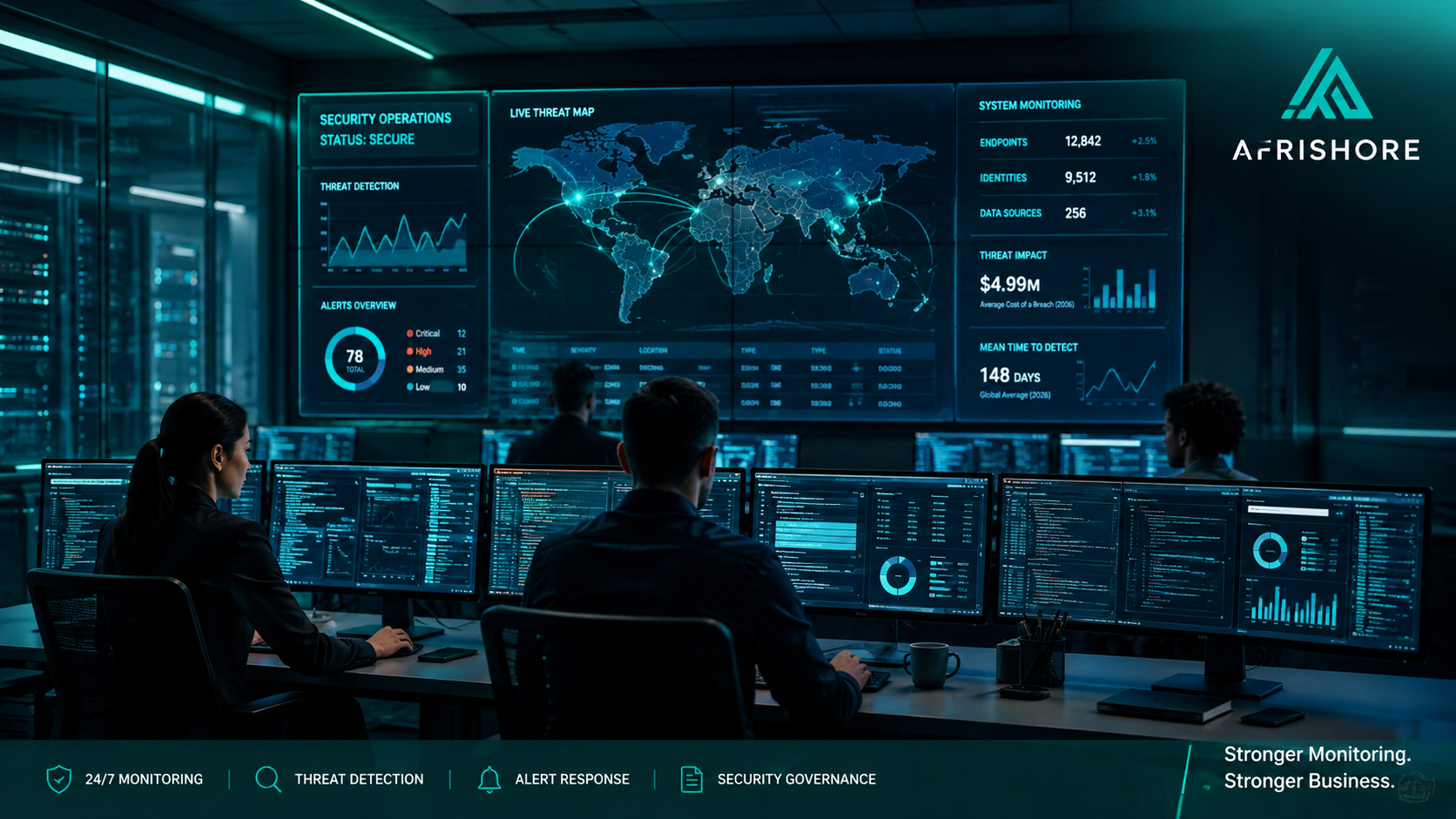
Quick Answer: Cybersecurity outsourcing, in the sense most mid-market companies need, means handing 24/7 security monitoring, alert triage, and security governance to a specialist team as part of managed IT, while keeping incident-response authority in-house. The core driver is arithmetic: round-the-clock coverage requires roughly five full-time staff per continuously staffed seat, and a realistic in-house 24/7 security operations centre needs 15 to 20 people. Very few mid-market firms can staff that, which is why monitoring is the security function most commonly outsourced.
Key Takeaways
- A 24/7 SOC is a headcount problem before it is a technology problem. Continuous coverage needs about five FTEs per seat, and a full tiered in-house SOC runs 15 to 20 people, more than most mid-market security teams have in total.
- The talent simply is not there to hire. ISACA found 55% of security teams are understaffed and 65% have unfilled roles, with 3 to 6 months to fill a role.
- Slow detection is directly priced. The 2026 IBM breach report put the global average at a record $4.99 million, with breaches past 200 days costing about a third more.
- In-house detection pays. Teams that find their own breaches close them weeks faster and cheaper than those told by an attacker, which is exactly what continuous monitoring buys.
- Compliance now mandates automated monitoring. PCI DSS v4.0 has required automated daily log review since 31 March 2025, and ISO 27001:2022 made monitoring an explicit control.
- Scope the contract clearly. A monitoring provider owns detection, triage, and escalation; you keep containment authority, recovery, and regulatory notification.
What Security Operations Outsourcing Covers
Security operations outsourcing means delegating the ongoing detection and monitoring function, not your entire security programme. It is best understood through the NIST framework, which separates the six functions Govern, Identify, Protect, Detect, Respond, and Recover. A monitoring provider owns the Detect function end to end and supports governance, while response and recovery remain a shared or client-owned obligation. That gives a clean contractual seam and avoids the common confusion between monitoring and full incident response.
In practice, the service covers 24/7 security monitoring, SIEM and log monitoring, alert triage and escalation, endpoint and EDR monitoring, security governance and reporting, and vulnerability monitoring. This is distinct from full managed detection and response or incident-response retainer work, which involve active threat hunting and hands-on containment. It is the operational backbone of managed IT, which is why it sits within Afrishore’s IT outsourcing division alongside managed IT services and the wider IT outsourcing services offering. It is also separate from, but complementary to, the certification-and-compliance framing covered in our guide to outsourcing data security and compliance.
How Much Does an In-House 24/7 SOC Cost?
An in-house round-the-clock security operations centre is expensive mainly because of the staffing math, not the tooling. Continuous coverage means filling 8,760 hours a year, while one full-time employee delivers roughly 1,800 productive hours after leave, sickness, and training. That means each continuously staffed seat needs about five people once you account for shifts, weekends, and holidays. The table below sets out how that compounds.
| Build | Headcount needed | Why |
| One continuously staffed seat | ~5 FTEs | 8,760 annual hours divided by ~1,800 productive hours |
| Tier 1 only, two analysts per shift | 9 to 10 FTEs | Shift math applied to two seats |
| Lean 24/7 (one analyst per shift plus lead) | 8 to 10 FTEs | Minimum sustainable coverage |
| Full tiered 24/7 SOC | 15 to 20 FTEs | Tier 1, Tier 2, Tier 3, detection engineer, and manager |
Set that against the reality of the talent market. ISACA found the median security team is just eight people, which means a mid-market company would have to devote its entire security function to shift rotation and still have nobody left for governance, engineering, or architecture. The salaries compound the problem: US information security analysts earn a median around $129,180, and UK cyber security analysts sit around £55,000, before employer taxes, tooling, and overhead. A full in-house 24/7 SOC therefore starts well into seven figures in salary alone. Outsourcing spreads that establishment cost across multiple clients, which is the same logic behind the true cost of offshore delivery.
Why Faster Detection Is Worth Paying For
The financial case for continuous monitoring is that slow detection is directly and measurably expensive. The 2026 IBM Cost of a Data Breach report put the global average at a record $4.99 million, driven principally by detection, escalation, and lost-business costs, with US breaches averaging more than twice that. Crucially, the mean time to identify and contain a breach rose to 247 days, reversing five years of improvement, and breaches that run past 200 days cost about a third more than those closed sooner.
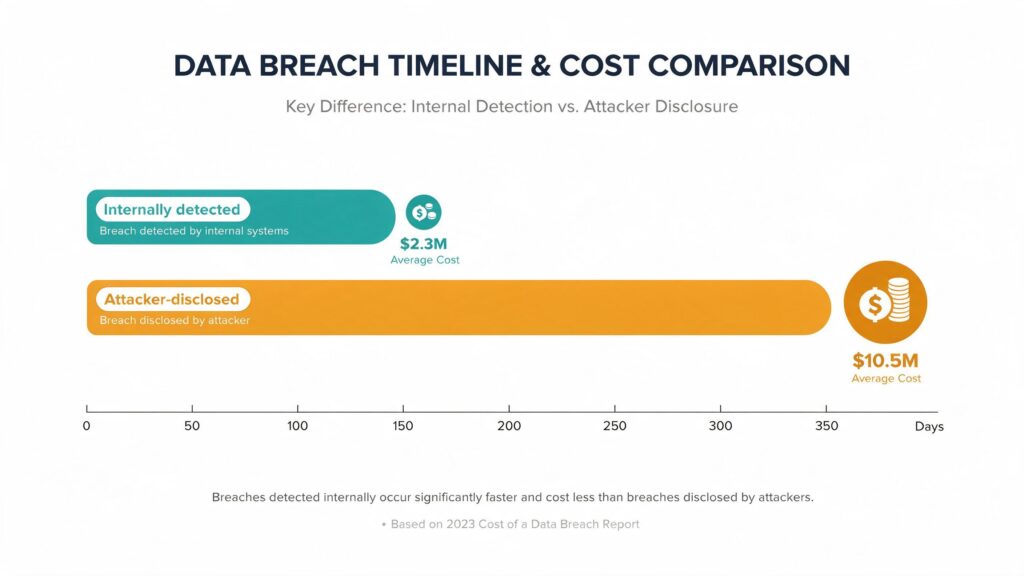
Discovery route matters just as much as speed. Organisations that detect breaches internally close them roughly five weeks faster than the global average, while breaches disclosed by the attacker cost the most of any route. Continuous monitoring is precisely the capability that moves an organisation from the attacker-disclosed column into the internally-detected one. The threat volume makes this urgent rather than optional: SOC teams face hundreds to thousands of alerts a day, and SANS found 73% of security teams name false positives as their top detection challenge, with an average of 70 minutes to fully investigate a single alert. No small in-house team can keep pace, which is why tiered outsourced monitoring exists.
Where the Responsibility Line Sits
The most important thing to get right in a monitoring contract is the boundary between what the provider does and what you retain, and the authoritative guidance is clear about it. Joint CISA and NCSC advisory guidance directs that provider and customer contracts must transparently identify ownership of security roles, that providers give customers visibility of logging including the provider’s own access, and that the customer enforces multi-factor authentication on all provider accounts and audits their use. The clean articulation is that the monitoring provider owns detection, triage, enrichment, escalation, and reporting to a defined SLA, while the client keeps containment authority, eradication and recovery, and legal and regulatory notification.
This boundary matters because outsourcing monitoring does introduce a third party, and third-party access is itself a risk category to govern. The honest framing, which the guidance supports, is that provider governance and auditability are non-negotiable: clear contractual ownership, segregated credentials, and monitoring of the monitors. Standards reinforce this. NIST SP 800-61r3 places continuous monitoring at the centre of the Detect function, SOC 2 criterion CC7.2 requires that detection tools themselves be monitored for effective operation, and ISO 27001:2022 made monitoring an explicit certifiable control for the first time. For buyers in regulated sectors, this connects directly to the certification framing in our data security and compliance guide and to sector-specific obligations like HIPAA-compliant delivery.
Compliance Is Now Forcing the Issue
For many mid-market companies, the decision to outsource monitoring is being made by their compliance obligations rather than their budget. PCI DSS v4.0 has mandated automated daily log review since 31 March 2025, which in practice means any in-scope company must run SIEM-class automated monitoring every day. ISO 27001:2022 introduced control A.8.16 for monitoring activities, with no predecessor in the 2013 version, so monitoring became an explicit requirement in the current revision. And the underlying threat data keeps pushing the same way, with ISACA reporting 65% of organisations have unfilled security roles and half unable to retain the people they have.
The result is a widening gap between what compliance requires and what a mid-market team can staff. That gap is the core reason security monitoring is the function most companies outsource first, ahead of the more specialised and occasional work of incident response.
Why South Africa Works for Security Operations
South Africa combines a genuine timezone advantage with a mature delivery sector and strong data-centre infrastructure. The timezone case is arithmetic: South Africa is UTC+2 year-round with no daylight saving, so a team working 08:00 to 17:00 local time covers the UK working day almost entirely and the US East Coast overnight window, which is exactly the follow-the-sun coverage a monitoring function needs. The delivery sector is at record scale, with South Africa’s global-business-services industry creating 26,346 new international jobs in 2025, its strongest year on record, and it delivers in fluent English at a substantial cost saving against UK and US in-house teams.
The infrastructure is well documented. Teraco’s Johannesburg campus holds ISO 27001, PCI-DSS, and Uptime Institute Tier III and IV certifications with carrier-neutral connectivity, which is the single strongest data point for a compliance-sensitive buyer. One point to handle correctly: South Africa does not hold a UK or EU data-protection adequacy decision, so a client sending monitored log data, which contains usernames and IP addresses and is personal data, is making a restricted transfer that requires appropriate safeguards such as the UK IDTA or EU standard contractual clauses, plus a transfer risk assessment. South Africa’s POPIA law maps closely onto GDPR, which makes that straightforward to satisfy, but it must be done. For the wider delivery case, see BPO in South Africa and the case for outsourcing to South Africa.
Frequently Asked Questions
What is security operations outsourcing? It is delegating the ongoing security detection and monitoring function to a specialist provider as part of managed IT. That covers 24/7 monitoring, SIEM and log monitoring, alert triage and escalation, endpoint monitoring, security governance and reporting, and vulnerability monitoring. It is distinct from full managed detection and response or incident-response retainer work, which involve active threat hunting and hands-on containment.
How is outsourced monitoring different from MDR? Monitoring owns the Detect function: it watches, triages alerts, enriches them, and escalates to a defined SLA. Managed detection and response goes further into active threat hunting and hands-on containment. Most mid-market companies need continuous monitoring and governance first, with response authority retained in-house or contracted separately. Being clear about this boundary is the single most important part of the contract.
Why is an in-house 24/7 SOC so expensive? Because of shift math, not tooling. Covering 8,760 hours a year when one person delivers about 1,800 productive hours means roughly five staff per continuously staffed seat. A full tiered in-house SOC needs 15 to 20 people, more than most mid-market firms have in their entire security team, and at median security-analyst salaries that runs well into seven figures before tooling and overhead.
How does faster detection save money? Breach cost rises sharply with detection time. The 2026 IBM report put the global average breach at a record $4.99 million and found breaches past 200 days cost about a third more than those closed sooner. Organisations that detect breaches internally close them weeks faster and cheaper than those told by an attacker. Continuous monitoring is what moves you into the faster, cheaper internally-detected category.
Who is responsible during an incident with an outsourced provider? The monitoring provider owns detection, triage, enrichment, escalation, and reporting. The client keeps containment authority, eradication and recovery, forensics, and legal and regulatory notification, unless response is separately contracted. Authoritative guidance directs that contracts transparently identify who owns each security role, and that the customer audits provider access and enforces multi-factor authentication on provider accounts.
Does compliance require security monitoring? Increasingly, yes. PCI DSS v4.0 has mandated automated daily log review since 31 March 2025, ISO 27001:2022 made monitoring an explicit control, and SOC 2 requires that detection tools be monitored for effective operation. For many mid-market companies these obligations, rather than budget, are what force the decision to outsource monitoring, because they cannot staff daily automated review in-house.
Is it safe to outsource security monitoring to South Africa? Yes, with the right transfer safeguards. South Africa offers a year-round UTC+2 timezone ideal for follow-the-sun coverage, a large English-speaking delivery sector, cost savings against UK and US teams, and Tier III and IV data centres with ISO 27001 and PCI-DSS certification. Because South Africa has no UK or EU adequacy decision, monitored log data must be transferred under standard contractual clauses or the UK IDTA with a transfer risk assessment, which its GDPR-aligned POPIA law makes straightforward.
Afrishore delivers security operations and monitoring from South Africa as part of its IT outsourcing division, giving mid-market US and UK companies round-the-clock coverage they cannot cost-effectively staff in-house, under clear contractual boundaries and transfer safeguards. Talk to us about a monitoring team scoped to your environment, your compliance obligations, and your response model.