
Quick Answer: Call center outsourcing to South Africa means running your inbound, outbound or blended voice operation from a dedicated team in Johannesburg, Cape Town or Durban, managed by a specialist provider. US and UK companies choose it for neutral, fluent English, a working day that matches the UK, and performance that beats onshore benchmarks. South African contact centers answer calls in an average of 27 seconds, against 116 seconds in the UK and 99 in the US, according to ContactBabel’s 2025-26 South Africa study.
Key Takeaways
- South Africa’s business services sector created 26,346 new jobs serving international markets in 2025, its highest annual total since 2018 (ITWeb, reporting BPESA data).
- South African contact centers resolve 86% of calls at first contact, compared with 81% in the UK and 76% in the US (ContactBabel).
- The average cost of an inbound call in South Africa is $3.54 (£2.68), roughly 40% of the UK figure, and new-agent salaries sit at about 20% of UK and US levels (ContactBabel).
- South Africa scores 602 on the 2025 EF English Proficiency Index, 13th in the world and in the “Very High” band (EF).
- The grid has been free of load-shedding since March 2024 (Daily Maverick), removing the risk buyers worried about most.
- POPIA, South Africa’s data protection law, only allows personal data to leave the country under binding protection or consent, which mirrors how GDPR treats transfers (POPIA section 72).
- A dedicated South African call center team is typically live in 4 to 6 weeks with Afrishore BPO.
Why South Africa Has Become a Call Center Destination for US and UK Buyers
South Africa has moved from niche option to mainstream choice because it scores well on the three things voice buyers care about most: how customers hear the agent, how fast issues get resolved, and what it costs. Independent benchmarks now put South African contact centers ahead of UK and US averages on speed and resolution.
The growth figures show the shift. South Africa’s global business services sector logged 26,346 new international jobs in 2025, up from 20,518 in 2024, with the Western Cape adding 13,056, KwaZulu-Natal 7,709 and Gauteng 3,969, according to BPESA data reported by ITWeb. Harambee Youth Employment Accelerator puts total jobs created by the sector since 2018 at 147,405.
Buyers have noticed. Ryan Strategic Advisory’s annual survey of contact center buyers named India and South Africa joint most favoured offshore CX locations in 2022, and placed South Africa joint second with the Philippines in 2024 (Ryan Strategic Advisory). ContactBabel counts roughly 300,000 agent positions across about 2,000 South African operations, with 73% of outsourced activity serving international clients (ContactBabel). For the wider market picture, see our overview of BPO in South Africa.
That reputation rests on performance, which is where the numbers get specific.
How South African Call Centers Perform Against the UK and US
On the core voice metrics, South African contact centers outperform both major buyer markets. They answer faster, lose fewer callers and fix more problems on the first call, while costing far less per call.
The table below uses ContactBabel’s 2025-26 South Africa study, which surveyed 106 senior South African contact center leaders and benchmarked them against UK and US operations.
Table: South African call center performance vs UK and US benchmarks
Metric | South Africa | UK | US |
Average speed to answer | 27 seconds | 116 seconds | 99 seconds |
Call abandonment rate | 4.2% | 5.9% | 8.9% |
First-contact resolution | 86% | 81% | 76% |
Annual agent attrition | 25% | 21% | 30% |
Cost per inbound call | $3.54 (£2.68) | About 2.4 times South Africa | Not reported |
Source: ContactBabel, The Inner Circle Guide to South African Contact Centres 2025-26. US speed to answer and abandonment match ContactBabel’s 2025 US Contact Center Decision-Makers’ Guide, which reports US abandonment rising from 7.1% to 8.9% against a historical norm of 5% to 6%.
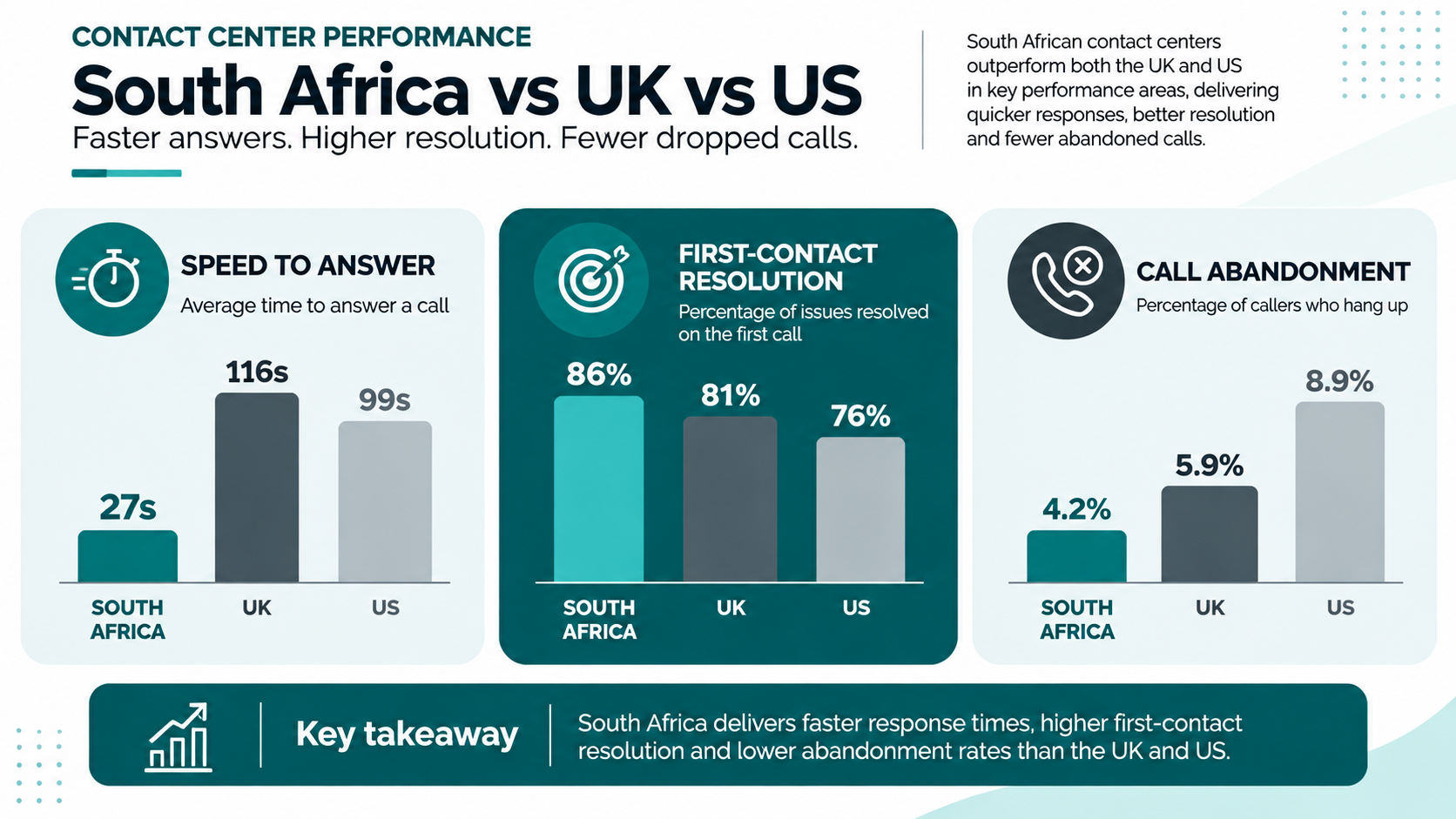
The cost and quality story run together. A South African call costs about 40% of a UK call, but it is answered roughly four times faster and resolved more often. That is why the comparison that matters is cost per resolved contact, not hourly rate. Our call center outsourcing cost guide breaks pricing models down in detail.
Attrition deserves an honest note. ContactBabel puts South African agent attrition at 25%, between the UK’s 21% and the US’s 30%. Early churn is low: 75% of operations lose fewer than 10% of new agents in the first 90 days. Our guide to offshore call center attrition rates covers what drives it and how providers manage it.
How Much Does Call Center Outsourcing to South Africa Cost?
South African call center outsourcing usually costs well under half of an equivalent onshore operation, because agent salaries are a fraction of UK and US levels while management, quality and technology costs are shared. ContactBabel puts the average inbound call at $3.54, about 40% of the UK cost.
Salaries drive most of that gap. ContactBabel’s averages are R122,000 a year for a new agent, R147,000 for an experienced agent, R228,000 for a team leader and R489,000 for a manager. That makes new agents about 20% of UK and US equivalents, with the gap narrowing at senior levels to roughly 35% to 40% for managers (ContactBabel). For comparison, the median US customer service representative earned $21.53 an hour in May 2025 (US Bureau of Labor Statistics).
Most providers price a dedicated team per full-time agent per month, with team leadership, quality assurance, workforce management, facilities and standard telephony included. Ask any provider to show exactly what sits inside the rate, because a lower headline price often means thinner supervision or quality coverage.
Government support also shapes the economics. The dtic’s Global Business Services Incentive pays qualifying projects between R130,000 and R290,000 per job created over five years. Projects doing mostly non-complex work, which covers most call center roles, must create at least 50 new offshore jobs within three years and employ at least 80% youth (KPMG; the dtic). The grant goes to the provider, not the buyer, but it helps keep South African pricing competitive.
Talent, Language and Time Zones
The second reason buyers choose South Africa is the people. The country has a large, young, English-fluent workforce that wants contact center careers, and a working day that lines up with UK business hours and US mornings.
English proficiency is the starting point for voice work. South Africa scored 602 on the 2025 EF English Proficiency Index, ranking 13th globally, with a reading score of 611 and listening score of 605 (EF EPI 2025 South Africa fact sheet). EF’s 2025 report also places South Africa among only three countries rated “High” for spoken English (EF EPI 2025).
The talent supply is deep. Official youth unemployment for South Africans aged 15 to 34 was 47.4% in the second quarter of 2026 (Statistics South Africa), so formal contact center roles attract strong applicants and offer real career paths. About 90% of the sector’s 2025 international jobs went to young people, and ContactBabel finds that 65% of South African operations run a formal impact sourcing policy. Our Impact Sourcing Report sets out Afrishore’s own hiring and promotion data.
Time zones complete the picture. South Africa runs on UTC+2 all year with no daylight saving, one hour ahead of the UK in summer and two in winter, so a normal South African day covers the full UK working day. A standard 08:00 to 17:00 shift in Johannesburg runs from about 01:00 or 02:00 to 10:00 or 11:00 US Eastern time, so it covers the US night and morning, and US afternoon and evening coverage runs on planned later shifts. Cultural fit matters too, and our guide to cultural alignment in customer support outsourcing looks at it in depth.
Operating Risks and How Providers Manage Them
The risks that used to dominate buyer conversations about South Africa have eased, and the remaining ones are manageable with the right provider controls. Power, connectivity and currency are the three to examine.
Electricity. South Africa has had no load-shedding since 26 March 2024, and Eskom marked 300 consecutive days without power cuts in January 2025 (Daily Maverick). Eskom’s summer outlook to 31 March 2026 forecast no load-shedding (BusinessTech). Established providers still run generator and battery backup, and you should ask to see it.
Connectivity and technology. South African centers are heavily cloud-based: ContactBabel reports 93% cloud penetration and 66% AI adoption, both higher than the UK or US (ContactBabel).
Currency. Contracts are normally priced in US dollars or pounds, so rand movements affect the provider’s costs rather than your invoice. Agree how pricing reviews work before you sign.
Location also carries a political dimension for US buyers. The proposed Keep Call Centers in America Act of 2025 (S.2495) would require agents to disclose their location and let customers ask for a US-based agent, and it would bar companies that move call centers offshore from some federal grants and loans (bill text, govinfo). It was referred to the Senate Commerce Committee in July 2025 and has not advanced. Worth monitoring, not a reason to delay.
Compliance for Offshore Call Centers
Compliance for a South African call center rests on three layers: South African data protection law, the standards your industry requires, and the rules of the country your customers live in. A good provider documents all three before you go live.
Data protection. POPIA governs personal information processed in South Africa. Section 72 only allows transfers abroad where the recipient is bound by a law, binding corporate rules or a binding agreement giving protection substantially similar to POPIA, or where the data subject consents (POPIA section 72). That structure lines up with how UK GDPR handles international transfers.
Payment calls. If agents take card payments, PCI DSS applies. The PCI Security Standards Council states that sensitive authentication data, including the card security code taken on a call, must not be stored after authorization, and it describes pause-and-resume recording and DTMF masking as ways to keep recordings out of scope (PCI SSC).
Customer-market rules. US calls must follow consent and recording rules, debt collection must follow the FDCPA, and healthcare work needs HIPAA safeguards. Our guides to HIPAA-compliant BPO and outsourcing data security and compliance cover the controls to ask for.
How to Shortlist South African Call Center Outsourcing Companies
The best South African call center partner is the one whose model fits your volume, channels and industry, not simply the biggest name. Shortlist on evidence: performance data, security controls, how teams are staffed, and how quickly they can scale.
Use these checks when comparing providers:
- Dedicated or shared agents. Dedicated teams learn your product and brand. Shared models suit low, irregular volumes.
- Performance reporting. Ask for speed to answer, abandonment, first-contact resolution and quality scores from live accounts, measured against the ContactBabel benchmarks above.
- Security and certifications. Confirm PCI DSS for payment calls, ISO 27001 for information security, and how call recordings are stored and masked.
- Leadership access. Find out who you will speak to when something goes wrong, and how quickly.
- Ramp speed. Ask how long it takes to recruit, train and go live, and how fast the team can grow for seasonal peaks.
For a ranked view of the market, our guide to BPO companies in South Africa lists the providers in Outsource Accelerator’s Top 40. If your priority is broader customer service rather than voice specifically, see outsourcing customer service to South Africa.
Setting Up a South African Call Center Team
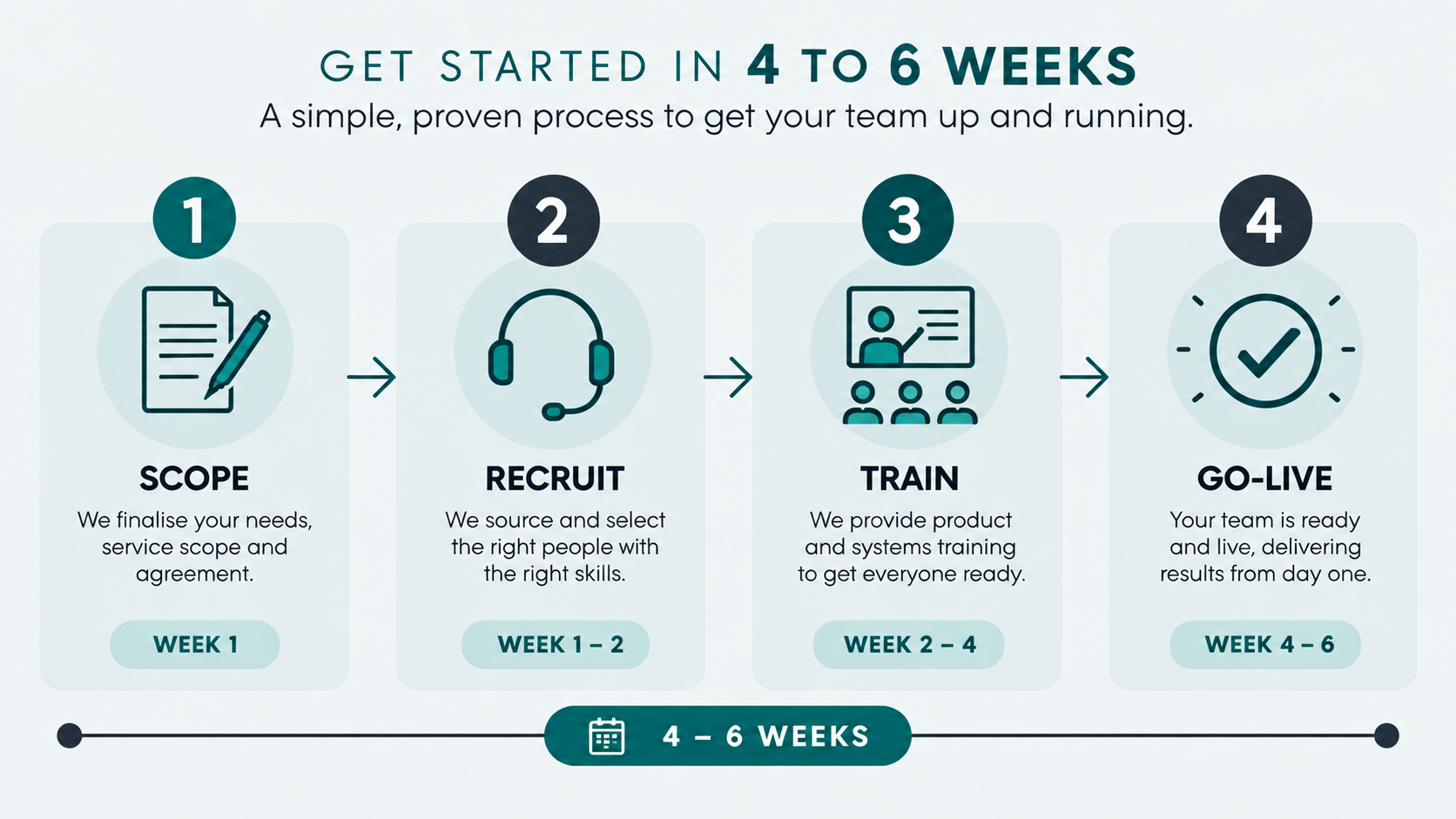
Most dedicated call center teams go live in 4 to 6 weeks with Afrishore BPO. The steps are consistent: agree scope and service levels, recruit, train on your systems and policies, then launch with close quality monitoring.
- Scope and contract. Define channels, hours, volumes, service levels and data handling, including a POPIA-compliant data processing agreement.
- Recruitment. The provider hires against your profile, including language, industry background and shift needs.
- Training and nesting. Agents learn your product, systems and tone, then handle live calls under close supervision.
- Go-live and stabilisation. Daily calibration on quality and handle time until the team reaches agreed service levels.
Frequently Asked Questions
Why do companies outsource call centers to South Africa? US and UK companies outsource call centers to South Africa for fluent, neutral English, strong performance and lower costs. ContactBabel’s 2025-26 study found South African centers answer in 27 seconds and resolve 86% of calls first time, at an average of $3.54 per inbound call.
How much does call center outsourcing to South Africa cost? An inbound call in South Africa costs about $3.54 (£2.68) on average, roughly 40% of the UK figure. New agents earn about R122,000 a year, around 20% of UK and US equivalents. Most providers price dedicated teams per full-time agent per month, with management and quality included.
Is load-shedding still a risk for South African call centers? South Africa has had no load-shedding since March 2024, and Eskom’s outlook to March 2026 forecast none. Established call center providers also run generator and battery backup, so buyers should confirm the provider’s power resilience during due diligence.
What time zone does South Africa use, and does it suit US clients? South Africa uses UTC+2 all year with no daylight saving. A standard day shift covers the full UK working day and the US Eastern night and morning, until about 10:00 or 11:00. US afternoon and evening coverage runs on planned later shifts, which providers schedule as part of the service.
Is South Africa better than the Philippines for call center outsourcing? It depends on your customers. South Africa ranked 13th on the 2025 EF English Proficiency Index and suits UK and many US voice programs well. Ryan Strategic Advisory placed the two countries joint second for buyer preference in 2024. Our South Africa vs Philippines guide compares them in detail.
How does POPIA protect customer data handled in South Africa? POPIA section 72 only allows personal information to be transferred out of South Africa where the recipient is bound by a law, binding corporate rules or an agreement giving similar protection, or where the person consents. This mirrors how UK GDPR controls international data transfers.
How long does it take to set up an outsourced call center in South Africa? With Afrishore BPO, a dedicated call center team is typically live in 4 to 6 weeks. That covers scoping and contracting, recruitment, training on your systems, and a supervised go-live before the team reaches agreed service levels.
What call center services are delivered from South Africa? South African centers handle inbound customer service, technical support, sales and retention, collections and back-office work for US, UK and Australian clients. Many also support chat, email and messaging alongside voice, with 35% of inbound interactions now arriving through digital channels.
Afrishore BPO runs dedicated call center and customer service teams from Johannesburg and Cape Town for companies in the United States, United Kingdom, Australia and Canada, including specialist programs for insurance claims and travel customer support. Compare destinations in our South Africa vs Philippines guide, or explore our full business process outsourcing services.
Talk to us about building your South African call center team: contact Afrishore BPO.