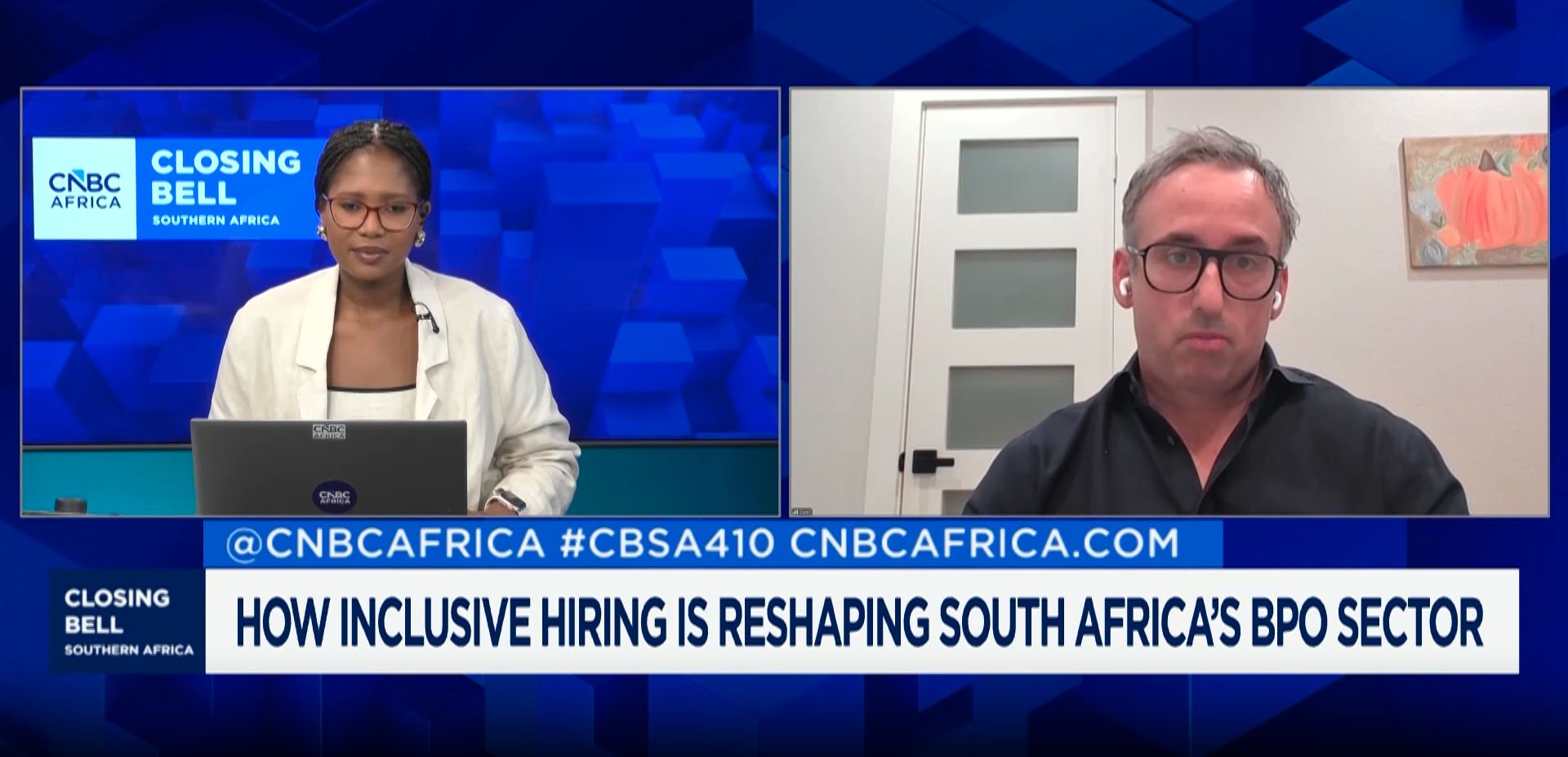
Quick Answer: Afrishore BPO President and Founder Sean Effune joined CNBC Africa’s Closing Bell on 2 October 2026. He discussed how inclusive hiring is reshaping South Africa’s BPO sector. The segment centred on Afrishore’s 2025/26 Impact Sourcing Report and BPESA data. That data shows the sector created 26,346 net new international jobs in 2025, and about 90% went to young people.
Key Takeaways
- Sean Effune appeared on CNBC Africa’s Closing Bell on 2 October 2026 to talk about impact sourcing and youth hiring. Watch the full segment on CNBC Africa.
- South Africa’s business services sector created 26,346 net new international jobs in 2025. That is the highest yearly total in BPESA’s records, which go back to 2018.
- 23,795 of those jobs, about 90%, went to people aged 18 to 34, the age range BPESA uses for youth (ITWeb).
- Youth unemployment is the backdrop. The official rate was 47.4% for South Africans aged 15 to 34 in Q2 2026 (Statistics South Africa).
- Afrishore’s own 2025/26 report records 669 jobs created, 34 internal promotions and 95.6% staff retention.
- Sean’s main point on AI: “clients are not coming to us for people, they’re coming to us for a solution.” The human strengths clients still pay for are empathy and reason.
What Sean Effune Discussed on CNBC Africa
The interview covered three things. What impact sourcing means. Why overseas clients now see it as more than a nice extra. And how AI is changing the work South African teams do. CNBC built the talk around Afrishore’s 2025/26 Impact Sourcing Report, which sets out the company’s hiring, training and retention data for the year.
Sean described Afrishore as “a global outsourced partner of both South African and global companies.” His view of the talent market is simple: “the talent out of South Africa is world class and why not share it with the world.” Asked to define impact sourcing, he kept it short. “Impact sourcing in its simplest form is providing opportunities,” he said. Those are opportunities for people “that might not have had that formal training.”
The business point came next. Sean argued that overseas buyers want more than a low price. “The global buying market not only wants cheap labour, not only wants skill set, they also want to see that there is a difference being made,” he told CNBC. For Afrishore’s US and European clients, seeing the people behind the work is “showing the human side of the global economy.” That, he said, is what turns ESG from a box-ticking exercise into something that “brings substance to the clients.”
The Sector Numbers Behind the Segment
South Africa’s offshore business services sector is growing faster than at any point in eight years. Almost all of that growth is going to young people. That is why CNBC treated impact sourcing as a jobs story, not a charity story.
BPESA’s GBS Sector Job Creation Report counts 26,346 net new international jobs in 2025. That is up from 20,518 in 2024 and 11,167 in 2018. Of the 2025 jobs, 23,795 went to people aged 18 to 34. BPESA’s latest workforce estimate put the sector at about 150,000 people in 2024, up from 65,000 in 2019. Our BPO statistics roundup tracks the wider market.
Table: South Africa GBS net new international jobs, 2018 to 2025
| Year | Net new international jobs | Change on prior year |
| 2018 | 11,167 | Series start |
| 2020 | 17,354 | Up |
| 2022 | 20,181 | Up |
| 2023 | 19,307 | Down slightly |
| 2024 | 20,518 | Up |
| 2025 | 26,346 | Up about 28%, series high |
Source: BPESA GBS Sector Job Creation Report, October to December 2025. Figures are industry-reported net new international jobs, not a Stats SA survey.
The youth share matters because of the backdrop. Statistics South Africa’s Quarterly Labour Force Survey for Q2 2026 puts official unemployment at 47.4% for 15 to 34 year olds. For 15 to 24 year olds it is 62.8%. Government policy pushes the same way. The dtic’s Global Business Services Incentive requires qualifying Tier 1 projects to keep at least 80% youth hiring. The dtic says the incentive created 4,603 new jobs in 2024/25, and more than 80% were youth jobs.
Inside Afrishore’s 2025/26 Impact Sourcing Report
Afrishore’s report puts company numbers on the same trend: 669 jobs created, 34 people promoted from within and 95.6% of staff retained across three regions. Those figures gave CNBC a real example of impact sourcing inside a working business.

The full report is covered in our article on impact sourcing in South African BPO. It records 669 new jobs, 4,619 completed training sessions, 34 internal promotions and 63% women in leadership for 2025/26. Training runs through the Afrishore BPO Academy. Buyers tend to notice retention first, because stable teams protect service quality. That is why staff turnover features so heavily in our analysis of offshore call centre attrition rates.
Older outside research points the same way. A 2014 Everest Group study for the Rockefeller Foundation looked at 60 BPO providers. It found 15% to 40% lower attrition among impact workers than among other BPO staff. The research is dated, but it matches Afrishore’s own retention data.
Sean’s View on AI and the Future of BPO Work
Sean was direct that AI will change BPO work. He was just as direct that it will not remove the need for people. In his view, automation takes over routine tasks while the work that needs judgement moves up. Offshore teams that train for that shift will gain from it.
“There clearly will be an effect, and there will be a change in the way mundane tasks are done and automated, and they should be if it makes sense,” he said, “because at the end of the day clients are not coming to us for people, they’re coming to us for a solution. So the solution is still there, the means are changing.” He expects AI to create “opportunities of upskilling.” Some frontline roles will shrink, he said, while “work will move up.”
What clients still want from people, in his words, is “empathy and reason.” He called them the two biggest reasons buyers keep a human element. Afrishore’s answer is a blend of people and technology. It is the same thinking behind our article on human and AI hybrid customer experience, and the AI and analytics layers in our IT Outsourcing division. Sean closed on the outlook for South African talent: “I see them changing, but I don’t see them going away.”
Why This Matters for US and UK Buyers
For a US or UK company choosing an offshore partner, the segment reflects a shift in how buyers judge providers. Cost and skills get you in the door. Proven social impact is now part of the decision too. And South Africa can show that impact across the whole sector, not just in single company claims.
Sean told CNBC that South Africa was “somewhat overlooked” in outsourcing for years, “not to knock any of our competitor countries.” He said technology, pricing and focus now let the country present itself as a delivery centre “for not just mundane work all the way up to super skilled work.” He moved to the US to work closely with clients there, and sees “a ton of opportunities for South Africa.” For buyers weighing locations, our guides for US companies and UK businesses show how South Africa compares. Our overview of BPO in South Africa covers the sector in depth.
Frequently Asked Questions
When did Afrishore appear on CNBC Africa? Sean Effune, President and Founder of Afrishore BPO, appeared on CNBC Africa’s Closing Bell on Friday 2 October 2026. The segment, titled “How inclusive hiring is reshaping South Africa’s BPO sector,” discussed Afrishore’s 2025/26 Impact Sourcing Report and youth job creation in South Africa’s business services sector.
What is impact sourcing? Impact sourcing is a hiring practice in which companies intentionally employ and develop people who would otherwise have limited access to formal employment. Sean Effune summarised it on CNBC Africa as “providing opportunities” for people who might not have had formal training or a route into skilled work.
How many jobs did South Africa’s BPO and GBS sector create in 2025? BPESA reports that South Africa’s global business services sector created 26,346 net new international jobs in calendar 2025. That is the highest annual total in its series dating back to 2018, up from 20,518 jobs in 2024.
How many of those new jobs went to young people? BPESA reports that 23,795 of the 26,346 new international jobs in 2025, about 90%, were filled by people aged 18 to 34. That matters in a country where official unemployment among 15 to 34 year olds was 47.4% in the second quarter of 2026.
What did Afrishore’s 2025/26 Impact Sourcing Report find? Afrishore’s 2025/26 report records 669 jobs created, 4,619 completed learning interventions, 34 internal promotions, 63% women in leadership and 95.6% employee retention across three regions.
Will AI replace offshore BPO jobs? Sean Effune’s view is that AI will automate routine tasks and reduce some frontline roles, but move work up rather than remove it. He argued that clients buy solutions rather than headcount, and that empathy and reason keep human agents central to customer-facing work.
Why do overseas buyers care about impact sourcing? According to Sean Effune, buyers increasingly want proof that their outsourcing creates real opportunity, alongside cost and skills. For Afrishore’s US and European clients, seeing the people behind the work makes ESG commitments tangible rather than a reporting exercise.
Afrishore BPO is a global outsourced partner delivering customer experience, back office, collections, finance and IT support from South Africa for clients in the US, UK and Europe. Read the full data in our 2025/26 impact sourcing article, learn more about Afrishore, or explore our business process outsourcing services.
Talk to Afrishore about building a South African team for your business.