
The actuarial profession in the US and UK is running a structural deficit. Demand for qualified actuaries is outpacing supply by a widening margin. IFRS 17 and US GAAP reforms have piled new reserving and reporting workloads onto teams already stretched thin. And the cost of keeping a credentialed actuary on payroll — once benefits, payroll taxes and overhead are factored in — is approaching a quarter of a million dollars a year for a mid-career hire.
South Africa is the answer a growing number of insurers are arriving at. With nearly 2,000 fully qualified actuarial Fellows, IFoA-recognised credentials, and a talent pool that exports to the US and UK every year, South Africa offers the rare combination of professional depth and material cost advantage — the same fundamentals that underpin its position as a leading BPO destination for US and UK clients. This article covers what the data shows and how the model works.
Key Takeaways
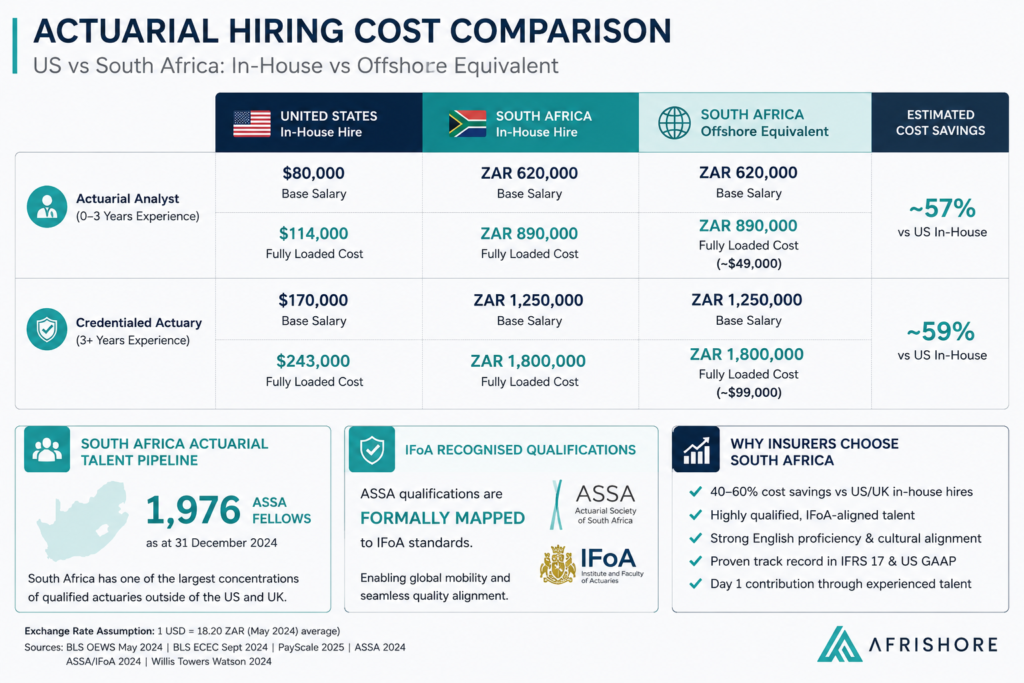
- US actuarial analysts cost $110k–$125k fully loaded; credentialed actuaries approach $243k or more (BLS OEWS May 2024, BLS ECEC).
- IFRS 17 implementation has cost the global insurance industry $21–27 billion, driving sustained demand for actuarial production capacity (Willis Towers Watson, 2024).
- South Africa’s Actuarial Society (ASSA) has 1,976 qualified Fellows with credentials formally mapped to IFoA standards (ASSA 2024; ASSA/IFoA 2024).
- BLS projects 22% growth in US actuarial employment by 2034, while unemployment among actuaries remains below 1% — the definition of a tight market.
- Offshore actuarial models deliver approximately 40% cost savings versus equivalent in-house resource, with Day 1 contribution from placed contractors.
What Is Driving the Global Actuarial Talent Shortage?
Both the US and UK are experiencing persistent structural shortfalls in qualified actuarial talent, driven by rising demand, a slow qualification pipeline, and a retirement wave among senior practitioners.
The US Bureau of Labor Statistics projects actuarial employment to grow 22% between 2024 and 2034 — roughly six times faster than the economy overall — with approximately 2,400 new openings per year (BLS Occupational Outlook Handbook, May 2024). Unemployment among US actuaries sits below 1%, which Selby Jennings characterised as “historic talent shortages” in their 2024 Insurance and Actuarial Talent Report. Actuarial recruiter DW Simpson, in its 2024 Market Trends report, noted that employers are “focusing heavily on retention” as competition for experienced talent intensifies.
In the UK, the IFoA Employer Hub states demand for actuaries and actuarial analysts “is on the rise.” Eames Consulting‘s January 2025 UK Actuarial Market Update confirmed that 2024 saw “high demand for actuarial talent continue with significant hiring levels across the non-life market.” A 2024 IFoA survey of over 500 members found firms struggling to build data science and modern pricing capabilities within actuarial teams, pointing to a qualitative skills shortage compounding the headcount one.
What Does a US Actuarial Hire Actually Cost?
Before factoring in the shortage, the in-house cost alone makes a compelling case for exploring alternatives. Once you move beyond base salary to total employer cost, the numbers shift significantly.
BLS OEWS data for May 2024 puts the median annual wage for US actuaries at $125,770, with experienced credentialed actuaries in the 75th percentile earning $164,860. Entry-level actuarial analysts typically start at $65,000–$85,000 (PayScale 2025; Actuary.info Salary Guide 2026).
The total employment cost picture is different. BLS Employer Costs for Employee Compensation (ECEC) data from September 2024 shows that for US private-industry workers, total compensation averages 1.43× base wages once benefits are included — covering health insurance, 401(k) contributions, paid time off, and legally required payroll taxes.
Applying that multiplier:
- US actuarial analyst (base $80k): fully loaded employer cost approximately $114,000 per year
- US credentialed actuary (base $170k): fully loaded employer cost approximately $243,000 per year
And those figures exclude recruitment costs, office overhead, and the time-cost of managing a role that typically stays vacant for 6–10 weeks during a hire cycle.
Why IFRS 17 and US GAAP Reforms Are Straining Actuarial Teams
Regulatory changes have compounded the resource problem by adding sustained workload that shows no sign of subsiding.
IFRS 17 — effective January 2023 across most jurisdictions — has been the single largest driver. Willis Towers Watson‘s 2024 survey of 235 insurers across 37 markets estimated the total global IFRS 17 implementation cost at $21–27 billion, a 15% increase versus their 2022 estimate. Average cumulative costs for large multinational insurers reached approximately $240 million per group. PwC‘s post-implementation survey of 15 UK insurer groups found collective IFRS 17 expenditure of around €1.1 billion (PwC, 2023/2024).
Crucially, implementation does not end the workload. IFRS 17 requires more granular cohort modelling, more frequent valuations, and ongoing compliance work that must be staffed each reporting cycle — driving demand for actuarial production capacity long after day-one go-live.
In the US, Long-Duration Targeted Improvements (LDTI) to GAAP and evolving NAIC statutory frameworks have similarly increased the frequency and complexity of reserving and assumption-setting. EY noted in a September 2023 NAIC bulletin that a new framework targeting implementation by January 2026 would impose an extended parallel-running period on US insurers — adding further actuarial resource demand through at least 2026.
Milliman‘s July 2024 paper The Changing Nature of Actuarial Departments observed that resource availability “remains a challenge, with significant lead times to fill vacancies,” and that high staff turnover post-pandemic is diverting senior actuaries into recruitment and training rather than substantive work. The natural response — co-sourcing or outsourcing to offshore actuarial teams for model runs, data production, and reporting support — is increasingly how insurers are managing the gap.
Why South Africa Is an Established Actuarial Hub
South Africa’s actuarial profession is unusually strong for an emerging market, and internationally recognised in ways that matter to UK and US insurers.
The Actuarial Society of South Africa (ASSA) reported 1,976 fully qualified Fellows in 2024, up from approximately 1,100 qualified actuaries in 2023 — placing it among the 10 largest actuarial associations globally and the largest on the African continent (ASSA 2024; Gitnux, summarising ASSA membership data, 2026). ASSA CEO Mike McDougall has stated that unemployment among South African actuaries is “effectively zero,” with demand for actuarial skills significantly exceeding domestic supply — evidenced by approximately 25 South African actuaries taking up overseas employment annually (ASSA, 2022).
Credential quality is not in question. A 2024 ASSA/IFoA subject mapping document formally sets out how South African university programmes and ASSA exam subjects map to IFoA requirements, meaning South African actuaries can have their credentials recognised by the UK’s professional body. South Africa produces actuaries trained in IFRS 17, SAM (Solvency Assessment and Management), life insurance, general insurance, and data analytics — the exact disciplines in demand.
GMT+2 is another structural advantage. South African actuarial contractors are online during UK and European business hours as a standard day shift, and can overlap with US Eastern mornings without requiring night-shift arrangements.
Two Delivery Models: Staff Augmentation vs Project Outsourcing
Offshore actuarial offshoring from South Africa typically operates under one of two models.
Staff augmentation places individually matched actuarial analysts — with skills, experience, and prior client feedback selected to fit — directly into client teams on contracts from one to twelve months. Contractors work seamlessly alongside existing staff, are available online during client business hours, and can be retained across recurring assignments, building institutional familiarity with the client’s products and processes. Mobilisation can happen at short notice, making it effective for covering peak reserving periods, regulatory project work, or unexpected headcount gaps.
Project outsourcing hands a defined scope — a valuation run, IFRS 17 model validation, experience investigation, reinsurance review, ORSA, or pricing support — to a managed team built around the requisite skills. The provider takes end-to-end accountability for delivery, from team assembly and data transfer through to presentation of outcomes, freeing client resource for strategic decisions rather than production management.
Both models allow insurers to flex actuarial capacity without carrying permanent overhead, and to access South African talent at approximately 40% below the equivalent in-house cost. For a data-driven comparison of South Africa against India, the Philippines, and Latin American markets, see our guide to outsourcing destinations for US companies.
What to Look For in an Actuarial Offshoring Partner
Not all actuarial offshoring arrangements are equal. A few criteria separate providers with genuine actuarial depth from those offering general finance staffing labelled as actuarial:
Exam progress and seniority matching. The right placement matches technical skills, years of experience, and exam attainment to the specific engagement — not just a category like “analyst.” Ask for individual contractor profiles, including exam progress, disciplines practised, and prior client feedback.
Market-specific training. South African actuaries are trained in ASSA, SAM, and IFRS 17 frameworks, but exposure to NAIC statutory reserving, US GAAP LDTI, Solvency II, or Lloyd’s market reporting varies. Confirm that contractors placed for US or UK work have relevant market exposure or explicit training built into the onboarding.
Qualified oversight. On outsourced projects, check that delivery is governed by a qualified senior actuary, not just managed by project administrators. For complex work like ORSAs, FCRs, or IFRS 17 fulfilment cash flows, oversight by a fully credentialed actuary is non-negotiable.
Transparent contracting. Flexible contracts that accommodate unforeseen demand changes, clear fee structures, and a single point of contact throughout reduce the operational friction that often undermines offshore actuarial arrangements.
Retention track record. High staff retention matters more in actuarial offshoring than in general BPO because institutional knowledge — understanding a specific client’s products, data, and modelling approach — compounds across engagements. Ask for evidence of contractor re-engagement rates on recurring assignments.
FAQs
Do South African actuarial credentials meet US and UK regulatory requirements? South African actuaries trained through ASSA can have their credentials mapped to IFoA requirements through a formal 2024 subject-mapping framework. ASSA is one of the 10 largest actuarial associations globally. For US regulatory submissions, South African-produced actuarial work should be reviewed and signed off by a Fellow of the CAS or SOA with the relevant Appointed Actuary or FCAS designation. Offshore actuarial teams handle production; qualified onshore review and signature remain the responsibility of the US/UK carrier.
Can an offshore actuarial team handle IFRS 17 work? Yes. ASSA-qualified actuaries are trained in IFRS 17 from their qualification curriculum, and South Africa’s insurance market has been running IFRS 17 parallel processes since before the 2023 global implementation date. Work typically offshored includes fulfilment cash flow calculation, risk adjustment modelling, cohort data production, and assumption validation — all standard actuarial production tasks.
What is a realistic cost saving from offshore actuarial resource? Approximately 40% versus the equivalent in-house cost in the UK or US. This reflects South African contractor rates that are 20–40% above equivalent domestic South African salaries — meaning top talent is attracted and retained — while still being materially below UK and US loaded employment costs.
How quickly can a contractor be mobilised? Short-notice mobilisation is achievable for staff augmentation arrangements, with contractors able to contribute from day one when matched correctly to an engagement. Project outsourcing involves an additional team assembly and data transfer stage, typically two to four weeks depending on scope complexity.
What disciplines does South African actuarial talent cover? Life insurance and reserving; general insurance and pricing; IFRS 17 and SAM; data analytics and quantitative modelling; experience investigations; product development; reinsurance review; ORSAs and FCRs. South Africa does not have the same depth in pensions as the UK, so defined-benefit scheme actuarial work is a less common use case.
Is offshore actuarial work appropriate for regulated submissions? The production of actuarial work offshore is appropriate and widely practised by global insurers. The NAIC data noted that approximately 31% of US insurers already outsource investment management at scale. For statutory actuarial opinions, the signing actuary must meet local regulatory requirements — typically a Fellow of the CAS or SOA for US work. The offshore team’s role is production; the regulated opinion and sign-off remain with a qualified onshore actuary.
What makes South Africa preferable to India for actuarial offshoring? India has a large IT and BPO sector but a smaller actuarial profession by comparison. South Africa’s ASSA is explicitly one of the 10 largest actuarial associations globally, with qualification standards directly mapped to the UK’s IFoA. GMT+2 gives South African contractors a natural day-shift overlap with UK and European working hours — relevant for UK Solvency II and IFRS 17 programmes. English is the professional language of South Africa’s actuarial sector, with no communication friction.
South Africa Delivers Actuarial Depth Without the Overhead
The combination of a persistent US and UK actuarial talent shortage, rising compliance workloads from IFRS 17 and US GAAP reform, and South Africa’s internationally recognised, IFoA-mapped actuarial profession creates a clear case for offshore actuarial capacity.
Afrishore BPO has operated as a leading offshore delivery partner for US and UK clients for over 20 years, with ISO 27001, ISO 9001, and PCI-DSS certification underpinning data security and quality standards. Alongside actuarial offshoring, Afrishore delivers insurance claims processing, outsourced accounting and finance functions, and professional services outsourcing for US and UK clients. For US businesses evaluating the full cost of in-house finance teams versus offshore alternatives, see our breakdown of outsourced finance function costs.
Afrishore Quant extends that delivery model specifically to actuarial functions — offering individually matched contractor placement and fully managed project outsourcing for insurers who need actuarial capacity without the overhead of permanent in-country headcount.
If your actuarial team is stretched by IFRS 17, US GAAP LDTI, or peak reserving demand, speak to Afrishore BPO about your options.