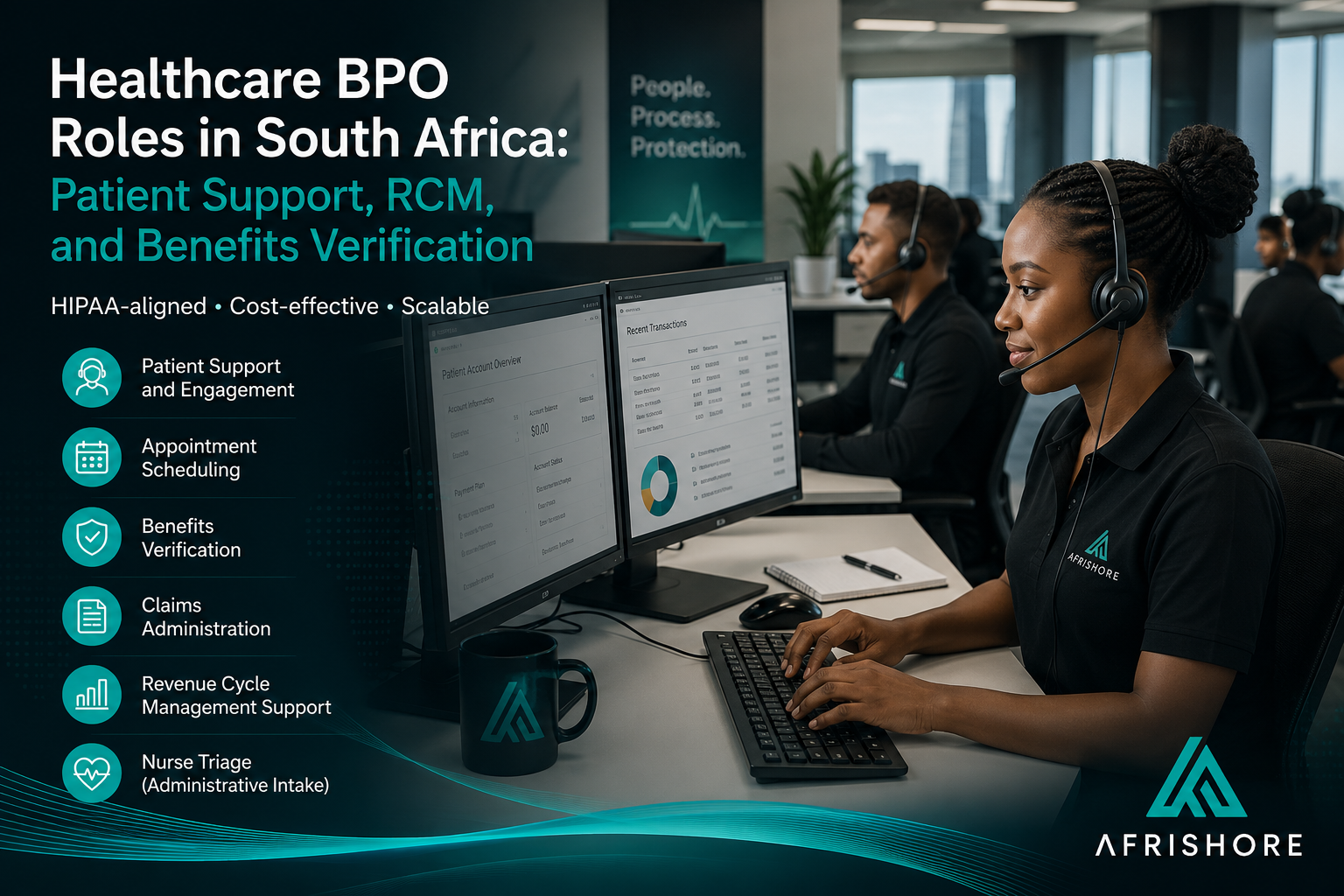
Quick Answer: South Africa delivers six healthcare administrative roles – patient support, scheduling, benefits verification, claims admin, RCM support, and nurse triage intake – at 55–65% below US costs under HIPAA-aligned controls. Any offshore BPO touching PHI must execute a Business Associate Agreement (BAA) before operations begin; HIPAA does not prohibit offshore PHI processing when this structure is in place.
Seventy-seven percent of US hospitals and health systems now outsource at least part of their revenue cycle, according to the 2024 HFMA Guidehouse Revenue Cycle Management Survey. The driver is not cost alone. The AAMC projects a shortage of up to 86,000 physicians by 2036, with HRSA modelling suggesting the gap could reach 187,000 by 2037 if current trends persist – and administrative roles are where the capacity crisis is most acute. Healthcare BPO from South Africa fills that gap with HIPAA-aligned controls, native English speakers, and operations at 55–65% below US costs. This article maps the specific roles, explains the compliance architecture, and shows what an effective healthcare delivery model from South Africa looks like.
Why Are US Healthcare Organisations Outsourcing Administrative Roles?
US healthcare admin costs consume 34.2% of total expenditure – USD 812 billion annually – yet the work is rules-based and doesn’t require clinical judgement, making it ideal for offshore BPO delivery at a fraction of the onshore cost.
Healthcare administration is growing faster than clinical care. US healthcare administration consumes an estimated 15–25% of total national health expenditures – approximately USD 950 billion annually (JAMA, 2021), and in hospitals specifically, administrative spending now outpaces direct patient care nearly 2:1 according to Trilliant Health’s 2025 CMS data analysis. Prior authorisation alone consumes an average of 12 hours per physician per week in physician and staff time – 43 authorisations per physician weekly, with 95% of physicians reporting the burden increases burnout (AMA, 2024). Despite the cost, these functions do not require clinical judgement. They require precision, language proficiency, compliance discipline, and scale.
South Africa’s healthcare BPO sector has built specifically for this gap. The country’s GMT+2 timezone overlaps with US East Coast business hours in the morning and handles West Coast afternoon hours with extended shifts. Agents are trained to US healthcare vocabulary, payer-specific terminology, and EHR system navigation. For functions where the work is rules-driven, language-fluent, and compliance-governed, South Africa competes with any offshore destination and outperforms most.
The global healthcare BPO market was valued at USD 395.3 billion in 2024 and is projected to reach USD 626.6 billion by 2029 at a CAGR of 9.7% (ResearchAndMarkets, 2024). North America accounts for 51.4% of that market – the largest buyer bloc, and the one where South Africa’s language and compliance alignment is most directly applicable.
Related reading: For the full picture of South Africa’s BPO advantages, see Why Outsource to South Africa and our comparison of South Africa vs Philippines BPO.
Which Healthcare BPO Roles Can South Africa Deliver?
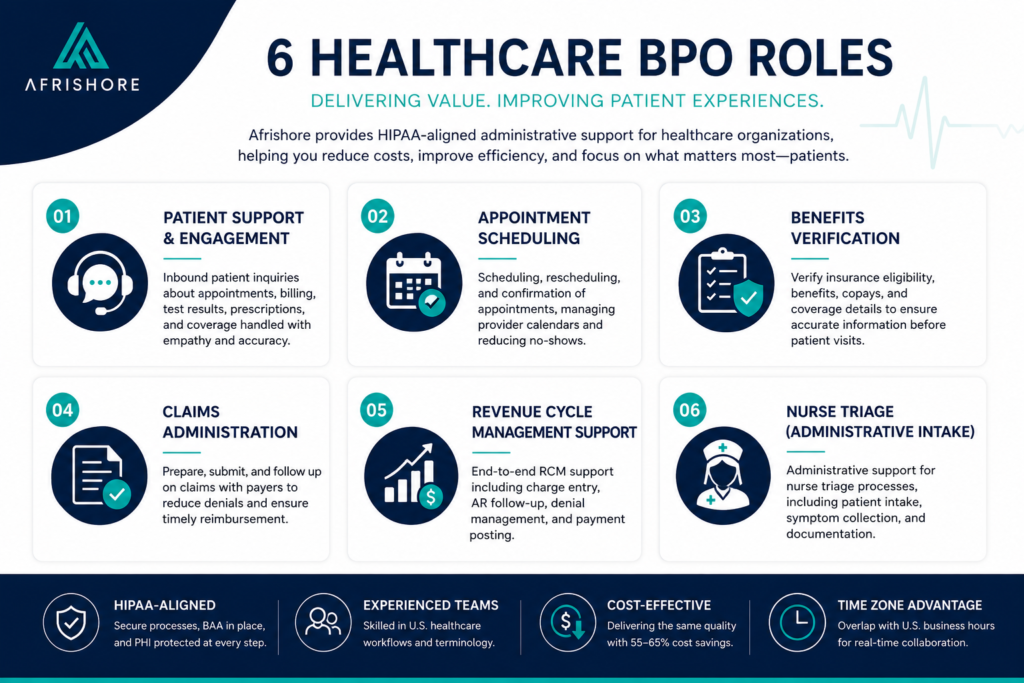
South Africa delivers six distinct healthcare administrative roles at scale: patient support, appointment scheduling, benefits verification, claims administration, revenue cycle management support, and the administrative component of nurse triage – all under HIPAA-aligned controls.
1. Patient Support and Engagement
Patient support is the front line of healthcare administration: inbound calls from patients asking about appointments, test results, billing statements, prescription refill processes, and coverage questions. In a South African BPO context, this role requires:
- Language parity: South Africa ranked 13th globally in the EF English Proficiency Index 2025 – agents handle US English naturally, without the neutralisation training required in other offshore markets.
- EHR navigation: Agents are trained on Epic, Athena, Cerner, and eClinicalWorks, handling read-only lookup tasks without clinical input.
- PHI discipline: Patient calls involve protected health information (PHI) by definition. Every agent handling patient support must operate under a HIPAA-compliant workflow, including access controls, minimum necessary standards, and call recording governance.
Patient support functions typically cover: appointment scheduling confirmation, billing inquiry resolution, general insurance and coverage questions, prescription status lookups, referral status tracking, and post-visit satisfaction follow-up.
2. Appointment Scheduling
Scheduling outsourcing is the fastest-growing healthcare BPO sub-function, driven by the shift to value-based care models that require more frequent touchpoints between patients and providers. South African BPO scheduling teams typically handle:
- New patient intake scheduling
- Specialist referral booking (co-ordinating between primary care and specialist calendars)
- Pre-procedure confirmation calls (reminding patients of prep requirements, transport needs, consent forms)
- No-show management and reschedule outreach
- Waitlist management for in-demand providers
Scheduling roles require familiarity with provider-specific scheduling rules, insurance pre-authorisation triggers, and patient communication scripts approved by clinical governance teams. These are teachable, auditable, and well-suited to offshore delivery where documentation discipline is high.
3. Benefits Verification and Eligibility
Benefits verification is the process of confirming a patient’s insurance coverage before a service is delivered. It prevents claim denials and protects provider revenue. It is also among the most expensive administrative functions to run manually: the 2023 CAQH Index found that manual eligibility verification costs USD 12.56 per transaction versus USD 2.22 electronically – a 5.7× gap that compounds across millions of annual checks.
An offshore benefits verification team handles:
- Real-time eligibility checks (via payer portals, phone, and EDI 270/271 transactions)
- Deductible and out-of-pocket status confirmation
- Prior authorisation requirement identification
- Coverage limitation and exclusion review
- Patient responsibility calculation and upfront financial counselling
These tasks are rules-based, document-intensive, and high-volume – exactly the profile where offshore delivery delivers maximum ROI. Claims and eligibility verification accounts for a significant share of total healthcare BPO revenue globally, reflecting both the volume and the strategic importance of getting it right before the service is rendered.
Important: Benefits verification that involves accessing, creating, or transmitting PHI triggers Business Associate Agreement (BAA) requirements under HIPAA. Any offshore BPO partner handling this function must have a signed, compliant BAA in place before processing begins. See HIPAA-compliant BPO from South Africa for Afrishore’s compliance architecture.
4. Claims Administration
Claims administration covers the lifecycle of a healthcare claim from submission to payment reconciliation. For offshore delivery, the function is typically split:
- Pre-submission: charge capture review, coding review support (CPT/ICD-10 accuracy), claim scrubbing, eligibility verification (see above)
- Submission: claim filing via clearinghouses (Availity, Change Healthcare, Emdeon), payer-portal submission, electronic remittance advice (ERA) monitoring
- Post-submission: denial management, rejection resolution, appeal letter drafting, payment posting, underpayment identification
South African teams handling claims admin operate under the same EHR and practice management systems as onshore staff. The compliance architecture – HIPAA-aligned data handling, encrypted transmission, access-controlled workstations – mirrors onshore requirements. The cost difference is 55–65%, driven by South Africa’s labour cost advantage, not any reduction in control or governance.
5. Revenue Cycle Management Support
Revenue cycle management (RCM) outsourcing is the broadest healthcare BPO category: the end-to-end management of patient billing from registration through payment. The global RCM market was valued at USD 148.84 billion in 2024 and is projected to reach USD 361.86 billion by 2032 at a 12.0% CAGR (Fortune Business Insights, 2025). Ninety-seven percent of US hospitals now outsource at least one RCM function (Savista/Becker’s 2025), with 77% outsourcing at least some revenue cycle work (HFMA Guide house, 2024).
An offshore RCM support team from South Africa typically handles the administrative and support functions within the revenue cycle while clinical coding decisions remain onshore:
- Patient financial services (financial counselling, payment plan setup, charity care screening)
- Accounts receivable follow-up (aging report management, payer follow-up calls, status tracking)
- Denial management and root cause analysis
- Denial prevention pattern identification (flagging recurring front-end errors)
- Payment posting and reconciliation
- Month-end reporting and KPI dashboards
For a more detailed breakdown of how offshore RCM outsourcing works, see our dedicated guide: Revenue Cycle Management Outsourcing to South Africa.
6. Nurse Triage Support (Administrative Component)
Nurse triage support refers to the administrative component of clinical triage programmes – not clinical decision-making, which must remain with licensed clinicians, but the intake, routing, and documentation functions that surround triage:
- Inbound call intake (symptom description capture, demographic confirmation, insurance verification)
- Routing to the appropriate clinical resource (live nurse, telehealth platform, appointment scheduling, 911)
- Post-triage documentation (call notes, routing decisions, outcomes)
- After-hours call management (intake for async clinical review)
The administrative component of nurse triage is well within offshore BPO scope when the BPO operates under a HIPAA-compliant workflow, with clear escalation protocols that route clinical decision points to licensed personnel. South African BPOs serving this function work under client-defined triage protocols, not independent clinical judgement.
What Is South Africa’s Healthcare BPO Compliance Architecture?
South Africa’s healthcare BPO compliance architecture combines HIPAA-mandated safeguards (BAA, access controls, encryption, audit logging) with POPIA data protection – the same regulatory rigour as GDPR – providing a dual-layer compliance foundation for US and UK healthcare clients.
| Element | Requirement | South Africa Delivery |
| Data protection | HIPAA Privacy & Security Rules | HIPAA-aligned controls; POPIA (SA equivalent of GDPR) |
| Data transfer | BAA required before PHI is shared | BAA executed at contract stage; offshore addendum for cross-border PHI |
| Access controls | Minimum necessary; role-based access | Biometric workstation access; agent-level access controls on EHR systems |
| Physical security | Secure facilities; no PHI on portable devices | 24/7 on-site security; device management; no data on agent-controlled media |
| Encryption | In transit and at rest | TLS 1.2+ for transmission; AES-256 for stored data |
| Audit trail | Audit logs for PHI access | System-level logging; quarterly access reviews |
| Breach notification | 60-day notification to HHS | Contractual breach notification timelines aligned to HIPAA; 60-day default |
| Subcontractor | Flow-down BAA required | Subcontractor BAAs in place where applicable |
2026 HIPAA Update: The Department of Health and Human Services published a Notice of Proposed Rulemaking in January 2025 proposing the most significant modifications to the HIPAA Security Rule since 2003. The proposed rules include annual technical safeguard verification requirements for business associates. A final rule is expected in summer 2026. Offshore BPO partners should be verifying their compliance posture against the proposed changes now, not after enactment. Read Afrishore’s HIPAA compliance approach.
How Do You Structure a Healthcare BPO Delivery Pod from South Africa?
A healthcare delivery pod is a dedicated, named team of 8–20 agents with consistent membership, documented protocols, and full accountability – not a shared resource pool. It ramps in 4–5 weeks and operates on transparent, named-team KPIs.
Anton’s concept of the “South Africa healthcare delivery pod” is worth unpacking. A healthcare pod is not a generic outsourcing arrangement – it’s a dedicated, named team with consistent membership, specific healthcare function ownership, documented protocols, and performance accountability. The structure typically looks like:
Pod composition (mid-market US practice group):
- 8–12 agents across patient support, scheduling, and benefits verification
- 1 team leader with healthcare BPO supervisor experience
- 1 quality analyst conducting HIPAA compliance call reviews
- Training owner (shared or embedded) responsible for protocol updates
Ramp timeline:
- Weeks 1–2: HIPAA training, EHR system access, payer-portal onboarding
- Weeks 3–4: Supervised live calls, shadow QA review
- Week 5+: Independent operations with weekly QA scoring and monthly performance review
KPIs for healthcare pods:
- Eligibility verification accuracy (target: ≥98%)
- First-call resolution on patient support (target: ≥85%)
- Scheduling no-show rate (monitor vs onshore baseline)
- Claim acceptance rate on submission (target: ≥97%)
- Denial rate by denial code (track monthly for pattern identification)
The “delivery pod” model gives US healthcare organisations something important: accountability. You know who handles your patients’ calls, who reviews their PHI access, and who owns their performance. It is a managed service with a named team, not a shared resource pool.
Key Takeaways
- 77% of US hospitals outsource at least part of their revenue cycle (HFMA Guidehouse, 2024); 97% outsource at least one RCM function (Savista/Becker’s, 2025).
- South Africa delivers six healthcare BPO roles – patient support, scheduling, benefits verification, claims admin, RCM support, and nurse triage administrative intake – at 55–65% below US costs with HIPAA-aligned controls.
- Every role that involves creating, accessing, or transmitting PHI requires a signed BAA before operations begin. This includes benefits verification, patient scheduling, and claims admin.
- South Africa’s POPIA data protection framework aligns closely with HIPAA and GDPR, providing a dual-layer compliance foundation for US and UK healthcare clients.
- The “healthcare delivery pod” model – a named, dedicated team with consistent membership and documented protocols – gives US organisations accountability alongside cost savings.
- A proposed HIPAA Security Rule update (NPRM, January 2025) will require annual technical safeguard verification by business associates. Offshore BPO partners should be preparing now.
Frequently Asked Questions
What is healthcare BPO and which functions can be outsourced from South Africa?
Healthcare BPO (Business Process Outsourcing) refers to the delegation of administrative and operational healthcare functions to a specialist third-party provider. Functions that can be delivered from South Africa include: patient support and engagement, appointment scheduling, benefits verification and eligibility checking, claims administration and submission, revenue cycle management support (AR follow-up, denial management, payment posting), and the administrative component of nurse triage intake. Clinical decision-making – anything requiring a licensed clinician’s judgement – remains onshore.
Does offshore healthcare BPO comply with HIPAA?
Yes, if structured correctly. HIPAA does not prohibit offshore processing of PHI. It requires that any business associate – including an offshore BPO – executes a compliant Business Associate Agreement (BAA) before PHI is accessed or transmitted, implements administrative, physical, and technical safeguards required by the HIPAA Security Rule, and provides breach notification within the required timelines. A compliant BAA with an offshore addendum addressing cross-border PHI access is the starting point. Beyond the contract, the offshore facility must implement access controls, encryption, audit logging, and physical security measures that match onshore requirements.
What is a Business Associate Agreement (BAA) and why does an offshore BPO need one?
A Business Associate Agreement is a legally required contract under HIPAA between a covered entity (the healthcare provider or insurer) and any third party that creates, receives, maintains, or transmits PHI on its behalf. An offshore BPO handling benefits verification, patient scheduling, or claims administration is a business associate by definition – it touches PHI as part of its work. The BAA specifies how PHI may be used, the security safeguards required, breach notification obligations, and the right to audit or receive audit reports (such as SOC 2 or HITRUST certifications). Signing a BAA with an offshore BPO that also has an addendum addressing geographic processing, subcontractor flow-downs, and data localisation requirements is non-negotiable before operations begin.
How does South Africa compare to India and the Philippines for healthcare BPO?
South Africa’s advantages for US healthcare BPO are specifically in language alignment, compliance culture, and timezone coverage. South Africa ranked 13th globally in EF English Proficiency Index 2025 – 1st in Africa – and is the top-ranked offshore destination for English-language healthcare admin work. BPO attrition in South Africa runs 15–20% annually (BPESA) versus 45% total in the Philippines (CCAP 2024) – meaning the team handling your patient calls is more stable, more experienced, and less likely to require continuous retraining. South Africa’s POPIA framework aligns closely with HIPAA, providing a ready regulatory foundation. The Philippines is strong on voice but has less mature data compliance infrastructure. India has deep coding expertise but higher attrition in front-office roles.
What QA process should a healthcare BPO use to maintain HIPAA compliance?
A healthcare BPO QA process for HIPAA compliance should include: regular call recording review (minimum 5% random sample per agent per week), a HIPAA-specific QA scorecard evaluating PHI handling discipline on every reviewed call, agent-level access log audits (confirming access was limited to the minimum necessary), quarterly compliance training refreshers, breach incident tracking and root cause analysis, and an annual third-party security assessment. QA scorecards should be shared with the US client and referenced in BAA compliance attestations. Where the NPRM becomes final, annual technical safeguard verification attestations will also be required.
What does a “healthcare delivery pod” from South Africa look like in practice?
A healthcare delivery pod is a dedicated, named team of 8–20 agents with consistent membership, specific function ownership, and documented protocols. It operates as a managed service: you know who handles your patients’ calls, who conducts HIPAA compliance reviews, and who owns performance accountability. A typical mid-market pod includes agents covering patient support, scheduling, and benefits verification; a team leader with healthcare BPO experience; a quality analyst; and a training owner responsible for protocol updates. The pod ramps over 4–5 weeks with supervised operations, then moves to independent delivery with weekly QA reporting.
How much does healthcare BPO from South Africa cost?
Healthcare BPO from South Africa typically delivers 55–65% cost savings versus comparable US onshore operations (Grand View Research, 2025). Exact pricing depends on function complexity, volume, shift patterns (daytime only vs extended hours), and compliance overhead. Functions requiring more extensive HIPAA training, specialised EHR proficiency, or higher QA intensity (nurse triage intake, denial management) carry a premium over general patient support. Afrishore operates on a seat-based model with transparent per-agent pricing rather than per-transaction rates, providing predictable cost visibility. Contact Afrishore for a healthcare-specific cost model.
Is PHI secure in a South African BPO facility?
A HIPAA-compliant South African BPO facility implements the same physical and technical security requirements as onshore providers: biometric workstation access, encrypted data transmission (TLS 1.2+), encrypted data storage (AES-256), no PHI on portable or agent-controlled media, 24/7 on-site security, system-level audit logging, and quarterly access reviews. Afrishore’s facility in Johannesburg operates under ISO 27001-aligned security management standards, with HIPAA-specific controls layered on top. The facility undergoes periodic security assessments, and compliance attestations are available to clients under confidentiality as part of BAA compliance documentation.